The actively at work clause in group life insurance says that an eligible employee's cover starts only if they are actively at work on the day it would otherwise take effect; if they are not, it starts on the day they return. It matters most at the moments a group plan starts or changes carrier, because that is when a whole workforce becomes insured on one date, and every employee on leave, disabled or confined that day falls under the clause. Brokers' censuses rarely say who those employees are. Botminds' Group Census & RFP Intake Automation reads the RFP letter's eligibility wording against the census and puts what the file leaves open into one message to the broker, so the question is asked before the quote, not after a claim.
The clause is short, but four bodies of rules surround it: the policy's own words, which courts read closely; the Family and Medical Leave Act, which protects benefits on return from leave; the NAIC's model rules on replacing one group carrier with another; and, for health cover only, HIPAA's limits on actively-at-work rules. A census that records status on the effective date is the only practical way to apply all four.
One employee on leave on the effective date: who decides what
A person decides
Employer and brokerSend a census of eligible employees. An employee on medical leave since September appears as an ordinary row; nothing says she is off work.
Agent
RFP readerReads the letter’s effective date and eligibility wording into cited fields, such as 1 January 2027 and 30 or more scheduled hours.
Never: infers a rule the letter does not state
Agent
Broker question drafterPuts every eligibility point the file cannot settle into the single message to the broker, with the rows attached.
Never: sends without the underwriter
A person decides
Group underwriterApplies the policy’s actively at work clause and, on a carrier change, the state’s takeover rules: is she covered on day one, deferred, or covered by the new carrier at the old plan’s level?
A person decides
Implementation and the prior carrierEnrol her when she returns, or confirm whether the prior plan’s disability extension, such as a premium waiver, continues.
What is the actively at work clause?
It is a policy provision with two parts: a definition of being at work, and a rule that cover waits until the definition is met. A group life policy reviewed by the Tenth Circuit in 2008 is typical. It defined the term: "You are actively at work on any day if on that day you are: 1. Working at the Employer's usual place of business or at such place or places that the Employer's normal course of business may require; 2. Performing all of the duties of your job on a full-time basis; and 3. Not confined in any institution providing care or treatment of physical or mental infirmities." And it applied it: "You must, however, be Actively At Work on that date. Otherwise, you will be insured on the date you are again Actively At Work" (Weber v. GE Group Life Assurance Co., No. 07-5036, 10th Cir. 2008).
The clause is separate from eligibility. The same policy's definition of an employee required that the person "Regularly works at least 30 hours per week" and be in an eligible class. An employee can be eligible, in the right class and over the hours threshold, and still not be insured on the effective date because they are off work that day.
What happens if an employee is on leave when coverage starts?
Under a clause like the one above, cover is deferred until the employee returns to work, and the words of the policy decide what counts as returning. In Weber, voluntary life cover took effect on 1 May 2003. The employee, who had been ill, worked part days from 12 to 15 May and died later that year; the insurer denied the voluntary benefit because she had not worked 30 hours a week after the effective date. The court affirmed an award of the benefit: "The plain language of the 'Actively At Work' provision does not require that the employee work any set number of hours, either on a particular day or over the course of a particular week."
Wording cuts both ways. The same opinion describes an earlier Tenth Circuit case where the plan had no actively-at-work requirement at all, and an employee on disability leave remained a "regular full-time" employee: "[i]f the defendant wanted to limit benefits to regular full-time employees who were actively working, it could have done so." And it notes a Sixth Circuit case reading "working a minimum of 30 hours each week" as a requirement of working now. For a carrier pricing a case, the lesson is practical: who is off work on the effective date, and why, is a fact the policy wording will turn on, and it should be known before the rate is set.
Eligibility says who belongs to the group. The actively at work clause says who is insured on the first morning. The census is built for the first question and almost never answers the second.
Does actively at work apply to employees on FMLA leave?
For group life and disability, the policy's clause still applies, but the Family and Medical Leave Act limits what can be taken away from an employee who was already covered. Its rule on benefits other than health cover is that entitlement during leave "is to be determined by the employer's established policy for providing such benefits when the employee is on other forms of leave (paid or unpaid, as appropriate)" (29 CFR 825.209(h)). On return, the employee "cannot be required to requalify for any benefits the employee enjoyed before FMLA leave began", and the rule gives life insurance as its example: no physical examination to requalify (29 CFR 825.215(d)(1)).
The same rule warns that "some employers may find it necessary to modify life insurance and other benefits programs in order to restore employees to equivalent benefits upon return from FMLA leave". That is a contract question between the employer and the carrier, and it starts with knowing who is on leave. For group health plans, a stricter federal rule applies: a plan may not base eligibility on being actively at work "unless absence from work due to any health factor (such as being absent from work on sick leave) is treated, for purposes of the plan or health insurance coverage, as being actively at work" (29 CFR 2590.702(e)). Disability income cover is an excepted benefit outside those health rules (45 CFR 146.145), and group life is not health cover at all, so the policy's clause governs.
Does the new carrier cover disabled employees at takeover?
Under the NAIC's model rules, yes in part: the new carrier covers people who were validly insured under the old plan even if they fail its actively-at-work rule, but only at the old plan's level and only for a time. The NAIC's Group Coverage Discontinuance and Replacement Model Regulation applies to group policies covering employees, and on a carrier change it leaves the old carrier liable only for what it already owed and for its extensions of benefits (NAIC Model Regulation #110, 2002 edition; the no loss no gain provisionquotes the takeover rules in full). The new carrier enrols each eligible person who was validly covered, subject to its own "actively-at-work and nonconfinement rules". Those the rules exclude must still be covered by the new carrier, at the prior plan's level of benefits, less anything the prior plan still pays, until the earliest of three dates: when they become eligible under the new plan (for example by returning to work), when their cover would end under the new plan's terms, or when the old carrier's required extension of benefits ends.
Two more provisions decide the census field. Status is measured at a precise moment: "Any reference in the following rules to an individual who was or was not totally disabled is a reference to the individual's status immediately prior to the date the succeeding carrier's coverage becomes effective." And a group life plan's disability extension survives the change: a premium waiver, an extended death benefit or income paid during total disability carries on even though the group policy itself has ended, as the no loss no gain provisionquotes from section 6B. The model's stricter rule, that actively-at-work rules must treat absence for a health reason as being at work, is written for health insurance cover only. It is a model; each state's enacted version governs.
What is a nonconfinement rule?
A nonconfinement rule defers cover for anyone confined to a hospital or care institution on the date it would start. It is often folded into the actively-at-work definition, as in the third limb of the Weber policy: "Not confined in any institution providing care or treatment of physical or mental infirmities." For group health plans, federal rules forbid basing eligibility or premiums on confinement, and the NAIC model forbids a succeeding health carrier from having nonconfinement rules at all. For group life and disability, they remain policy terms, and the NAIC model's takeover protection is what covers the confined employee who was insured under the prior plan.
How do carriers know who is actively at work?
Usually they do not, until a claim. The status lives in the employer's payroll and leave systems, the current carrier's disability and waiver-of-premium files and the workers' compensation carrier's claims, and a census export rarely brings any of it across. The State of Indiana, answering bidders on its 2019 group life RFP, was direct: "Employees on our disability program are included on the census data. There is no disability identifier on the census file" (Indiana RFP 19-112, questions and answers). Bidders on the City of Providence's 2024 life RFP asked for an "active/retired/disabled status" on the census, and for any premium waivers "with date of birth, gender, date of disability, approval date, the face amount and reserve amount" (City of Providence).
The fix is to treat status as a census field with a source, like any other. The table below sets out the values, where each comes from and what each decides.
The status field: values, sources and what each decides
| Status on the effective date | Where it comes from | What it decides |
|---|---|---|
| Active and at work | Payroll: paid for work in the period before the effective date | Covered on day one, subject to eligibility |
| On approved leave (FMLA, state paid leave, personal) | The employer’s leave records or leave administrator | Deferral under the clause; restoration rights on return under FMLA |
| On short-term disability | The current STD carrier or the employer’s salary continuation | Deferral; who carries the risk if the absence becomes long-term |
| On long-term disability or premium waiver | The current carrier’s claim and waiver files | Whether the prior plan’s extension continues after the change |
| Off work under workers’ compensation | The workers’ compensation carrier or employer | Deferral; overlap with other income for disability offsets |
| Confined to a hospital or care facility | Usually only the employer or family knows | Nonconfinement deferral, where the policy has one |
| Laid off, furloughed or seasonal | Payroll status codes | Usually not eligible on the effective date at all |
The people who need the field, and what it changes for each
The status field is filled by one party and used by four. When it is missing, each of them finds out about an absent employee at a different, later moment.
Who handles an employee who is off work on the effective date
Today
Exports the census from payroll; leave and disability statuses stay in other systems.
With agents
Is asked once, with the rows listed, which employees are off work on the effective date and why.
Still theirs: The records that answer the question.
Today
Learns of an absent employee when a claim is questioned, months after the sale.
With agents
Answers the status question in the same reply as the other open points, before the quote.
Still theirs: The client relationship and the plan design advice.
Today
Prices the group as if everyone were at work, without a view of deferrals or takeover liabilities.
With agents
Prices with the absent employees known and the prior plan’s extensions identified.
Still theirs: The decision on how the clause and the state’s takeover rules apply.
Today
Discovers deferred employees during enrolment and chases their return dates by email.
With agents
Starts installation with a list of who enrols on return and who stays with the prior carrier’s extension.
Still theirs: Enrolment and the notices to employees.
The questions to send the broker
Ask once, in the same message as the census's other open points, and attach the rows. In the solution's fictional sample case, the one message to the broker carried four points, among them a request to confirm that 14 employees scheduled 20 to 28 hours a week were not eligible under the letter's 30-hour wording, and the broker answered all of them in one reply. Status on the effective date belongs in the same message.
Six actively-at-work questions for the broker
- Who will be off work on the effective date, and why?
Leave, short-term disability, long-term disability, workers’ compensation or confinement, with expected return dates.
- Who is receiving a premium waiver or disability extension from the current carrier?
Those extensions may continue after the change, and the new carrier should not double-insure them.
- Are disabled employees on the census, and can they be marked?
Indiana’s 2019 census included them with no identifier.
- What does the current certificate say about actively at work?
The definition and the deferral rule, word for word.
- How does the employer treat life and disability cover during unpaid leave?
The FMLA ties non-health benefits to the employer’s established policy for other leave.
- Which state’s takeover rules apply?
Situs decides; the NAIC model is a template that states enact with changes.
One message to the broker, with the eligibility point and its rows
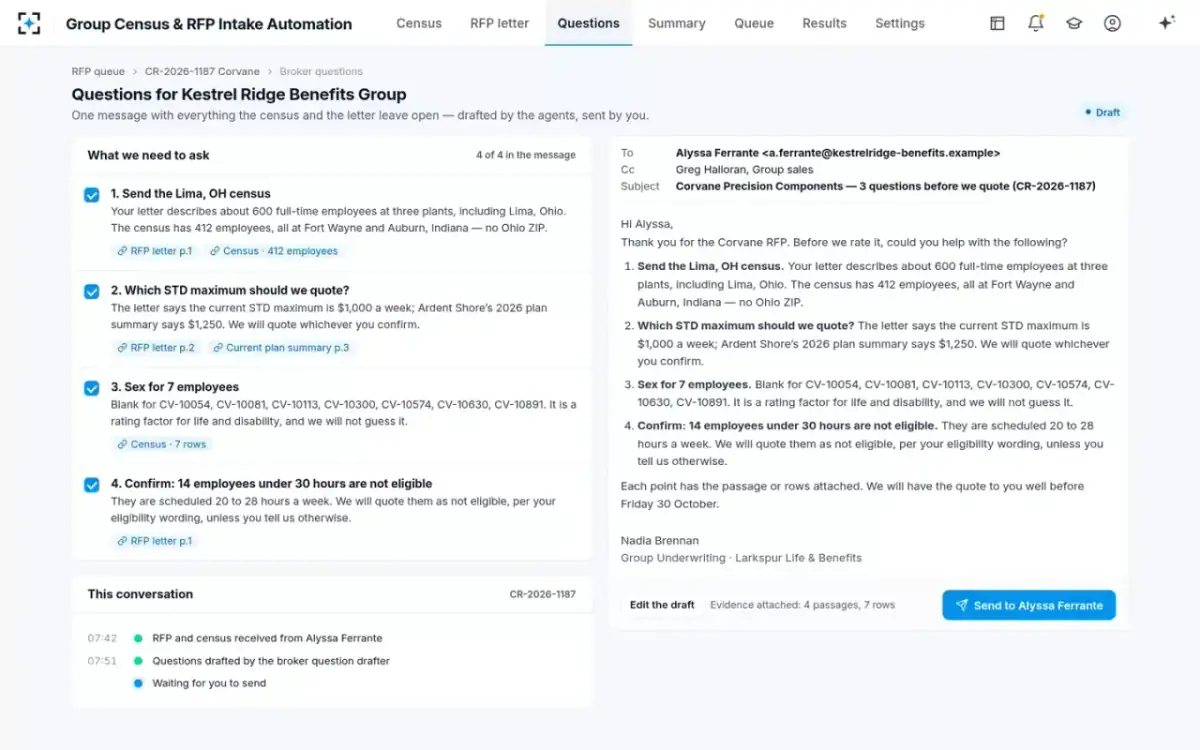
How the eligibility wording becomes a field on the census, alongside birth date, earnings and class, is set out in the employee census template, and why missing fields matter more than malformed ones in census data cleaning.
What rating receives: eligible lives, and every assumption in writing
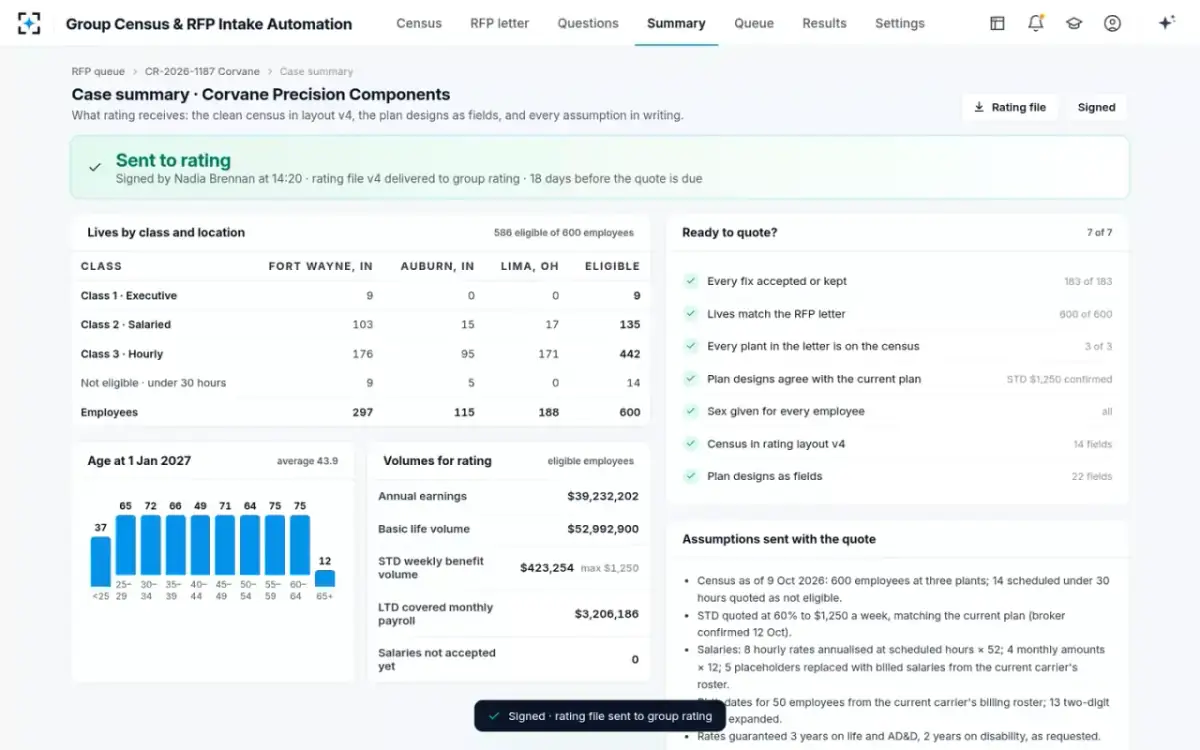
Questions people ask
What does not actively at work mean in insurance?
It means the employee does not meet the policy's definition on a given day: typically not working at the usual place, not performing all duties on a full-time basis, or confined to a care facility. Under most group life policies, cover that would have started that day waits until the employee is again actively at work.
Is the actively at work clause the same as eligibility?
No. Eligibility decides who belongs to the insured group, for example employees regularly scheduled 30 or more hours in an eligible class. The actively at work clause decides when an eligible employee's cover starts. The Weber policy had both, in separate definitions.
What happens to group life insurance when an employee is on disability?
It depends on the policy. Many group life plans have a disability extension, such as a premium waiver, that keeps cover in force for a totally disabled employee, and the NAIC model says a carrier change does not terminate it. Indiana told bidders in 2019 that its current carrier waived premiums for up to 12 weeks from the last day the insured was actively at work.
Does actively at work apply to voluntary life insurance?
Usually, and often more strictly, because voluntary amounts are elected and may need evidence of insurability above a guaranteed issue limit. In Weber, the dispute was over voluntary life; the basic life cover, a continuation of the employer's prior plan, was paid without dispute.
Can a group health plan use an actively at work rule?
Only if absence for a health reason counts as being at work, under federal rules for group health plans. Those rules do not apply to group life or disability income cover, where the policy's own clause governs, subject to state law and the FMLA's restoration rules.