A no loss no gain provision is the name the group insurance trade gives to the rules for a change of carrier: employees covered under the old plan should not lose coverage because of the switch, and should not gain more than they had or than the new plan offers. The phrase is shorthand. The text regulators actually wrote, the NAIC's Group Coverage Discontinuance and Replacement Model Regulation and the state rules modelled on it, says something narrower: the prior carrier stays liable for what it already owes, the new carrier enrols the people its own eligibility rules allow, and people left between the two get a defined minimum for a defined time. What a carrier offers beyond that is in its certificate and its takeover letter. Botminds' Group Benefits Quote Comparison reads those documents for every carrier in a marketing case, because takeover terms are where proposals that look alike often differ.
The rule text below is quoted from the NAIC model (2002 edition) and Minnesota's rule; each state's own enacted version governs in that state. The case examples come from a fictional sample case as it runs through the solution.
Five beliefs about a no loss no gain provision, against the text regulators wrote
What people say: "Every state requires no loss, no gain."
What the text says: The phrase is in neither text quoted here. The NAIC model is a model; Minnesota's rule is one state's law. Coverage depends on the state and on the certificate.
What people say: "The new carrier picks up the whole group on the effective date."
What the text says: The new carrier enrols people who are eligible under its own plan, including its actively-at-work and nonconfinement rules. Others are covered under a separate, limited rule.
What people say: "From 1 January the prior carrier owes nothing."
What the text says: It "remains liable only to the extent of its accrued liabilities and extensions of benefits," which includes disabilities already under way.
What people say: "Employees get at least what they had."
What the text says: For people left between carriers, Minnesota's minimum is the lesser of the prior plan's benefits, net of what the prior carrier pays, or the new plan's.
What people say: "No loss, no gain is about medical plans."
What the text says: The model applies to "all insurance policies and subscriber contracts issued or provided by a carrier on a group or group-type basis," with special rules for health added on top.
What is a no loss no gain provision, in the regulators' words?
In the regulators' words it is "Continuance of Coverage in Situations Involving Replacement of One Carrier by Another," the title of section 7 of the NAIC model. The section's stated job is to "indicate the carrier responsible for liability in those instances in which one carrier's (succeeding carrier) policy, contract or certificate replaces a plan of similar benefits of another (prior carrier)" (NAIC Model 110, § 7A).
The model does three things. It fixes the prior carrier's liability at what it has already accrued and must extend. It tells the succeeding carrier to enrol everyone eligible under its plan. And it creates a fallback for people who were validly covered under the prior plan but are not eligible under the new one on the takeover date, typically because they are not actively at work. The "no loss" is that fallback: the person is covered, at a level tied to the prior plan. The "no gain" appears where a text caps benefits at the lesser of two plans, as Minnesota's rule does for the fallback and both texts do for pre-existing conditions.
Minnesota's rule, which predates the 2002 edition of the model, says its purpose in one sentence: "to indicate which carrier is responsible for coverage in those cases where one carrier's plan of benefits replaces a prior plan which offered similar benefits" (Minn. R. 2755.0300). Neither text uses the words no loss, no gain.
Who pays a claim that started under the prior carrier?
The prior carrier does. Under the model, "After discontinuance of the policy, contract or certificate, the prior carrier remains liable only to the extent of its accrued liabilities and extensions of benefits," and its position "shall be the same whether the group policyholder or other entity secures replacement coverage from a new carrier, self-insures, or foregoes the provision of coverage" (§ 7B).
"In the case of a group plan providing benefits for loss of time from work or specific indemnity during hospital confinement, discontinuance of the group policy, contract or certificate during a disability shall have no effect on benefits payable for that disability or confinement."
NAIC Group Coverage Discontinuance and Replacement Model Regulation, § 6C (2002 edition)
For disability, section 6C makes the point explicit, as the quotation above shows: an employee who became disabled before the takeover keeps claiming from the prior carrier for that disability. For group life, section 6B does the same for disability extensions such as a waiver of premium: "the discontinuance of the group policy, contract or certificate shall not operate to terminate the extension." Minnesota's rule says the prior carrier "remains liable to the extent of its accrued liability and any contractual liability for extension of benefits at the time of replacement" (Minn. R. 2755.0400).
Does the new carrier cover employees on leave at takeover?
Not under its ordinary eligibility rules, if those rules require active work, but under the fallback. The model's first rule enrols each person validly covered under the prior plan who falls in an eligible class of the succeeding carrier's plan and meets its actively-at-work and nonconfinement rules, and who requests enrolment (§ 7C(1)(a)). For health coverage the model then softens the actively-at-work rule, treating absence for a health reason as active work; it does not do so for life or disability.
Someone on leave on the takeover date, and so not eligible under that first rule, "shall nevertheless be covered by the succeeding carrier" if they were validly covered under the prior plan, including benefit extension, and belong to an eligible class. The minimum level of benefits is "the applicable level of benefits of the prior carrier's plan reduced by any benefits payable by the prior plan," and the coverage lasts until the earliest of the date the person becomes eligible under the new plan, the date their coverage would end under the new plan's termination rules, or, for a disabled person, the end of the prior carrier's required extension (§ 7C(2)).
One employee on medical leave across a 1 January takeover: who covers what, month by month
- Insures the groupIn force to 31 Dec
- Pays that disabilityPays the November disability
- Not yet in force
- Fallback cover while not at workFallback · lesser level
- Full coverage after returnFull cover
- At workAt work
- On leave from 10 NovemberOn leave · 10 Nov to 1 Mar
- Back at workBack · 1 Mar
Does no loss no gain apply to disability and life, or only health?
It applies to all group lines under the model, with extra protections for health layered on top. The scope section covers "all insurance policies and subscriber contracts issued or provided by a carrier on a group or group-type basis covering persons as employees of employers or as members of unions or associations" (§ 2). The model's definition of health insurance coverage excludes "Coverage only for accident, or disability income insurance," which means the health-only rules, not the takeover rules as a whole, pass disability by.
The practical difference for disability is the actively-at-work rule. A medical plan's new carrier under the model must treat an absence for a health reason as active work; a disability carrier need not, so its fallback coverage under section 7C(2) is what protects an employee on leave. That is why a disability proposal's takeover letter is worth reading as closely as its rates.
Does no loss no gain mean nobody can be worse off?
No. It means nobody falls between two carriers with nothing; it does not promise the better of the two plans. Minnesota's rule is the clearest on this: for people not eligible under the new plan's ordinary rules, "The minimum level of benefits that shall be provided by the succeeding carrier shall be the lesser of the benefits available under the prior carrier's plan reduced by any benefits payable by the prior carrier, or the benefits available under the succeeding carrier's plan" (Minn. R. 2755.0500, subp. 2).
The same three questions in the NAIC model and in Minnesota's rule
| Question | NAIC model (2002 edition) | Minnesota Rules 2755.0500 |
|---|---|---|
| Minimum for people not eligible on day one | "the applicable level of benefits of the prior carrier's plan reduced by any benefits payable by the prior plan" | "the lesser of the benefits available under the prior carrier's plan reduced by any benefits payable by the prior carrier, or the benefits available under the succeeding carrier's plan" |
| Pre-existing condition limitation in the new plan | Benefits are "the lesser of" the new plan without the limitation, or the prior plan, while the limitation applies | "the lesser of the benefits of the new plan determined without regard to the preexisting condition limitation, or the benefits of the prior plan" |
| Deductibles and waiting periods | Credit for satisfaction under the prior plan; for deductibles, expenses in the 90 days before the change | Credit "for the full or partial satisfaction of the same or similar provisions under the prior plan" |
The pre-existing condition row is the one that most often matters for long-term disability. Under both texts, a transferring employee whose disability comes from a condition the new carrier's limitation would exclude still receives the lesser of the two plans' benefits, not nothing. A certificate that applies its pre-existing condition limitation to transferring employees without that credit is offering less than the model's floor, and in a state that adopted the floor, the regulation decides; in any state, the committee should know.
What is a prior carrier deductible credit, and what is the equivalent in disability?
A prior carrier deductible credit means the new carrier counts what an employee already paid toward a deductible under the old plan, so a mid-year change does not restart it. The model requires it for "deductibles or coinsurance amounts applicable to the out-of-pocket maximums or waiting periods," and for deductibles limits it to expenses incurred "during the ninety (90) days preceding the effective date of the succeeding carrier's plan" (§ 7C(5)).
The disability equivalent is the waiting period. An employee part-way through a short-term disability elimination period, or a new-hire eligibility wait, should get credit for time already served. Minnesota's rule says the same in fewer words: "the succeeding carrier shall give credit for the full or partial satisfaction of the same or similar provisions under the prior plan" (subp. 4).
What to look for in a carrier's takeover terms
Look for four things in each proposal's takeover letter and certificate, and compare them with the incumbent's. In the sample case one carrier's proposal described its pre-existing condition limitation only as "3/12"; its certificate, on page 31, applied it "to all Insureds, including those insured under a prior plan." The solution flagged it as a high-impact difference found only in the certificate: employees with a recent condition would have no carrier paying for twelve months.
In Group Benefits Quote Comparison, a takeover difference found only in the certificate and the question to fix it

Four takeover terms to compare, carrier by carrier
- Credit for prior coverage under the pre-existing condition limitation
Does the limitation apply to employees insured under the prior plan, and if so, is time insured there credited?
- The actively-at-work rule and its exceptions
Who on leave on the effective date is enrolled at once, and who falls to the fallback coverage?
- Credit for waiting periods served
Elimination periods and eligibility waits part-served under the prior plan.
- Continuity of amounts
Life amounts above guaranteed issue that the prior carrier approved: does the new carrier honour them without new evidence of insurability?
The last item crosses into evidence of insurability, which has its own rules. Ask for the promise in the certificate's wording, not only in a letter: a letter that is not part of the contract is a weak place for an employee's coverage to live.
Why the committee should see takeover terms before it votes
Because a gap discovered after the effective date is paid for by an employee, and fixing it then can mean taking coverage away. A retroactive cancellation of disability coverage is itself a claims decision under federal rules: for disability plans, an adverse benefit determination includes "any rescission of disability coverage," defined as "a cancellation or discontinuance of coverage that has retroactive effect" other than for unpaid premium (29 CFR 2560.503-1). Getting the takeover terms right before the vote avoids both the gap and the cure.
In the sample case the committee's eight must-haves included "No loss, no gain at takeover," defined as prior coverage credited. On the proposal summaries all five carriers met it; with certificate wording one did not, and its rank fell. The other provisions worth testing in an LTD certificate are laid out as a planted-trap test, and where takeover provisions sit in a specimen certificate is annotated on its own page.
Twelve differences in Group Benefits Quote Comparison, three found only in certificates
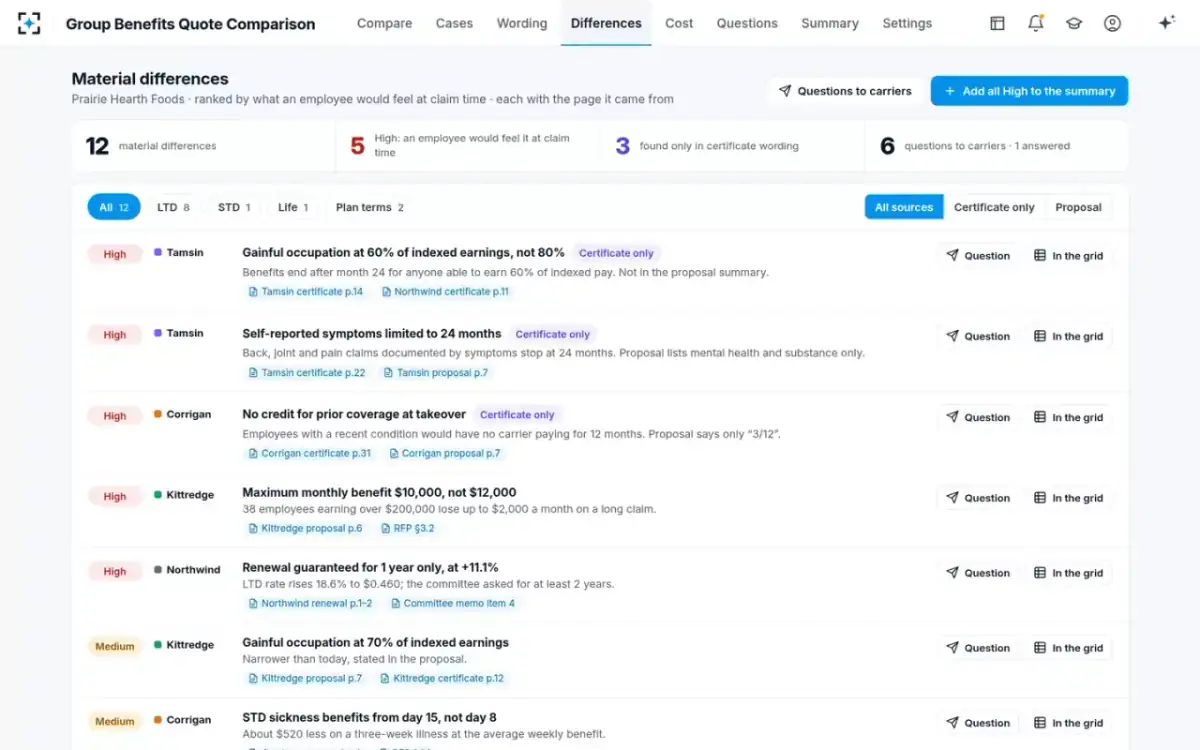
The agents read and flag; they do not decide what the state's rule requires of a particular carrier, which is a question for the consultant and, where it matters, counsel. To see the case end to end, start from Group Benefits Quote Comparison.
Questions people ask
What does no loss no gain mean in insurance?
It is shorthand for the takeover rules when one group carrier replaces another: covered people should not lose coverage because of the switch, and should not gain benefits beyond what the plans provide. In Minnesota's rule the minimum for people not yet eligible under the new plan is the lesser of the prior plan's benefits, net of what the prior carrier pays, or the new plan's.
What is continuity of coverage?
Continuity of coverage is the broader idea that an employee's protection should not break at a change of carrier. The NAIC model delivers it in three parts: the prior carrier's accrued liabilities and extensions, enrolment under the new carrier's rules, and fallback coverage for people who are not eligible on the effective date.
Is no loss no gain required by law?
Only where a state has adopted rules like the NAIC model, and only as that state wrote them. The model is a template for states, first adopted in 1972 and amended in 2002; Minnesota's rule is an example of a state version. Check the state where the group policy is issued.
Does the new carrier have to cover pre-existing conditions at takeover?
Under the model and Minnesota's rule, a transferring employee subject to the new carrier's pre-existing condition limitation receives the lesser of the new plan's benefits without the limitation, or the prior plan's benefits. A certificate that ignores prior coverage should be questioned before the committee votes.
Who pays an LTD claim if the employee became disabled before the carrier change?
The prior carrier. The model says discontinuance "during a disability shall have no effect on benefits payable for that disability," and the prior carrier remains liable for its accrued liabilities and extensions.
Does no loss no gain apply to group life insurance?
The model's scope covers all group policies, and section 6B keeps a group life plan's disability extension, such as a premium waiver, alive after discontinuance. People not actively at work on the takeover date fall under the same fallback coverage rule as for other lines.