The benefits renewal process is the run of work between an insurer's renewal offer and the first day of the new plan year: the incumbent prices the renewal, the broker or consultant decides whether to market the plan, competing carriers quote, someone compares the proposals and their certificates, the employer's benefits committee decides, and the chosen carrier installs the plan. For group life and disability most of that work lands in the same few autumn weeks, because most insured plans that file with the Department of Labor renew on 1 January. Rates are easy to line up in that rush; definitions of disability, limitations and takeover terms are not, and they are what an employee feels at claim time. Botminds' Group Benefits Quote Comparison exists for that squeeze: agents read every proposal and certificate and set them side by side, and the consultant decides.
The examples below come from a fictional sample case as it runs through the solution: Prairie Hearth Foods, 1,186 employees, marketing group life, AD&D, short-term and long-term disability for 1 January 2027. The market figures come from the Department of Labor's public filings and the Bureau of Labor Statistics, linked where they appear.
Two in three insured LTD contracts start their year on 1 January
What is the benefits renewal process, step by step?
The benefits renewal process has six steps, and only the first and last are fixed by the calendar: the incumbent's renewal arrives, the employer decides whether to test the market, carriers quote, the proposals are compared, the committee chooses, and the plan is installed. Everything between the renewal letter and the installation competes for the same few weeks.
The incumbent goes first. It reviews the case's claims and enrolment and sends a renewal with new rates and the length of time those rates are guaranteed. In the sample case the incumbent, Northwind Mutual Life, renewed at +11.1%, guaranteed for one year, with its long-term disability rate up 18.6%, from $0.388 to $0.460 per $100 of covered payroll.
A renewal like that usually triggers marketing: a request for proposal (RFP) with the employer's data and the plan design it wants quoted. The sample RFP went out on Monday 14 September with proposals due Friday 9 October, and five carriers answered with 21 files: proposals and plan summaries, rate exhibits, specimen certificates and takeover letters. Then the comparison, the questions back to carriers, the committee on Thursday 22 October, and ten weeks to install a new carrier for 1 January.
The pattern is not limited to large cases, but the public evidence is. The Department of Labor's Form 5500 data covers "approximately 800,000 retirement and welfare benefit plans," DOL says; insured welfare plans with fewer than 100 participants are generally exempt from filing, so the counts on this page describe plans of roughly a hundred lives and up.
Why most group life and disability renewals land in one autumn
They land together because the plan years do. In our count of 2024 Schedule A filings, 68.0% of contracts that insure long-term disability alone began their policy year on 1 January; the next most common start, 1 July, had 6.5%. Group life alone was 69.5% and short-term disability alone 65.0%. A consultant with a book of January cases is therefore pricing, comparing and presenting nearly all of them between September and November.
Count the people affected and the squeeze is not small. The Bureau of Labor Statistics found that in March 2026 "Fifty-nine percent of private industry workers had access to life insurance plans, 44 percent had access to short-term disability plans, and 37 percent had access to long-term disability plans" (BLS, Employee Benefits in the United States, March 2026). Every one of those plans has a renewal date, and for most of them it is the first of January.
The crowding reaches the carriers too. An underwriter who quotes January cases has the same few weeks as every consultant, and an amendment requested in the last days before a committee arrives when there is little time left to price it. That is why the order of the work matters as much as its speed.
When should group benefits renewals start? Work back from the committee date
Start from the committee meeting, not from the effective date. The committee has to see a finished comparison, a carrier needs time to answer questions and price amendments, and carriers need time to quote: 25 days in the sample case. That puts the RFP about five and a half weeks before the committee and the committee about ten weeks before the effective date.
One 1 January case, by role: the comparison is the shortest phase and the most crowded
- RFP out, carriers quotingQuoting · 25 d
- Compare, ask, summariseCompare · 13 d
- Install, enrolment, certificatesInstall · 71 d
- Underwrite and quoteQuote · 25 d
- Answer questions, price amendmentsAmend · 13 d
- Winner installs the planWinner installs
- Must-haves agreedMemo · 2 Oct
- Reads the summary, meets22 Oct
- Enrolment and employee noticesEnrolment
The thirteen days in the middle are where cases go wrong. By hand, the product team estimates a five-carrier life and disability comparison at about 15.5 hours: five keying rates, plan designs and deviations, four reading certificates against the summaries, two scoring the employer's must-haves, an hour and a half on one- and three-year cost, and three on questions and the committee summary. That is two working days per case, before a certificate has been read closely, and a consultant carries several cases into the same fortnight. The solution's target is a cited comparison within one hour of the last proposal arriving.
If the case also changes its plan design, add time at the front. A committee that wants to discuss a higher LTD maximum or a different own-occupation period should agree its must-haves before the RFP goes out; in the sample, the committee's memo of Friday 2 October set eight of them, and every carrier was scored against those.
What is a rate guarantee, and how should it change the comparison?
A rate guarantee is the period for which a carrier promises not to change the rates in its proposal. It changes the comparison because a one-year guarantee compares a year of price with three years of price: the cheaper first year can be the dearer contract.
Three years of premium in the sample case, with each carrier's rate guarantee
| Carrier | Year one | Guarantee | Three years | Against today |
|---|---|---|---|---|
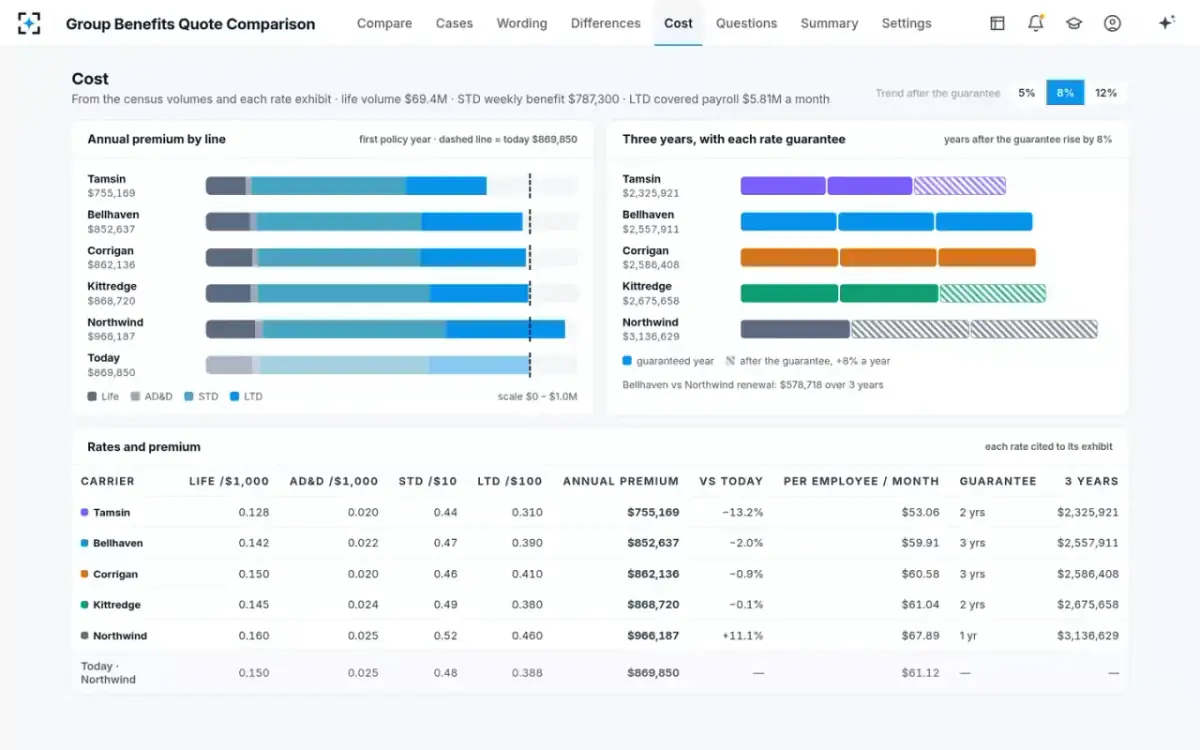
| Tamsin | $755,169 | 2 years | $2,325,921 | −13.2% in year one |
| Bellhaven | $852,637 | 3 years | $2,557,911 | −2.0% |
| Corrigan | $862,136 | 3 years | $2,586,408 | −0.9% |
| Kittredge | $868,720 | 2 years | $2,675,658 | −0.1% |
| Northwind (renewal) | $966,187 | 1 year | $3,136,629 | +11.1% |
On these numbers, moving to Bellhaven saves $113,550 against Northwind's renewal in year one and $578,718 over three years, because Northwind's rate is held for one year and Bellhaven's for three. The cheapest first year, Tamsin, is the cheapest three years as well, and that is exactly the case where the comparison must look beyond price; what Tamsin's certificate changes for a claimant is worked through on its own page.
Read the guarantee's conditions in the rate exhibit, not only its length: check whether it still holds if enrolment moves or the plan design changes, and list any condition beside the number of years, so the committee is not surprised at the first anniversary.
The cost view in Group Benefits Quote Comparison: one year by line, three years with each guarantee
Who is busy when: the five people on one renewal
A renewal is carried by at least five people on three sides, and each is busiest at a different moment. The consultant is busiest in the comparison fortnight; the carrier's underwriter in the quoting weeks and again when amendments are asked for; the HR lead in the week of the committee and again at enrolment.
Five roles on one January renewal, before and with the agents reading
Today
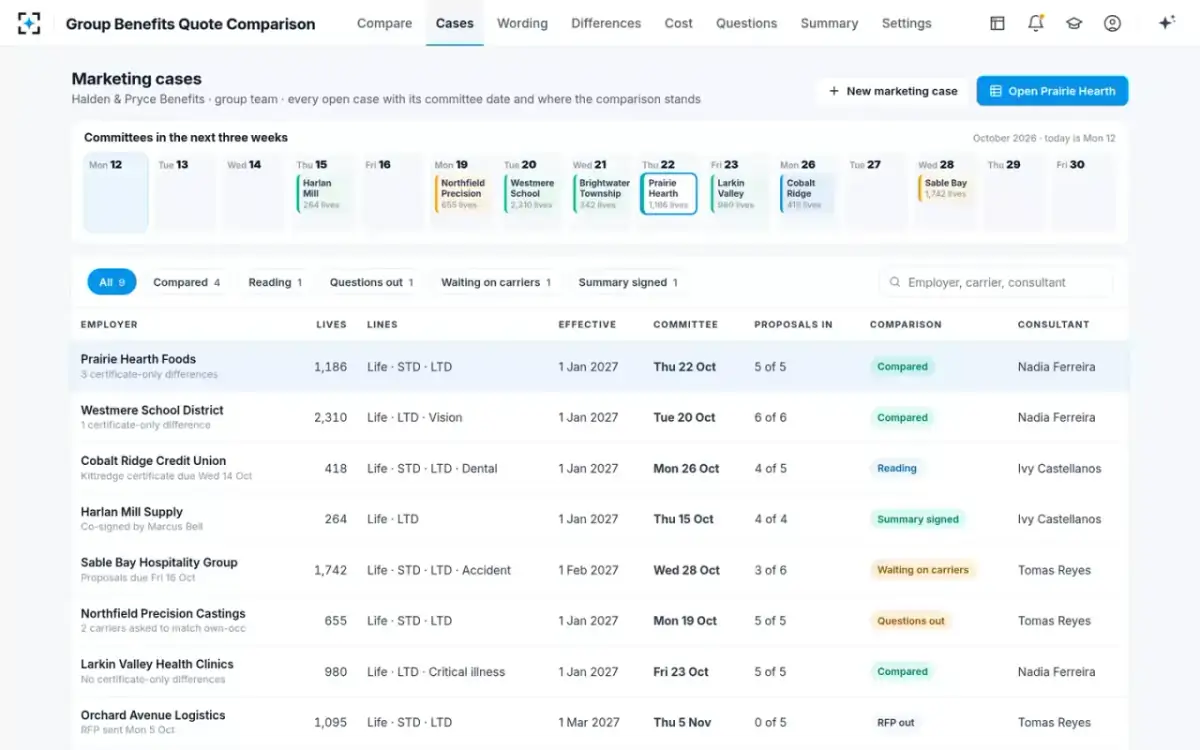
Nine open cases with committees inside three weeks; lines up rates in an afternoon, then worries about the certificate page she has not had time to read.
With agents
Starts from a grid already keyed and cited, and spends the week on the five or six differences that change what an employee is paid.
Still theirs: The recommendation, every question sent to a carrier, the signature
Today
Co-signs a recommendation for a thousand-plus employees on the strength of a rate table.
With agents
Reads the claim-time example and the page behind each number before the summary leaves the firm.
Still theirs: The co-signature and the client relationship
Today
Receives the cheapest option and a rate table, not what the plan gives up.
With agents
Receives a ranked choice with the reasons the cheapest proposal is not first, in plain words.
Still theirs: The decision, and the vote of the committee
Today
Learns about a definition he could have matched after the finalists are picked.
With agents
Gets a cited question while there is still time to amend and price it.
Still theirs: What the carrier offers
Today
Is asked to price an amendment after the finalists are picked.
With agents
Gets a question that names the certificate page and the date the answer is needed.
Still theirs: Every rate and every amendment
The roles explain why the order of the work matters. A question that reaches an underwriter in the first days after proposals close can be priced before the committee; the same question raised at the committee reaches no one. The sample's question to Tamsin, asking it to amend its gainful occupation definition to 80% of indexed earnings and price the change, was drafted with the certificate pages cited and an answer date, Friday 16 October, six days before the committee, and waits for the consultant's approval before it is sent.
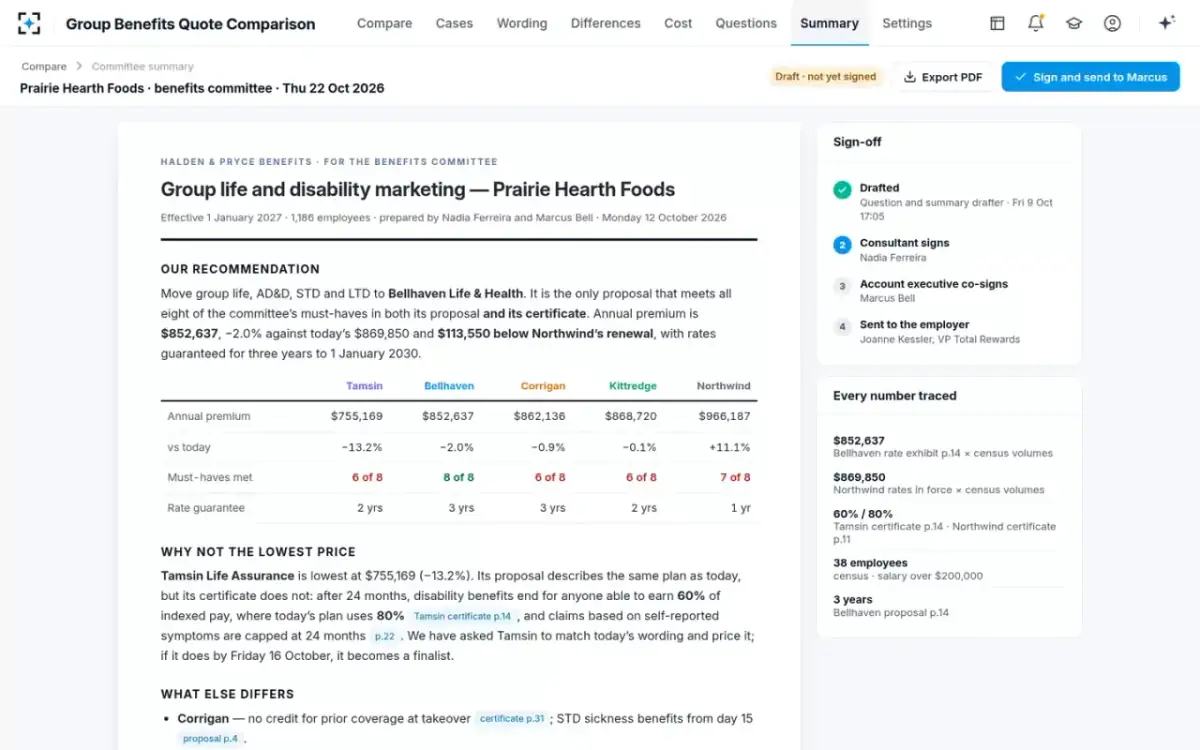
"We have asked Tamsin to match today's wording and price it; if it does by Friday 16 October, it becomes a finalist."
From the sample case's committee summary, under 'Why not the lowest price'
What happens at a benefits renewal meeting?
At the renewal meeting the employer's benefits committee chooses between renewing and moving, and the consultant explains the recommendation. A good meeting decides on three things the committee can see side by side: which proposals meet the must-haves in both the proposal and the certificate, what each costs over its guarantee, and what an employee would lose or gain at claim time.
The third is the one a premium chart leaves out. In the sample case, the cheapest proposal met all eight must-haves on its summary and six on its certificate, because its certificate ends disability benefits after month 24 for anyone able to earn 60% of indexed pre-disability earnings, where the current plan uses 80%, and caps claims based on self-reported symptoms at 24 months. The committee summary says so in a section headed "Why not the lowest price," with the certificate page beside each sentence.
The committee summary in Group Benefits Quote Comparison: the recommendation and why not the lowest price
The meeting also needs a decision rule for open questions. The sample committee had one: Bellhaven, or wait for Tamsin's answer. Writing that choice down, with its deadline, keeps a cheaper but narrower proposal from winning by default because its amendment was promised and never priced.
After the vote: the deadlines the law sets on a carrier change
The committee's vote starts legal clocks that run well past 1 January. Three matter most for insured life and disability plans covered by ERISA.
First, employees must be told about a material change. A plan administrator must furnish a summary of any material modification "not later than 210 days after the close of the plan year in which the modification or change was adopted" (29 CFR 2520.104b-3), and the summary plan description itself must set out the circumstances in which benefits can be denied, reduced or offset (29 CFR 2520.102-3(l)). A move from an 80% to a 60% earnings test is such a circumstance, which is one more reason to see it before the vote rather than after.
Second, the new carrier owes the plan its reporting data. ERISA requires an insurer that provides plan benefits to "transmit and certify the accuracy of such information to the administrator within 120 days after the end of the plan year" (29 U.S.C. § 1023(a)(2)), and the plan's Form 5500 is due by the last day of the seventh month after the plan year ends, with a single extension of up to 2½ months on Form 5558 (2025 Form 5500 instructions). For a calendar-year plan that is 31 July, or 15 October with the extension.
Third, people who are not at work on the effective date need a home. The prior carrier stays liable for disabilities that began on its watch, and the new carrier's actively-at-work rule decides who it enrols on day one; how the takeover rules divide those people between carriers is the subject of its own page.
An employee benefits renewal checklist for the comparison fortnight
The checklist below covers the thirteen days between the last proposal and the committee, where most errors are made. It assumes the RFP asked every carrier for a specimen certificate; without one, the comparison is a comparison of summaries.
Ten checks before a renewal comparison goes to the committee
- Every proposal has its certificate
A plan summary that says "standard definitions apply" cannot be compared; ask for the specimen certificate or the policy form.
- Rates are keyed by one person and checked by another
Transposed rates survive a single reader. Keep the writer and the checker apart.
- Each must-have is scored on the certificate, not the summary
In the sample case two of five carriers lost must-haves only when their certificates were read.
- Today's plan is a column
Narrower and broader only mean something against what employees have now.
- Deviations are listed by carrier
A $10,000 LTD maximum where $12,000 was asked for affects every employee earning over $200,000 a year.
- Cost runs over each guarantee
Show one year and three, with the trend after the guarantee stated as an assumption.
- Takeover terms are read
Prior-coverage credit for pre-existing conditions and the actively-at-work rule decide who is covered on 1 January.
- Questions to carriers name the page and the date
An underwriter can price an amendment before the deadline only if the question says what and by when.
- The summary explains why not the lowest price
If the cheapest proposal is not first, the committee should read why, in plain words.
- Two people sign
The consultant signs the recommendation; a second person co-signs before the employer sees it.
Most of the list is reading and keying, which is the part the solution's agents do: a proposal reader keys rates, designs and deviations with a page for every value; a certificate reader quotes each definition word for word; a wording comparer marks each clause narrower, broader or the same as today. The consultant keeps the judgement: which differences matter for this employer, what to ask, and what to recommend. If your current comparison is a workbook, how to keep the writer and the checker apart in it is the place to start.
Marketing cases: nine renewals and their committee dates in one view
To see the whole case, from the renewal letter to the signed committee summary, start from Group Benefits Quote Comparison.
Questions people ask
How long does a group benefits renewal take?
For a 1 January plan, the visible part runs from an RFP in mid-September to installation by year end, about fifteen weeks in the sample case. The comparison itself took thirteen calendar days there; the product team estimates the hands-on work of a five-carrier life and disability comparison at about two working days by hand.
When should an employer market its benefits?
When the renewal is materially higher, when the plan design no longer fits, or when the incumbent will not guarantee rates for long enough. Marketing has to start early enough for carriers to quote and answer questions before the committee; in the sample case that was an RFP about five and a half weeks before the meeting.
Does every renewal have to go to market?
No. A renewal can be negotiated with the incumbent alone, and the RFP, the quoting and the comparison all cost carriers and consultants time. In the sample case it was the size of the increase, +11.1% with rates guaranteed for only one year, that sent the case to market.
What is included in a benefits renewal?
A renewal sets new rates by line, the length of the rate guarantee and any change the carrier proposes to the plan. For a full comparison, ask the incumbent for its current certificate as well, so its wording sits beside the competitors' certificates rather than beside their summaries.
Which plans have to file a Form 5500 after a renewal?
ERISA welfare plans file unless an exemption applies; fully insured or unfunded welfare plans with fewer than 100 participants at the start of the plan year are generally exempt. A plan that files attaches a Schedule A for each insurance contract, showing the insurer, the premium and the commissions; how to read an incumbent's Schedule A before you quote covers the public search.
What is the difference between a renewal and a re-enrolment?
The renewal is between the employer and the carrier: rates, guarantee and contract terms. Re-enrolment, or open enrolment, is between the employer and its employees, who choose coverage for the new plan year; a change of carrier usually brings new certificates and, where the plan changed materially, a summary of material modifications.