A group benefits quote comparison tool is software that takes the proposals, rate exhibits and certificates carriers send for an employer's group plans and lines them up so a broker or consultant can compare them carrier by carrier against today's plan. The useful ones do three things a spreadsheet cannot do on its own: read the documents rather than wait for someone to key them, cite the page behind every value, and show where a certificate says something narrower than its proposal. They should not ask a practice to abandon the workbook its committees know, the agency system that holds its clients and commissions, or the consultant's signature. Botminds' Group Benefits Quote Comparison is built that way: agents read everything carriers send and set it out in one plan grid, and the consultant decides what goes to the employer.
Examples come from a fictional sample case as it runs through the solution: Prairie Hearth Foods, 1,186 employees, marketing group life, AD&D, short-term and long-term disability for 1 January 2027. Hours are the product team's estimates and targets, labelled as such.
Where a five-carrier comparison's hours go, by hand and with Group Benefits Quote Comparison
By hand · about 15.5 hours (estimate)
- Keying rates, designs, deviations · 32%
- Reading certificates · 26%
- Scoring must-haves · 13%
- Cost · 10%
- Questions and summary · 19%
With the solution · about 1.7 hours (estimate)
- Keying · 12%
- Reading · 12%
- Scoring · 12%
- Cost · 6%
- Consultant's questions, review and signature · 58%
What is a quote comparison tool, and which kind do you need?
There are three kinds of tool sold as quote comparison, and they solve different problems. Quoting portals and rating engines return a carrier's own price for a small group from the data a broker types in. Templates and spreadsheet add-ins format whatever someone has keyed. Document-reading comparisons start from the proposals and certificates carriers send and do the keying and the reading themselves. A broker marketing a 200-life life and disability plan through an RFP needs the third kind.
Three kinds of quote comparison tool, and the case each one fits
| Kind | Starts from | Good at | Cannot do |
|---|---|---|---|
| Quoting portal or rating engine | Data the broker enters; the carrier's own rating | Fast prices for small, standard groups | Read a certificate, or compare carriers that do not connect to it |
| Template or spreadsheet add-in | Values someone keyed | A consistent house format | Check its own inputs; see what a summary left out |
| Document-reading comparison | The proposals, rate exhibits and certificates as received | Every value with its page; certificate wording against the summary and today's plan | Decide what matters for this employer; that stays with the consultant |
Why group life and disability quotes arrive as documents
When a case is marketed by RFP, carriers answer with a proposal, a rate exhibit and, if asked, a specimen certificate, not a price from a portal. The public filings give a sense of the size of insured plans that report. In our count of 2024 Form 5500 Schedule A filings, the median contract insuring long-term disability alone covered 190 people and paid $48,302 of premium a year (DOL Schedule A dataset, form year 2024); plans under 100 participants that are fully insured generally do not file at all (29 CFR 2520.104-20), so the filings describe the larger cases.
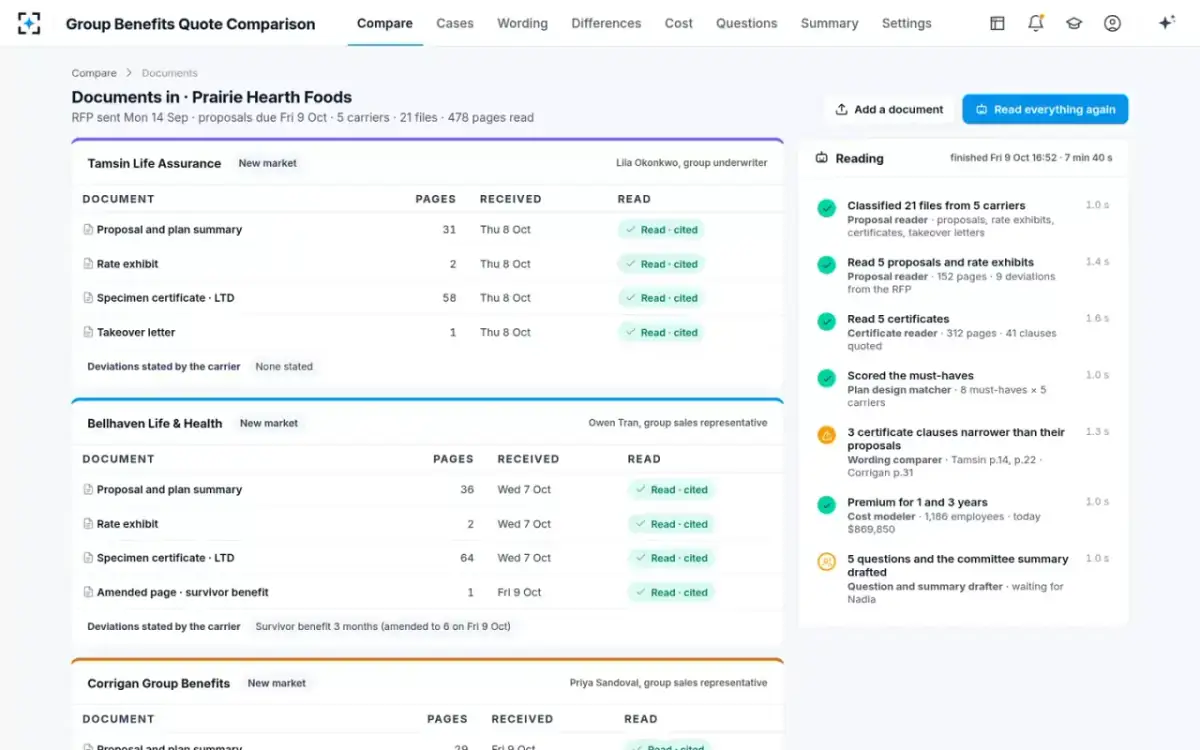
In the sample case the RFP produced 21 files from five carriers, 478 pages in all: proposals and plan summaries, rate exhibits, specimen certificates, takeover letters and the incumbent's renewal. A tool that only takes typed values leaves all of those pages to a person.
Everything carriers sent for one case, read and cited
Can a comparison tool read carrier proposals reliably?
It can, if reading means three specific things: every value carries the page it came from, a value the document does not state stays empty rather than being filled from a default, and a missing certificate is reported as missing. Ask any vendor to show those three on one of your own past cases before anything else.
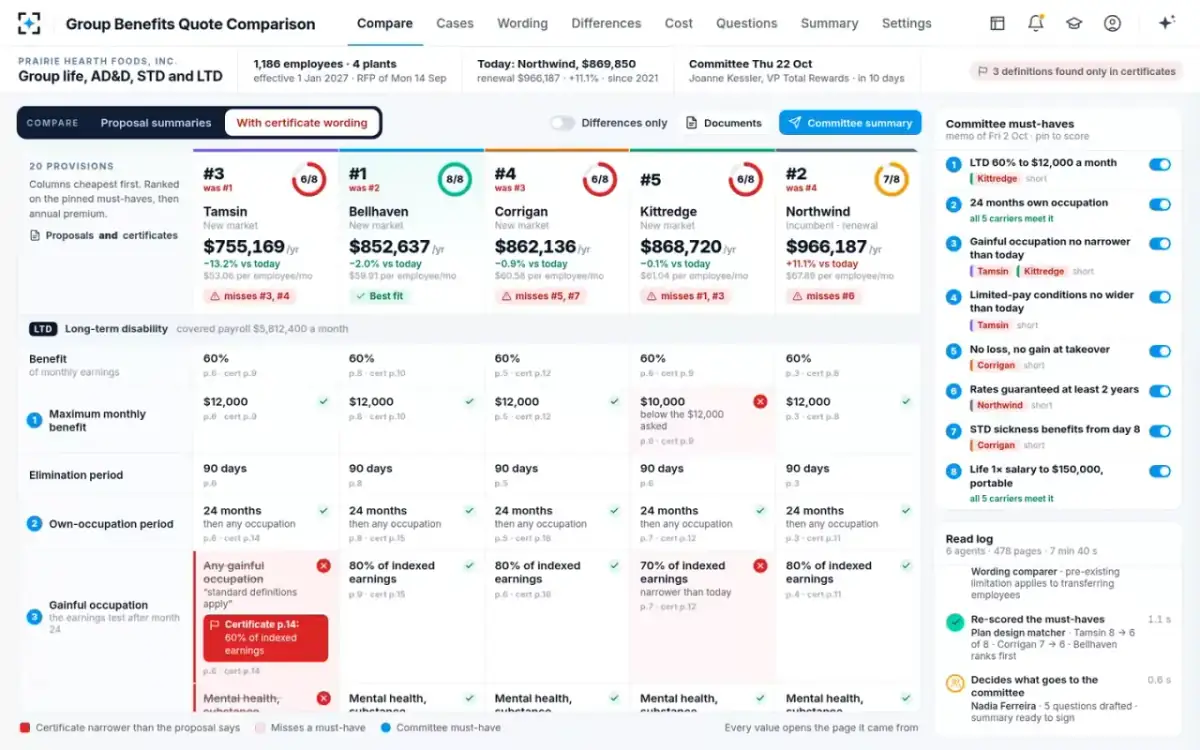
The second point is the one that separates reading from guessing. In the sample case one carrier's proposal said its long-term disability definitions were "standard" after 24 months. A tool that fills the cell with the market's usual wording shows a clean grid; the solution's proposal reader "never fills a value the proposal does not state," and its certificate reader then found the definition on page 14 of the certificate: gainful occupation at 60% of indexed earnings, where today's plan uses 80%. What that one definition costs a claimant is priced on its own page.
The plan grid with certificate wording: the cheapest column flagged
Does quote comparison software work with Excel and the agency system?
It should leave them where they are and feed them. A practice's workbook is its house format, its committee members know how to read it, and its agency or customer system holds the client, the contacts and the commission. A comparison tool earns its place by producing the comparison those systems need, with sources, not by replacing them.
What stays in the practice's systems, and what the comparison supplies
| System | What stays there | What the comparison supplies |
|---|---|---|
| Agency or customer system | The client, contacts, policies in force, commission and renewal dates | Nothing it must re-key; the case is opened from the employer and its committee date |
| The house workbook | The format committees know; the practice's own analysis | Values with their pages, so any cell copied across can still be traced |
| Email and the carrier relationship | Every message to a carrier | Drafted questions, each citing its page, sent only on the consultant's approval |
| Document store | Carrier documents as received | The same documents, kept unchanged with a fingerprint, and every read and edit on an activity trail |
| The committee | The decision | A summary with every number traced, signed by the consultant and co-signed |
Two of those rows are compliance questions as well as convenience. Carrier documents and the employer's data include employees' salaries and ages, and the Department of Labor confirmed in 2024 that its cybersecurity guidance reaches health and welfare plans as well as retirement plans, including its tips for hiring service providers (EBSA Compliance Assistance Release 2024-01). And in New York a producer must, on request, describe the alternative quotes it presented, with their coverage, premium and the compensation it would have earned (11 NYCRR 30.3(b)), which is easier when every quote presented is kept with its sources.
How do brokers compare quotes from different carriers?
Brokers compare quotes from different carriers in four passes: put rates in the same units and recompute premium from the employer's volumes, line up the plan designs, list each carrier's deviations from what was asked, and read the certificates against today's plan. Templates and portals cover the first two at best. The last two decide the recommendation.
The four passes, by hand and in Group Benefits Quote Comparison
By hand in a workbook: Rates keyed from five exhibits; premium recomputed if someone remembers the units.
Group Benefits Quote Comparison: Annual premium by line from the employer's volumes and each exhibit, one and three years with each guarantee; the trend is a stated setting.
By hand in a workbook: Keyed from summaries, carrier by carrier.
Group Benefits Quote Comparison: Keyed by the proposal reader with a page for every value.
By hand in a workbook: Found if the proposal letter is read closely.
Group Benefits Quote Comparison: Listed under each carrier's documents, and in the differences list.
By hand in a workbook: Read for the likely winner, if time allows.
Group Benefits Quote Comparison: Every certificate read; each clause marked narrower, broader or the same as the summary and today's plan.
The order matters as much as the passes. A comparison that reads certificates last has to unwind its ranking when it finds something; in the sample case the certificate pass moved the cheapest carrier from first to third and another carrier down a place. A tool that reads certificates first never ranks on summaries at all.
What should a group benefits comparison tool include? A buyer's checklist
A group benefits comparison tool should include document reading with citations, today's plan as a column, the employer's own must-haves, cost over each rate guarantee, and a sign-off that keeps the consultant in charge. The checklist below turns those into things to see in a demonstration on your own past case.
Ten things to see before buying a group benefits quote comparison tool
- Run it on one of your own closed cases
You already know the answer; count what it finds and what it misses.
- Open any cell and see the page
A value without a source is a value you will have to check by hand.
- Find an empty cell
Where a proposal states nothing, the tool should say so, not fill a default.
- See the certificate against the summary
Narrower wording the proposal does not mention should be flagged on the grid.
- See today's plan as a column
Narrower and broader need a baseline.
- Set the employer's must-haves
Ranking should follow the committee's priorities, then price, and re-score when one changes.
- Change the trend after the guarantee
Three-year cost should move, and the assumption should show on the chart.
- Try to send a question without approval
It should not be possible.
- Read the committee summary
Plain words, a reason for not choosing the lowest price, and a page behind every number.
- Ask where the documents live and who can see them
Employee salaries and ages are in every case; ask for the access and retention terms in writing.
How long does it take to set up a comparison tool?
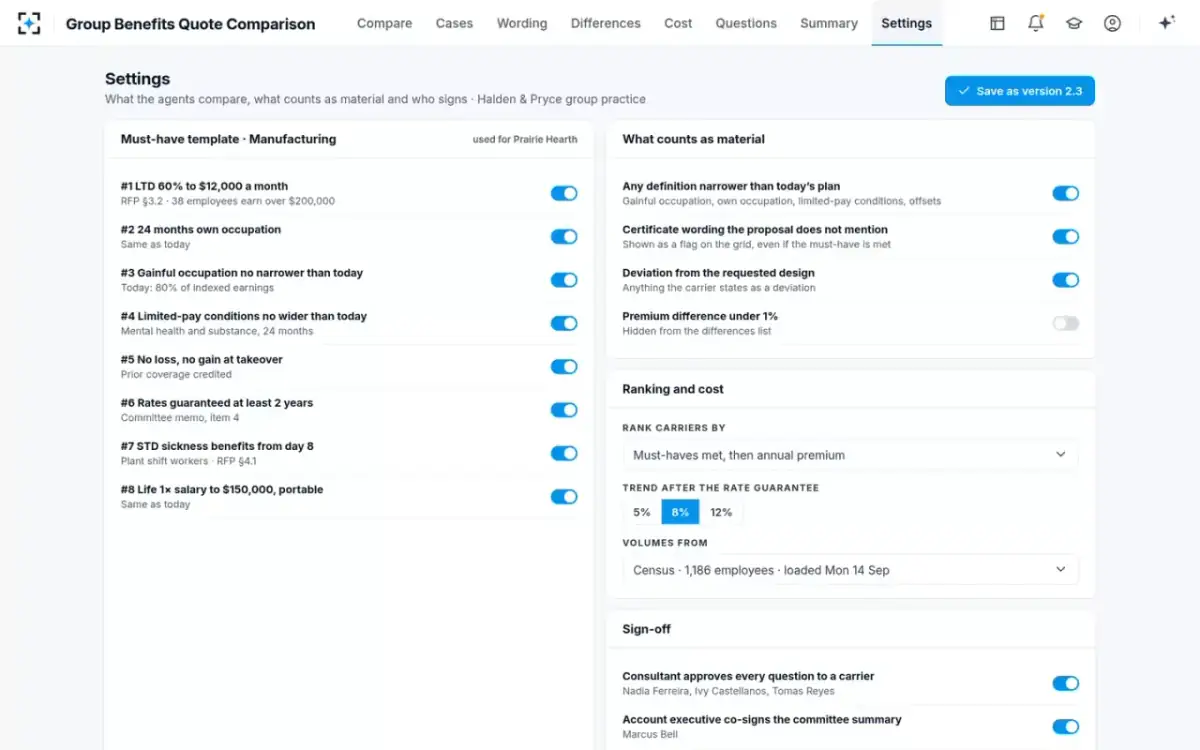
Setting up a document-reading comparison is mostly configuration of the practice's own rules, not data migration. For Group Benefits Quote Comparison the inputs are the practice's must-have templates, its plan grid, its house style for committee summaries and a sample of past cases, and it goes live once its quality checks pass on those cases. We do not quote a number of weeks here, because it depends on how many templates and lines a practice uses.
The practice's rules: must-haves, what counts as material, ranking and sign-off
The fastest honest test is the one in the checklist: a closed case the practice already knows, run end to end, with the consultant who worked it scoring the result. If the tool misses what the consultant found, or finds what the consultant missed, both are worth knowing before a live renewal season.
Where Group Benefits Quote Comparison fits as a quote comparison tool, and where it does not
It fits cases marketed by RFP, where proposals and certificates arrive as documents and the definitions matter: group life, AD&D, short- and long-term disability; other cases in the sample book also carry dental, vision, accident and critical illness lines. It does not price: agents never change a carrier's rate, and the solution is not a rating engine or a quoting portal for instant small-group prices.
It does not decide either. The committee's must-haves, the practice's materiality rules and the consultant's judgement set the recommendation; agents read, cite and draft. For property and casualty quotes, where the documents are quotes, binders and policy forms, see insurance proposal software for commercial lines. For group benefits, how to keep the maker and the checker apart is the companion to this page, and the full case is on Group Benefits Quote Comparison.
Questions people ask
What is the best quote comparison tool for employee benefits?
The one that reads the documents your carriers actually send and shows you the page behind every value. For small groups quoted through portals, a rating engine is enough; for cases marketed by RFP, test any tool on a closed case and count what it finds in the certificates.
Can a quote comparison tool replace my spreadsheet?
It can replace the keying, not the judgement or the format your committees know. Keep the workbook as the house format if you like; what matters is that every value in it can be traced to a page, which is easiest when a tool has read the documents first.
Does a comparison tool need my employee data?
To compute premium it needs volumes by line, which come from the employer's data: covered payroll, life volume and weekly benefit. In the sample case those were $5.81 million of monthly LTD covered payroll, $69.4 million of life volume and $787,300 of STD weekly benefit.
Can a comparison tool send questions to carriers?
It can draft them; whether it may send them is a control you should set. In the sample case questions are drafted from the differences, each citing its page, and nothing is sent until the consultant approves it.
How accurate is AI at reading insurance proposals?
Accuracy has to be measured on your own documents, not quoted. Plant known differences in a closed case and count the catches, the misses and the false alarms; a twelve-trap test for LTD certificates gives a kit.
Is a quote comparison template enough for small groups?
Often, for groups whose carriers quote standard designs through portals. It stops being enough when proposals arrive as documents with their own certificates, because a template cannot read what a summary left out.