Insurance proposal software produces the document a broker presents to a commercial client at renewal: the recommended carrier, the other options and what each gives up, the changes from the expiring policy and what is needed to bind. Some products are presentation templates that a person fills in; others, like Botminds' Insurance Quote Comparison, read the carriers' quotes and forms themselves, build a cited comparison and draft the proposal from it for a person to approve. Either kind should be judged the same way: on renewals your team has already presented and bound, where the right answer is known. Two weeks is enough to do it properly, if the pass lines are written down before the first file goes in.
The screens and settings shown here come from the solution's sample case, a fictional brokerage with a fictional account executive carrying nine renewals in market. The pilot plan is ours and applies to any product.
A two-week pilot of insurance proposal software, with three checkpoints
- Prepare files and pass linesDays 1–3
- 1 · Score cellsDays 4–6
- 2 · Review differencesDays 7–8
- 3 · Live renewal, decideDays 9–10
- Idle while the team preparesDays 1–3
- Read 10 renewals; re-read disputed cellsDays 4–8
- Live renewalDays 9–10
What is insurance proposal software?
It is software that turns a set of carrier quotes into the client-facing proposal, and the category splits into two kinds that are easy to confuse. Template tools lay out a branded document from data someone has typed in: premium, limits, a schedule of coverages. Reading tools take the quotes, declarations and forms as they arrive from each carrier, extract the terms with their pages, compare them, and draft the proposal from the comparison. The first saves formatting time; the second changes who does the reading and how it is checked.
The difference matters for what a pilot can test. A template tool's output is only as accurate as the typing, so a pilot measures layout and speed. A reading tool's output can be scored cell by cell against the bound policy, which is the test this page lays out. Insurance Quote Comparison is a reading tool: six agents read the quotes and forms, check them, match them to the client's requirements, track subjectivities and draft the proposal, and people approve, co-sign and send.
What should a proposal show the client?
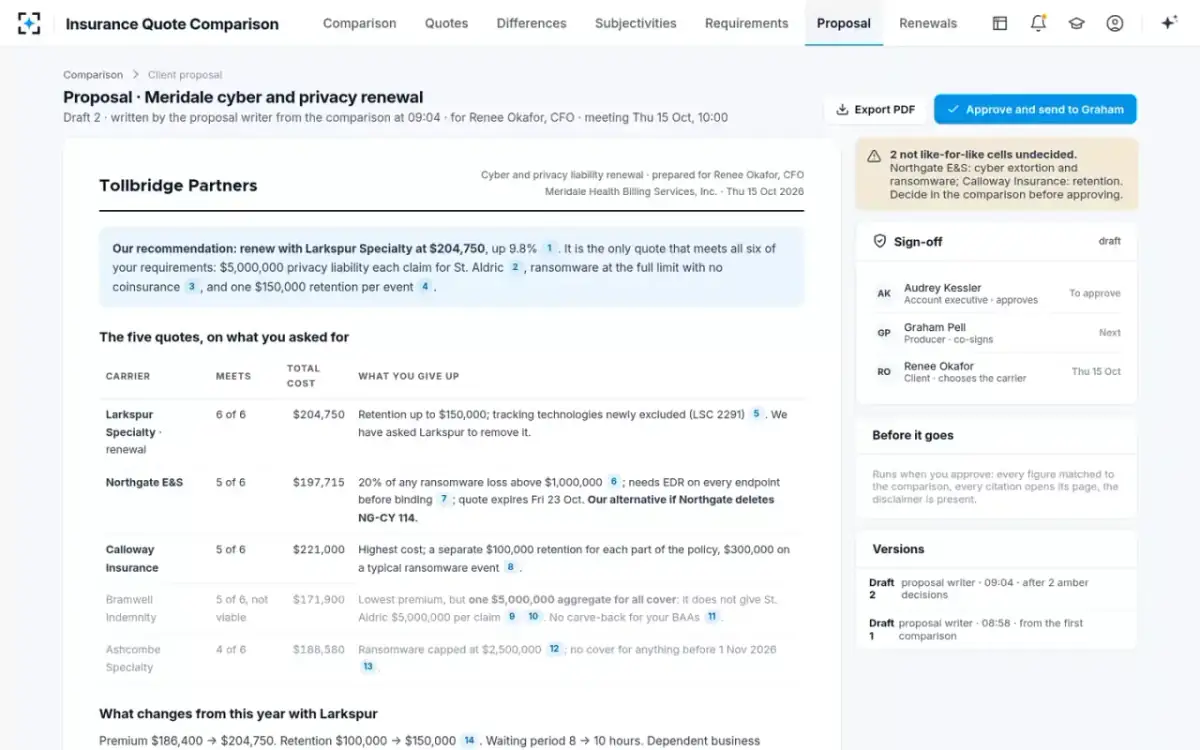
A proposal should show the recommendation and why, every viable option and what each gives up against the client's requirements, what changes from the expiring policy, what the client must do to bind and by when, and a statement that the policy wording governs. Each figure should point to the carrier's page. In New York, a broker's liability turns on whether the client made a specific request and whether it was met, so the proposal is also the evidence of both (American Bldg. Supply v Petrocelli, 2012).
A drafted proposal with citations, waiting for a person to approve it
Why test insurance proposal software on renewals you already bound
Because bound renewals are the only files where the right answer exists. The bound policy says what each term finally was; the proposal the team presented says what the team found; the claims and endorsements since say whether anything was missed. A vendor's demonstration on its own sample documents shows the product works on those documents, which is not the question.
NIST's AI Risk Management Framework puts the same principle in general terms: performance should be measured, and shown to hold, in conditions like those where the system will be used, and the system should be shown to be valid and reliable, with the limits of its results outside the conditions it was built in written down (NIST AI RMF 1.0, MEASURE 2.3 and 2.5). For a brokerage, conditions similar to deployment means your carriers, your lines, your proposal standard and your files.
How do you measure a pilot of proposal software?
Measure four things, and write the pass line for each on day 1, before anyone has seen output. Cell accuracy against the bound policy; differences found, both the ones your team found by hand and any the team missed; false alarms; and time. Overall impressions from a demo are not a measure.
Pilot measures for insurance proposal software, with a pass line to set before day 1
| Measure | How to count it | Example pass line (yours to set) |
|---|---|---|
| Cell accuracy | For each cell: value and basis both match the bound policy and the page cited says what the cell says. | No more than 1 wrong cell in 1,000, with every wrong cell explained. |
| Differences the team found | Each not-like-for-like difference recorded in the original proposal or file notes, and whether the software marked it. | All of them marked. |
| Differences the team missed | Cells the software marked that the team had not, each confirmed against the wording by a senior reviewer. | Reported, not passed or failed: each one is a finding about the old process. |
| False alarms | Cells marked not like-for-like that a reviewer judges equivalent. | Few enough that the account executive reads them all. |
| Forms opened | Forms read against forms listed on each schedule. | All of them, on every quote. |
| Time | Hours from quotes in to a proposal ready for approval, against the team’s own timing on a comparable live renewal. | Set from your own baseline. |
The third row is where pilots earn their keep. If the software marks a difference that the team did not catch when the renewal was presented, the brokerage has learned something about its own exposure on a policy that is now in force, and the account manager can decide whether to raise it with the client.
How many renewals does a pilot need? The arithmetic of zero errors
Enough cells that a clean result means something. If a pilot checks n cells and finds no errors, the honest conclusion is not “the error rate is zero” but “the error rate is probably below about 3 in n”. The trap is old enough to have its own literature: a 1983 paper in JAMA on how to read a count of zero errors made the point for medicine (Hanley and Lippman-Hand). The exact one-sided 95% upper bound after n clean checks is 1 − 0.05^(1/n), close to 3 ÷ n, which is why the shortcut is known as the rule of three; the chart below computes it.
What a clean pilot proves: the 95% upper bound on the error rate when no errors are found
Ten bound renewals with four quotes each, compared on 25 rows, give 1,000 cells, which is why the plan above starts with ten. Pick them on purpose: different lines, at least two with non-admitted quotes, at least two where the team recorded a difference in the file, and one that went wrong. A pilot of three easy renewals proves only that the software can read easy renewals.
Can proposal software read carrier quotes?
Reading tools can, and this is the first thing to test on day 4: each carrier's own layout, each schedule and every form on it. In the sample case Insurance Quote Comparison read five quotes of 38 to 52 pages and 61 forms, 214 pages in all, in 6 minutes 12 seconds, and cited each of 125 cells to its page. Six minutes from five quotes in to a cited comparison is the design target; the pilot is where a brokerage learns what it is on its own files.
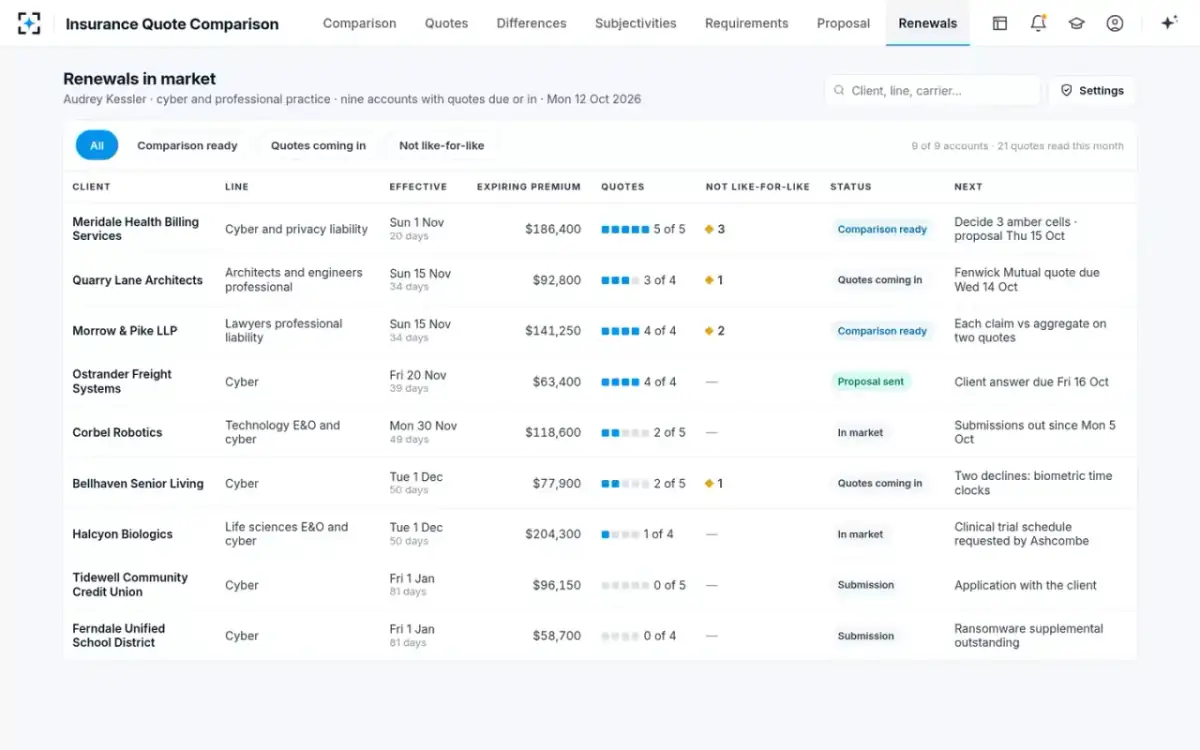
Renewals in market: where a pilot's live renewal on day 9 comes from
Does proposal software work with my agency system?
Ask what goes in and what comes out, and do not assume more. Insurance Quote Comparison works from the documents a renewal already produces: carrier quotes and indications in each carrier's layout, the forms on each schedule, the expiring policy, the client's contracts and memos, and documents on file such as attestations and loss runs. Its output is the cited comparison, the subjectivities list, drafted emails and the client proposal, exported as PDF. It does not replace an agency management system and is not a rater; how it fits next to a rater is covered in commercial insurance quote comparison against a rater.
The pilot should also settle the data questions before client files are uploaded. Where the NAIC's Insurance Data Security Model Law has been adopted, a licensee must choose its service providers with due diligence and require each to protect, with administrative, technical and physical safeguards, the systems and nonpublic information it can reach (NAIC Model #668); what to ask outsourcing firms covers the same duty. Adoption varies by state; the questions are worth asking everywhere.
What does insurance proposal software cost, and what is it worth?
No regulator or research body publishes prices for this software, and vendors' list prices depend on volume and lines. What a brokerage can compute is the value side, from its own numbers, and the pilot supplies the one it does not have: the time a renewal takes with the software. The formula below is how we would set it out.
What insurance proposal software is worth to a brokerage, as a sum to fill in
Hours returned
(hours per renewal by hand − hours with the software) × renewals a year
Our estimate for a five-carrier cyber renewal is about 5 hours by hand and about 1 with the solution; the pilot replaces it with yours.
From the pilot timing
Value of an hour
hours returned × loaded cost per hour
BLS puts the median wage for insurance sales agents at $62,280 in May 2025; add your benefits and overhead.
Your payroll
Differences caught
differences the team missed in the pilot ÷ renewals checked × renewals a year
Each is a gap a client could have found at claim time. Price it with your own E&O history; no public rate exists.
Your E&O lead
Cost
licence + setup of rows and standard + review time on amber cells
Review time stays: the account executive still decides every amber cell.
Vendor quote and pilot
One account executive in the sample book carries 38 renewals a quarter, each sent to four to six markets. At four hours returned per renewal that would be roughly 600 hours a year for one person, on our estimate; the pilot is how a brokerage replaces that estimate with a measurement. The differences-caught term is the one most buyers leave out and the one most likely to decide the case.
What a failed pilot looks like, and what it teaches
A pilot can fail in three distinct ways, and each tells the brokerage something different. It can fail on cells: values or bases that do not match the bound policy. That is a reading failure, and the question is whether the wrong cells cluster, on one carrier's layout, one line, or scanned rather than native documents, because a cluster is fixable and a scatter is not. It can fail on differences: a not-like-for-like difference the team recorded by hand that the software did not mark. That is a checking failure, and it matters more than a wrong cell, because the difference is the thing the client relies on. And it can fail on time: correct output that takes the team as long to review as it took to build by hand, usually because every cell was re-keyed rather than only the amber ones decided.
The third failure is often a process problem rather than a product one, which is why the measures are set before the pilot and the review rule is written down: the account executive decides marked cells and spot-checks the rest against their pages, rather than rebuilding the sheet. If the team cannot trust a cell without retyping it, the pilot has found that the citations are not good enough, and that is a failure worth knowing before the contract is signed.
What to set up before the pilot starts
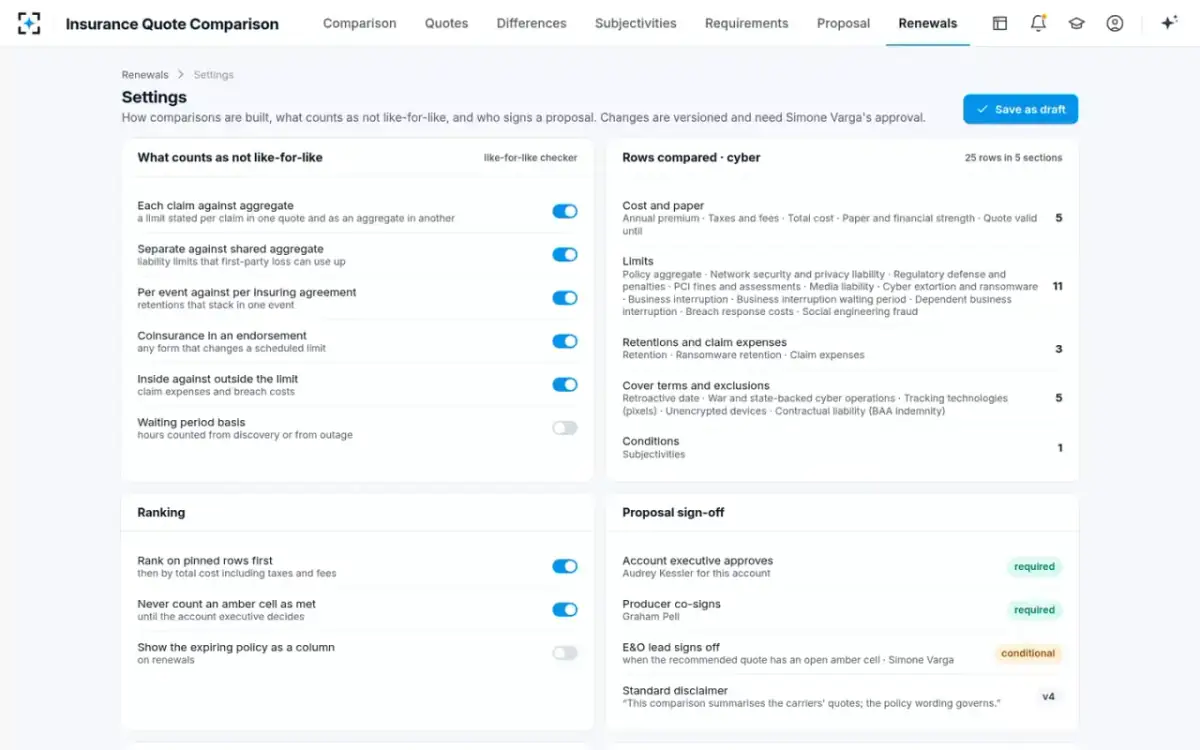
The pilot fails if it measures configuration instead of reading. The brokerage's own proposal standard should be in place before day 4: which rows each line compares, what counts as not like-for-like, how carriers are ranked and who signs. In Insurance Quote Comparison those are settings owned by the placement and E&O lead, versioned, and changed only with that person's approval.
The proposal standard as settings: what counts, how carriers rank, who signs
Before day 1: what to have ready for an insurance proposal software pilot
- Ten bound renewals, chosen on purpose
Mixed lines, admitted and non-admitted quotes, files with recorded differences, one that went wrong.
- The full quote packages, not summaries
Each carrier’s quote, schedule and forms, the expiring policy and the bound policy.
- The client requirements for each
Contract clauses, memos and emails that state what the client asked for.
- Your proposal standard in writing
Rows per line, what counts as not like-for-like, ranking, sign-off.
- Pass lines, signed
Cell accuracy, differences found, false alarms, forms opened, time.
- A blind reviewer
Someone senior who did not handle the renewals scores the disputed cells.
- Data terms agreed
Storage, retention, deletion, access, and no training on your clients’ documents.
- One live renewal for day 9
Quotes due in the second week, presented as normal by the team.
Where Insurance Quote Comparison fits and where it does not, so the pilot tests the right thing: it reads, compares, checks, tracks subjectivities and drafts; it does not bind, send or decide. It is built for accounts where wording differs between carriers, such as cyber, professional liability and specialty lines; for small accounts priced from filed rates a rater may be all that is needed. For the duty the proposal records, see the broker's duty of care; for how the comparison should be tested cell by cell, see the quote comparison spreadsheet guide. To run the pilot on your own renewals, start from Insurance Quote Comparison.
Questions people ask
How long does a software pilot take?
Two weeks is enough for a reading tool if the files and pass lines are ready on day 1: about three days of setup, three of scoring cells, two of reviewing differences, one live renewal and a decision. A longer pilot often means the setup was not done in advance, not that more testing was needed.
What is commercial insurance proposal software?
Proposal software for commercial accounts, where quotes differ in wording and forms rather than only in price. It has to handle each carrier's layout, endorsements named by number, conditions to bind and quote expiry dates, which is why reading tools matter more there than in personal lines.
Who should run the pilot at a brokerage?
An account executive who presents renewals, an account manager who binds them, and the person who owns the proposal standard, usually an E&O or placement lead, with a senior reviewer who did not handle the files scoring disputed cells. The vendor should run the software, not score it.
What if the software finds a difference we missed on a bound policy?
Record it as a finding, confirm it against the wording, and decide with the account manager whether to raise it with the client. Under New York law a broker's liability depends on what the client specifically requested, so the first step is to check the request in the file.
Can a pilot use anonymized files?
It can, but redaction often removes exactly the details that make wording differ, such as named insureds, schedules and endorsements. It is usually better to agree data terms with the vendor and use the real files, which the brokerage already holds under its own security obligations.