A demands and needs statement is the document a UK insurance distributor must give a customer before an insurance contract is concluded, setting out, on the basis of information obtained from the customer, what that customer wants and needs from the cover; the FCA's rule is ICOBS 5.2.2R. When the broker also makes a personal recommendation, ICOBS 5.3.4R adds a personalised explanation of why the recommended contract best meets those demands and needs. For commercial clients the statement is the end of a comparison: the requirements the client gave, the quotes the broker analysed and the reason one won. Botminds' Insurance Quote Comparison builds that comparison with every requirement tied to its source and every quote term tied to its page, which is the evidence each element of the statement needs. One change catches many brokers out: since 9 December 2025, larger commercial customers and specialist risks contracts are outside these rules.
The statement used as the worked example below is fictional, written for an invented dental group and broker; the rules are quoted from the FCA Handbook as published today. This is guidance on the rules, not legal advice.
The demands and needs statement, element by element, with the comparison cell that evidences each
- The customer’s demands, from information obtained from the customer (5.2.2R(1))
Evidence: each requirement as a row, with the contract clause, memo or answer it came from.
- The customer’s needs, at the right level of detail (5.2.2R(2))
Evidence: the rows set for this line of business, modulated to the contract’s complexity and the type of customer.
- Given before the contract is concluded (5.2.2R(3))
Evidence: the dated proposal version the customer saw before the bind instruction.
- The proposed contract is consistent with them (5.2.2BR)
Evidence: each quote scored met or not met against every requirement, never on premium alone.
- A demands and needs test on every sale (5.2.2DR)
Evidence: the requirements grid exists for this placement, whether or not advice was given.
- If advising: suitability for a customer who relies on the firm (5.3.1R)
Evidence: what each option gives up, in the customer’s terms.
- If claiming a fair analysis: enough contracts analysed (5.3.3R)
Evidence: the markets approached, the quotes received and the declinations.
- If recommending: a personalised explanation (5.3.4R)
Evidence: the recommendation sentence, with each reason cited to the wording.
- On paper or another durable medium, free (4.1A)
Evidence: the exported proposal and the date it was sent.
What is a demands and needs statement?
It is the written result of a test the FCA requires on every UK insurance sale within ICOBS: find out what the customer wants and needs, check that the contract proposed is consistent with it, and tell the customer, before the contract is concluded. The rule itself reads:
“(1) Prior to the conclusion of a contract of insurance a firm must specify, on the basis of information obtained from the customer, the demands and the needs of that customer. (2) The details must be modulated according to the complexity of the contract of insurance proposed and the type of customer. (3) A statement of the demands and needs must be communicated to the customer prior to the conclusion of a contract of insurance.”
FCA Handbook, ICOBS 5.2.2R (implementing article 20 of the Insurance Distribution Directive)
Two further rules frame it. ICOBS 5.2.2BR: “When proposing a contract of insurance a firm must ensure it is consistent with the customer's insurance demands and needs.” And ICOBS 5.2.2DR: “The sale of a contract of insurance must always be accompanied by a demands and needs test on the basis of information obtained from the customer.” The FCA's guidance adds that the consistency rule applies “whether or not advice is given” (ICOBS 5.2).
Is a demands and needs statement required for commercial insurance?
For most small business customers, yes. For larger commercial customers and for specialist risks, no longer: since 9 December 2025 only ICOBS 2, the cross-selling rules and the multi-occupancy buildings disclosure rules apply to them, so ICOBS 5.2 and 5.3 fall away (ICOBS 1 Annex 1; FCA PS25/21). The FCA's policy statement explains the split it made: specialist risks are excluded “based on the nature of the risk they cover”, larger commercial customers “based on the thresholds”.
Who needs a demands and needs statement since 9 December 2025
| Customer and contract | Does ICOBS 5.2 apply? | What the rules say |
|---|---|---|
| Consumer, any general insurance contract with UK risk | Yes | ICOBS applies; for a specialist risks contract, without the insurance product information document rules. |
| Commercial customer that is a micro-enterprise or small business, general insurance | Yes | Full ICOBS, including demands and needs and, if advising, ICOBS 5.3. |
| Larger commercial customer, general insurance (not specialist risks) | No | Only ICOBS 2 (general matters), ICOBS 6A.3 (cross-selling) and ICOBS 6A.7 (multi-occupancy buildings) apply. |
| Any commercial customer, specialist risks contract | No | The same three apply. Specialist risks: rail rolling stock, aircraft, ships, goods in transit, aircraft and ship liability, and business credit and suretyship. |
| Risk located outside the UK | No | ICOBS does not apply, whatever the customer type. |
The thresholds are precise and worth getting right on every placement. A larger commercial customer is a commercial customer that is a charity with annual income of £6.5 million or more, a trustee of a trust with net assets of £5 million or more, or an enterprise that is neither a micro-enterprise nor a small business (FCA 2025/54). A micro-enterprise employs fewer than 10 persons and has a turnover or balance sheet not exceeding €2 million (Glossary). A small business, in this definition, has annual turnover below £6.5 million and either fewer than 50 employees or a balance sheet below £5 million (Glossary). So, setting micro-enterprises aside, a company with turnover of £6.5 million or more is a larger commercial customer, and so is one with 50 or more staff and a balance sheet of £5 million or more, whatever its turnover.
The FCA also says whose size counts: the thresholds “only need to be applied to the policyholder involved in making the arrangements preparatory to them concluding the contract of insurance” (PS25/21). A brokerage that keeps writing statements for larger clients breaks no rule; one that stops writing them for small ones does. The safe practice is to record the test for each client, with the figures it rested on.
What must a demands and needs statement include?
It must state the customer's demands and needs, specified from information obtained from the customer, at a level of detail that suits the contract and the customer, and it must be given before the contract is concluded. The FCA does not prescribe wording or a form. For a commercial placement, that means the requirements the client gave, the needs the broker identified, and, where a recommendation is made, the explanation of why the recommended contract best meets them and what it does not do.
A demands and needs statement for a small business, annotated
Demands
You asked for cyber cover that pays your patients’ data claims up to £2,000,000 each claim, because your NHS contract requires it (clause 14.2), and for ransomware cover with no share of the loss left with you.
ICOBS 5.2.2R(1): specified on the basis of information obtained from the customer
Needs
From your practice systems questionnaire we also identified a need for business interruption cover beginning within 12 hours of an outage, because your appointment system is cloud-hosted and you lose bookings from the first hour.
ICOBS 5.2.2R(1) and (2): the detail suits a cyber contract and a small dental group
What we compared
We analysed quotes from six insurers available to us for practices of your size and compared them on the six points above, using each insurer’s policy wording.
ICOBS 5.3.3R: a fair analysis, if we say we give one
Our recommendation
Insurer B, because it is the only quote that pays £2,000,000 each claim from a liability limit of its own; insurers A and D share one limit with your own losses, and insurer C applies 20% coinsurance to ransomware above £500,000.
ICOBS 5.3.4R: a personalised explanation of why this contract best meets your demands and needs
What it does not do
Its business interruption cover starts after 12 hours, not immediately; the cheaper quote from insurer A starts after 8 hours but shares its limit.
ICOBS 5.2.2BR: the proposed contract is consistent with your demands and needs, and the gaps are stated
The example separates demands from needs on purpose. Demands are what the client asked for; needs include what the broker found from the information obtained, which the client may not have thought to ask. Both must come from information obtained from the customer, which is why the evidence for each line in a cited comparison is a clause, an answer or a document, not the broker's memory of a meeting.
What is the difference between advised and non-advised sales?
In a non-advised sale the firm gives information and checks consistency; in an advised sale it makes a personal recommendation and takes on a suitability duty. Both need the demands and needs test. For non-advised sales the FCA says the format of the statement “is flexible”, and gives examples such as a statement built into an application form or product documentation (ICOBS 5.2.4G). For advised sales, ICOBS 5.3.1R adds a duty of reasonable care that the advice suits any customer entitled to rely on the firm's judgement, the UK half of the insurance broker's duty of care.
Non-advised and advised sales: what the statement has to carry
Non-advised: Required on every sale (5.2.2DR)
Advised (personal recommendation): Required on every sale (5.2.2DR)
Non-advised: Required (5.2.2BR)
Advised (personal recommendation): Required (5.2.2BR)
Non-advised: Not applicable
Advised (personal recommendation): Reasonable care to ensure suitability (5.3.1R)
Non-advised: Not required
Advised (personal recommendation): Why this contract best meets the demands and needs (5.3.4R)
Non-advised: Flexible, may sit in an application form or product documentation (5.2.4G)
Advised (personal recommendation): A statement of this customer’s demands and needs and the reasons for the recommendation
Non-advised: Scope of service disclosure before the contract (4.1.6R)
Advised (personal recommendation): Scope of service disclosure before the contract (4.1.6R)
Before the contract, an intermediary must also tell the customer whether it gives a personal recommendation on the basis of a fair and personal analysis, works with one or more insurers exclusively, or neither, naming the insurers in the last two cases (ICOBS 4.1.6R). The demands and needs statement should be consistent with what that disclosure promised.
What is a fair analysis of the market?
A fair analysis is advice based on enough of the market to support a recommendation. ICOBS 5.3.3R says that an intermediary that tells a customer it advises on the basis of a fair analysis “must give that advice on the basis of an analysis of a sufficiently large number of contracts of insurance available on the market to enable it to make a recommendation”, “in accordance with professional criteria, regarding which contract of insurance would be adequate to meet the customer's needs”. The FCA's guidance allows panels of insurers, provided they are sufficient, reviewed regularly, and selected on “product features, premiums and services offered to customers, not solely on the benefit offered to the firm” (ICOBS 4.1.8G).
For a comparison, the practical consequence is that the markets approached and the quotes received are part of the evidence. A fair analysis claim backed by two quotes from the same panel insurers every year is hard to defend; a comparison that records which markets were approached, which declined and which quoted, with each quote's terms read from its wording, is the record the rule assumes.
What is a personalised explanation under ICOBS?
It is the reasoned part of the statement, required whenever the firm makes a personal recommendation: “the firm must, in addition to the statement of demands and needs, provide the customer with a personalised explanation of why a particular contract of insurance would best meet the customer's demands and needs” (ICOBS 5.3.4R). Personalised means tied to this customer's demands and needs, not a product description; explanation means reasons.
The strongest explanations are comparative. “Insurer B best meets your needs” explains nothing; “Insurer B is the only quote that pays £2,000,000 each claim from a liability limit of its own, which your NHS contract requires” explains why, and it can be checked against the wording. That is the sentence a cited comparison produces. In the US sample case Insurance Quote Comparison uses, the draft proposal's first line does the same job: the recommended carrier is “the only quote that meets all six of your requirements”, followed by the three that decided it, each cited.
Requirements read from the client's own documents: the raw material of demands and needs
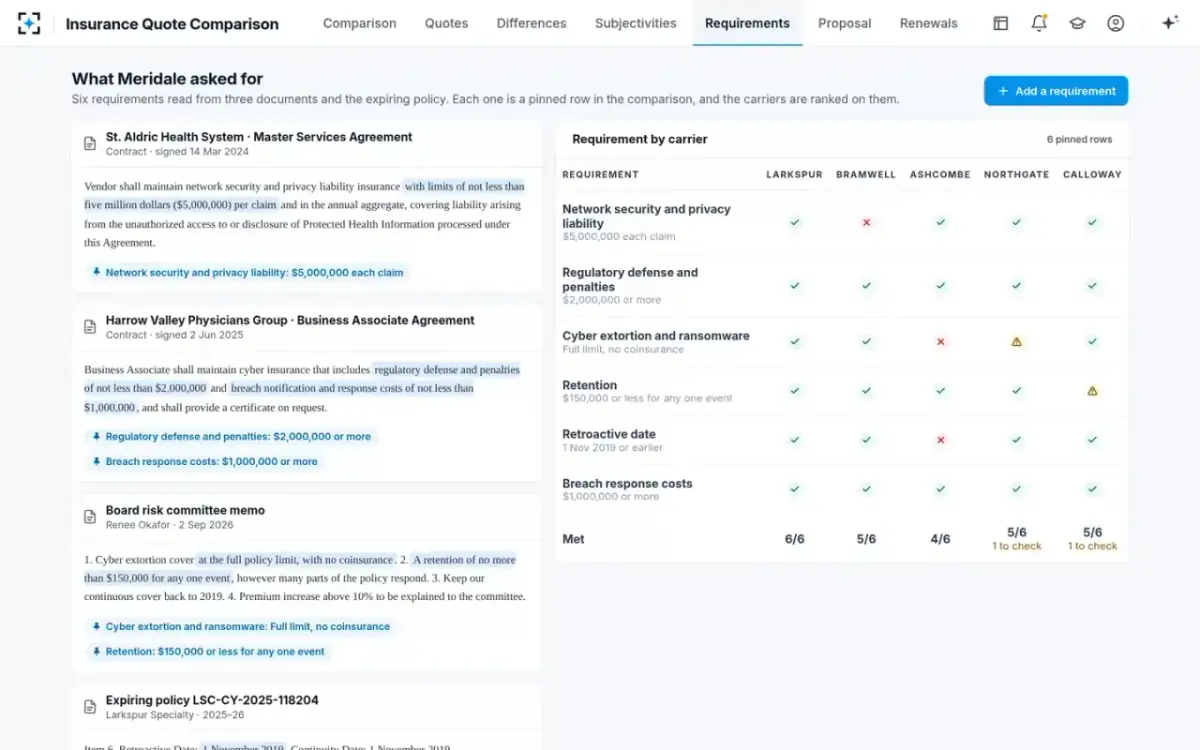
When must the demands and needs statement be given?
Before the contract of insurance is concluded, which for a commercial renewal means before the bind instruction, not with the policy documents afterwards. It must be given on paper or another durable medium, or on a website meeting the FCA's conditions, “in a clear and accurate manner, comprehensible to the customer”, and free of charge, with a paper copy free on request (ICOBS 4.1A).
At renewal the test is worth repeating rather than copying. A client's demands change with its contracts: a new customer agreement, a lender's covenant, a board decision. A statement that repeats last year's demands because nobody asked again is consistent with nothing in particular, and the information obtained from the customer is the part the rule insists on.
Is there a demands and needs statement template?
The FCA does not publish one, and for non-advised sales it describes the format as flexible. A usable template for advised commercial business has five parts, mirroring the annotated example above: demands, needs, what was compared, the recommendation and its reasons, and what the recommended contract does not do. The last part is the one most templates omit, and it is the one that protects both sides when a claim tests the cover.
A proposal that states the recommendation, the options and what each gives up
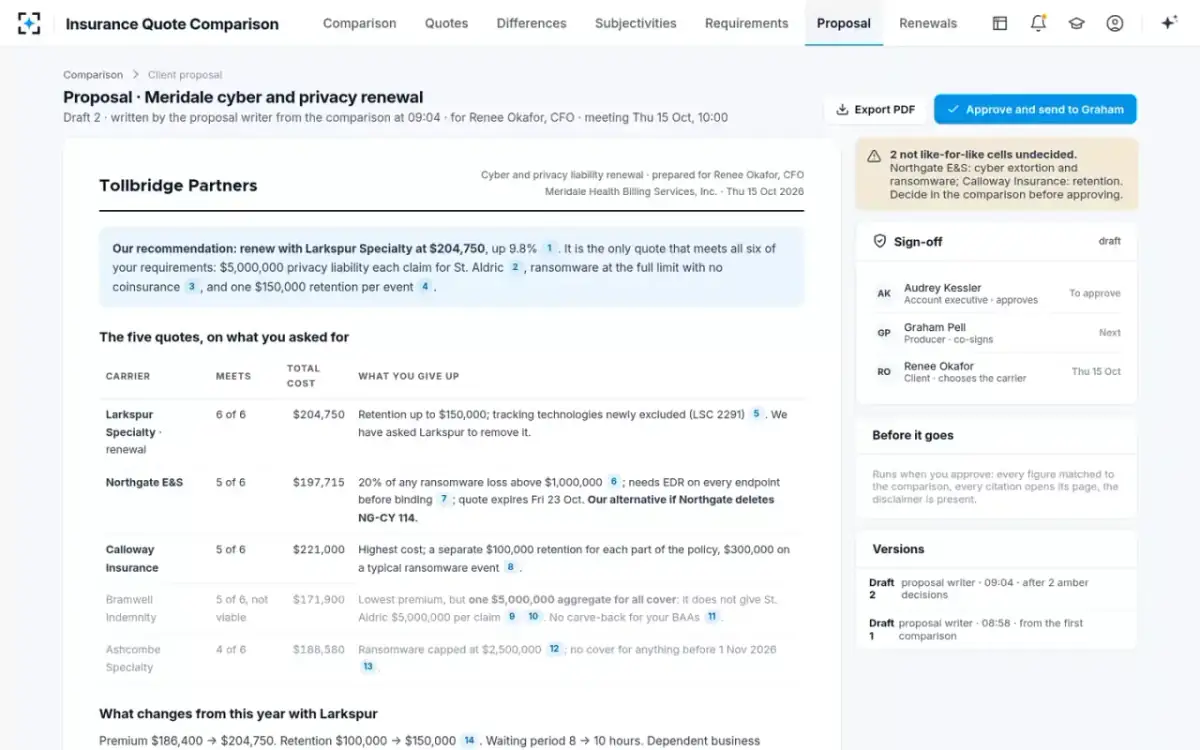
Commission, on request
A commercial customer can also ask what the broker earns, and the answer is not optional: on request, the broker must promptly disclose its own and its associates' commission on the policy (ICOBS 4.4), including profit-share, volume and premium-finance payments, as insurance commission rates sets out. A recommendation that is explained on the client's own requirements is the easiest one to defend when that question is asked.
Where Insurance Quote Comparison fits for a UK firm, and where it does not: it supplies the evidence, the requirements with their sources, the quote terms with their pages and a drafted explanation for a person to approve. The sample case it ships with is a US cyber renewal, so a UK brokerage would configure its own rows, its own statement wording and its own status disclosures, and keep the classification of each client against the FCA's thresholds as its own decision. For the same duty seen from New York's courts, see the broker's duty of care; for how the comparison behind the statement is built, see the quote comparison spreadsheet guide and Insurance Quote Comparison.
Questions people ask
Is a demands and needs statement the same as a suitability report?
Not quite. The demands and needs statement is required on every sale within ICOBS 5, advised or not; a suitability assessment and a personalised explanation are added only when the firm makes a personal recommendation. In an advised sale the two usually sit in one document.
Does the statement have to be signed by the customer?
The rules require it to be communicated to the customer before the contract is concluded, on paper or another durable medium; they do not require a signature. Many firms ask for confirmation anyway, because it records that the requirements were the customer's.
Do demands and needs rules apply to renewals?
ICOBS 5.2.2R applies prior to the conclusion of a contract of insurance, and a renewal is usually a new contract. ICOBS 4.1.2R also requires status information “if necessary, on its amendment or renewal”. Re-running the test at renewal is the way to show the information was obtained from the customer this year.
What counts as a micro-enterprise for these rules?
An enterprise that employs fewer than 10 persons and has a turnover or annual balance sheet not exceeding €2 million, applying articles 3 to 6 of the Annex to the EU Micro-enterprise Recommendation as the FCA Glossary directs. Micro-enterprises are not larger commercial customers, so ICOBS 5.2 still applies to them.
Do larger commercial customers lose all protection?
No. ICOBS 2 still applies, including the customer's best interests rule, and the FCA reminds firms of their obligations under the Principles. What falls away is the detailed sales process, including the demands and needs statement and the personalised explanation.