Insurance quote subjectivities are the conditions a carrier writes into its quote or binder: things the insured or the broker must provide or confirm, either before the carrier will bind cover or within a stated time after binding. Typical ones are a signed application, a recent loss run, an inspection, or, in cyber, written confirmation of security controls such as multi-factor authentication or endpoint detection. They are easy to treat as paperwork and dangerous to treat that way, because a quote with an unmet pre-bind subjectivity cannot be bound, and a missed post-bind one hands the carrier a reason to act on a policy the client thinks is settled. Botminds' Insurance Quote Comparison lists every subjectivity in every quote with its timing, matches the documents already on file, and puts the open ones in the comparison where they can change the recommendation.
The example is the solution's sample case: a fictional brokerage, Tollbridge Partners, renewing the cyber cover of a fictional client, Meridale Health Billing Services, with five fictional carriers, for cover from Sunday 1 November 2026. The law quoted is New York's and Arizona's, linked where it appears; other states differ.
Two quotes, two subjectivity clocks: the one that can still be missed
- Finish EDR; bind by 23 Oct12–23 Oct
- Bound, before inception23 Oct–1 Nov
- Surplus lines affidavit within 30 days of bindingto 22 Nov
- Signed renewal application; bind by Sat 31 Oct12 Oct–1 Nov
- Ransomware supplemental questionnaire within 30 days after bindingto 30 Nov
- Last 12 endpoints pending12–23 Oct
- Quote lapsedfrom 23 Oct
What are subjectivities in insurance?
Subjectivities are conditions on an offer of insurance: the carrier will provide the quoted cover subject to something being done or confirmed. The word covers two different things that are worth keeping apart. A pre-bind subjectivity must be satisfied before the carrier will bind, so it is a condition of the offer. A post-bind subjectivity must be satisfied within a stated period after binding, so it is a condition the bound cover carries with it.
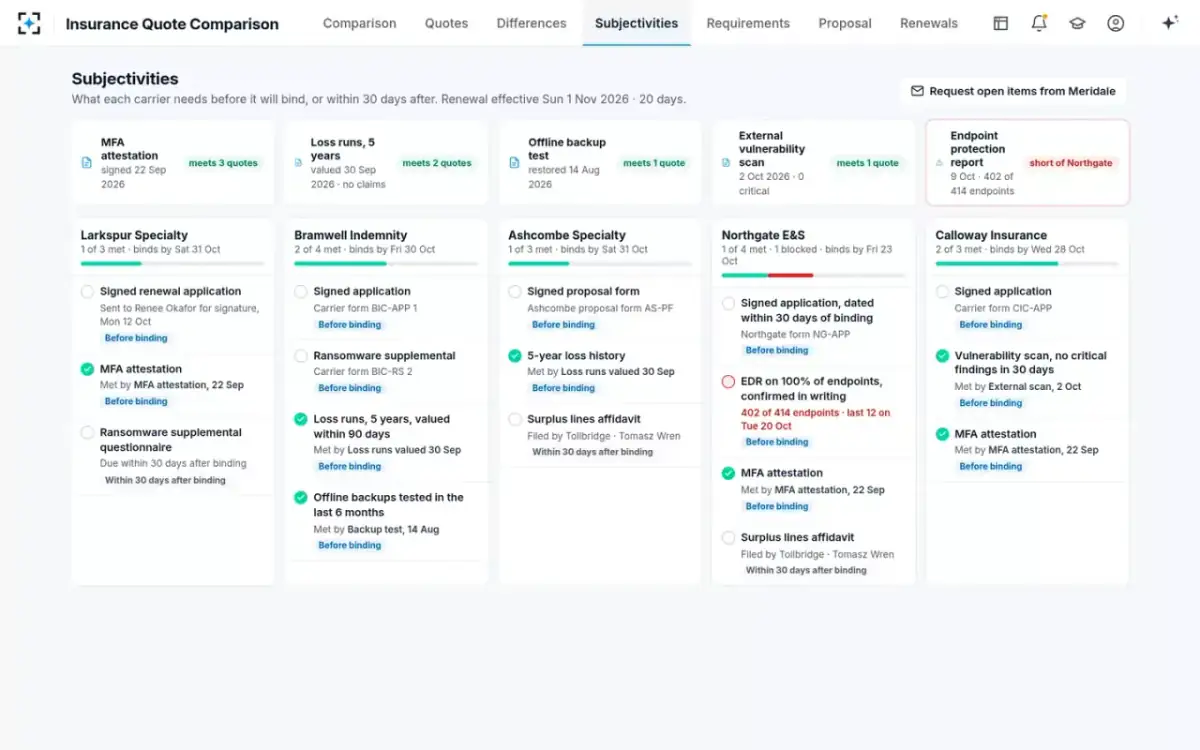
In the sample renewal the five quotes carried 17 subjectivities between them, 14 due before binding and 3 within 30 days after. Seven were already met by documents the brokerage had on file. One was blocked, and it belonged to the quote that would otherwise have been the recommended alternative.
What is the difference between pre-bind and post-bind subjectivities?
The difference is who carries the risk while the condition is open. While a pre-bind subjectivity is open there is no cover from that carrier, and the client knows it. While a post-bind subjectivity is open there is cover, and the risk is that the carrier relies on the unmet condition later. The table lists the sample case's 17 by carrier and timing.
All 17 subjectivities in five quotes, by timing
| Carrier and bind-by date | Before binding | Within 30 days after binding |
|---|---|---|
| Larkspur · Sat 31 Oct | Signed renewal application (sent for signature 12 Oct); MFA attestation (met, 22 Sep) | Ransomware supplemental questionnaire |
| Bramwell · Fri 30 Oct | Signed application; ransomware supplemental; loss runs, 5 years, valued within 90 days (met, 30 Sep); offline backups tested in the last 6 months (met, 14 Aug) | None |
| Ashcombe · Sat 31 Oct | Signed proposal form; 5-year loss history (met, 30 Sep) | Surplus lines affidavit, filed by the brokerage |
| Northgate · Fri 23 Oct | Signed application dated within 30 days of binding; EDR on 100% of endpoints confirmed in writing (blocked: 402 of 414); MFA attestation (met, 22 Sep) | Surplus lines affidavit, filed by the brokerage |
| Calloway · Wed 28 Oct | Signed application; vulnerability scan with no critical findings in 30 days (met, 2 Oct); MFA attestation (met, 22 Sep) | None |
Two of the post-bind items are the brokerage's own: a surplus lines affidavit is filed by the broker who places a non-admitted quote. Treating them as the client's paperwork is a common way for them to be forgotten.
What happens if a subjectivity is not met?
It depends on which kind it is and on the words the carrier used. An unmet pre-bind subjectivity means the carrier does not bind, and if the quote's validity date passes first, the offer is gone. In the sample case, Northgate's quote must bind by Friday 23 October; if the client cannot confirm endpoint detection on every device in writing by then, Northgate is no longer an option, however good its price.
An unmet post-bind subjectivity is a term of the cover the client already has. Arizona's binder statute is a clear statement of how terms travel with a binder: the binder carries the policy's usual terms and the endorsements it names, unless its own clear terms say otherwise (Ariz. Rev. Stat. § 20-1120; the clock and the wording are read in how long a binder is good for). A subjectivity written clearly into the binder is part of the deal; one left in an email thread may not be.
The terms can also move once the carrier has what it asked for. New York's Department of Financial Services considered a case in 2005 where a commercial property binder was issued with a building limit of $450,000; the insurer then inspected the building and issued the policy with a limit of $512,000 and a higher premium. The department's view was that “the insurer may modify the terms and limits of coverage and premium due after the binder is issued as part of the issuance of the insurance policy”, subject to New York's cancellation rules (NY Insurance Department, Office of General Counsel opinion, 9 August 2005). An inspection subjectivity is exactly that kind of condition: the binder is provisional until it is met.
Can a carrier cancel for an unmet subjectivity?
Often it can, but how, and how fast, depends on the state and the paper. New York's commercial cancellation statute is a good illustration because it draws the lines in different places for new admitted policies, for renewals, and for non-admitted business.
Can a carrier cancel over an unmet post-bind subjectivity? Three positions under New York law
What New York Insurance Law § 3426 says: “During the first sixty days a covered policy is initially in effect … no cancellation shall become effective until twenty days after written notice is mailed or delivered” to the insured and its agent or broker.
What it means for an open subjectivity: No listed ground is required in this window, so a 30-day subjectivity falls inside it. Missing it can end the policy on 20 days’ notice.
What New York Insurance Law § 3426 says: Cancellation only on listed grounds, including “a violation of any policy condition, that substantially and materially increases the hazard insured against”, on 15 days’ notice.
What it means for an open subjectivity: On a renewal with the same carrier, the protected rules apply from the effective date; the carrier needs a listed ground.
What New York Insurance Law § 3426 says: The section “shall not apply to … policies written on an excess line basis”.
What it means for an open subjectivity: The policy’s own cancellation clause governs, so its wording on subjectivities is the whole answer.
Two of the five sample quotes are non-admitted, Northgate's and Ashcombe's. For those, a comparison that records only “subjectivity: surplus lines affidavit within 30 days” is missing the point the client cares about: what the policy itself says happens if a condition is not met. That wording is worth one row of its own.
How long do you have to meet subjectivities?
As long as the quote or binder says, and no longer. There is no general statutory period for subjectivities; the carrier sets each one, and in the sample case every post-bind subjectivity ran 30 days from binding while the pre-bind ones ran to each quote's bind-by date, which fell between 23 and 31 October. The useful habit is to convert every relative deadline into a calendar date on the day the quote arrives, because “within 30 days of binding” has no date until someone decides when to bind.
Some conditions carry their own clocks inside them. Northgate's signed application had to be dated within 30 days of binding; Bramwell's loss runs had to be valued within 90 days; Calloway's vulnerability scan had to show no critical findings within 30 days. A document that met the condition in September can fail it in November. Those dates, and the date each quote stops being an offer, belong in the same calendar.
Who tracks subjectivities at an agency?
Usually the account manager who binds, and the work is mostly matching. Most subjectivities ask for the same few documents, so one attestation or loss run can satisfy several carriers at once. In the sample case one multi-factor authentication attestation, signed on 22 September, met three quotes' conditions.
Seven of seventeen subjectivities met by five documents already on file
The matching is mechanical and the follow-up is not. The tracker drafts one request to the client for everything still open; the account manager sends it and binds. The agents cannot confirm a bind or tell the client they are bound, which keeps the one statement a client relies on most in a person's hands.
Every subjectivity by carrier, with the document that meets it and the one that is blocked
Are subjectivities negotiable?
They are terms of an offer, so they can be asked about like any other term, and the best time is before binding, when the carrier still wants the business. A pre-bind condition the client cannot meet in time can sometimes be moved after binding, given a deadline, or replaced with something the client already has. In the sample case the endpoint condition could reasonably be put to the underwriter with the evidence: 402 of 414 endpoints covered on 9 October, the last 12 scheduled for 20 October.
Whatever the answer, it should arrive in writing and replace the quote's wording in the comparison. A subjectivity relaxed on the phone and still printed in the binder is still in the binder.
Why subjectivities belong in the quote comparison
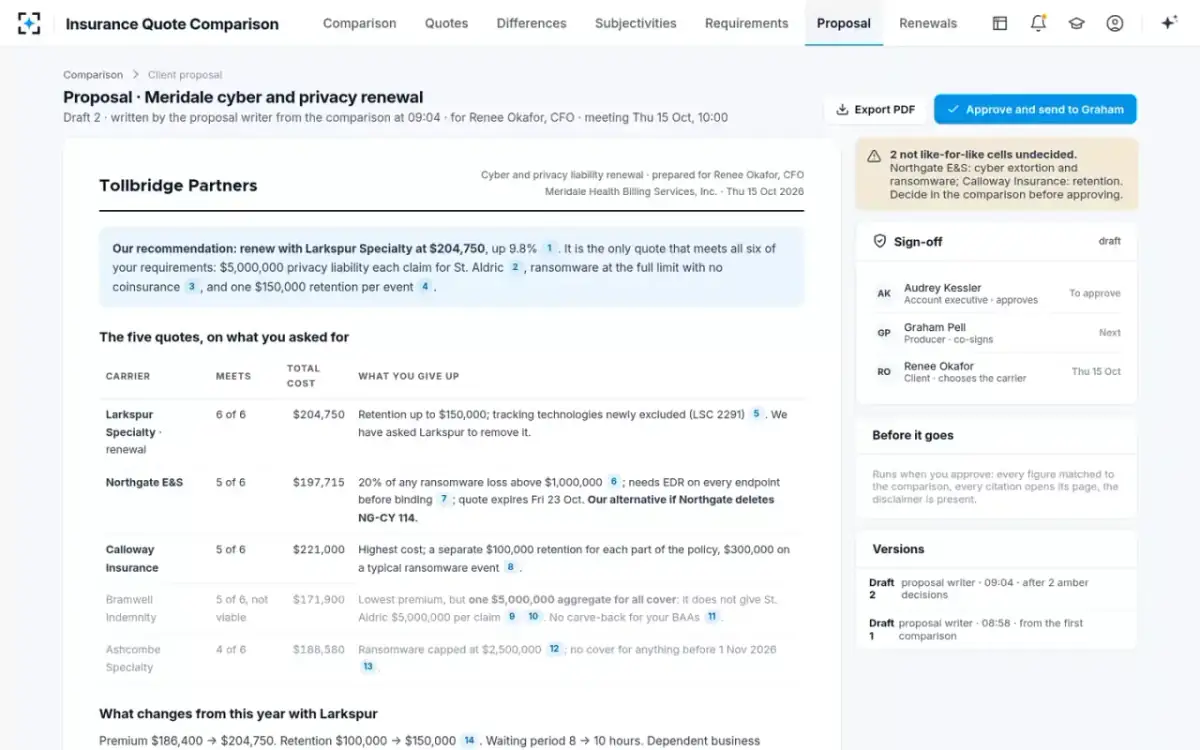
Because they change which quotes are real options. A quote with a condition the client cannot meet before the bind-by date is not an alternative, and a quote whose post-bind conditions the client will struggle with carries a risk the premium does not show. In the sample proposal, the alternative to the recommended carrier was described as conditional twice over: on the carrier deleting a coinsurance endorsement, and on endpoint detection being confirmed before its quote lapsed.
The proposal names the condition that makes the alternative conditional
What to record for every subjectivity in a quote comparison
- The exact wording, with the page
Not “EDR attestation” but “EDR on 100% of endpoints, confirmed in writing”.
- Before binding or after, and the calendar date
Turn “within 30 days of binding” into a date as soon as the bind date is planned.
- Who must satisfy it
The client, the brokerage (surplus lines affidavits) or a third party (inspectors, auditors).
- The document that meets it, and its own date
Loss runs valued within 90 days, scans within 30 days: documents expire too.
- Whether one document serves several carriers
One request to the client instead of five.
- What the policy says happens if it is missed
For non-admitted quotes, the policy’s cancellation clause is the whole answer in New York.
- The status, and who changed it
Open, met, blocked, waived in writing by the carrier.
Cyber subjectivities: why carriers ask for controls
Cyber quotes carry more subjectivities than most lines because the carrier is pricing the client's security, and the subjectivities are how it checks what the application said. New York's regulator expects cyber insurers to assess each insured's programme through information on “corporate governance and controls, vulnerability management, access controls, encryption, endpoint monitoring, boundary defenses, incident response planning and third-party security policies” (NY DFS, Insurance Circular Letter No. 2 (2021)). The sample case's conditions map onto that list almost line by line: multi-factor authentication, endpoint detection, offline backups, external vulnerability scans.
That makes cyber subjectivities part of the cover decision, not an afterthought. A client that cannot evidence a control may face a different price, a narrower term or no offer; one that evidences it once can use the same document for every carrier. How those controls interact with the rest of a cyber quote is set out in the cyber insurance coverage comparison; the whole renewal can be seen from Insurance Quote Comparison.
Questions people ask
What is a subjectivity to bind?
A condition the carrier must see satisfied before it will bind the quoted cover, such as a signed application or written confirmation of a security control. Until it is met there is no cover from that carrier. In the sample case 14 of 17 subjectivities were of this kind.
Is a binder with open subjectivities real cover?
Yes, while it lasts: New York's insurance department calls binders “the equivalent of temporary insurance until a formal policy is issued”. Open post-bind subjectivities do not stop the binder from being cover, but they are terms of it, and the carrier may rely on them later.
Can the broker satisfy a subjectivity for the client?
Only where the condition is the broker's own, such as filing a surplus lines affidavit, or where the broker holds the document, such as loss runs it requested. Attestations about the client's controls must come from the client. The broker's job is to know which is which and to ask once.
Do subjectivities appear on the final policy?
Conditions that survive binding should be reflected in the policy or its endorsements, and the policy as issued governs. That is why a comparison should note how each carrier words the consequence of a missed condition, and why the issued policy should be checked against the binder.
What is the most common subjectivity in commercial insurance?
No public body counts them, so there is no market-wide answer. In the sample case a signed application appeared in all five quotes, an MFA attestation in three, and recent loss runs and a ransomware supplement in two each; the pattern in your own book is easy to count once subjectivities sit in the comparison.