AI insurance quote comparison means software that reads the quotes, declarations, schedules and endorsements carriers send back for one account and lines their terms up side by side, so a broker can see where cover differs before recommending a carrier. The reading is now fast and good; the risk is in the word every comparison promises, “like for like”. A model that extracted a $5,000,000 limit from two quotes will, if asked to check itself, tend to confirm what it already wrote. Botminds' Insurance Quote Comparison therefore separates the jobs: reader agents fill and cite every cell, a like-for-like checker that did not build the grid compares the wording behind equal-looking values, and the account executive decides each difference. This page explains why that split matters and what to ask before buying any AI tool for the job.
The examples come from the solution's sample case, a fictional brokerage renewing the cyber cover of a fictional client, Meridale Health Billing Services, with five fictional carriers. Research is linked where it is used.
Insurance Quote Comparison: who builds the grid, who checks it, who decides
Agent
Quote readerReads each quote, declarations page and schedule; fills every cell with its value, its basis (each claim, aggregate, sublimit, per insuring agreement) and its page.
Never: Fill a cell from memory or from another carrier’s quote; it writes “not stated” instead.
Agent
Forms and endorsements readerOpens every form on every schedule and finds the ones that change a limit, retention, coinsurance, exclusion or date.
Never: Assume a form’s content from its number or from a similar form elsewhere.
Agent
Like-for-like checkerRe-reads the wording behind values that look equal and marks a cell amber when the basis, aggregate, retention or coinsurance differs, with both passages.
Never: Decide whether the difference is acceptable.
Agent
Requirements matcherWrites the client’s requirements as tests on rows and ranks carriers on them, then on total cost.
Never: Count an amber cell as met before a person decides.
A person decides
Account executiveOpens each amber cell, reads both passages and marks it met or not met, or sends the question back to the underwriter. A changed answer goes back through the readers and the checker.
Can AI compare insurance quotes?
Yes: reading quotes is the part AI now does well, provided every value comes with the passage it was read from. In the sample case the agents read five quotes and 61 forms, 214 pages in all, in 6 minutes 12 seconds, filled 25 terms for each carrier and cited each of the 125 cells to its page. Six minutes from five quotes in to a cited comparison is the solution's design target; the run below is the sample case, not a customer's measured result.
Where six minutes went in one AI insurance quote comparison
What AI does not do well, and should not be asked to do, is the judgement at the end: whether a shared aggregate is acceptable for this client, whether a coinsurance clause is worth a lower premium, whether to ask the underwriter to delete an endorsement. Those are the decisions a broker's duty attaches to, and the broker's duty of care runs to the person who makes them, not to the software that prepared the page.
Why the agent that builds the grid never checks it
Separating the builder from the checker is the oldest control in accounting, applied to a new kind of worker. The federal internal control standard asks management to split key duties among different people so that no one person's error, misuse or fraud goes unchecked (GAO, Standards for Internal Control in the Federal Government, 2025). The reason is not distrust of the builder. It is that a reviewer who shares the builder's assumptions repeats the builder's mistakes.
Language models add a specific reason. NIST's profile of generative AI risks defines confabulation as content generated and confidently presented that is erroneous or false, and warns that such systems can also invent reasoning or citations that appear to support an answer, which makes people trust the output more than they should (NIST AI 600-1, 2024). A cited cell is only as good as the citation, so the check has to open the cited page and read it again, with a different question: not “what is the limit?” but “is this limit the same kind of thing as the one beside it?” Reinsurance has the same problem one level up, between the slip and the treaty wording, and the guide to treaty wording comparison reaches the same conclusion about drafter and checker.
Builder and checker in an AI insurance quote comparison: same documents, different questions
| Reader agents (builder) | Like-for-like checker | Account executive | |
|---|---|---|---|
| Question asked | What does each quote say for this term, and on which page? | Do two values that read the same rest on the same wording? | Does the difference matter for this client, and what do we do about it? |
| Reads | Quote, declarations, schedules, every form on the schedule | The cited passages for both carriers, and every form that touches the row | Both passages, the client’s requirement, the underwriter’s answer |
| Produces | A value, its basis and its page in every cell | An amber cell with both passages and the difference in one line | Met, not met, or a question to the carrier, with a reason |
| Is never allowed to | Fill a cell without a cited passage | Decide that a difference is acceptable | Hand the decision to the agents |
What errors does AI make reading quotes?
The errors that matter in quote reading fall into a handful of kinds, and each needs its own control. The generic one, confabulation, is the least interesting in practice when every value must carry a page: an invented number has no passage to point at. The dangerous errors are true values with the wrong meaning.
Six ways an AI reading of insurance quotes goes wrong, and the control for each
| Error | What it looks like | Control in the solution |
|---|---|---|
| Invented value | A limit or retention with no passage behind it, stated confidently. | No cell without a cited passage; “not stated” where the quote is silent. |
| Borrowed value | A term filled from another carrier’s quote because the layout was similar. | Each cell is read from its own carrier’s pages only; the citation shows which. |
| Dropped basis | “$5,000,000” recorded without “each claim” or “aggregate, shared with all cover”. | The basis is part of the cell; the checker compares bases across carriers. |
| Form assumed from its number | An endorsement listed on the schedule but never opened. | Every form on every schedule is opened: 61 of 61 in the sample case. |
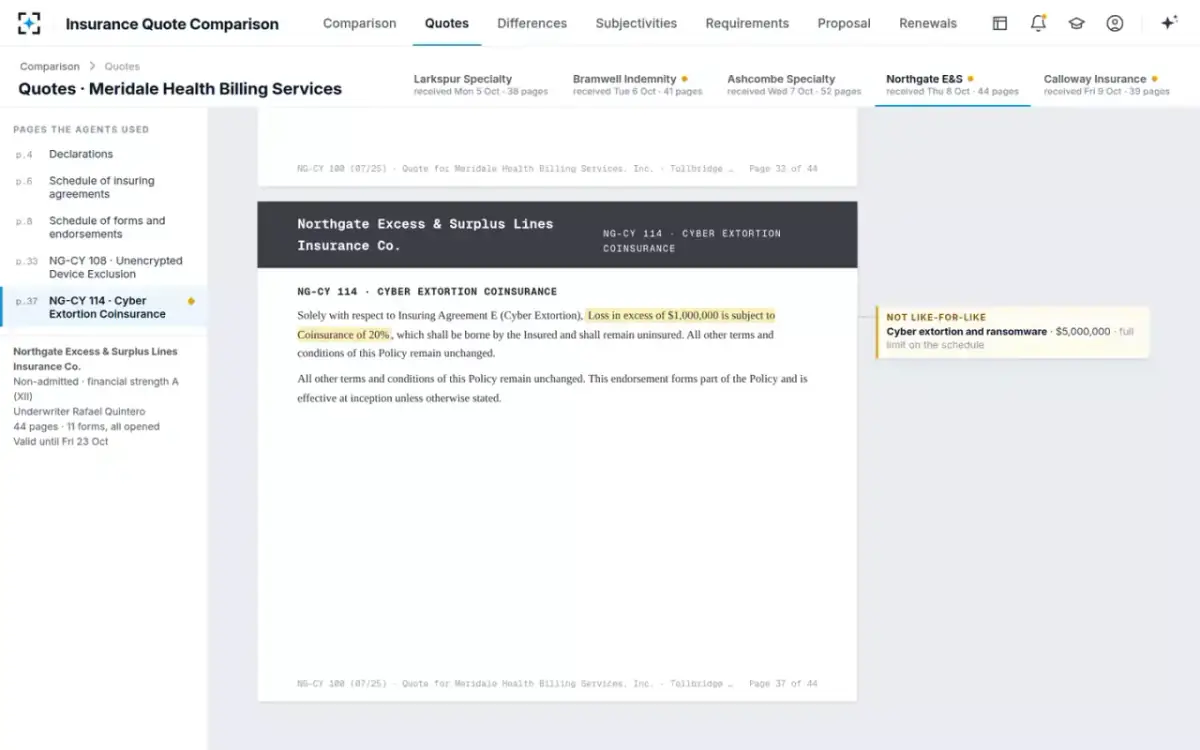
| Passage missed deep in a long quote | A coinsurance clause on page 37 of 44 that changes a schedule figure. | The forms reader works form by form, not across the whole file at once. |
| Right words, wrong document | A superseded quote or the expiring policy read as the renewal offer. | Each quote shows its date received and valid-until date beside its cells. |
The fifth row has research behind it. Testing language models on long inputs, Liu and colleagues found that they use information best when it sits at the start or the end of the input and noticeably worse when it sits in the middle, even models built for long documents (Lost in the Middle, Transactions of the ACL, 2024). An insurance quote is that test in real life: the schedule is on page 6, and the endorsement that rewrites it is on page 37.
What is like for like in insurance comparisons?
Two values are like for like when the wording behind them gives the client the same thing, not when the numbers match. In Insurance Quote Comparison the placement and E&O lead sets which differences count, and the sample brokerage checks five: a limit stated each claim against an aggregate; a separate liability aggregate against one shared with first-party loss; one retention per event against one per insuring agreement; coinsurance added in an endorsement; and costs inside against outside the limit.
Same row, same $5,000,000: what the cyber extortion wording actually gives
Northgate E&S, as the forms read: Cyber extortion and ransomware: $5,000,000, full limit on the schedule
Larkspur Specialty, as the forms read: “Insuring Agreement E · Cyber Extortion: $5,000,000 · full limit.”
Northgate E&S, as the forms read: NG-CY 114, page 37 of 44: cyber extortion loss above $1,000,000 carries 20% coinsurance, borne by the insured and left uninsured.
Larkspur Specialty, as the forms read: “No coinsurance applies to any Insuring Agreement under this Policy.”
Northgate E&S, as the forms read: $400,000 of coinsurance plus the $100,000 retention: $500,000
Larkspur Specialty, as the forms read: The $150,000 retention
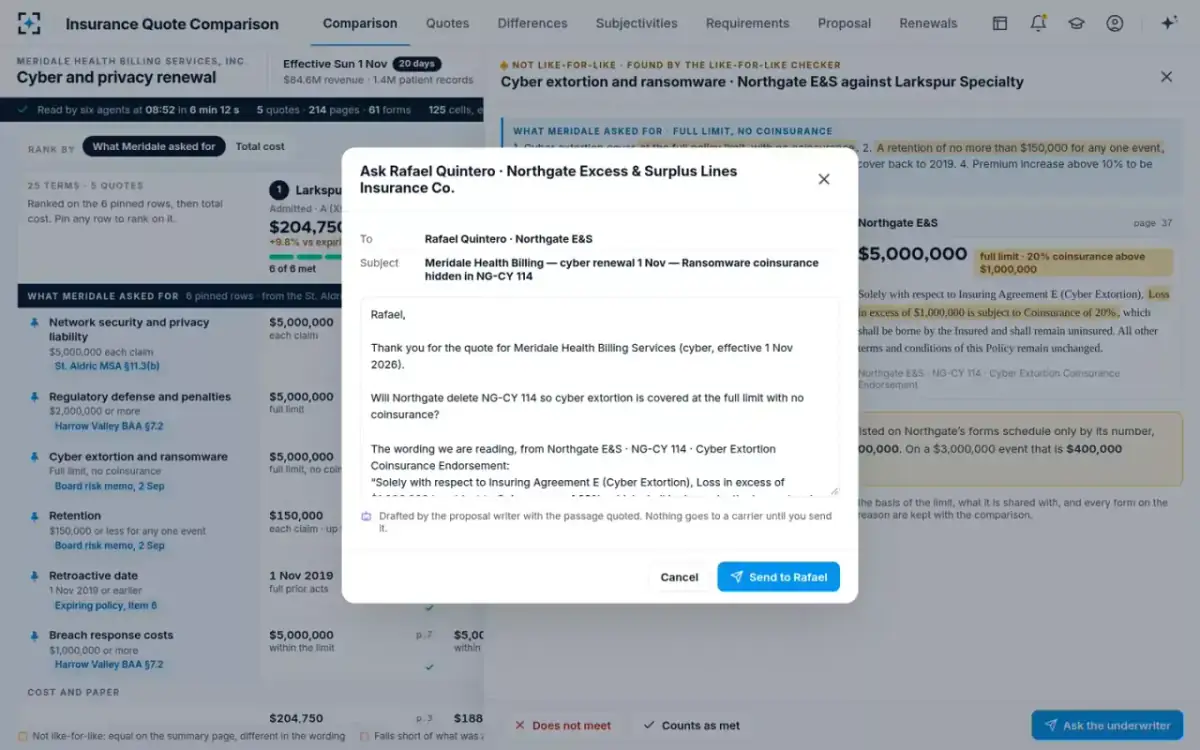
Northgate E&S, as the forms read: Asks for full limit with no coinsurance: amber until the account executive decides
Larkspur Specialty, as the forms read: Meets it
The same five tests apply to any line where limits and retentions stack, which is why the rows a brokerage compares are set per line of business. In cyber they are the hardest to see, because so much of the cover is in endorsements; the cyber insurance coverage comparison works through the rows that most often hide a difference.
Can AI read endorsements and exclusions?
It can, if it opens them. The quotes in the sample case listed between 11 and 14 forms each, and the summary pages named most of them only by number. The forms reader opened all 61 and found four that change a term the schedules do not show: NG-CY 114 (coinsurance on cyber extortion), NG-CY 108 (an unencrypted device exclusion), LSC 2291 (a new exclusion for tracking technologies in the renewal) and section V.A of Calloway's base form, CIC-CY 01.
Every cell opens its page: the endorsement nobody would have opened
Exclusions work the same way. A new exclusion is a difference only if someone compares the renewal's forms list with the expiring policy's; in the sample case the renewal view compared 22 terms and found six changed, among them LSC 2291, which matters because the client's payment portal uses analytics tags.
How accurate is AI at reading insurance quotes?
No regulator, university or non-profit has published an accuracy figure for AI reading of commercial insurance quotes, and a vendor's own figure measured on its own documents tells a brokerage little about its own. The honest answer is to measure it on your files: take renewals you have already bound, run the comparison, and score every cell against the bound policy. A pilot built that way, with the pass lines written down before it starts, is laid out in testing proposal software on last quarter's renewals.
Three numbers are worth more than an overall accuracy score. The share of cells whose value and basis match the bound policy. The not-like-for-like differences the team had found by hand that the checker also found, and any it missed. And the differences the checker found that the team had not, each confirmed against the wording. In the sample case the checker marked 3 of 125 cells; the useful question for a pilot is how many of the real ones it caught.
Should a person check an AI quote comparison?
A person should decide, which is different from re-checking every cell. Re-keying 125 cells to verify a machine undoes the point of the machine; deciding three amber cells, each with both passages on screen, is the part of the work only a broker can do. The account executive's decision, the reason and the time are kept with the comparison, and a cell stays amber in the ranking until it is decided.
A person sends the question to the underwriter, with the wording quoted
Regulators have not banned or prescribed any particular tool. The UK's Financial Conduct Authority calls itself technology-neutral and says its rules seldom require or forbid a particular technology (FCA AI Update, 2024), a stance set out more fully in AI for commercial insurance brokers; for business outside retail markets it reminds firms to treat customers fairly and to communicate in a way that is clear, fair and not misleading. In the United States, the NAIC adopted a model bulletin on insurers' use of AI systems on 4 December 2023, and states have been adopting it since (NAIC adoption map); it is addressed to insurers, but a brokerage that uses AI on a client's file will be asked the same questions about governance and records.
Is it safe to upload client quotes to AI?
It is safe only on terms a brokerage would accept from any service provider that holds client data. Quotes and applications carry a client's loss history, revenue and security controls, and in many cases personal information about the client's own customers. The federal policy for financial institutions is that each one “has an affirmative and continuing obligation to respect the privacy of its customers and to protect the security and confidentiality of those customers' nonpublic personal information” (15 U.S.C. § 6801).
The practical questions follow from that sentence. Where are the documents stored and for how long; is any of them used to train a model that other customers use; who at the vendor can see them; can the brokerage delete a client's files on request; and does every action leave a trail the brokerage can export. A tool that cannot answer those in writing is not ready for client documents, whatever its accuracy.
AI comparison or a rater: which job is this?
A comparative rater prices a standard risk across carriers before quotes exist; an AI quote comparison reads what came back. They overlap only in the word “compare”. Raters work where carriers' rating rules are filed and classes are standard; the AI comparison is for the quotes a rater cannot price, with manuscript wording, endorsements and conditions. The line between the two, and which an agency needs for which lines, is drawn in commercial insurance quote comparison against a rater.
What to ask before buying an AI insurance quote comparison tool
Ask for behaviour you can test on your own documents, not claims about the model. The list below is the one we would use, and it applies to Insurance Quote Comparison as much as to anything else.
Questions for any AI insurance quote comparison vendor
- Does every cell open the page it came from?
A citation you can click and read, not a document name.
- What happens when the quote is silent?
The right answer is “not stated”, never a default or a value from another carrier.
- Are all forms opened, and can you prove it?
A count of forms opened against forms listed, per quote.
- Is the like-for-like check separate from the extraction?
Ask which component marks a difference and what it reads to do so.
- Who decides a difference, and is the decision kept?
A named person, with the reason and time, stored with the comparison.
- Can it send, bind or tell the client they are bound?
It should not be able to do any of the three.
- How are carriers ranked?
On the client’s written requirements first, then total cost including taxes and fees, never premium alone.
- Will you run it on renewals we have already bound?
The only accuracy figure worth having is measured on your files.
Where Insurance Quote Comparison fits, and where it does not: it reads carrier quotes, forms, the expiring policy and the client's contracts, and produces a cited comparison, a list of subjectivities and a draft proposal for a person to approve. It does not price risks before quotes exist, does not bind, and does not send anything to a carrier or a client by itself. The rows it compares are configured per line of business, so a line the brokerage has not set up starts with that configuration work. To see the whole flow on the sample renewal, start from Insurance Quote Comparison.
Questions people ask
What is an AI insurance comparison tool?
For consumers, it usually means a site that collects personal auto or home quotes. For brokers, it means software that reads the quotes and policy forms carriers return for a commercial account and lines up the terms. Insurance Quote Comparison is the second kind: in the sample case it read 214 pages and produced 125 cited cells in a little over six minutes.
Can AI replace the account executive in a quote comparison?
No. AI can read and line up terms, but deciding whether a difference is acceptable, which quote to recommend and what to ask the underwriter is advice, and the duty attached to advice falls on the broker. In the solution the agents cannot mark a disputed cell met, send an email or bind.
How does AI handle a quote in a carrier's own layout?
It reads each quote as its own document: declarations, schedule of insuring agreements, forms list and each form. The five sample quotes ran from 38 to 52 pages, each in its carrier's layout, and every cell still cites the page in that carrier's document.
What does a cited cell look like?
A value, its basis and a page: for example “$5,000,000, aggregate, shared, page 14” for one carrier and “$5,000,000 each claim, page 7” for another. Clicking the cell opens the quote page with the passage highlighted, so anyone checking the comparison reads the carrier's own words.
Does the AI ever fill a gap with a typical value?
It should not, and in Insurance Quote Comparison it cannot: a value the agents could not find on a page reads “not stated”. NIST's generative AI profile lists confabulated citations among the main risks of these systems, which is why a cell with no passage behind it is treated as empty, not estimated.