AI for commercial insurance brokers, on the submission desk, means software that reads a client's renewal documents and fills each insurer's applications, supplements and portal screens, and there are four practical ways to do that work today: by hand, with a general chat assistant, with scripted form-filling (robotic process automation) or with AI agents that cite the source of every value. Tried on the same remarketed renewal, the four differ less in raw speed than in what they leave behind. Only the last leaves, for every submitted figure, the page it came from and the person who confirmed it, which is what an account manager needs when an underwriter questions a number and what a broker needs when a claim turns on one. Botminds' Broker Submission Automation is an example of that fourth approach: six agents with written limits read the client file, build a sourced fact sheet and fill every form from it, while the account manager decides conflicts and releases.
The comparison uses one fictional sample renewal, Halvorsen Millwork & Cabinetry, placed by the fictional Corbett Lane Insurance Partners with four invented insurers: 63 documents, 46 client facts, 196 fields. The judgements about the other approaches are ours, made on how each works, not on a benchmark; no regulator or research body publishes accuracy figures for any of them on broking work.
Four ways to fill one commercial submission, compared on the same account
| On the sample renewal | By hand | Chat assistant | Scripted form-filling (RPA) | Agents that cite sources |
|---|---|---|---|---|
| Reading 63 documents, 412 pages | A person reads; values live in their notes and memory | Reads what is pasted or uploaded, within its limits; answers in prose | Does not read documents; copies fields already in a system | Reads every page; lifts 1,284 values, each with its page and line |
| Four documents, four payroll figures | Found if noticed; one figure typed | May pick one, or average, unless told to show all | Copies whatever the source record holds, often last year's | Shows all four with the reason they differ; a person chooses |
| Filling 196 fields in nine forms and two portals | Typed field by field, 312 entries across four packages | Drafts answers a person then types in | Fast on screens it was scripted for; breaks when a screen changes | Fills every field from confirmed facts; enters portal answers for review |
| Derived fields, such as the rating worksheet | Calculated by hand | Can calculate if asked; no record of the inputs | Copies a stored result | Recalculated from confirmed facts, before and after kept |
| When an underwriter asks "where is that from?" | Search the file | Re-ask the assistant; the answer may differ | The source system, if it is current | Click the figure: the document, page and confirmer |
| Client data | Stays in the agency's systems | Sent to a third-party service; check its terms | Stays in the agency's systems | Processed by a vendor under the agency's due diligence |
How are commercial insurance brokers using AI?
For reading, drafting and checking, mostly, with people keeping the decisions. The tasks that suit AI on a broking desk are the ones that are reading-heavy and checkable: summarising loss runs, pulling values out of statements of values and payroll registers, drafting cover letters and proposals, and comparing what an insurer asks for with what a package contains. The tasks that do not suit it are the ones that commit the client or the agency: choosing markets, deciding between conflicting documents, signing and releasing.
Regulators have so far regulated outcomes rather than tools. The UK's Financial Conduct Authority describes itself as "a technology-agnostic, principles-based and outcomes-focused regulator", and adds that its rules "do not usually mandate or prohibit specific technologies". In the United States, the NAIC's model bulletin on insurers' use of AI systems, adopted on 4 December 2023, is being adopted state by state (NAIC adoption map); its adoption is tracked in Botminds' guide to the NAIC AI model bulletin adoption map. Neither changes who is accountable for a submission: the client for its statements, the broker for how it presented them.
Can ChatGPT fill out ACORD forms?
A general chat assistant can draft the answers to many ACORD fields from documents you give it, and a person can then type them in. The difficulties show on a real renewal. It answers in prose, not into the form; it does not, by default, tell you which page each value came from; asked twice, it may answer differently; and when documents disagree it may choose without saying so. None of those is a flaw in a chat tool. They are reasons it is a drafting aid, not a submission system.
The bigger question is the client's data. Sending a client's payroll, losses and financial statements to a third-party service is a decision about the client's nonpublic information, and in states that have adopted the NAIC's Insurance Data Security Model Law, licensees, which include producers, must exercise due diligence in selecting the third parties that handle it (NAIC Model #668, section 4); the model exempts licensees with fewer than ten employees from that section, though not from the client's expectations. An account manager pasting a loss run into a personal account is not diligence of any kind.
Calculated fields are where unanchored answers go wrong
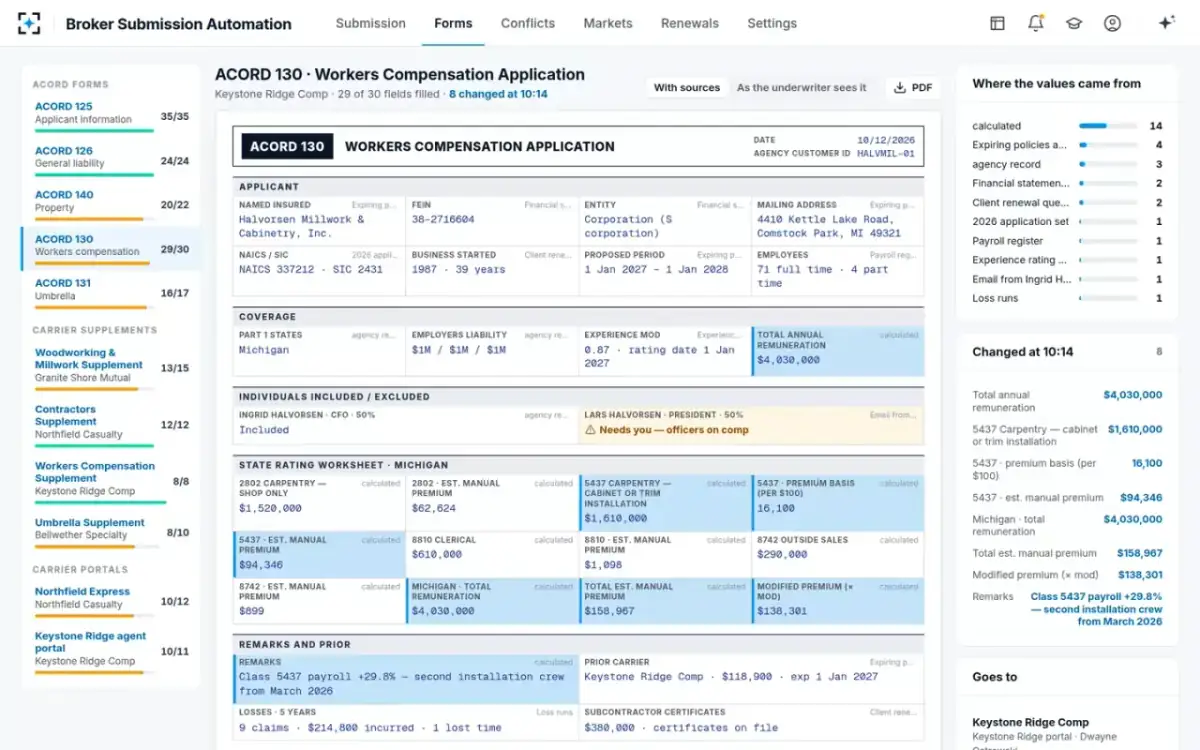
On a workers' compensation application, many values are not read from any document; they are calculated from other values. On the sample's ACORD 130, 14 of 30 values are calculated: premium bases, estimated manual premiums by class, the total and the premium after the experience modification. A tool that reads documents well but calculates without rules gives answers that look right and cannot be checked.
On one ACORD 130, fourteen of thirty values are calculated, not read
In the sample, the rating worksheet was recalculated the moment the installation payroll was confirmed: premium basis 16,100, estimated manual premium $94,346, total $158,967, and $138,301 after the 0.87 modification, with the remarks explaining the 29.8% rise in payroll. Each calculated field shows its inputs. That is the standard to ask any AI tool to meet: not "is the number right?" but "can I see how it was made?"
The ACORD 130 with sources: every value shows where it came from
What is the difference between an AI assistant and AI agents for brokers?
An assistant answers a person's questions; agents do assigned work within limits and hand back what they could not settle. The difference is not intelligence. It is structure: an agent has a job, inputs, outputs, rules about what it may never do, and a record of what it did.
The six agents in the sample each have one job and written limits. The client file reader never guesses a missing value. The loss run summarizer never fills a missing year with "no losses". The fact reconciler never chooses between conflicting current documents, and never lets last year's application confirm a value alone. The form filler never fills a field without a confirmed fact and never submits a portal page. The requirements checker never sends anything. The cover letter writer never states a figure that is not a confirmed fact. Those limits are what make it safe to let the agents work at machine speed: insurance broker automation, task by task shows where the line falls on all forty tasks.
The sample renewal in four numbers
1,284
values lifted from 412 pages, each with its page and line
41of 46
client facts confirmed by agents where current documents agreed
5
facts sent to the account manager with every source
196
fields filled in nine forms and two portals
How accurate is AI at reading loss runs?
No regulator or research body publishes an accuracy figure for AI reading insurance loss runs, and any vendor figure is the vendor's own test. The honest answer is to test it on your own closed files: run last season's loss runs through the tool and compare its five-year summaries, line by line, with what your staff produced and what the insurers' runs say.
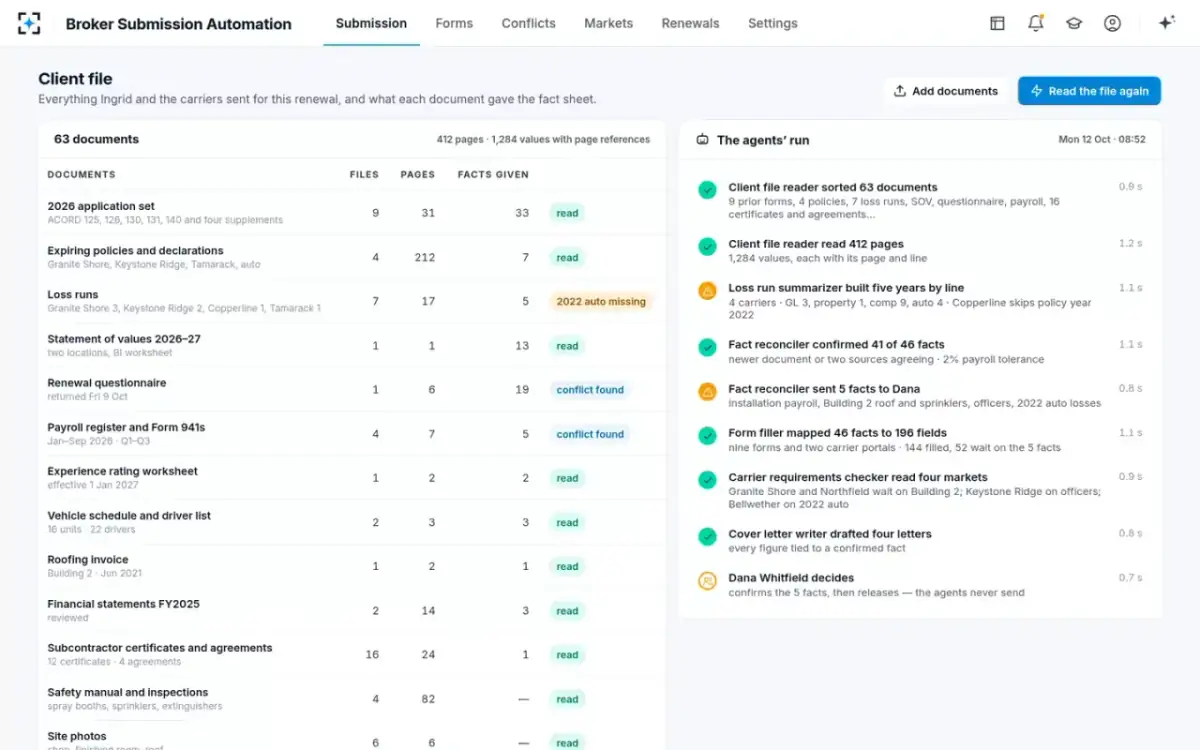
Accuracy on the values is only half the test. The other half is what the tool does with what is missing. In the sample, one insurer's auto loss run covered 2021 and 2023 and skipped 2022 without saying so. The right behaviour is to report the missing year by insurer and policy number and never to fill it with "no losses"; the umbrella market in the sample would not quote without it. When the missing year arrived, it held one claim of $4,750, closed. A summary that had treated the gap as clean would have been wrong in exactly the way that matters.
The client file read in full, and a missing loss year named
How to run a fair trial of AI tools on your own renewals
Run every candidate on the same closed renewals and score what each leaves behind, not how impressive the screens look. A fair trial takes three renewals already done by hand this season, ideally one simple, one remarketed to several markets and one with a known problem, such as a missing loss year or a changed building.
Score four things for each approach. First, coverage: of the fields your staff actually submitted, how many did the tool fill, including insurers' supplements and portals. Second, traceability: for a sample of twenty filled values, how many can you trace to a document and page in under a minute. Third, conflicts: of the disagreements your staff found by hand, and any they missed, how many did the tool surface before release rather than resolve silently. Fourth, the gaps: did it name what was missing, or fill it.
Time matters, but last. A chat assistant can look fastest on the first renewal and slowest on the third, because every answer has to be checked from scratch; scripted form-filling looks fastest of all until a portal screen changes. The bar to score against is simple to state: every submitted value traceable to a page and to the person who confirmed it.
Will AI replace commercial insurance brokers?
The public evidence does not point that way. BLS projects employment of insurance sales agents, the occupation covering most licensed agency staff, to grow 3% from 2025 to 2035, with about 43,100 openings a year (BLS Occupational Outlook Handbook). The one large field study of an AI assistant at work, in customer support rather than insurance, found productivity rose 14% on average and 34% for novice and low-skilled workers (NBER Working Paper 31161), which suggests the gains go first to newer staff learning the job.
The parts of broking that rest on judgement and relationships, choosing markets, negotiating terms, explaining a renewal to a client, are the parts the agents in this guide are designed to leave alone. What changes is the share of an account manager's week spent typing: by Botminds' estimate, about 11 of 20 hours on a remarketed renewal like the sample's go on keying forms, supplements and portals, and what one remarketed submission costs prices those hours.
What should a broker ask an AI vendor?
Ask what it leaves behind, what it is never allowed to do, and whether it will run on your own files before you buy. The questions below separate the four approaches quickly. Botminds' answer to the last one is yes: it runs Broker Submission Automation on one of the agency's own client files first.
Ten questions for any AI vendor selling to a commercial brokerage
- Can I click any value and see the document and page it came from?
If not, nobody can answer an underwriter's "where is that from?" without redoing the work.
- What happens when two current documents disagree?
A person should choose, with every value and the reason shown.
- What is the tool never allowed to do?
Written limits: never guess, never fill a missing loss year, never submit, never send.
- Does it fill insurers' supplements and portals, not only ACORD forms?
In the sample those are 68 of 196 fields.
- How are calculated fields made, and can I see the inputs?
Fourteen of thirty values on the sample's ACORD 130 are calculated.
- What is recorded when a value changes?
The before and after of every field, with who and when.
- Where is our clients' data processed, and under what terms?
In states that adopted the NAIC data security model law, due diligence on the vendor is part of a licensee's security programme unless it has fewer than ten employees.
- Who releases a submission?
A named person, after the client has signed and the producer has approved the letters.
- How do you test accuracy, and on whose files?
Ask for a test on your closed renewals, compared field by field.
- What does it not do?
Broker Submission Automation, for instance, does not rate, quote or choose markets; carrier appetite search does the last.
Where this approach fits and where it does not is worth stating plainly. It is for the agency or broker building submissions from client documents. It is not an insurer's intake system, not a rater, and not a market-selection tool; for choosing markets, carrier appetite matched by agents is the related guide. How the fact layer sits with the agency's existing forms and systems is covered in ACORD form software for insurance agents.
Questions people ask
What AI tools do insurance agencies use?
Broadly four kinds on the submission desk: general chat assistants for drafting, scripted form-filling for moving data between systems, document-reading tools for loss runs and schedules, and agents that combine reading, checking and form-filling under written limits. They differ in whether each output can be traced to its source.
Is AI safe for client data at a brokerage?
It can be, with diligence. In states that have adopted the NAIC's Insurance Data Security Model Law, licensees, producers included, must exercise due diligence in selecting third-party service providers, as part of the information security programme in section 4; licensees with fewer than ten employees are exempt from that section. Pasting client documents into a personal chat account is not diligence.
Does AI submit to insurers on its own?
It should not, and in Broker Submission Automation it cannot: the agents enter portal answers for review but never submit a portal page or email an insurer. In the sample, release came at 10:41, after the client's CFO had e-signed the applications at 10:32 and the producer had approved the four letters at 10:36.
Can AI choose which markets get a submission?
It can check a package against what each insurer asks for and flag a market whose appetite does not fit, as the requirements checker does in the sample. Choosing the markets stays with the producer and placement specialist, because it turns on the client's goals and on which insurers the agency is appointed with.
Will AI replace commercial insurance brokers?
Not on the public evidence: BLS projects 3% growth in insurance sales agent employment from 2025 to 2035. The work AI takes over first is reading and keying; choosing markets, negotiating and advising clients stay with brokers.