Insurance submission automation is software that turns a client's renewal documents into each insurer's completed applications, supplements and portal answers, and the case for it rests on what one submission costs by hand. By Botminds' estimate, a remarketed commercial renewal with four lines going to four markets takes about 20 hours of agency time, and priced with Bureau of Labor Statistics wage and benefit data that is roughly $845 per renewal. Fourteen of those hours are reading the client file and keying the same facts into forms and portals. Botminds' Broker Submission Automation is built to take out those fourteen: its agents read the file once, confirm each client fact against its sources, and fill every form, supplement and portal from it, which by the same estimate leaves about 4 hours of review, judgement and signatures.
The figures on this page are of three kinds, and each is labelled where it appears: Botminds' estimates of hours, public data from BLS and state regulators, and sample data from a fictional renewal (Halvorsen Millwork & Cabinetry, placed by the fictional Corbett Lane Insurance Partners) as it runs through the solution. None is a customer's measured result. The formula near the end is there so you can replace our estimates with your own numbers.
One remarketed submission, step by step: twenty hours by hand, four with the agents
By hand · 20 hours
- Read the file 3 h · 15%
- Forms and supplements 7 h · 35%
- Portals 4 h · 20%
- Conflicts 3 h · 15%
- Letters 2 h, sign 1 h · 15%
With the agents · 4 hours
- Review file, forms, portals 1.5 h · 37.5%
- Conflicts 1 h · 25%
- Letters 0.5 h, sign 1 h · 37.5%
How long does it take to prepare a commercial insurance submission?
For a mid-sized commercial account going to several markets, a day or more of working time, spread over a week or two of waiting for documents. No regulator or research body publishes a measured figure, and the honest way to size it is to count the work. The sample renewal is a useful yardstick because its pieces can be counted: 63 documents and 412 pages in the client file, 46 client facts, and 196 distinct fields across five ACORD forms, four insurers' supplements and two insurers' portals.
Counted per insurer, the work is larger than the field total suggests. The four packages hold 312 field entries, because the ACORD 125 goes to three insurers and each insurer's package is assembled separately: 96 for the first general liability and property market, 105 for the second, which also wants its portal, 49 for workers' compensation and 62 for the umbrella. Forty-six facts typed into 312 places is the arithmetic behind the 20 hours.
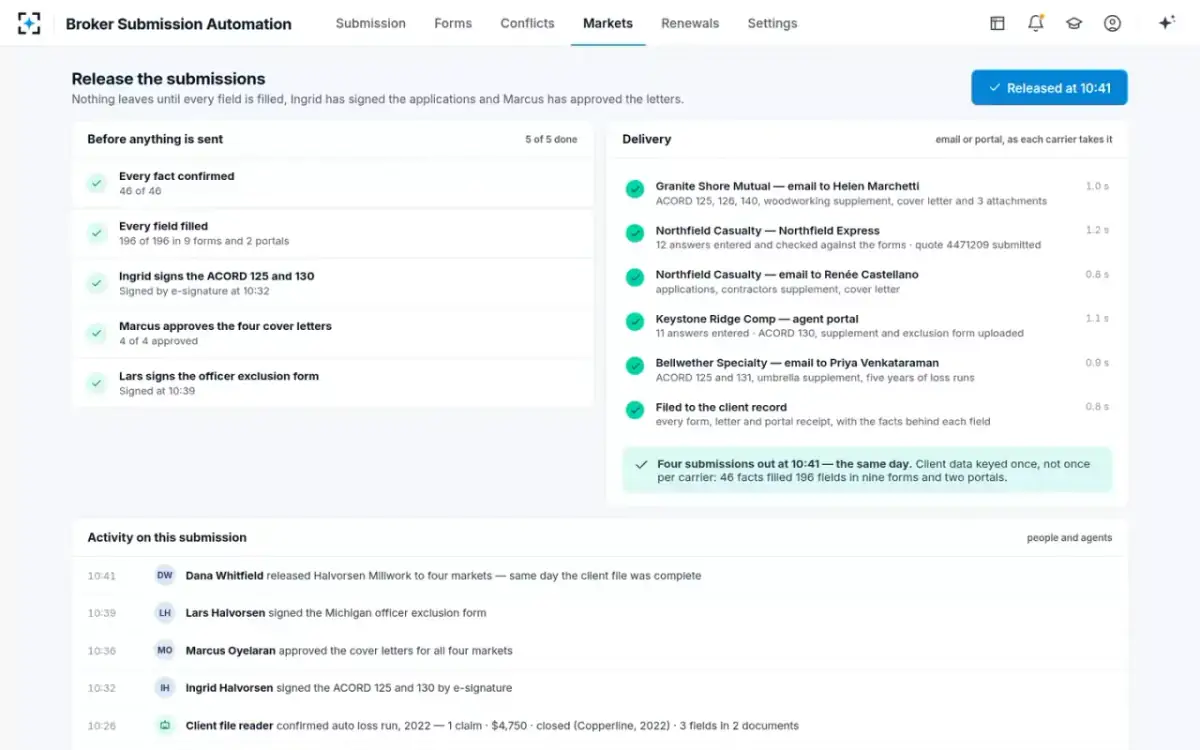
Elapsed time is a different number. In the sample the client file was complete on a Friday, the agents read it at 08:52 on Monday, and four submissions went out at 10:41 the same morning. By hand, 20 hours of work fitted between other clients usually means a week or more on the calendar, which is why turnaround is measured in the section below from the complete file, not from the renewal date.
Pricing an hour of agency time from public data
The cleanest public price for an hour of account-management time starts from BLS's median pay for insurance sales agents employed by insurance agencies and brokerages: $61,550 a year in May 2025. BLS does not publish account managers as a separate occupation, so this is a proxy; licensed commercial account managers at large brokerages are often paid more. Divided by 2,080 working hours, it is $29.59 an hour in wages.
Wages are not the whole cost. BLS's employer cost survey put wages at 70.0% of what private employers spent on compensation in June 2026, an average of $32.82 an hour, with benefits making up the remaining 30.0% (BLS Employer Costs for Employee Compensation). Loading the wage at that ratio gives a cost of about $42.27 an hour. A second, higher yardstick is the average annual pay across all employees of insurance agencies and brokerages, producers included, which BLS's quarterly employment and wage counts put at $104,375 for 2024 (BLS QCEW, NAICS 524210).
Two public prices for an hour of agency time
| Basis | Annual pay | Wage per hour | Loaded cost per hour | 20-hour submission |
|---|---|---|---|---|
| Median, insurance sales agents in agencies and brokerages (May 2025) | $61,550 | $29.59 | $42.27 | $845 |
| Average pay, all agency and brokerage employees (2024) | $104,375 | $50.18 | $71.69 | $1,434 |
How much does a submission cost an agency?
At the conservative rate, about $845 in staff time for one remarketed renewal like the sample's, and about $1,434 at the all-employee average. Neither figure includes the producer's time on strategy, the client's time gathering documents or anything after the submission goes out. They price the submission itself.
Where $845 goes: the cost of one submission by step, by hand
Set against what the account earns, $845 is not large. Insurers' commission and brokerage expense came to 11.11% of earned premium across all property and casualty lines in 2024, on the direct business of insurers writing in Texas, according to the Insurance Expense Exhibit that the Texas Department of Insurance compiles from the NAIC database (TDI, 2024 Insurance Expense Exhibits). The sample account's expiring premium is $447,000; at that ratio its business carries roughly $49,700 a year of commission and brokerage across everyone paid it. The submission is under 2% of that.
The cost that matters is capacity, not cash. Twenty hours per remarketed account, concentrated in the weeks before a heavy renewal date (four of the sample book's eleven renewals in the next 120 days fall on 1 January), decides how many accounts an account manager can take to market at all, and which ones are renewed as expiring because there was no time to shop them. That is where the return in the formula below comes from.
What parts of a submission take the longest?
Keying the forms and supplements, then the portals. In the estimate they are 11 of the 20 hours, and both are the same facts typed again. Forms take longest because each insurer's package repeats them: the ACORD 125 in the sample has 35 mapped fields and goes to three insurers. Portals are slower per field than forms, because each insurer's screens ask in their own order and words, and the answers cannot be pasted from a form.
One fact sheet on the left, eleven forms, supplements and portals on the right
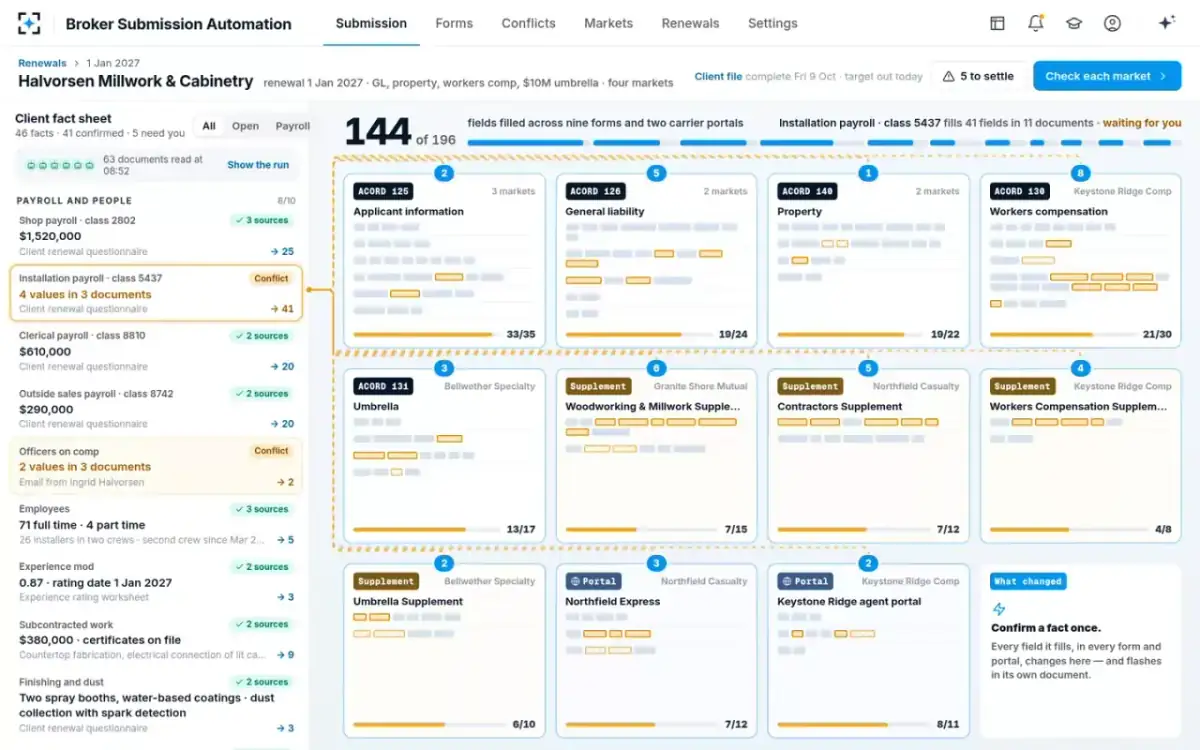
What insurance submission automation can take out, and what it cannot
It can take out reading, keying and first drafts. It cannot take out the client's time to answer a question, an underwriter's time to quote, or the hour of signatures and approvals at the end. In the estimate, the hand-done hours fall from 20 to 4, and of the 4 that remain, 2 are judgement (conflicts and the letters' review) and 1 is signing and release, which takes as long with agents as without them.
The conflicts are the honest limit. Agents can find all of them in seconds: in the sample, five of 46 facts, including a roof year that would have gone to two property insurers as 2009 when the roof was replaced in 2021. Settling them still needs the account manager, and sometimes the client. What changes is that every conflict is found before release rather than by an underwriter afterwards, and each one, once settled, fills every field it feeds.
The return on submission automation, as a formula you fill in
The return is the staff time released, priced, plus the accounts that capacity lets you take to market, minus what the software and the review cost. Each term below can be filled with an agency's own numbers; our estimates are the defaults only.
Annual return on insurance submission automation: four terms to fill with your own numbers
Hours released
remarketed submissions a year × hours saved each × loaded hourly cost
Our default: 16 hours saved at $42.27, about $676 a submission.
Operations, from your own time records
Accounts taken to market
extra accounts remarketed × share placed better × value of a better placement
Only if the released hours go to shopping accounts that were renewed as expiring for lack of time.
Producers and the principal
Subscription and setup
annual price + one-off mapping of forms, supplements and portals
Field maps per insurer are the setup work; ask for the price per renewal or per seat.
The vendor's quote
Review time kept
submissions × review hours × loaded hourly cost
Our default: 4 hours a submission stay with people, about $169.
Account management leads
The second term is the one most business cases leave out and the one that often decides the answer. Hours released are only a return if they are spent: on remarketing accounts that would otherwise renew as expiring, or on taking on accounts without hiring. Insurance broker automation, task by task shows which hours move and which do not.
How do you measure submission turnaround?
From the moment the client file is complete to the moment the last submission is released, in business hours, per account. Measuring from the renewal date mixes the agency's speed with the client's, and measuring per insurer hides the account that waits for its slowest market.
The sample shows why the starting point matters. The file was complete on Friday 9 October; the agents read it at 08:52 on Monday; release was at 10:41. The interval that the agency controls was under two hours of Monday morning, and the sample agency's target, kept as a setting, is the same business day. What the agency does not control, how long the client takes to return the questionnaire, belongs in a separate measure that the account assistant can act on.
Released the same morning: five checks passed, four deliveries, every receipt filed
Does automation reduce errors in submissions?
It should, and you should measure whether it does rather than take it on trust, because no regulator or research body publishes submission error rates. Three counts will show it on your own renewals: facts in conflict found before release, submitted figures without a source, and underwriter questions that the file could have answered. Run the counts on renewals done by hand this season and on the same kind of renewals with automation.
The sample gives a sense of what the first count finds. Of 46 client facts, five needed a person: an installation payroll with four values, a roof year that last year's application still gave as 2009, sprinklers left blank in one document and answered "No" in another, an officer exclusion asked for in an email, and a loss run missing its 2022 year. Each of those, by hand, could have reached an underwriter as a wrong answer or as a question. The misrepresentation risk in the first is traced in one payroll, traced.
What to look for when you buy insurance submission automation
Look for evidence on every value, rules you can set, and a person at every signature and send. Be clear, too, about what this kind of software is not. It is not a comparative rater, which prices standard risks; it is not an insurer's intake and clearance system, which works on the other side of the submission (Commercial Lines' guide to submission intake automation covers that); and it does not choose markets for you, which is the job of an insurance appetite checker.
Eight questions to put to any insurance submission automation vendor
- Can I click any filled field and see the document and page it came from?
If not, the software has made the client's representation without a record of why.
- What happens when two current documents disagree?
The right answer is that it shows both and a person decides. A tool that picks silently is faster and more dangerous.
- Can last year's application confirm a value on its own?
It should not, by default. It is the document most likely to be out of date.
- Does it fill insurers' own supplements and portals, or only ACORD forms?
In the sample, supplements and portals are 68 of 196 fields, more than a third of the work.
- Who approves a new version of a form or supplement?
Field maps go stale when insurers change their questions; a person should approve each new version before it is used.
- Does it ever submit a portal page or email an insurer by itself?
Release should be a named person's action, after the client has signed.
- What does it keep when a value changes?
The before and after of every field, with who and when, is what an agency shows when a figure is questioned.
- Will you run it on one of our own client files before we buy?
A demonstration on sample data proves the screens; one of your renewals proves the fit.
Most agencies will want the software to fit around the systems they already run rather than replace them; how the pieces connect is the subject of ACORD form software for insurance agents, and how this approach compares with chat assistants and scripted form-filling is set out in AI for commercial insurance brokers.
Questions people ask
What does submission automation software cost?
Vendors do not publish standard prices, and pricing varies by seat, by renewal or by premium volume. The useful comparison is with the staff time it replaces: by our estimate about 16 hours a remarketed renewal, roughly $676 at a BLS-based loaded cost of $42.27 an hour. Ask for a price per renewal so the two can be set side by side.
How many hours do account managers spend on data entry?
On a remarketed renewal like the sample's, Botminds estimates 11 of 20 hours go on keying forms, supplements and portals, and 3 more on reading and sorting the file. The sample's four packages hold 312 field entries filled from 46 client facts, which is why the keying, not the judgement, dominates.
What is the ROI of submission automation?
Hours released multiplied by loaded cost, plus the value of the accounts those hours let you remarket, minus the software and the review time that remains. At our defaults, an agency remarketing 300 renewals a year releases about 4,800 hours; whether that is a return depends on what the released hours are spent on.
Is submission automation the same as submission intake automation?
No. Submission automation, in the sense used here, sits at the agency or broker and builds what goes out to insurers. Submission intake automation sits at the insurer and reads what comes in, clearing and routing it to underwriters. The two meet in the middle, and a complete, sourced submission makes the insurer's intake faster.
Can a small agency justify submission automation?
Run the formula with your own count of remarketed renewals. An agency with few remarketed accounts may release too few hours to justify a subscription; one whose staff cannot remarket accounts in the 1 January season for lack of time has the strongest case, because its return is in accounts shopped, not only hours saved.