Insurance broker automation is the use of software to do the repetitive parts of an agency's or brokerage's work, and on the commercial submission desk that means reading the client's documents, matching the same facts across them and keying them into every insurer's forms, supplements and portals. It works when the line between what software does and what people decide is drawn task by task, before anything is switched on. Botminds' Broker Submission Automation draws it with six agents that read the client file, confirm facts where current documents agree, and fill every form from those facts, while the account manager settles conflicts, the client signs and a person releases. This guide lists the forty tasks between a complete client file and four submissions out, and says who should own each one and why.
The examples come from a fictional sample renewal as it runs through the solution: Halvorsen Millwork & Cabinetry, placed by the fictional Corbett Lane Insurance Partners with four insurers, all of them invented. The hours are Botminds' estimates, labelled where used, not a customer's measured results.
Forty submission tasks: twenty for agents, eight prepared for a person, twelve for people only
20 Agents do it
Reading, matching and copying, where every output can show its page and nothing is decided.
Client file
- Sort 63 documents by type
- Read every page; lift each value with page and line
- Mark values from documents over twelve months old as prior
- Build five years of losses by line, every carrier
- Find the policy year a loss run skips
Facts
- Confirm a fact two current sources agree on
- Apply the payroll tolerance between sources
Forms and portals
- Map each fact to every field it feeds
- Fill the ACORD 125
- Fill the line sections: 126, 140, 130, 131
- Recalculate the state rating worksheet
- Fill each insurer's supplement
- Enter portal answers for review
Markets, letters, record
- Check each package against what the insurer asks for
- Flag a market whose appetite does not fit
- Draft one cover letter per market
- Tie every figure in a letter to a confirmed fact
- Check every field is filled before release
- Keep the before and after of each field change
- File everything to the client's account
8 Agents prepare, a person decides
The agent can gather the evidence and recommend; a choice between documents or a statement to a third party needs a person.
Facts
- Choose between conflicting current documents
- Accept a changed rating fact: roof year, sprinklers, class codes, losses
- Ask the client about an open item
Forms and portals
- Accept the remarks that explain a change
- Approve a field map update
- Review portal answers before they go
Requests and questions
- Request a missing loss run from the insurer
- Answer an underwriter's follow-up question
12 People only
Signatures, choices of market and anything that leaves the agency carry a person's name.
Client
- Send the renewal questionnaire
- Chase the client and insurers for documents
- Decide an officer's inclusion or exclusion
- Sign the applications (the client)
- Sign the officer exclusion form (the officer)
Markets
- Choose which markets to approach
- Decide whether a missing document holds a market back
- Approve a new edition of a form or supplement
Letters and release
- Decide what to tell the underwriter beyond the facts
- Approve every cover letter (the producer)
- Submit a portal page
- Release each submission
What can be automated in an insurance agency's submission work?
Anything that is reading, matching or copying can be automated, provided the output shows where it came from. In the grid above that is half the tasks: sorting and reading the client file, building five years of losses by line, mapping each confirmed fact to every field it feeds, filling the ACORD applications and the insurers' supplements, recalculating the rating worksheet, checking each package against what the insurer asks for, drafting the letters and filing the result.
The test for each task is simple. Can the output be checked against a page? A value lifted from page 4 of the client's questionnaire can be. A five-year loss summary can be checked line by line against the carriers' runs. A field filled from a confirmed fact can be traced back to that fact. Those tasks go to agents because a reviewer can verify them in seconds; the agent's work is cheap to check, which is what makes it safe to delegate.
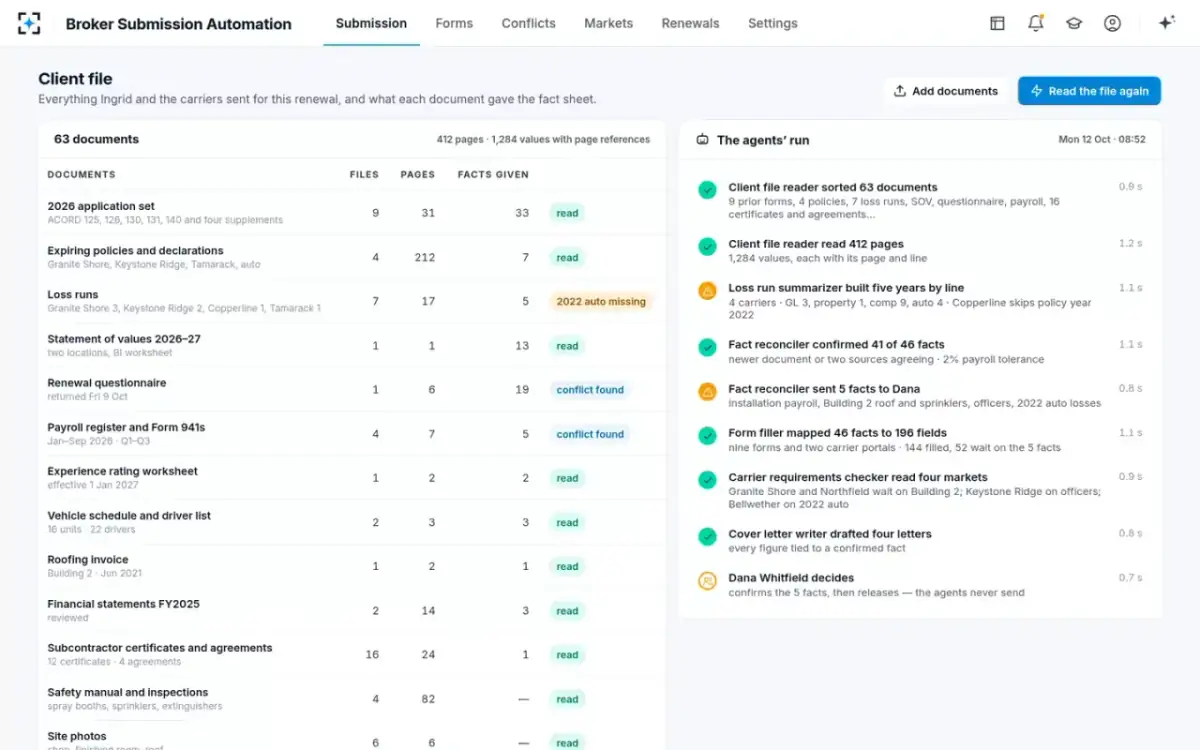
The middle column is where most of the design work sits. An agent can lay out every value of a disputed payroll with its source and recommend one, but choosing between two current documents is a judgement about which the client meant, and the solution gives that call to the account manager by rule. In the sample renewal the agents confirmed 41 of 46 client facts and sent five to a person: installation payroll, a roof year, sprinklers, an officer exclusion and a missing loss year.
Which agency tasks should not be automated?
Signatures, the choice of markets, anything a third party will rely on, and the release itself should stay with people. The reasons are legal as much as practical. The statements in an application are the client's, which is why the client signs. A change of rating fact can make a misrepresentation material, and under New York's statute only a material misrepresentation can avoid the contract or defeat a claim (N.Y. Ins. Law § 3105). Deciding which facts are material to a particular insurer is underwriting knowledge an account manager brings and an agent does not.
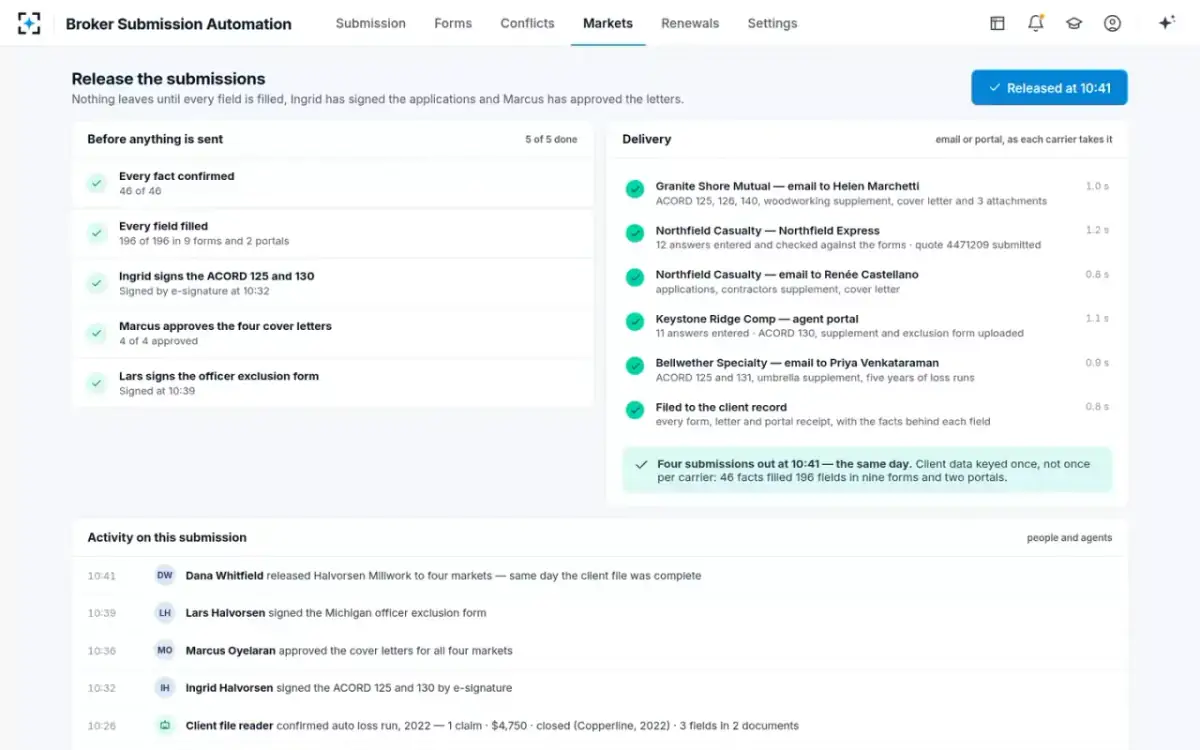
Electronic signing has its own reason. Federal law protects an agent or broker from liability for deficiencies in electronic procedures the parties agreed to, but only if, among other conditions, the agent or broker was not involved in developing or establishing those procedures and did not deviate from them (15 U.S.C. § 7001(j)). An agency that lets software improvise how a signature is captured is giving that protection away. The rule in the sample is that the client e-signs the ACORD 125 and 130, and an officer exclusion needs the officer's own signature on the state form.
The agents' run, step by step, and the one step that is a person's
How much time do account managers spend re-keying?
On a remarketed commercial renewal, most of it. No regulator or research body publishes a measured figure, so the numbers here are Botminds' estimate for one renewal like the sample's, with four lines going to four markets: about 20 hours by hand, of which 14 are reading the file, keying forms and supplements, and entering the same answers in insurers' portals.
Half the tasks, four-fifths of the hours: where the agents' share of the work sits
Forty tasks, by count
- Agents · 50%
- Prepared for a person · 20%
- People only · 30%
Twenty hours by hand, by kind
- Work agents can take · 80%
- Conflicts · 15%
- Sign, release · 5%
The two bars disagree on purpose. Counted by tasks, automation looks like half the job. Counted by hours, it is four-fifths, because the tasks that stay human are short and the tasks that move are long. Keying one ACORD 125 takes minutes; keying the same 35 fields into three insurers' packages, then the workers' compensation application, then two supplements and a portal, takes an afternoon. What one remarketed submission costs turns those hours into dollars with public wage data.
Can AI fill out insurance applications?
Yes, if it fills them from facts a person can check, and no, if it fills them from its own reading without a trail. The difference shows on the first conflict. A tool that reads four documents with four payroll figures and silently picks one has filled the application; it has also made the client's representation for them, with no record of why.
In the sample, the form filler's rule is that it never fills a field without a confirmed fact, and every field it fills shows the fact and the fact's sources. That is what lets 196 fields across nine forms and two portals be reviewed in minutes rather than re-checked from scratch. It also changes what an error looks like: one fact confirmed wrongly is wrong in every field it feeds, which is the risk the next section deals with.
What is the difference between RPA and AI agents in insurance?
Robotic process automation copies structured data between screens by following a script; AI agents read unstructured documents and decide what a value is, which is why they need limits that a script does not. Both can be useful on a submission desk, but they automate different halves of it.
Two kinds of broker automation, and what each can do on a renewal
Robotic process automation (RPA): Fields already in a system: the agency management record, a spreadsheet, last year's form.
AI agents with limits: Documents as they arrive: scanned loss runs, a questionnaire, a payroll register, an email from the client's CFO.
Robotic process automation (RPA): When a portal screen or a form layout changes, the script fails or, worse, types into the wrong box.
AI agents with limits: When two documents disagree. Without a rule it will pick one; with a rule it sends the choice to a person.
Robotic process automation (RPA): Whatever is in the source record, including last year's roof year.
AI agents with limits: Only confirmed facts, each with the documents behind it.
Robotic process automation (RPA): A log of keystrokes.
AI agents with limits: A fact sheet: each value, its pages, who confirmed it and every field it filled.
Robotic process automation (RPA): Moving a finished, checked package into an insurer's portal or the agency system.
AI agents with limits: Turning a client file into checked facts and filled forms.
What are the risks of automating submissions?
The main risk is speed applied to a wrong fact: automation that fills 41 fields from one confirmed payroll also fills 41 fields from one wrong one. In the sample renewal the installation payroll appears in nine forms and two portals, and the four source documents give four figures: the client's 2027 estimate of $1,610,000, an annualized register of $1,548,600, a July to September run rate of $1,642,800 and last year's application at $1,240,000. Picking the wrong one is not one error; it is forty-one.
The controls follow from that. Confirm facts, not fields. Never let last year's application confirm a value alone, because it is the document most likely to be stale. Send every changed rating fact to a person even when two current sources agree, because a roof year or a class code changes the price. And keep the before and after of every field, so that when a figure is questioned the agency can show who confirmed it and when. Those are the default settings in the solution, and they are settings, so an agency can tighten them.
Release: five checks, four deliveries, and the activity of people and agents
How do you start automating an agency without changing its systems?
Start with one remarketed renewal, read-only, and measure it against the same renewal done by hand. Automation that needs a new agency management system before it can prove itself is a project, not a pilot. The steps below keep the first month small and the evidence clear.
A first month of submission automation, one renewal at a time
- Pick three renewals already done by hand this season
Run the client files through again and compare the facts, the conflicts found and the fields filled with what was actually sent.
- Write the confirmation rules down first
Which facts two current sources may confirm, the payroll tolerance, which rating facts always go to a person. These become settings.
- Map one insurer's package completely
Its ACORD forms, its supplement and its portal screens, field by field, with versions. Field maps are the slow part; do the market you use most.
- Keep portal submission and release human
Let the agents enter portal answers for review if you like, but keep the submit button and the release with a named person.
- Count what changes
Hours from complete file to release, facts settled by a person, underwriter questions the file could have answered. Compare the next renewals with the hand-done ones.
Most agencies already own the systems the work runs through: a mailbox, a document store, an agency management system and the insurers' portals. The integration question is which of them the agents read from and write to, which ACORD form software for insurance agents walks through system by system.
Will automation replace account managers?
Nothing in the public data suggests it. The Bureau of Labor Statistics expects the occupation most licensed agency staff fall under, insurance sales agents, to add jobs over the decade to 2035 and to need tens of thousands of replacements a year (BLS Occupational Outlook Handbook). And the best-known field study of an AI assistant, run in customer support rather than insurance, found the largest gains among the newest staff (NBER Working Paper 31161), which is where a desk that re-divides forty tasks should expect them too.
The tasks in the right-hand column of the grid are also the ones that make an account manager valuable: the conversation that settles a conflict, the judgement about a market, the letter that tells an underwriter what changed. The seats that carry a renewal, and what each keeps, are set out in commercial insurance account manager duties. Regulators, for their part, do not rule on tools as such: the UK's Financial Conduct Authority describes its rules as not usually mandating or prohibiting specific technologies (FCA AI Update, 2024), which leaves the division of labour to the firm and the accountability with it.
Questions people ask
What is insurance broker automation?
Software that does the repetitive parts of an agency's or brokerage's work, such as reading client documents, re-keying facts into insurers' forms and portals, and filing the results. On the submission desk it is useful when each automated output shows its source, and a person still decides conflicts, signs and releases.
How much time do account managers spend re-keying?
Enough to show in a simple count. The four packages in the sample renewal hold 312 field entries (96, 105, 49 and 62 for the four insurers), filled from just 46 client facts, so by hand each fact is typed almost seven times on average. Botminds estimates the keying and portal entry alone at about 11 of the 20 hours such a renewal takes by hand.
Who is liable when automation makes a mistake on a submission?
The software does not carry the liability; the client's application and the agency's handling of it do. That is why the confirmation of each fact, the client's signature and the release should each carry a named person and a time. Federal law shields an agent from liability for agreed electronic procedures only if the agent did not develop them, did not deviate from them and was not negligent.
Does broker automation work with an agency management system?
It should sit beside it, not replace it. The agents read the client file from the agency's mailbox and document store, fill the forms, supplements and portal screens, and file every form, letter and portal receipt back to the client's account. Which systems to connect first is a short list, set out system by system in the guide to ACORD form software.
Can AI fill out insurance applications?
It can prepare them, and the client still signs. Examiners look for applications that are complete, accurate and signed where required, so a filled application is only finished when the client has signed it; in the sample, the client's CFO e-signed the ACORD 125 and 130 at 10:32, before anything was released.