A commercial insurance account manager's duties are to keep a book of business accounts insured: collect the renewal information from each client, build the applications, supplements and portal answers each insurer needs, send the submissions, chase the underwriters' questions, check the quotes and policies that come back, and keep the client's records straight in between. The hard part is the middle of that list. A remarketed renewal can need the same payroll, buildings and loss history typed into a dozen forms and screens, one insurer at a time, and every retyped figure is a chance for two copies to disagree. Botminds' Broker Submission Automation exists for that middle: its agents read the client file once, build one fact sheet with a source for every figure, and fill every form, supplement and portal from it, so the account manager decides the few facts that need judgement instead of keying all of them.
The duties below are described seat by seat, as they fall in an agency or brokerage that places commercial property and casualty business. The worked examples use a fictional sample agency, Corbett Lane Insurance Partners, and its client Halvorsen Millwork & Cabinetry as they run through the solution; every person and company in them is invented. Research figures come from the U.S. Bureau of Labor Statistics, state regulators and UK legislation, linked where they appear.
Four seats carry one commercial renewal, and each hands facts to the next
Today
Owns the relationship and the client's goals for the renewal. Reads the cover letters last, and learns that a figure was stale when the underwriter calls.
With agents
Approves one letter per market in which every figure links to the document it came from.
Still theirs: Which markets to approach, what to tell the client, and the final word on the letter.
Today
Sorts the client file, keys the same facts into each insurer's forms, supplement and portal, finds the conflicts by accident and writes the letters.
With agents
Settles the handful of facts where the documents disagree or a rating fact changed. Each confirmation fills every field it feeds.
Still theirs: The judgement on every conflict, the client conversation, and the release of each submission.
Today
Sends the questionnaire, requests loss runs carrier by carrier, and finds the missing policy year when the umbrella market asks for it.
With agents
Sees which carrier's loss run skips which year on the morning the file is read, and chases that one document.
Still theirs: The requests to clients and carriers, and the client contact that gets documents back.
Today
Keeps each insurer's appetite notes, supplements and portal questions current by hand, market by market.
With agents
Maintains one map of what each market asks for, field by field, with versions the agents check every package against.
Still theirs: Market knowledge, appetite judgement and approving a new version of a form or supplement.
What does a commercial insurance account manager do?
A commercial insurance account manager services a book of business accounts from renewal to renewal, and the renewal submission is the largest single job in it. The federal government does not count account managers as an occupation of their own. The nearest Bureau of Labor Statistics category is insurance sales agents, whose listed duties include to "Handle policy sales and renewals" and to "Maintain client records". Of the 572,600 jobs BLS counts in that occupation in 2025, 63% were in insurance agencies and brokerages, the employers where commercial account managers sit.
In a commercial agency the work divides by where a renewal is in its year. The table below is the duty list as it falls on the account manager's desk, with the share of each that is reading and re-keying rather than deciding.
Commercial account manager duties across one renewal year
| When | Duty | What the work mostly is |
|---|---|---|
| About 120 days out | Send the renewal questionnaire; request loss runs from every carrier on the account; collect the statement of values, payroll and vehicle schedules | Requests and follow-up. The account assistant often holds this. |
| 90 to 60 days out | Read what came back; compare it with last year's application; find what changed and what is missing | Reading. The judgement is spotting the changes that alter the rate. |
| 60 to 45 days out | Build each market's package: the ACORD applications and line sections, the insurer's own supplement, the portal screens, the cover letter | Re-keying the same facts once per insurer. |
| 45 to 15 days out | Answer underwriters' questions; compare quotes; prepare the proposal with the producer | Judgement and client conversation. |
| Bind and after | Bind, issue certificates, check the policy against the quote, process endorsements, file everything to the client's account | Checking and record keeping. |
Two duties never appear in a job description and decide how the rest go: knowing which document each submitted figure came from, and knowing which figures changed since last year. Both are invisible until an underwriter asks a question the submission should have answered, or a claim turns on a number nobody can source.
Producer, account manager, assistant, placement specialist: who owns which duty?
The producer owns the client and the strategy, the account manager owns the file and the submissions, the assistant owns the requests, and the placement or marketing specialist owns the market knowledge. The cards above show the seats as one sample renewal moves through them. The friction is not inside any one seat. It is at the hand-offs, where a fact leaves one person's head or inbox and is typed again by the next.
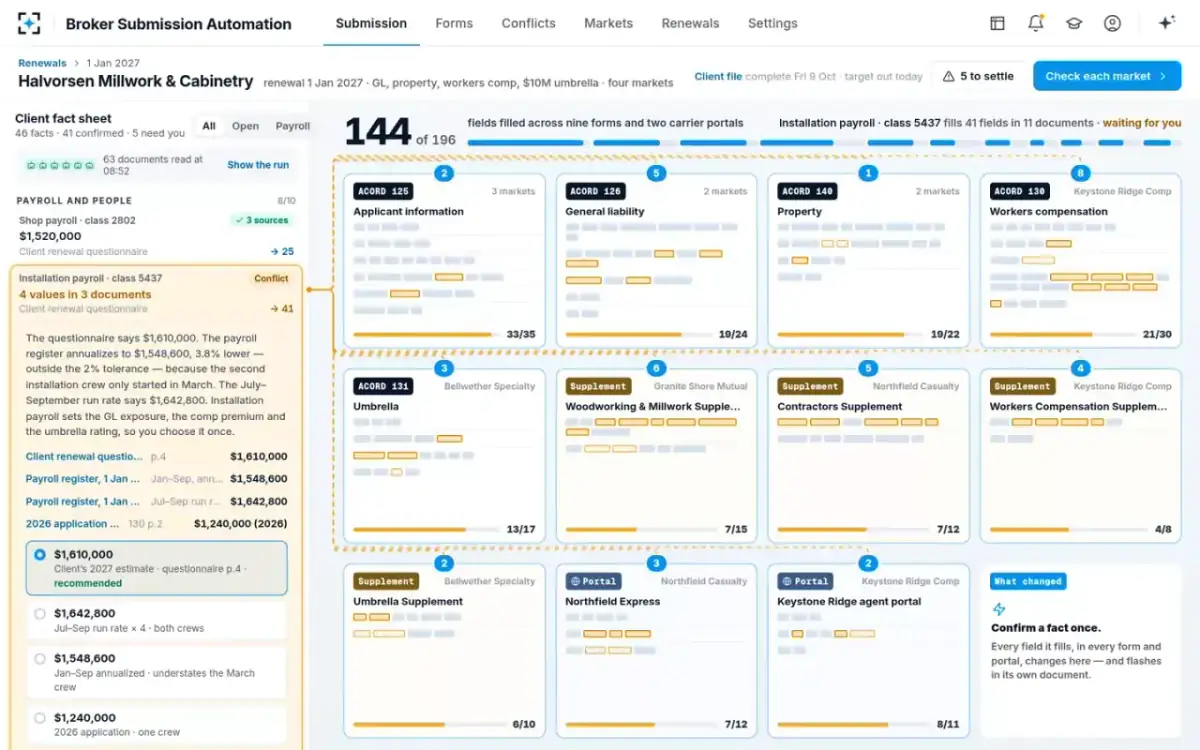
Take the sample account. Halvorsen Millwork renews general liability, property, workers' compensation and a $10 million umbrella on 1 January 2027 and is going to four markets. Its installation payroll appears in the client's questionnaire, in the payroll register, in last year's application and in the workers' compensation experience rating worksheet, and four documents give four different figures. By hand, that payroll is retyped into the general liability section, the workers' compensation application, two insurers' supplements and two portals. In the solution it is one fact, and it fills 41 fields in 11 documents once the account manager confirms it.
One fact with four values: the account manager's call, with every source beside it
Does a commercial account manager need an insurance license?
Usually yes, if the account manager talks to clients about coverage. The NAIC's Producer Licensing Model Act, the template most states' producer licensing laws follow, requires a licence to sell, solicit or negotiate insurance, and its definition of negotiate covers conferring with or advising a buyer about the substantive benefits, terms or conditions of a particular contract (NAIC Model #218, section 2). An account manager who explains to a client why a renewal carries a new exclusion is doing exactly that.
The same model, in section 4, exempts an agency employee who takes no commission and whose work is executive, administrative, managerial or clerical and only indirectly related to selling, soliciting or negotiating. That exemption is why some agencies employ unlicensed assistants for requests and filing. States enact the model with their own wording, so the line between clerical and negotiating is drawn by each state's statute, not by the job title. The BLS profile puts the general rule plainly: agents "must be licensed in the states where they work" (BLS Occupational Outlook Handbook).
How many accounts does a commercial account manager handle?
There is no published benchmark from a regulator or a research body; agencies set the number from their own mix of account sizes and service levels. What can be measured is the hours a book demands, and the useful way to size a book is from the renewals rather than the account count. A book of 64 accounts with a cluster of 1 January renewals is a different job in October from the same book in May.
The sample account manager carries 64 accounts, and eleven of them renew in the next 120 days. If each remarketed renewal takes about 20 hours by hand, which is Botminds' estimate for an account like the sample's (four lines, four markets), eight remarketed accounts in a quarter is 160 hours of submission work before a single underwriter's question is answered. That arithmetic, not a headcount ratio, is the one to run on your own book.
The account manager's next 120 days, from first request to renewal date
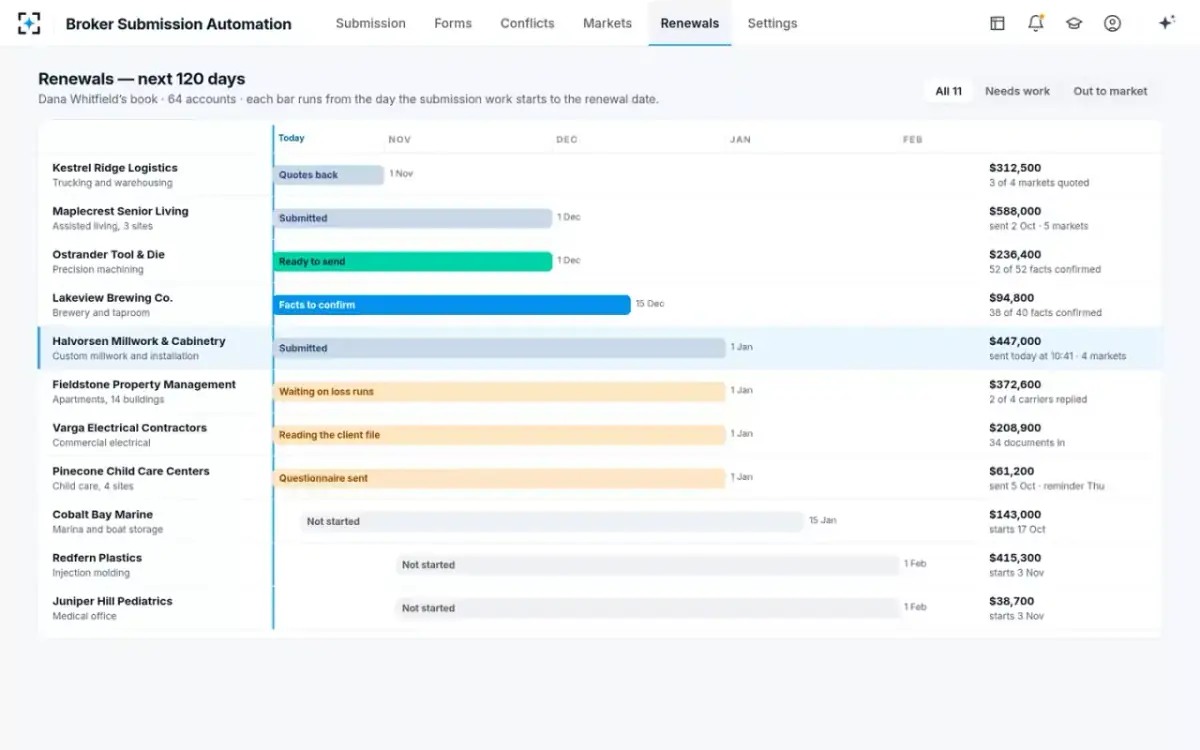
Eleven renewals in the next 120 days: six are still gathering documents or not started
The sample book, by stage
- Not started · 3 · 27.3%
- Gathering documents · 3 · 27.3%
- Building submissions · 2 · 18.1%
- With the markets · 3 · 27.3%
The six renewals on the left of that bar are next season's workload arriving. Each will need its client file read, its facts settled and a package built for every market it goes to, and the account manager's capacity is set by how many of those can be built while the servicing work carries on.
Where an account manager's week goes: re-keying, not judgement
On a remarketed renewal most of the account manager's hours go on moving facts from documents into forms, not on deciding anything. Botminds' estimate for one renewal like the sample's puts sorting and reading the file at 3 hours, keying the ACORD forms and supplements at 7, entering the same answers in insurers' portals at 4, finding and chasing conflicts at 3, writing a letter per market at 2, and signatures and release at 1.
Fourteen of those twenty hours are reading and keying. With the agents doing the reading, mapping and first drafts, the same renewal takes about 4 hours by Botminds' estimate, and the hours that remain are the ones that were always the job: the conflicts, many of which turn on a conversation with the client, and the signatures and approvals, which take as long as they ever did. What one remarketed submission costs prices each step with public wage data.
The unwritten duty: knowing where every figure came from
An account manager's knowledge can become the client's knowledge in law, which makes sourcing a duty rather than a nicety. Under the UK's Insurance Act 2015, a business insured is taken to know what is known to the people responsible for its insurance, and that phrase covers anyone who takes part in procuring the insurance on the insured's behalf, including "as an employee of the insured's agent" (section 4(8)(b)). The government's explanatory notes to the Act say the category "may also include an individual acting as the insured’s broker" (Explanatory Notes, paragraph 53).
United States law gets to a similar place by a different road: a misrepresentation in an application is judged by what the application said, whoever typed it, and examiners check that applications are complete, accurate and signed where required and that the underwriting file supports the decision (NAIC Market Regulation Handbook, chapter 21). Either way the account manager's file is the evidence. Misrepresentation on an insurance application traces one payroll figure through that file, step by step.
What stays the account manager's when each fact is keyed once
Judgement, conversation and release stay with the account manager; reading, mapping and keying move to agents with limits. The flow below is the sample renewal, from a complete client file to four submissions out, with each step marked by who does it and what the agent may never do.
Broker Submission Automation: what the agents do, and what the account manager keeps
Agent
Client file readerSorts and reads 63 documents, 412 pages; lifts 1,284 values, each with its page and line.
Never: Guesses a missing value.
Agent
Fact reconcilerConfirms 41 of 46 client facts where current documents agree; sends 5 to the account manager with every source.
Never: Chooses between conflicting current documents.
A person decides
Account managerSettles installation payroll, a roof year, sprinklers, an officer exclusion and a missing loss year.
Never: Is bypassed on a rating fact that changed.
Agent
Form fillerFills 196 fields in nine forms and two portals from the 46 confirmed facts; recalculates derived fields.
Never: Fills a field without a confirmed fact, or submits a portal page.
A person decides
Client, producer, account managerThe client e-signs the applications, the producer approves four letters, the account manager releases.
Never: Release without every check passed.
Some duties change shape rather than size. The account manager still writes to underwriters, but the cover letter arrives drafted from confirmed facts only, and the cover letter, part by part shows what each paragraph should carry. The account manager still sends to several markets, but the packages are built side by side rather than one after another, which is the subject of four markets in parallel.
Skills a commercial lines account manager needs now
The skills that matter most are the ones keying used to crowd out. Reading a schedule of values and spotting a building whose roof year does not match last year's application is a skill. So is telling a client, without alarming them, that an officer exclusion needs the officer's own signature, or deciding that a payroll estimate is more credible than an annualized register because a second crew started in March.
BLS lists five qualities it considers important for insurance sales agents: analytical skills, communication skills, initiative, interpersonal skills and self-confidence (BLS, How to become an insurance sales agent). The commercial desk adds a fluency in forms, class codes and rating worksheets that no general list captures. Automation does not remove that fluency. It changes where it is spent, from typing a class code into the right box to judging whether the class is still the right one.
How to measure a commercial lines account manager's submission work
Measure what the submission produces, not how busy the desk looks. The four measures below can be counted from an agency's own records and say more about a desk than renewals processed per month.
Four measures for the submission desk, each countable from your own files
- Days from a complete client file to submissions released
Start the clock when the last requested document arrives, not when the renewal comes due. The sample agency's target is the same business day.
- Facts settled by a person per renewal
How many client facts needed judgement. On the sample account it was 5 of 46; a rising number says the client file is arriving worse, not that the desk is slower.
- Underwriter questions per submission that the file could have answered
Each one is a fact that was missing, stale or buried. Count them by cause.
- Submitted figures without a source
The target is zero. A figure with no document behind it is the one nobody can defend after a claim.
Questions people ask
Is a commercial account manager the same as an account executive?
Often the titles overlap. In many agencies the account executive is the senior service role on larger accounts, sometimes with a book of its own, while the account manager services accounts a producer brings in. The duties on this page apply to either title; what matters is who owns the submission file.
Who fills out the ACORD forms at an agency?
Usually the account manager, sometimes an account assistant under the account manager's review. The client then signs the applications, because the statements in them are the client's representations to the insurer. In the sample renewal the client's CFO e-signs the ACORD 125 and 130 before anything is released.
Who talks to underwriters at an agency?
The account manager handles most underwriter contact on a renewal, from the submission to the follow-up questions, with the producer stepping in for negotiation on larger or difficult accounts. A placement or marketing specialist may own the relationship with particular markets, especially wholesalers.
How much does a commercial account manager earn?
BLS does not publish pay for account managers as such. The nearest figure is the median for insurance sales agents employed by agencies and brokerages, $61,550 in May 2025, against $62,280 for the occupation as a whole. Licensed commercial account managers in large brokerages are often paid more; agencies set pay by book size and line.
Will automation replace commercial account managers?
The evidence points the other way for now. BLS projects insurance sales agent employment to grow 3% from 2025 to 2035, with about 43,100 openings a year. One field study of an AI assistant in customer support, not insurance, found productivity up 14% on average and 34% for novice workers (NBER Working Paper 31161), which suggests the tools help newer staff most.
Who decides which insurers get the submission?
Usually the producer, with the placement specialist, rather than the account manager alone. Market selection depends on the client's goals, the insurers' appetite and which insurers the agency is appointed with: a licence by itself, the NAIC model says, gives no authority to represent or commit an insurer. The account manager builds what each chosen market asks for.