The duty of fair presentation is the rule in the UK's Insurance Act 2015 that, before a business insurance contract is made or renewed, the insured must give the insurer a fair presentation of the risk: disclose every material circumstance it knows or ought to know, do so in a manner reasonably clear and accessible to a prudent insurer, and make sure its material statements of fact are substantially correct. The second element is the one brokers underestimate. A presentation can contain every relevant fact and still fail if the facts are buried in an undigested pile of documents, which is why more paper is not more disclosure. Botminds' Broker Submission Automation is built around the opposite of the pile: it reads the whole client file, builds one fact sheet in which every fact carries its sources, sets out what changed since last year, and sends the facts on which documents disagree to a person before anything goes to an insurer.
The examples use a fictional account and a fictional sample renewal; the statute, the government's explanatory notes and the judgments quoted are real and linked where they appear. This guide explains the law in general terms and is not advice on a particular policy.
The same account presented twice: a data dump and a fair presentation
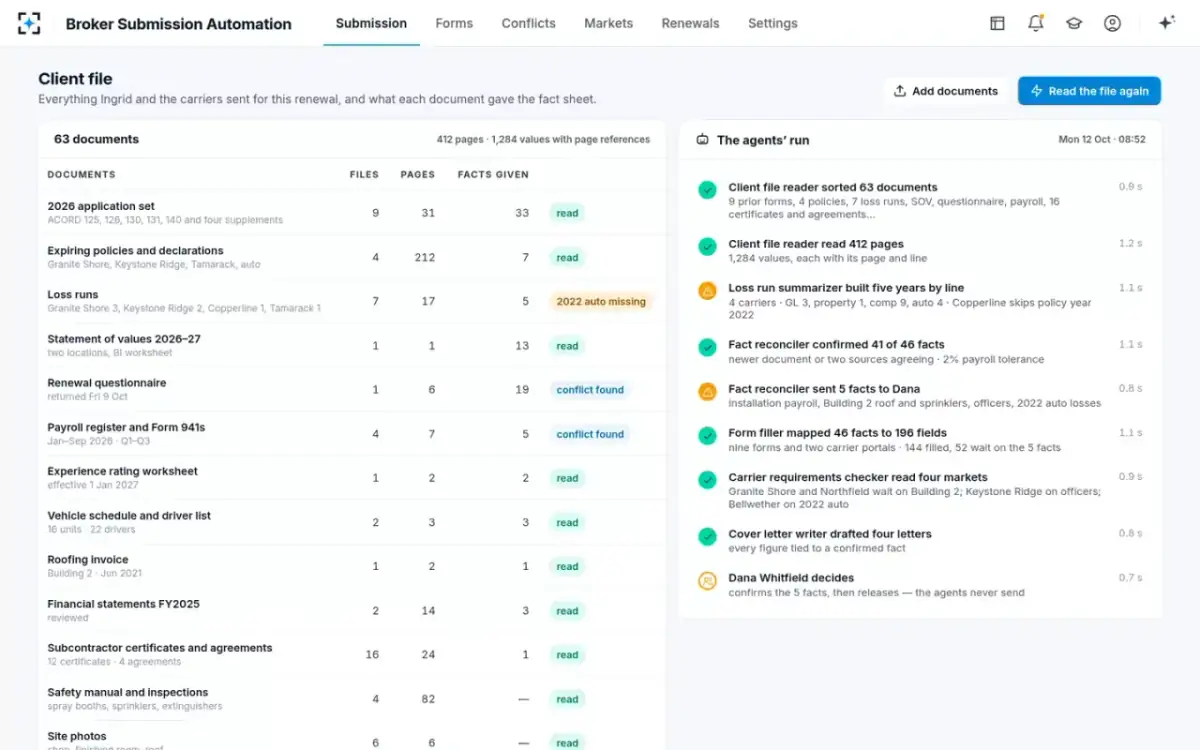
Forwarded as received: Four hundred pages in sixty files: last year's proposal, five insurers' loss runs, a schedule of values, financial statements, a safety manual, site photos.
Presented from a sourced fact sheet: A covering presentation of the account and its changes, the proposal and the insurer's own questions answered, and the documents behind each answer, indexed.
Forwarded as received: A second installation team started in March; it appears only in the monthly payroll, as a rise in headcount.
Presented from a sourced fact sheet: Stated on page one: payroll for installation work up 30% on last year, because of a second team from March, with the payroll page it comes from.
Forwarded as received: Each insurer's loss run as printed, in its own format; one omits a year without saying so.
Presented from a sourced fact sheet: Five years by line, every claim, open reserves and the valuation date; the missing year named, and the request for it on file.
Forwarded as received: Not mentioned: there was no claim, so no one thought of them.
Presented from a sourced fact sheet: Listed, with what was done after each, because a prudent insurer would want to take them into account.
Forwarded as received: Left in the pile for the underwriter to find, or not find.
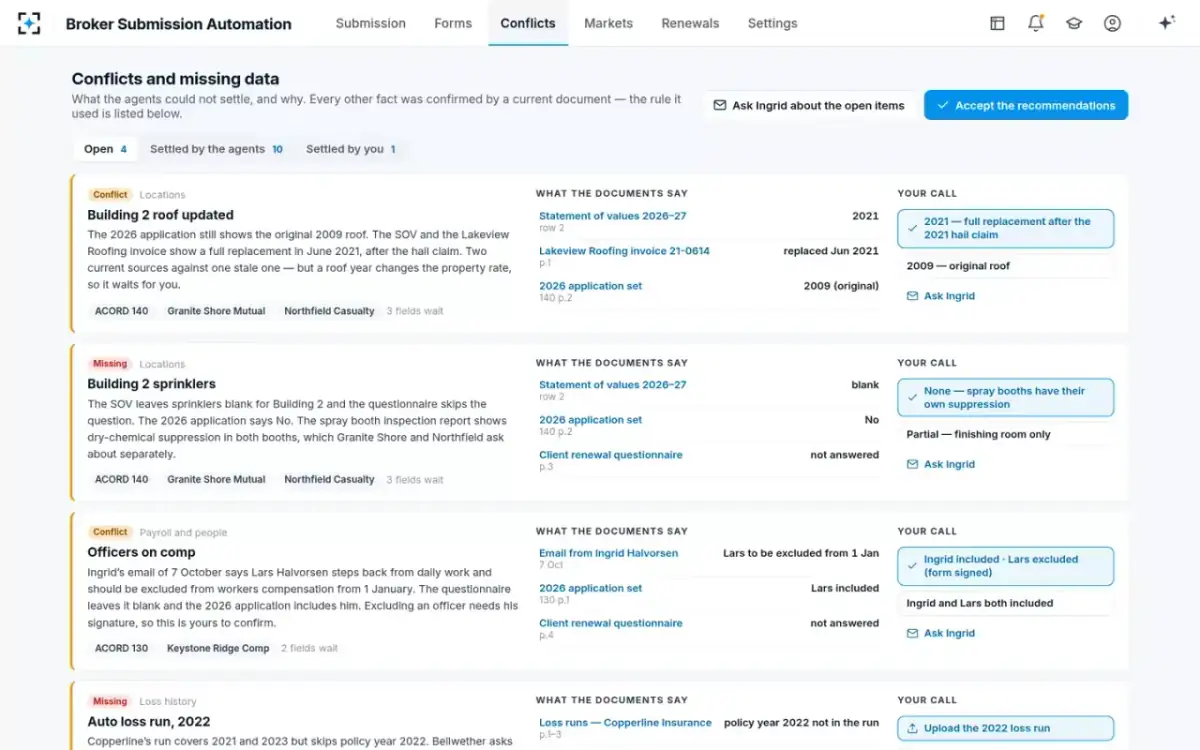
Presented from a sourced fact sheet: Settled before sending: the value chosen, the reason, and the other documents' figures.
Forwarded as received: That it sent four hundred pages.
Presented from a sourced fact sheet: Which page said what, what was presented, and when.
What is the duty of fair presentation?
It is the insured's duty, before the contract is entered into, to present the risk fairly, and it replaced the old duties of disclosure and representation in the Marine Insurance Act 1906 for business insurance. Section 3 opens: "Before a contract of insurance is entered into, the insured must make to the insurer a fair presentation of the risk." It applies to non-consumer insurance only; consumer insurance has its own regime under the Consumer Insurance (Disclosure and Representations) Act 2012, as the government's explanatory notes to the 2015 Act record (Explanatory Notes, paragraph 37). The Act's contract-law provisions came into force on 12 August 2016, eighteen months after Royal Assent (Explanatory Notes, paragraph 172).
Section 3(3) gives the presentation three elements. It must make the disclosure the Act requires; it must make that disclosure "in a manner which would be reasonably clear and accessible to a prudent insurer"; and every material representation of fact must be substantially correct, with every material representation of expectation or belief made in good faith. The disclosure itself, under section 3(4), is either every material circumstance the insured knows or ought to know, or, failing that, enough to put a prudent insurer on notice that it needs to ask further questions.
What does "reasonably clear and accessible" mean?
It means the insurer can find and understand the material facts without excavating them: the Act regulates the form of the presentation as well as its content. The government's explanatory notes name the target directly.
It is intended to target, at one end of the scale, “data dumps”, where the insurer is presented with an overwhelming amount of undigested information. At the other end, it is not expected that this requirement would be satisfied by an overly brief or cryptic presentation.
Explanatory Notes to the Insurance Act 2015, paragraph 46
Both ends matter to a broker. A presentation that forwards everything has not made the facts accessible; one that summarises an account in three lines has not made them clear. The Act does not require a single document: section 7(1) says a fair presentation need not be in only one document or oral presentation, and the notes add that everything given to the insurer by the time the contract is made forms part of the presentation (section 7). What it requires is that the material facts can be found and understood by a prudent insurer reading what it was given.
Is data dumping a breach of fair presentation?
It can be, and it is a separate failure from non-disclosure: a presentation can disclose every material fact and still breach section 3(3)(b) if those facts are not clear and accessible. The notes also make clear that the usual exceptions to disclosure do not soften this element: "The exceptions do not apply to the requirement to make the disclosure in a clear and accessible manner, nor to the duty not to make misrepresentations." (paragraph 48). That an insurer could have found a fact on page 212 does not cure the way it was presented.
A breach gives the insurer a remedy only if it was induced by it. Under section 8(1), the insurer must show that, but for the breach, it "would not have entered into the contract of insurance at all, or" would have done so only on different terms. In practice that means the insurer must show that a fact presented clearly would have changed its decision, and a buried fact is exactly the kind an underwriter can say it would have acted on.
What is a material circumstance under the Insurance Act 2015?
A circumstance is material if it would influence the judgement of a prudent insurer in deciding whether to take the risk and, if so, on what terms (section 7(3)). The Act gives examples: special or unusual facts relating to the risk, any particular concerns that led the insured to seek cover, and anything people in that class of insurance and field of activity would generally understand should be dealt with in a fair presentation (section 7(4)). Section 7(2) adds that a circumstance includes any communication made to, or information received by, the insured.
The threshold is low. In Delos Shipholding SA v Allianz Global Corporate and Specialty SE, Dias J said the test under the 2015 Act is substantively the same as before, and that it was common ground that insurers did not need to show the undisclosed circumstances would have had a decisive effect: "It is sufficient that he or she would have wanted to take them into account." ([2024] EWHC 719 (Comm), paragraph 220). A broker's working test follows: if an underwriter in that class would want to know it, present it, plainly.
What the insured ought to know, and why the broker's file counts
The insured must disclose what it ought to know, not only what its directors happen to remember, and what it ought to know includes what a reasonable search would reveal. Section 4(6): an insured ought to know "what should reasonably have been revealed by a reasonable search of information available to the insured", and section 4(7) says that information includes what is held by others, such as the insured's agent. The notes describe the search as one that may include enquiries of the insured's staff and agents, such as its broker (paragraph 56).
That makes the broker's file part of the insured's knowledge. The Act does not put a separate duty on the broker: "the Act does not include a separate duty on the agent to disclose information to the insurer" (paragraph 58). But what the broker holds about the client can be swept into what the client ought to know, and a broker who receives a client's incident report and does not put it in the presentation has made the client's presentation incomplete. The account team's part in that, seat by seat, is in commercial insurance account manager duties.
The client file read in full, with each document's contribution and what is missing
Does the duty of fair presentation apply at renewal?
Yes, in full, every year. The explanatory notes put it simply: "Since the law regards renewals as new contracts, the duty also applies when an insurance contract is renewed." (paragraph 41). A renewal placed "as expiring", with no new questions asked, carries the same duty as the first placement, and the insurer's silence is not a waiver.
The Commercial Court applied exactly that in July 2026. In Cometsambre SA v Lloyd's Insurance Company SA, a charterers' liability cover had been renewed on almost identical terms each year from 2010 to 2022 with very little correspondence. Between May 2020 and October 2021 the insured had five fires in its scrap metal cargoes, two on the quayside and three on board chartered vessels, none of which led to a claim on the policy and none of which was disclosed at the 2022 renewal. After a large fire in June 2022, the insurer avoided the policy, and Butcher J upheld the avoidance.
Cometsambre: what the renewal did not say, and what the court made of it
| Point | What happened | What the court held |
|---|---|---|
| The incidents | Five fires in about 18 months, after twelve years with almost none; no claim on the policy from any of them | Material: a prudent underwriter would want to know of fires whether or not they led to a claim, and the pattern made it clearer |
| The questions asked | At inception, the broker's own questionnaire asked only for the claims record; no renewal questionnaire in later years | No waiver: "The absence of a renewal questionnaire could not reasonably be understood to be a waiver of disclosure of material circumstances." |
| Renewal "as expiring" | Renewed on the same terms for years, with little correspondence | Each renewal is a new contract; facts that should have been disclosed earlier must be disclosed if still relevant and unknown to the insurer |
| Inducement | The underwriter said he would not have renewed for 2022 had the fires been disclosed | Accepted: the insurer was entitled to avoid and tender return of the premium; the claim was dismissed |
The lesson for a renewal desk is mechanical as much as legal. A renewal process that asks the client only for what changed in the questionnaire will miss what the client did not think of as a change, such as incidents without claims. A process that reads the year's documents, including incident reports and surveys, and lists what is new, will not.
What are the remedies for breach of fair presentation?
They depend on whether the breach was deliberate or reckless, and on what the insurer would have done if the presentation had been fair. The Act replaced the old all-or-nothing remedy of avoidance with a scale, set out in section 8 and Schedule 1. It is for the insurer to show that a breach was deliberate or reckless (section 8(6)).
The insurer's remedies for a qualifying breach, under Schedule 1
| If the breach was | And the insurer would have | The insurer may |
|---|---|---|
| Deliberate or reckless | Not written it, or written it only on different terms | "avoid the contract and refuse all claims", and need not return any premium (paragraph 2) |
| Neither deliberate nor reckless | Refused the risk on any terms | Avoid the contract and refuse all claims, but must return the premiums paid (paragraph 4) |
| Neither deliberate nor reckless | Written it on different terms, other than premium | Treat the contract as if made on those terms, for example with an exclusion (paragraph 5) |
| Neither deliberate nor reckless | Charged a higher premium | Reduce each claim proportionately: pay premium charged ÷ higher premium × 100 per cent of it (paragraph 6) |
The proportionate remedy is the one that catches careful insureds. An understated exposure, presented in good faith, can mean every claim in the year is paid short; misrepresentation on an insurance application works the formula through on one payroll. The explanatory notes are explicit that recklessness is meant to be more culpable than carelessness, and that innocent breaches still give a remedy if the insurer can show inducement (paragraphs 80 and 81).
Does the duty of fair presentation apply to brokers?
The duty is the insured's, not the broker's, but the broker does most of the presenting. The Act removed the separate statutory duty on an agent to disclose, and attributes to the insured the knowledge of the individuals responsible for its insurance, a category the notes say may include the insured's broker. The Act's remedies run against the insured, not the broker; whether a client then has a claim against its broker for a poor presentation is a matter for their contract and the general law.
In practice that puts the broker in charge of the presentation's quality and the client in charge of its truth. The broker should ask the questions a prudent insurer would ask, organise the answers so they are clear and accessible, and keep a record of what was presented. The client should confirm the facts and sign what states them. A cover letter that does the organising is set out part by part in the commercial insurance submission template.
How the Insurance Act 2015 differs from US misrepresentation law
The Act imposes a positive duty to disclose material circumstances, judged by what a prudent insurer would want, with remedies scaled to what the insurer would have done. In the United States the rules are set state by state, and statutes such as New York's are framed around misrepresentation in the application. New York's provides that a misrepresentation cannot avoid a contract unless it was material, and asks whether the insurer would have refused the contract had it known the truth (N.Y. Ins. Law § 3105).
Two differences matter most to a broker placing on both sides of the Atlantic. The UK test of materiality is influence on a prudent insurer, a lower bar than refusal; and the UK remedies include proportionate reduction of claims, which New York's statute does not provide. A presentation built to the UK standard, complete, organised and sourced, will generally satisfy a US insurer's questions too; the reverse is not guaranteed.
How to build a presentation a prudent insurer can use
Start from the facts, not the documents: decide what a prudent insurer in this class would want to know, find each fact in the client's documents, settle the disagreements, and present the result with the evidence indexed behind it. The steps below are the ones a broker can check before sending.
Every disagreement settled before the presentation goes out, with each document's answer
Before a business presentation goes to an insurer: eight checks for a fair presentation
- The changes since last year are stated first
New operations, new locations, new staff numbers, new owners or officers, changed buildings. A renewal is a new contract.
- Incidents are listed, not only claims
Fires, near misses, regulatory visits, complaints that could become claims. Cometsambre turned on fires that never became claims.
- Every figure names its source
Payroll, turnover, values and headcount, each with the document and page it came from.
- Disagreements between documents are settled and explained
The value chosen, the reason, and the other documents' figures, not left for the underwriter to find.
- Losses are summarised by year and line, with gaps named
A missing year is reported as missing, never as no losses.
- The documents behind the presentation are indexed
Clear and accessible means the underwriter can find the page that supports a statement.
- The client has confirmed the facts
Senior management and the people responsible for the insurance know what is being presented in their name.
- A record of what was presented is kept
What was sent, to whom and when, so the presentation can be shown later exactly as made.
Questions people ask
What does the insured "ought to know" mean under the Insurance Act 2015?
What a reasonable search of the information available to the insured would reveal, including information held by others such as its broker. For a company, actual knowledge is that of its senior management and the people responsible for its insurance; "ought to know" extends it to what those people would find if they looked properly.
What are the remedies for breach of fair presentation?
For a deliberate or reckless breach, avoidance with no return of premium. Otherwise the remedy matches what the insurer would have done: avoidance with the premium returned if it would have refused the risk, the different terms it would have imposed, or a proportionate reduction of claims if it would have charged more.
Does the duty of fair presentation apply to consumers?
No. Part 2 of the Insurance Act 2015 applies to non-consumer insurance. Consumers are covered by the Consumer Insurance (Disclosure and Representations) Act 2012, which, in the words of the 2015 Act's explanatory notes, replaced the consumer's duty to volunteer information with a duty to answer the insurer's questions honestly and reasonably.
Can an insurer waive the duty of fair presentation?
An insurer can waive information about a particular matter, and section 3(5)(e) then excuses its disclosure in the absence of enquiry. But waiver is read narrowly: in Cometsambre, neither a broker's questionnaire that asked only for the claims record nor the absence of renewal questions was a waiver of the insured's fires.
Is a fair presentation one document?
It need not be. Section 7(1) says a fair presentation need not be contained in only one document or oral presentation, and everything given to the insurer before the contract is made counts. What matters is that the material facts are clear and accessible in what was given, which is why a covering summary with an indexed file works better than either alone.