A commercial insurance submission template has two parts: the package each insurer receives (its applications and line sections, its own supplement, five years of loss runs, the statement of values and schedules, any inspection reports it asks for) and a cover letter written for that insurer's underwriter. The package carries the facts; the letter says which of them matter this year and why. A good letter states the account in plain words, sets out what changed since last year with figures that can be traced, explains the loss history, says what is enclosed and what the client is asking for, and gives a date. Botminds' Broker Submission Automation drafts one such letter per market from confirmed facts only, so every figure in it links to the document it came from, and the producer approves each letter before anything is released.
The letter annotated below is from a fictional sample renewal, Halvorsen Millwork & Cabinetry, placed by the fictional Corbett Lane Insurance Partners with four invented insurers. The structure, not the account, is the template.
One submission cover letter, annotated: what each paragraph does and where its figures come from
1 · The account in plain words
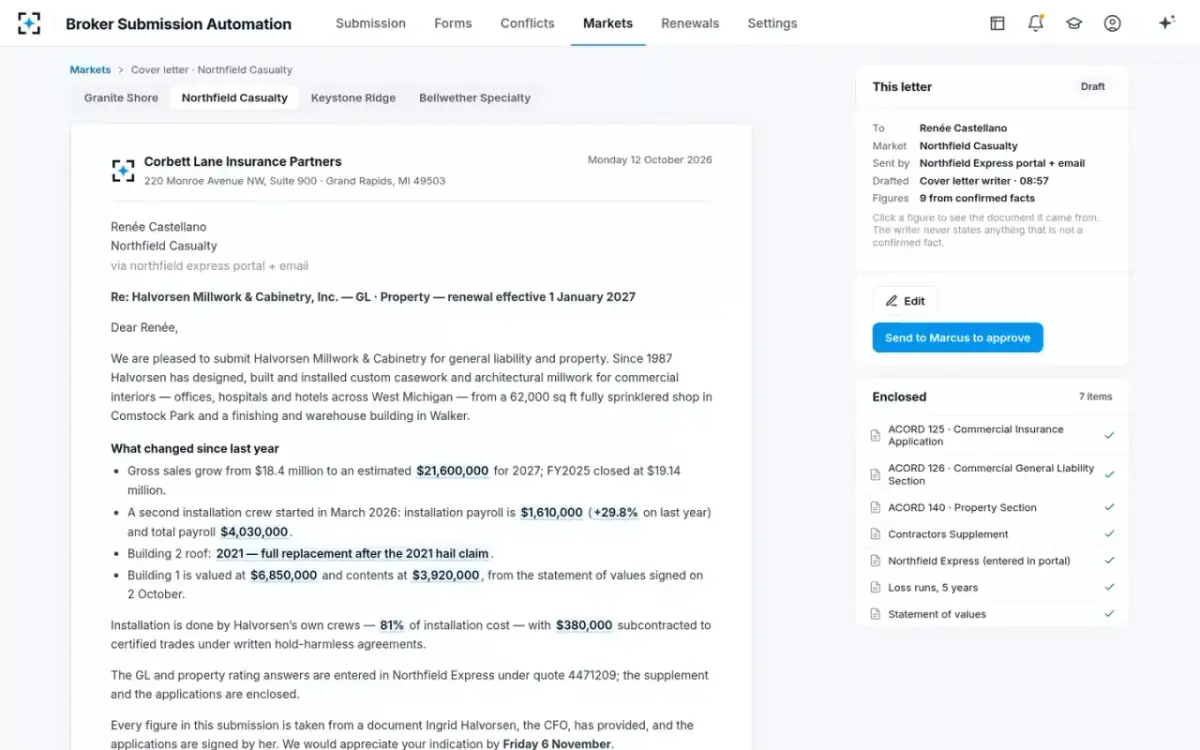
We are pleased to submit Halvorsen Millwork & Cabinetry for general liability and property. Since 1987 Halvorsen has designed, built and installed custom casework and architectural millwork for commercial interiors (offices, hospitals and hotels across West Michigan) from a 62,000 sq ft fully sprinklered shop in Comstock Park and a finishing and warehouse building in Walker.
What the business does, where, and since when, in a sentence the underwriter can repeat to a referral underwriter. Years in business and buildings come from the expiring policies and the statement of values.
2 · What changed since last year
Gross sales grow from $18.4 million to an estimated $21,600,000 for 2027; FY2025 closed at $19.14 million. A second installation crew started in March 2026: installation payroll is $1,610,000 (+29.8% on last year) and total payroll $4,030,000. Building 2 roof: 2021, full replacement after the 2021 hail claim. Building 1 is valued at $6,850,000 and contents at $3,920,000, from the statement of values signed on 2 October.
The paragraph an underwriter reads twice. Each figure is a confirmed fact: sales from the financial statements and the client's estimate, payroll confirmed by the account manager, the roof from the roofing invoice and the statement of values.
3 · How the risk is run
Installation is done by Halvorsen's own crews (81% of installation cost), with $380,000 subcontracted to certified trades under written hold-harmless agreements.
The answer to the question this market asks about contractors before it asks. Sources: payroll, subcontractor certificates and agreements on file.
4 · Where the answers are
The GL and property rating answers are entered in Northfield Express under quote 4471209; the supplement and the applications are enclosed.
Tells the underwriter what is in the portal and what is attached, so nothing is looked for twice.
5 · Who stands behind it, and by when
Every figure in this submission is taken from a document Ingrid Halvorsen, the CFO, has provided, and the applications are signed by her. We would appreciate your indication by Friday 6 November.
The source of the facts, the signature, and a date. A request without a date is a request to be answered last.
What should a commercial insurance submission include?
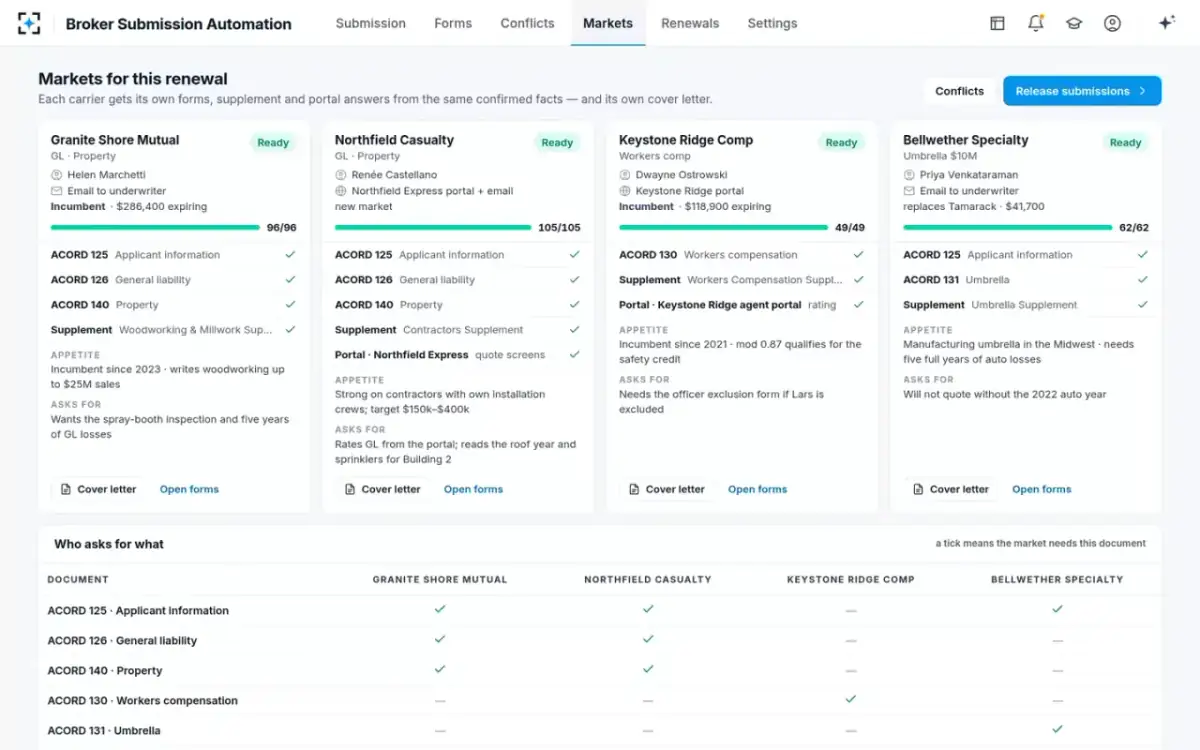
What each insurer asks for, and no less: the common application, the line sections for the lines it is quoting, its own supplement, the loss history it requires, and the schedules and reports its underwriting needs. The list differs by insurer even on one account, which is why a single package sent to every market is usually wrong for some of them. In the sample renewal, four insurers asked for four different things.
Four insurers, one account: what each asked for
| Insurer (fictional) | Lines | Forms and supplement | Also asks for |
|---|---|---|---|
| Granite Shore Mutual, incumbent | General liability, property | ACORD 125, 126, 140; woodworking and millwork supplement | The spray-booth inspection and five years of general liability losses |
| Northfield Casualty, new market | General liability, property | ACORD 125, 126, 140; contractors supplement; its own portal | Rates in its portal, where it reads Building 2's roof year and sprinklers |
| Keystone Ridge Comp, incumbent | Workers' compensation | ACORD 130; workers' compensation supplement; agent portal | The officer exclusion form, signed, if an officer is excluded |
| Bellwether Specialty, replacing the expiring umbrella | $10 million umbrella | ACORD 125, 131; umbrella supplement | Five full years of auto losses; will not quote without the missing 2022 year |
Whatever the insurer, the package should let an underwriter decide without asking for anything you already had. Examiners, for their part, expect underwriting decisions to rest on adequate information gathered at or near inception, not after a claim (NAIC Market Regulation Handbook, chapter 21), and the submission is where that information starts.
Why the cover letter carries the submission
The cover letter is the one document in the package written for this underwriter about this year. The applications are standard forms filled in; the supplement answers the insurer's own questions; the loss runs are the insurers' printouts. Only the letter can say that installation payroll rose 29.8% because a second crew started in March, that the roof on Building 2 is five years old rather than seventeen, and that the client has already had its 2022 loss year requested.
It is also the document most likely to go wrong, because it is written last, under time pressure, often from memory. A letter that quotes last year's sales, or a payroll that differs from the application enclosed with it, invites exactly the question it was meant to prevent. That is why in the solution the letter writer may state only confirmed facts, and why each figure is a link back to its source.
The letter as drafted: every figure a confirmed fact, one click from its document
How do you write a submission cover letter to an underwriter?
In six short parts, in this order, each with a job. The order follows what an underwriter needs to decide whether to quote: who the client is, what is different, how the risk is run, how it has gone, where the details are, and what is wanted by when.
The six parts of a submission cover letter
- The account in plain words
What the business does, where, since when, for which lines. One or two sentences an underwriter can repeat.
- What changed since last year
Sales, payroll by class, locations, buildings, vehicles, officers, operations. Figures with their source, and the reason for each change.
- How the risk is run
The facts this insurer's appetite turns on: own crews or subcontractors, safety programmes, protection, contracts and certificates.
- The loss story
Five years by line, open claims and reserves, the large ones explained, and what changed afterwards. A missing year said to be missing.
- What is enclosed and where
The forms, the supplement, the loss runs, the schedules, and what was entered in the insurer's portal.
- What the client asks for, and by when
The coverage, limits and terms requested, any specific request in the client's words, and the date you need an indication.
The last part deserves care. In New York, the Court of Appeals has repeated that agents have a common-law duty to obtain the coverage a client requests within a reasonable time, or to tell the client they cannot, and that a claim against a broker needs a specific request (American Building Supply Corp. v Petrocelli Group, 2012). Stating the client's request in the letter, in the client's words where it has them, puts that request on the record of every market.
What do underwriters want in a submission?
Enough to decide without writing back, organised so they can find it. Each insurer's own questions are the best guide, because the supplement and the portal are the insurer telling you what it rates on. In the sample, one insurer wanted the spray-booth inspection report; another rated in its portal and read the roof year directly; the umbrella market would not quote without five full years of auto losses.
The UK's insurance law reform made the point in statute. A business insured must present the risk in a manner reasonably clear and accessible to a prudent insurer, and the explanatory notes to the Insurance Act 2015 recognise that "the insurer may need to ask questions about the information in the initial presentation in order to draw out the information it requires to make the underwriting decision" (paragraph 72). A good letter anticipates those questions; the duty of fair presentation explains why that matters under English law.
Each market's package checked against what that insurer asks for
Should you include loss runs in a submission?
Yes, for as many years as the insurer asks, from every insurer that wrote the account in that period, and with a summary on top. Loss runs arrive in each insurer's own format with its own valuation date, and an underwriter comparing four formats will notice a missing year before the broker does, unless the broker says so first.
The sample shows the trap. One auto insurer's run covered 2021 and 2023 but skipped policy year 2022 without saying so, and the umbrella market would not quote without it. The summary named the missing year by insurer and policy number, the account manager requested it, and when it arrived (one claim, $4,750, closed) it went into the package. A missing year is reported as missing, never filled in as "no losses". Reading loss runs well is its own skill; Botminds' guide to how to read a loss run report covers it.
How do you present a bad loss history?
Plainly, early and with what changed. Underwriters find large losses in the loss runs whether or not the letter mentions them, so the letter's job is to explain them: what happened, what it cost, whether it is closed, and what the client did afterwards. A loss followed by a documented change in operations reads differently from the same loss with no comment.
Three rules help. Lead with the trend, not the worst claim, if the trend is better. Separate one-off events, such as a hail storm, from frequency, such as repeated small injuries in one department. And never describe a loss more favourably than the loss run does, because the underwriter will read both. In the sample, the roof that was replaced after a hail claim is reported as an improvement, with the roofing invoice behind it.
What is a submission narrative, and how is it different from the remarks on a form?
The narrative is the cover letter's account of the business and the year, in prose; the remarks are the short explanation the application forms themselves leave room for. Both should say the same thing. In the sample, the ACORD 130's remarks read "Class 5437 payroll +29.8% — second installation crew from March 2026", and the letter to each insurer gives the same change with its context.
Two cover letters for the same renewal
Generic: "Please find attached a submission for the above account for your consideration."
Written from confirmed facts: What the client does, where, since when, and the lines being submitted.
Generic: "Exposures have been updated."
Written from confirmed facts: Installation payroll $1,610,000, up 29.8%, because a second crew started in March 2026.
Generic: "Loss runs attached."
Written from confirmed facts: Five years by line, the missing 2022 auto year named and requested.
Generic: "We look forward to your quote."
Written from confirmed facts: The coverage requested, what is entered in the portal, and an indication by Friday 6 November.
Generic: The account manager searches the file.
Written from confirmed facts: The figure links to its document and the person who confirmed it.
A commercial submission template you can copy
Use the package list for what goes in and the six parts for the letter. Adapt both to each insurer: the letter to the new market explains more than the letter to the incumbent, and the umbrella letter leads with the underlying limits and the auto history. When four markets are being approached at once, build the four packages side by side from the same facts, which is the subject of four markets in parallel; the insurer-specific questions are covered in supplemental application insurance.
Before the package goes: a submission template checklist
- Applications and line sections for each line quoted
Signed by the client. The common application once per insurer that wants it.
- The insurer's own supplement, fully answered
No blanks; "not applicable" or "unknown, being confirmed" where that is the truth.
- Loss runs for every year asked, from every insurer
With a summary by year and line, and any missing year named.
- Statement of values, schedules and payroll by class
The current versions, dated and signed where the client signs them.
- Reports the insurer asks for
Inspections, safety programmes, contracts, certificates.
- Portal entries checked against the forms
The same facts in the portal as on paper.
- A cover letter for this insurer, approved
Six parts, every figure traceable, a date for the indication.
Questions people ask
How long should a submission cover letter be?
Long enough to cover the six parts and no longer; for a mid-sized commercial account, one to two pages is a sensible aim. The sample letter fits on one page with nine figures, because the detail sits in the enclosed forms and the letter only has to say what changed and why.
What makes a submission stand out to underwriters?
A package that answers the insurer's own questions before they are asked, a letter that explains the year's changes with figures that match the forms, and a date. In the sample, each insurer's package was checked against what that insurer asks for, and all four were marked ready before release.
Should one cover letter go to every market?
No. The facts should be the same for every market, but each letter should answer that insurer's appetite and questions. In the sample, the general liability letters stress own installation crews, while the umbrella letter has to address the missing auto loss year.
Who signs the submission cover letter?
The producer or account manager signs or sends it for the agency; the client signs the applications. In the sample, the letters were drafted at 08:57, the producer approved all four at 10:36, and the client's CFO had e-signed the applications at 10:32.
Should a submission state the coverage the client is asking for?
Yes, explicitly. In New York, a claim that a broker failed to obtain coverage needs a specific request, so the client's request, in its words where possible, belongs in the letter and the file. It also stops markets quoting something the client did not ask for.