A supplemental application in insurance is an additional questionnaire an insurer requires alongside the standard application, asking about the hazards of a particular class of business or line of cover that the standard forms do not reach. A woodworking supplement asks about spray booths and dust collection; a contractors supplement asks how much work is subcontracted and on what terms; an umbrella supplement asks about the fleet and the underlying limits. The answers are part of what the client represents to the insurer, and because each insurer writes its own, they are the questions most often answered from memory, left blank or copied from last year. Botminds' Broker Submission Automation maps every insurer's own supplement field by field to the client's facts, fills each answer from a fact with its sources, and sends the answers the documents cannot settle to the account manager.
The mapping below comes from a fictional sample renewal, Halvorsen Millwork & Cabinetry, placed by the fictional Corbett Lane Insurance Partners with four invented insurers; the question wording is illustrative of a woodworking and millwork supplement. Statutes and the judgment quoted are real and linked.
One supplement mapped: question, client fact, source, and who confirms it
Describe your finishing operations: spray booths, coatings used.
Client factTwo spray booths; water-based coatings
SourceClient's renewal questionnaire; safety manual and inspections
Who confirmsAgents: two current sources agree
Is there dust collection, and does it have spark detection?
Client factDust collection with spark detection
SourceClient's renewal questionnaire; inspection report
Who confirmsAgents: two current sources agree
Are spray booths protected by automatic suppression?
Client factDry-chemical suppression in both booths
SourceSpray booth inspection report
Who confirmsAgents, from the inspection report
Is each building sprinklered?
Client factBuilding 2: none; the booths have their own suppression
SourceStatement of values blank; last year's application "No"; questionnaire unanswered
Who confirmsAccount manager: a rating fact the documents leave open
Year of last roof replacement, by building
Client factBuilding 2: 2021, full replacement after a hail claim
SourceStatement of values; roofing invoice. Last year's application says 2009
Who confirmsAccount manager: a roof year changes the property rate
Annual sales, last year and next
Client factFY2025 $19.14 million; 2027 estimate $21,600,000
SourceFinancial statements; client's questionnaire
Who confirmsAgents: actual and estimate, each labelled
Work subcontracted, and are certificates held?
Client fact$380,000; certificates and written agreements on file
SourceSubcontractor certificates and agreements (16 files)
Who confirmsAgents
Five years of general liability losses
Client factSummarised by year from every insurer's loss run
SourceLoss runs from the incumbent and prior insurers
Who confirmsAgents; a missing year goes to a person
What is a supplemental application in insurance?
It is the insurer's own set of questions, added to the standard application for the class or line it is quoting, and it is usually where the insurer's underwriting guidelines show through. The standard forms carry what every insurer needs: the applicant, locations, payroll, sales, buildings, prior insurance and losses. The supplement carries what this insurer, for this class, rates or declines on.
That makes supplements numerous. In the sample renewal, four insurers asked for four supplements: woodworking and millwork, contractors, workers' compensation and umbrella. Between them they held 45 questions that no standard form on the account carried, and each insurer asked its own version of overlapping questions, such as sprinklers and suppression, in its own words.
Four supplements on one renewal, 45 answers no standard form holds
Why do carriers require supplemental applications?
Because the questions on a supplement are the facts that decide whether, and at what price, that insurer takes a class of risk, and a standard form cannot know them. Fire in a finishing room, falls from a roof, liquor served late, work handed to subcontractors: each class has the hazards its losses come from, and the supplement is how the insurer asks about them.
The questions matter in law as well as underwriting. New York's statute on misrepresentation lets a court, in deciding whether a misstatement was material, hear evidence of how the insurer has accepted or rejected similar risks (§ 3105(c)); underwriting data quality reads the section from the carrier's side. A supplement is a written record of that practice. The UK's Insurance Act 2015 lists among its examples of material circumstances "special or unusual facts relating to the risk" (section 7(4)(a)), which is what most supplement questions are written to draw out. A question on a supplement is the insurer telling you it is material; misrepresentation on an insurance application follows what happens when an answer is wrong.
Which classes need supplemental applications?
Most classes with a distinctive hazard, and most excess and specialty lines. Search suggestions single out restaurants, hotels, manufacturing, roofing and general contractors, and the pattern of questions follows the hazard in each. The examples below are typical of the kind of question, not quotations from any insurer's form.
The hazard drives the question: what supplements for five classes typically ask about
The hazard: Cooking fires, liquor liability, late hours
The kind of question a supplement asks: Cooking equipment and hood suppression, share of sales from alcohol, closing time, entertainment
The hazard: Premises injuries, pools, security
The kind of question a supplement asks: Number of rooms and stories, pool and fitness facilities, security staffing, sprinklers
The hazard: Products, fire, machinery
The kind of question a supplement asks: Products made and where sold, finishing and dust, hazardous materials, recalls
The hazard: Falls, hot work, fire
The kind of question a supplement asks: Maximum working height, torch-down work, residential versus commercial share, fall protection
The hazard: Subcontractor injuries and defects
The kind of question a supplement asks: Work subcontracted, certificates and indemnity agreements, types of projects, residential exposure
Two classes of question recur across almost every supplement: how the risk is protected (sprinklers, suppression, alarms, training) and how much of the work the client does itself. Those are also the answers most likely to differ between an insurer's supplement and the client's other documents.
Who signs a supplemental application?
The applicant, through an authorised officer, as for the main application: the answers are the client's representations to the insurer, whoever writes them down. Florida's statute, for example, treats what is said in an application, or in negotiating a policy, as a representation and not a warranty (Fla. Stat. § 627.409). Agencies often complete supplements for the client and send them for signature; the signature is what makes the answers the client's own.
Electronic signatures are valid for insurance documents in the United States, and federal law says expressly that it applies to the business of insurance (15 U.S.C. § 7001). In the sample, the client's CFO e-signed the applications before release, and an officer being excluded from workers' compensation signed the state's exclusion form himself.
What happens if a supplemental question is left blank?
A blank answers nothing, and the insurer and the client may later read it differently. To the insurer it may mean "no", "not applicable" or "we did not ask"; to the client it may mean "the broker knows". In the sample renewal, one question showed all three problems at once: the statement of values left Building 2's sprinklers blank, last year's application said "No", and the client's questionnaire skipped the question. The truth, from the spray-booth inspection report, was that the building has no sprinklers but both booths have dry-chemical suppression, which two of the insurers asked about separately.
A blank, a “No” and an unanswered question, settled with the evidence side by side
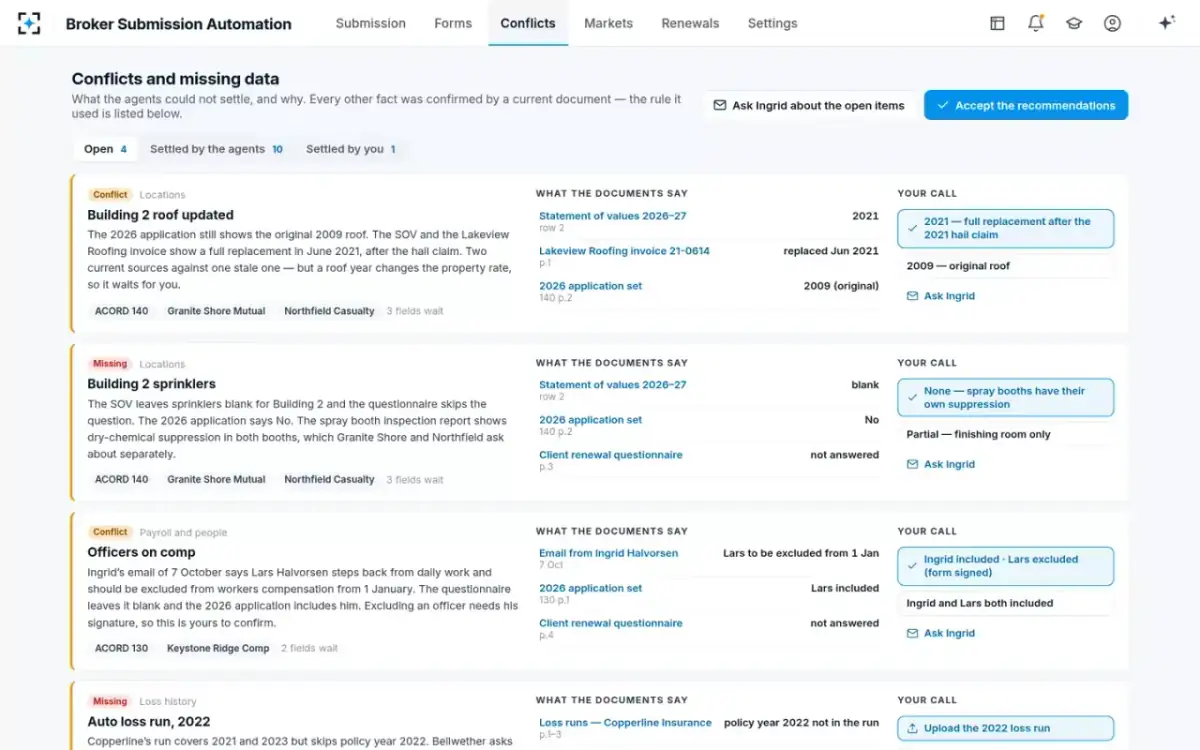
Under the UK Act a blank can sometimes be enough, but only in a narrow sense: the duty is met if the insured discloses enough to put a prudent insurer on notice that it needs to make further enquiries (section 3(4)(b)). That is a fallback, not a strategy. The safe rule is that no supplement question goes out blank: answer it, write "not applicable" where that is true, or say "being confirmed" and confirm it before binding.
Can I reuse answers from last year's supplement?
Only as a starting point, and never as the confirmation. Last year's supplement is the document most likely to be stale, because it was right for last year. In the sample, last year's application still showed a 2009 roof on a building whose roof was replaced in June 2021 after a hail claim; reused, that answer would have gone to two property insurers.
The solution's rules make the point mechanical: values from documents older than twelve months are marked as prior, last year's application never confirms a value on its own, and rating facts such as roof year, sprinklers, officers, class codes and losses go to a person even when current sources agree. Reusing last year's answers is how a supplement drifts from the truth one renewal at a time.
Are supplemental applications part of the policy?
They can be: an application's declaration or the policy itself may state that the application and its supplements form part of the contract, or the basis on which it was issued. What that means depends on the law. In Florida, statements in an application are representations, not warranties, so a wrong answer defeats recovery only on the statute's conditions. In UK business insurance, the Insurance Act 2015 went further: "This section abolishes basis of the contract clauses in non-consumer insurance." (Explanatory Notes, paragraph 84, on section 9). A declaration on a UK supplement can no longer turn every answer into a warranty.
Incorporated or not, the answers are evidence of what the client told the insurer. That is the reason to keep, for every supplement answer, the fact it came from and who confirmed it. The same discipline applies to the presentation as a whole; the duty of fair presentation sets out the UK rules in full.
One fact, asked four ways: overlapping supplement questions
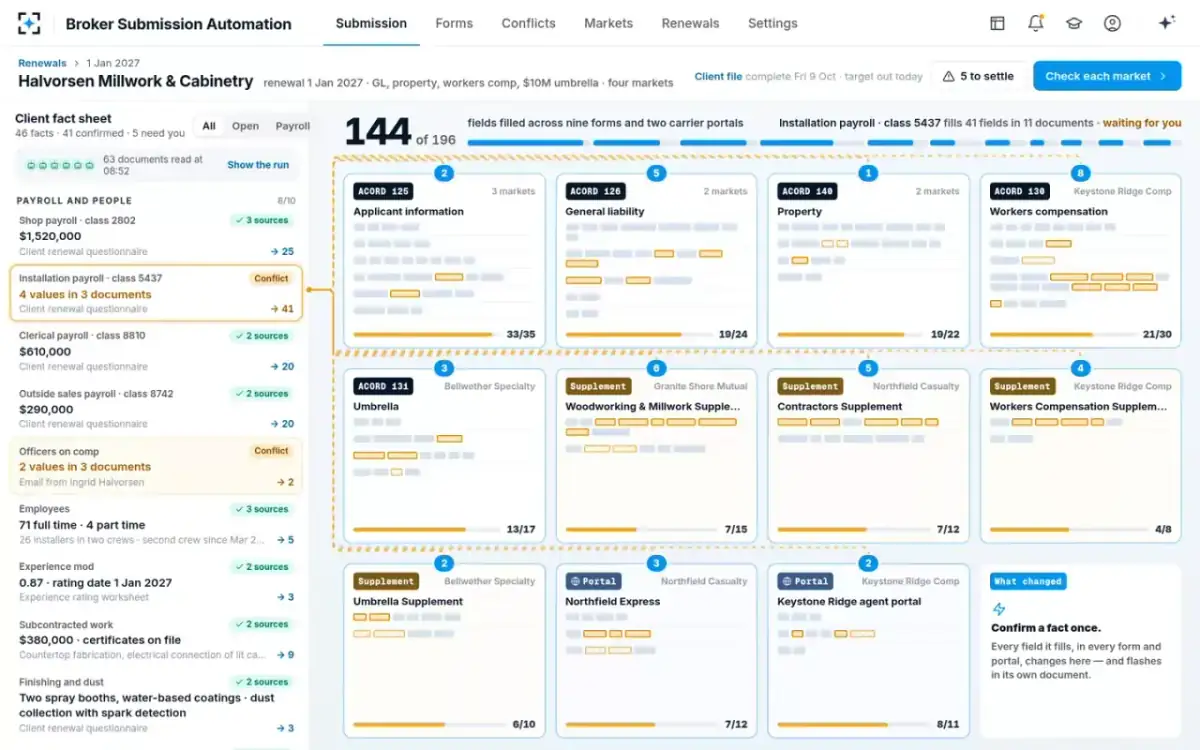
Most supplement questions are not new facts at all; they are facts already in the file, asked in an insurer's own words. Both general liability and property insurers in the sample asked about Building 2's protection, one through its own forms and one in its portal. The installation payroll that sets the general liability exposure is asked again, in a different form, by the contractors supplement and the workers' compensation application. The share of installation work done by the client's own crews, 81%, is asked on the contractors supplement and again in the same insurer's portal.
Typed by hand, each of those is a fresh chance for two insurers to receive two answers. Mapped, each points to one fact: installation payroll fills 41 fields in eleven documents in the sample, and once the account manager confirmed it at 10:14, every one of them changed together. The hard work in a supplement is therefore the small number of genuinely new questions, the ones no other document answers, and those are exactly the ones that should go to the client in writing.
How to keep every insurer's supplement mapped and current
Map each supplement once, field by field, to the client facts it asks for, keep the version with the map, and have a person approve a new version before it is used. In the sample agency the placement specialist owns that work: one place that records what each market asks for, which the agents check every package against. Supplements change when insurers change their guidelines, and an old map silently misses a new question.
Mapping is also where the questions only one insurer asks become visible. Once every supplement is mapped, the agency can see which questions are new facts for the client to supply, which are the same fact asked in different words, and which no document in the file answers. The last group is the client's to-do list for next year's questionnaire. How the maps sit with the agency's other systems is covered in ACORD form software for insurance agents.
Every market's forms, supplement and portal, with what it asks for
Answering a supplement: six rules for the account team
- Answer from this year's documents, not last year's supplement
Use last year's answers to know what to look for, never as the answer.
- Never send a blank
Answer, write "not applicable", or mark it "being confirmed" and confirm before binding.
- Send rating facts to a person
Roof year, protection, officers, class, losses: a person confirms even when documents agree.
- Give the same fact to every insurer
Overlapping questions in different words must get the same answer.
- Ask the client what no document answers
And add the question to next year's renewal questionnaire.
- Have the client sign
The answers are the client's representations; the signature shows it.
Questions people ask
How do you handle a supplement question you cannot answer?
Say so in the answer and find out before binding, rather than guess or leave it blank. If the client does not know, write what is known and what is being confirmed; under the UK Act, disclosure that puts the insurer on notice to ask further questions can satisfy the duty where full disclosure has not been made.
Does a broker's own questionnaire limit what the client must disclose?
No. In Cometsambre v Lloyd's Insurance Company (2026), the court noted that "The questionnaire was one prepared by Cometsambre’s own broker", so its narrow question about claims showed nothing about what the insurer wanted to know, and the undisclosed fires let the insurer avoid the policy. An insurer's own supplement shows its interests; a broker's form does not limit them.
Why do carriers require supplemental applications?
To ask about the hazards of a particular class or line that the standard application does not cover, such as finishing operations, roof work or liquor sales. In New York, an insurer's practice with similar risks is admissible evidence of whether a misstatement was material, and a supplement is that practice in writing.
Are supplemental applications part of the policy?
They can be, by reference, and the effect depends on the law. Florida treats application statements as representations, not warranties; the UK abolished basis of the contract clauses for business insurance in section 9 of the Insurance Act 2015, so answers on a supplement are no longer automatically warranties there.
Can I reuse answers from last year's supplement?
Only to know what to ask. In the sample renewal last year's application still gave a 2009 roof for a building re-roofed in 2021, and reusing it would have sent the wrong roof year to two property insurers.