A misrepresentation on an insurance application is a statement of fact in the application, or in the talks before the policy is made, that turns out to be false. Whether it costs the insured anything depends on the law that governs the policy: in New York a misrepresentation can avoid the contract only if it was material, meaning the insurer would have refused the contract had it known the truth; Florida also counts a fact that would have changed the premium; and in the UK an insurer of a business can cut a claim in proportion to the premium it should have charged. In every version, the fight afterwards is about one figure and where it came from. Botminds' Broker Submission Automation is built so that the answer is on file before anyone asks: every value it puts in an application, supplement or portal carries the documents it came from and the person who confirmed it.
This guide follows one figure, the installation payroll of a fictional sample client, Halvorsen Millwork & Cabinetry, from four disagreeing documents to forty-one fields. The client, its agency and its insurers are invented; the statutes and the judgment quoted are real and linked where they appear. Nothing here is legal advice for a particular policy.
One payroll figure's path, each step with its source and who confirmed it
Agent
Client file readerLifts four values for installation payroll (class 5437), each with its page: the questionnaire's 2027 estimate $1,610,000 (p. 4); the payroll register annualized, $1,548,600; the July to September run rate, $1,642,800; last year's application, $1,240,000.
Never: Guesses a value a document does not give.
Agent
Fact reconcilerFinds the register 3.8% below the estimate, outside the agency's 2% tolerance, and explains why: the second installation crew started in March. Recommends the client's estimate.
Never: Chooses between conflicting current documents, or lets last year's application confirm a value.
A person decides
Account managerConfirms $1,610,000 at 10:14, with the reason on file.
Never: Is skipped: the payroll sets the general liability exposure, the workers' compensation premium and the umbrella rating.
Agent
Form fillerFills 41 fields in nine forms and two portals; recalculates the workers' compensation rating worksheet; records each field's before and after.
Never: Fills a field without a confirmed fact.
A person decides
The clientThe client's CFO e-signs the ACORD 125 and 130 at 10:32, making the statements her company's own.
Never: Is presented with figures she cannot trace.
What counts as a misrepresentation on an insurance application?
A misrepresentation is a false statement of past or present fact made to the insurer to induce it to make the contract, whether the applicant writes it or someone writes it for them. New York's Insurance Law defines a representation as a statement made "by, or by the authority of, the applicant for insurance or the prospective insured" before the contract, and a misrepresentation as a false one (§ 3105(a)). An application filled in by an agency and signed by the client is the client's representation.
Three kinds of statement cause most of the trouble on a commercial application. Exposure figures, such as payroll, sales and vehicle counts, which are estimates and change. Physical facts, such as a roof year or whether a building is sprinklered, which are true or false on the day. And history, such as prior losses, cancellations and claims, which a client may remember differently from the insurer's records. An estimate made honestly is not false because the year turns out differently; a roof year copied from last year's application after the roof was replaced is.
Florida's statute adds an important distinction: what an applicant states in an application or in negotiations is a representation and not a warranty, so a misstatement does not defeat recovery automatically, only on the conditions the statute sets out (Fla. Stat. § 627.409(1)). The next section compares those conditions.
When is a misrepresentation material? New York, Florida and the UK compared
A misrepresentation is material when the truth would have changed the insurer's decision, but jurisdictions draw "changed" in different places. New York's statute opens with the principle: "No misrepresentation shall avoid any contract of insurance or defeat recovery thereunder unless such misrepresentation was material." The comparison below shows how three regimes then define the word.
Three tests for a material misrepresentation, and what each means for a payroll figure
The test, in the law's words or close to them: Material only if knowing the true facts would have led the insurer to refuse to make the contract. Evidence of the insurer's practice with similar risks is admissible.
What it means for a wrong payroll: The question is refusal. An insurer that would have written the account at a higher premium has to show more than a price difference.
The test, in the law's words or close to them: Recovery can be prevented if, knowing the true facts, the insurer in good faith would not have issued the policy, "would not have issued it at the same premium rate," would not have issued as large an amount, or would not have covered the hazard that caused the loss.
What it means for a wrong payroll: A figure that changes the premium can be enough. The premium-rate test is the one a payroll understatement meets most easily.
The test, in the law's words or close to them: "A circumstance or representation is material if it would influence the judgement of a prudent insurer in determining whether to take the risk and, if so, on what terms." The insurer also has to show it was induced: that it would not have written the contract, or only on different terms.
What it means for a wrong payroll: Price is a term. If the insurer would have charged more, it can reduce the claim in proportion (see the worked example below).
For a broker, the practical point is that "material" is judged by the insurer's own underwriting, which the broker can see in the insurer's questions. A question that appears on an insurer's supplement is evidence that the insurer cares about the answer; supplemental application insurance works through what that means for the questions only one insurer asks.
Two documents that disagree: what the submission file should show
When documents disagree, the file should show every value, the reason they differ and who chose, before the application is signed. The sample's payroll is a clean example because none of the four figures is a lie. The questionnaire gives the client's 2027 estimate. The register is a correct record of the first nine months, annualized, but understates a year in which the second crew works all twelve months. The run rate overstates it slightly. Last year's application was right for last year.
An account manager working by hand would most likely copy one figure into the first form, perhaps last year's out of habit, and the others into later forms as the documents came to hand. The danger is not the choice; it is that the choice is invisible, and different insurers can end up with different payrolls. Once the account manager confirmed $1,610,000, the same figure, with the same reason, went into every field that needed it.
The ACORD 130 after the payroll was confirmed: every value with its source
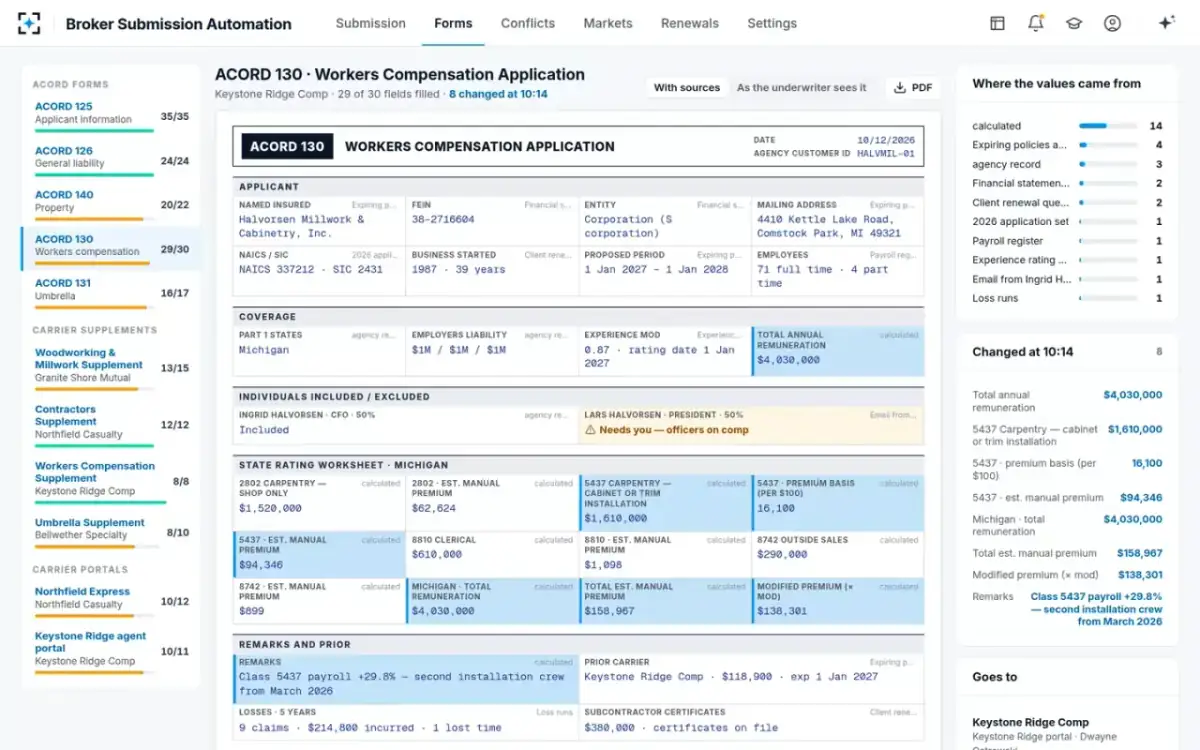
What happens if payroll is wrong on an insurance application?
For workers' compensation and most general liability rated on payroll, the payroll on the application is an estimate, and the final premium is set by an audit after the policy year. Examiners check that insurers which audit have a structured system for verifying final premium from payroll records (NAIC Market Regulation Handbook, chapter 21, standard 9). So a payroll that turns out higher than estimated usually means an additional premium at audit, not a lost claim.
That is not the end of it. An estimate made without the information the client had, such as a second crew already hired, can still be a misrepresentation; and the classification the payroll sits in, the split between own employees and subcontractors, and the officers included are statements of fact, not estimates. A large audit bill is also a client-relations problem for the agency that submitted the estimate. Under the UK Act, where the insurer would have charged more, the remedy is arithmetic, and the sample's figures show how it works.
If the stale payroll had gone in: the UK's proportionate reduction, worked on the sample figures
| Step | Calculation | Result |
|---|---|---|
| 1. Rate per $100 of installation payroll | $94,346 ÷ 16,100 | $5.86 |
| 2. Manual premium on last year's payroll | 12,400 × $5.86 | $72,664 |
| 3. Total manual premium that would have been charged | $158,967 − $94,346 + $72,664 | $137,285 |
| 4. Premium actually charged, at the 0.87 mod | $137,285 × 0.87 | $119,438 |
| 5. Premium the true payroll calls for | $158,967 × 0.87 | $138,301 |
| 6. Share of a claim the insurer pays (X%) | $119,438 ÷ $138,301 × 100 | 86.4% |
| 7. On a $250,000 claim | 86.4% × $250,000 | $215,900 |
Under the Act, if the insurer would have entered into the contract but at a higher premium, "the insurer may reduce proportionately the amount to be paid on a claim" (Schedule 1, paragraph 6). The point of the table is the size of the effect: a payroll 23% too low on one class costs about 14% of every claim. The duty of fair presentation sets out the Act's other remedies, including avoidance.
Is an honest mistake on an application a misrepresentation?
Often, yes: in most regimes a statement can be a misrepresentation without any intent to deceive, and intent changes the remedy rather than the label. New York's statute requires the misrepresentation to have been intentional only for certain hospital, medical, surgical and prescription drug expense policies (§ 3105(b)(2)); for a commercial property or casualty application, materiality is the test. Florida's statute lists fraud as one route and materiality as another.
The UK Act is explicit. Its explanatory notes say that in business insurance, "“Innocent” breaches of the duty will also give an insurer a remedy if the insurer can show inducement" (paragraph 81). What the Act does reserve for deliberate or reckless breaches is the harshest remedy: the insurer may avoid the contract and keep the premium (section 8 and Schedule 1). An honest mistake costs less, but it is not free.
Who is responsible if the agent filled in the application wrong?
Toward the insurer, the client is: the application is the client's representation, made by the client or on its authority, and the client signs it. Between the client and the agency, the question becomes whether the agency used reasonable care in transcribing what the client gave it, which is an errors and omissions question. No government or research body publishes how often such claims arise, so the honest advice is about evidence, not odds.
The evidence that settles it is the one this page keeps returning to: which document the figure came from and who chose it. If the client's questionnaire said $1,610,000 and the application said $1,240,000, the agency has a problem. If the application says what the questionnaire said, and the file shows the client's CFO signed it, the agency has a defence. The duties that produce that file are set out seat by seat in commercial insurance account manager duties.
Confirmed once: the payroll's forty-one fields change together, and the change is listed
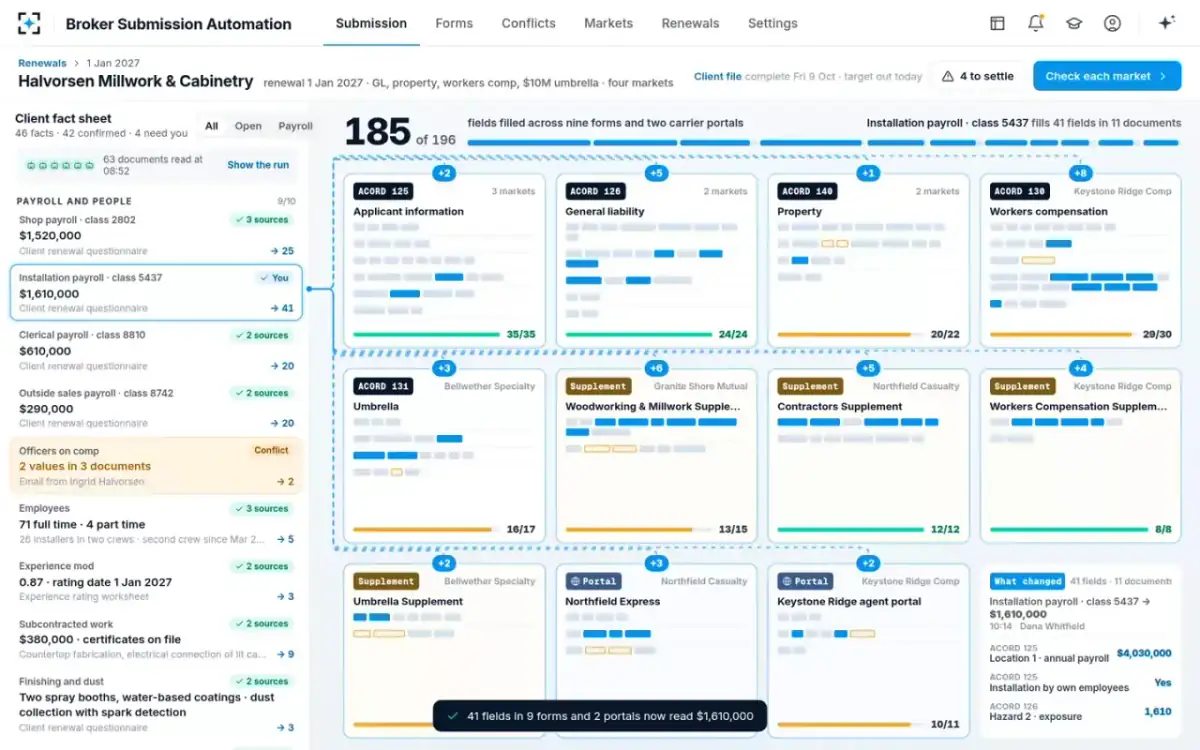
How do you correct an insurance application after submission?
Before the policy is bound, by telling the insurer in writing at once; afterwards, by telling the insurer and letting it decide what follows. The UK Act states the first half directly: "A representation may be withdrawn or corrected before the contract of insurance is entered into" (section 7(6)). A correction sent to one insurer should go to every insurer that received the same figure, which is easy to forget when four submissions were built separately.
After binding, a correction is still better than silence. A misstatement found and reported by the insured is a conversation about premium; the same misstatement found by the insurer after a claim is a coverage dispute. Examiners expect underwriting decisions to rest on information gathered at or near inception rather than information developed after a claim (NAIC exam standards), and at each renewal the presentation starts again, so the next application is the natural place to put the record straight.
The control that matters: a source and a confirmer for every submitted value
Every value that leaves the agency should be able to answer two questions on demand: which document says so, and who decided it was the right one. Everything else on this page, materiality, remedies, correction, is easier to handle when those answers exist.
Before an application is signed: six checks on the figures in it
- Every exposure figure names its document and page
Payroll by class, sales, vehicle counts, square footage. If it came from the client's questionnaire, say which page.
- Last year's application never confirms a value alone
It is the document most likely to be stale. In the sample it still showed a 2009 roof that was replaced in 2021.
- Disagreements are settled by a named person, with the reason
The reason travels with the figure: "second crew from March" explains a 29.8% rise before an underwriter asks.
- Changed rating facts go to a person even when sources agree
Roof year, sprinklers, officers, class codes and losses change the price; two documents agreeing is not the same as the client confirming.
- The same figure goes to every insurer
Four submissions with three payrolls is a misrepresentation waiting for whichever insurer has the claim.
- The client signs what the client stated
By e-signature if you like; the statements are the client's, and the signature makes that visible.
Questions people ask
What is a material misrepresentation?
A false statement that would have changed the insurer's decision. New York asks whether the insurer would have refused the contract; Florida also counts a different premium or amount; the UK asks whether it would have influenced a prudent insurer and whether this insurer was actually induced. A difference so small that a prudent insurer would not consider it material leaves a representation "substantially correct" under the UK Act.
Can an insurer rescind a policy for a mistake on the application?
Only if the mistake meets the governing test of materiality, and the remedy varies. In New York a material misrepresentation can avoid the contract; in the UK, an innocent breach lets the insurer avoid only if it would not have written the risk at all, and it must then return the premium. Where it would have charged more, it reduces claims proportionately instead.
What happens if payroll is wrong on an insurance application?
On payroll-rated workers' compensation and general liability, the premium is usually corrected at the audit after the policy year. A figure understated without regard to information the client had, or a payroll in the wrong class, can still be a misrepresentation, and in the sample a stale payroll would have understated the modified premium by $18,863.
Is an honest mistake on an application misrepresentation?
Generally yes, if it is material. New York requires intent only for certain health policies, and the UK Act gives an insurer a remedy for an innocent breach if it can show inducement. Intent matters to the remedy: a deliberate or reckless breach under the UK Act lets the insurer avoid the policy and keep the premium.
How long can an insurer challenge an application?
For commercial property and casualty policies the question usually arises when a claim is made, and the answer depends on the state's statute and the policy. English law treats each renewal as a new contract, as the explanatory notes to the UK Act point out, and a US renewal application restates the facts too, so an error carried forward from an old application is repeated, not cured, every year.
Who signs an insurance application?
The applicant, through an authorised officer for a business, because the statements are the applicant's. Agencies often complete the forms, but the signature makes them the client's representations. In the sample the client's CFO e-signed the ACORD 125 and 130, and the officer being excluded from workers' compensation signed the state exclusion form himself.