An insurance broker submission is the package a broker or agent sends to an insurer, on the client's behalf, to ask for a quote: the applications and line sections, that insurer's own supplement and portal answers, loss runs, schedules and a cover letter. When an account is remarketed, the same client facts go to several insurers, and most of the time the packages are built in turn, one market's forms after another's, because one person keys them. That order is not a rule of the market; it is a consequence of retyping. Once the client's facts are confirmed once, every market's package can be built and checked at the same moment, and the only steps that genuinely have to happen in order are confirming the facts, the client's signature, the producer's approval and the release. Botminds' Broker Submission Automation is built on that: its agents fill every insurer's forms, supplements and portal answers from one set of confirmed facts, so four packages are ready together.
The examples follow a fictional sample renewal, Halvorsen Millwork & Cabinetry, placed by the fictional Corbett Lane Insurance Partners with four invented insurers. Hours are Botminds' estimates; times on the sample day come from the solution's activity record. Nothing here is a customer's measured result.
Serial by hand, parallel after one confirmation: twenty hours of work against four
- Read the file3 h
- Conflicts3 h
- Market 13.5 h
- Market 2 + portal4.5 h
- Market 32.5 h
- Market 42.5 h
- Sign1 h
- All four, reviewed4 h
What is an insurance broker submission?
It is the client's request for a quote, assembled by the broker for a particular insurer, with everything that insurer needs to decide whether to quote and at what price. BLS describes brokers as working for the client: "They represent their clients, rather than insurers", and because independent brokers are not tied to an insurer, BLS adds, they "must involve an insurer or insurance agent to complete a sale". The submission is that involvement, in writing.
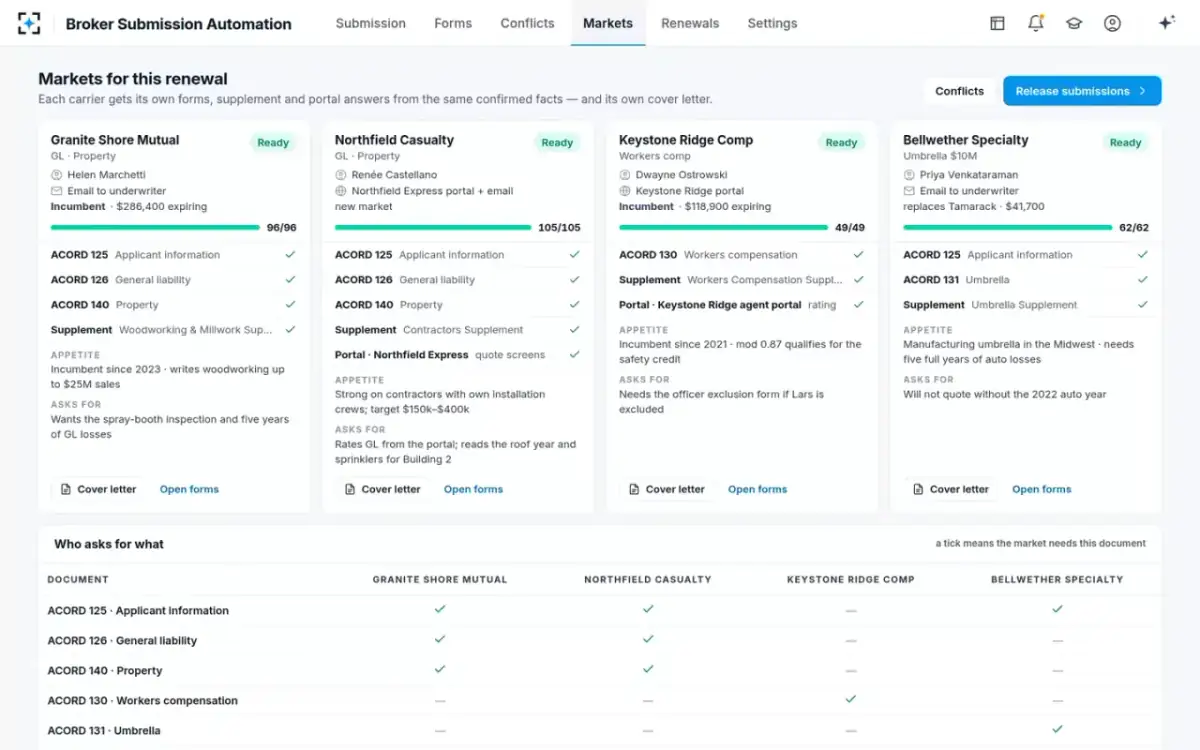
What goes in depends on the insurer. In the sample renewal the four packages differed: two insurers took the common application with the general liability and property sections and their own supplements, one of them also rating in its portal; the workers' compensation insurer took its own application, supplement and agent portal; the umbrella insurer took the common application, the umbrella section, its supplement and five full years of auto losses. The cover letter for each is the subject of the commercial insurance submission template.
Why insurance broker submissions go out one market at a time
Because one person types them, and typing is serial. By hand, an account manager builds the first insurer's forms, then the second's, then enters the second insurer's portal, then the workers' compensation application, then the umbrella. Each package takes hours, so the first is ready days before the last, and the facts can drift between them: a corrected payroll reaches the third package but not the first.
Serial building has a second cost that is easy to miss. The first insurer receives the account earliest and has the longest to quote; the last receives it latest and may have the least information if it was the one waiting on a missing document. In the sample, the umbrella market would not quote without a loss year one auto insurer's run had skipped, and by hand that package would have sat at the back of the queue until the document arrived, while the others went out with whatever loss history they had.
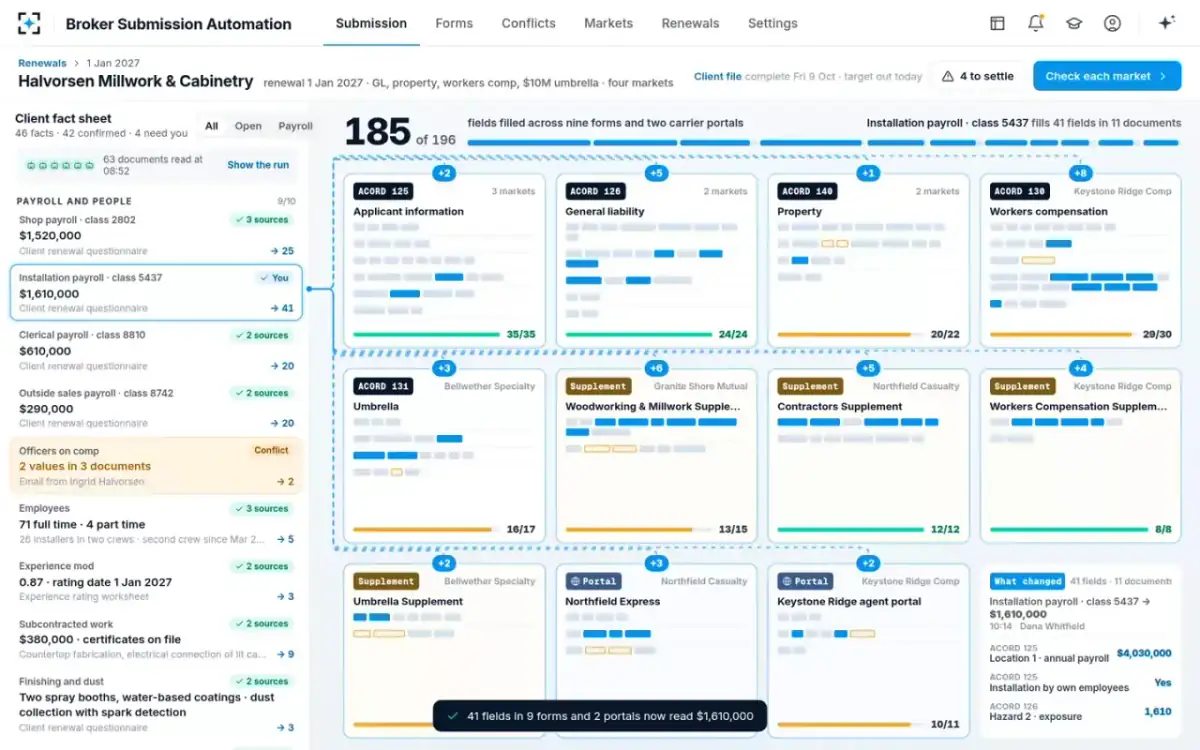
One confirmation, eleven documents: every market's package changes at once
The steps of a broker submission that must happen in order
Only four: settle the facts, have the client sign, have the producer approve, then release. Everything between the first and the second can run in parallel across markets. The flow below is the sample renewal's day, with the times the solution recorded.
Broker Submission Automation: the sequence that remains when packages are built in parallel
Agent
Read, reconcile, fill, draft (08:52)The agents read 63 documents, confirm 41 of 46 facts, fill every market's forms, supplements and portal answers, and draft four letters.
Never: Fill a field from an unconfirmed fact.
A person decides
Settle the open facts (10:12 to 10:26)The account manager confirms installation payroll, the roof year, sprinklers and the officer exclusion; the missing loss year arrives and is read.
Never: Is skipped on a rating fact.
A person decides
Client signs (10:32)The client's CFO e-signs the ACORD 125 and 130.
Never: Signs figures she cannot trace.
A person decides
Producer approves (10:36)Approves all four cover letters.
Never: Approves a letter stating an unconfirmed figure.
A person decides
Officer signs, account manager releases (10:39, 10:41)The excluded officer signs the state form; four submissions go out by email and portal.
Never: Release before every check passes.
Should submissions go to all markets at once?
Usually yes, with the same facts, unless there is a reason to stagger. Sending every market the same confirmed facts on the same day removes the drift between packages and gives each insurer the same time to quote. It also helps under English law, where a business insured owes each insurer a fair presentation (Insurance Act 2015, section 3) and a fact corrected for one insurer has to be corrected for all of them.
There are good reasons to stagger, and they are decisions rather than accidents. A broker may give the incumbent first sight of the renewal, hold a market back until the client approves the approach, or wait for an insurer's appetite answer before building its package. What parallel building changes is that those become choices made on purpose, not the side effect of how long the typing takes.
How many carriers should a broker submit to?
As many as can genuinely write the risk and the agency can genuinely place it with, and no more. There is no rule giving a number. In the United States the practical limit is appointments and appetite: a licence alone gives a producer no authority to represent or commit an insurer (NAIC Producer Licensing Model Act), so the markets a retail agency can place with directly are those it holds an agency agreement with, and the rest come through wholesalers. The sample went to four, each chosen for appetite: one writes woodworking risks up to $25 million in sales, one targets contractors with their own installation crews.
In the UK, the FCA's rules add a test for intermediaries that advertise breadth. Where an intermediary tells a customer it advises on the basis of a fair analysis, it must base that advice on enough of the market's contracts to support a recommendation (ICOBS 5.3.3R), a test read in full in the demands and needs statement. Choosing which insurers can write a class is its own discipline, starting from what underwriting appetite means.
What is a blocked market in a broker submission?
A blocked market is an insurer that will not take a second broker's submission for an account it has already received from another broker. It is the insurer's rule, applied at its intake, and it is a reason not to send every market everything without checking. Commercial Lines' guide to blocked market insurance meaning explains how insurers apply it.
Four markets, one renewal: each with its underwriter, delivery, appetite and what it asks for
How long do underwriters take to respond to a submission?
No regulator or research body publishes response times, and they vary by insurer, class and season. What the broker controls is the request: a date in the cover letter, and a package complete enough that the underwriter has no reason to write back before quoting. In the sample, each letter asked for an indication by Friday 6 November, a little under four weeks after release and eight weeks before the 1 January renewal.
Track the response time per market from release, not from the renewal date, and track the questions as well as the quotes. An underwriter's question that the file could have answered is a delay the broker caused; counting them by cause is how a desk gets faster. Insurance broker automation sets out which of those tasks agents can take on.
When do brokers release a submission?
When every check for that market has passed, and early enough for the insurers to quote and the client to decide before the renewal date. In New York, an insurer that intends not to renew a commercial policy, or to renew it on worse terms, must give notice at least 60 and no more than 120 days before expiry, with a copy to the broker (N.Y. Ins. Law § 3426(e)); a broker who starts work about 120 days out sees those notices arrive. The sample agency's setting starts renewal work 120 days before.
The checks before release are the same whichever market it is: every fact confirmed, every field filled, the client's signature on the applications, the producer's approval of the letter, and any form a market requires, such as the signed officer exclusion one insurer needed. In the sample all five were green at 10:41.
How do you track multiple carrier submissions?
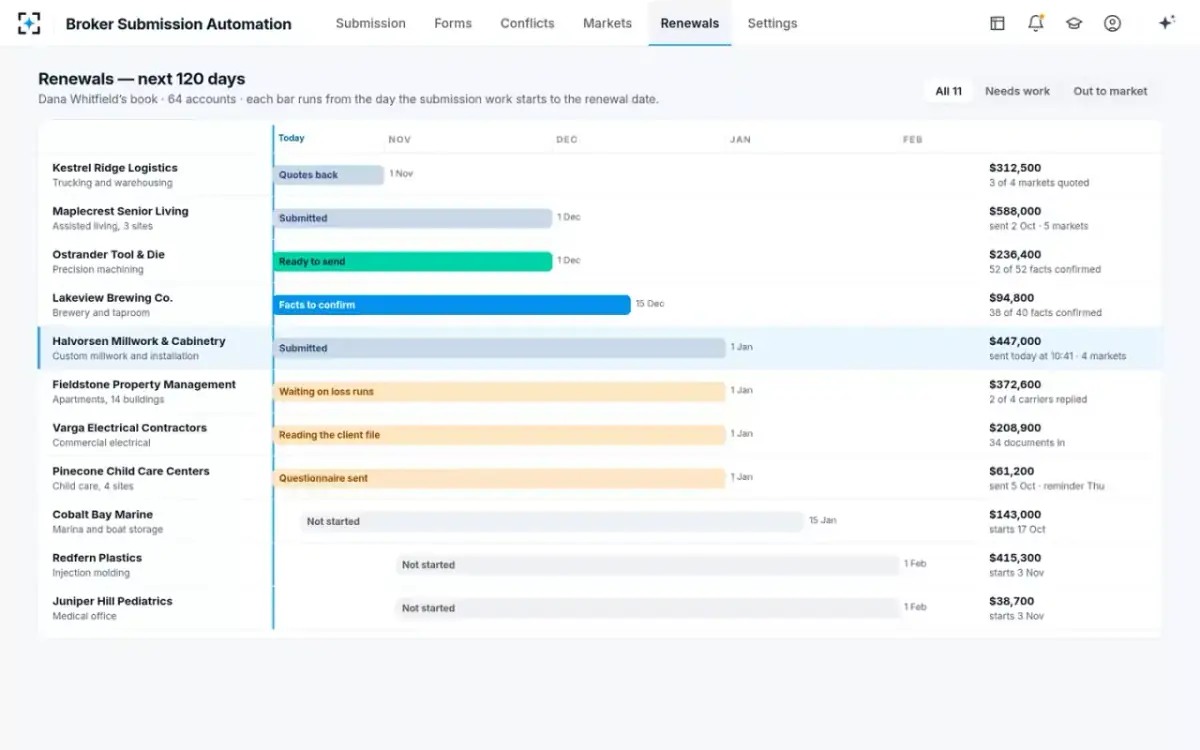
By market and by fact: one row per insurer showing what it was sent, when, what it still needs and what it has asked; and one list of the facts every package relies on, so a change reaches all of them. The renewal calendar above the account shows where each client sits between first request and renewal date.
Who waits on whom during a four-market submission
Today
Waits for the broker to say what is missing, often after the first package has gone.
With agents
Sees the five open questions on the morning the file is read and signs once.
Still theirs: The truth of the facts, and the signature.
Today
Waits on documents, then keys market after market; the last package leaves days after the first.
With agents
Settles the open facts, reviews four packages together and releases them together.
Still theirs: Every conflict, and the release.
Today
Waits for letters drafted last, under pressure, sometimes from memory.
With agents
Approves four letters that state only confirmed facts, at the same sitting.
Still theirs: Market strategy and the letter's final word.
Today
Receive the account on different days, sometimes with different figures.
With agents
Receive the same facts on the same day, each with the forms it asked for.
Still theirs: The decision to quote and the price.
The account manager's renewals, from first request to renewal date
A submission tracker should show, for every market
- What it was sent, and the version of each form
Applications, supplement, portal answers, loss runs, schedules, letter.
- When it was released, and by whom
Response time is measured from here.
- What it still needs
A missing loss year, an inspection report, a signed form.
- What it has asked, and the answer given
With the document the answer came from.
- Which facts its package relies on
So a corrected fact can be sent to every market that received the old one.
- The date it was asked to respond by
And whether a reminder has gone.
Questions people ask
Do all markets get the same submission?
They should get the same facts but not the same package. Each insurer asks for its own forms, supplement and portal answers; in the sample the four packages held 96, 105, 49 and 62 fields, built from one set of 46 confirmed facts.
What happens if a fact changes after submissions go out?
Tell every market that received it, promptly and in writing. Under the UK Insurance Act 2015 a representation may be withdrawn or corrected before the contract is entered into (section 7(6)); keeping a list of which packages used which facts is what makes that possible without missing one.
Can a broker submit to an insurer it is not appointed with?
A broker acting for the client is not the insurer's appointed agent, but placing the business still needs an insurer or agent that can bind it, which is why retail brokers reach some markets through wholesalers or agencies holding the appointment. Rules differ by state, so check the state where the risk is placed.
Who releases a broker submission?
A named person at the agency, usually the account manager, after the client has signed and the producer has approved the letters. In the sample the agents never submitted a portal page or emailed an insurer; the account manager released all four packages at 10:41.
How many carriers should a broker submit to?
No rule sets a number. Submit to markets that can write the class and that the agency can place with, checking appetite and blocked-market rules first; in the UK, an intermediary that claims to advise on a fair analysis must analyse a sufficiently large number of contracts on the market.