Underwriting appetite means the classes, sizes, locations and risk features an insurer, MGA or other market wants to write, and on what conditions. A risk inside a market's appetite gets an underwriter's attention; one outside it comes back "out of appetite", usually without being underwritten. Appetite is narrower than what the insurer is licensed to write and wider than what it will finally quote, and it is published to agents in appetite guides, bulletins, portal pages and underwriters' notes. Botminds' Carrier Appetite Search reads those sources and tells a retail agency which carriers, MGAs and wholesale markets will write a given risk, which is only possible if words like appetite, eligibility, appointment and declination each mean one thing.
They often do not. In agencies, "the market won't write it" can mean the class is excluded, the agency is not appointed, the state is not filed or the underwriter's book is full. The twelve definitions below tie each term to the rule or document that gives it meaning, so a new account manager can tell a market that may not write a risk from one that will not.
From the board's risk appetite to one line in an appetite guide
What does underwriting appetite mean?
It means what a market wants, not what it is allowed to do. An insurer may be licensed for commercial multiple peril in a state and still have no appetite for restaurants with late liquor; an MGA may have binding authority for contractors and no appetite for roofers. The FCA, describing London brokers, uses the word in exactly this sense: the broker's job is to find insurers that have the capacity, the risk appetite and the financial strength to underwrite each risk (FCA, Wholesale Insurance Broker Market Study, 2019).
Appetite comes in degrees. Most guides sort classes into something like target, acceptable, refer and excluded, and attach conditions to each: a building size, a sprinkler requirement, a loss-free period. "Underwriting appetite" and "carrier appetite" are the same idea seen from the insurer's desk and from the agent's. "Market appetite" usually means the same thing for a group of markets, or the market as a whole.
Twelve market terms, each with where it is written
| Term | What it means | Where it is written |
|---|---|---|
| Underwriting appetite | The risks a market wants to write, and on what conditions | Appetite guides, bulletins, portals, underwriters’ notes |
| Risk appetite | The insurer’s overall principles on risk-taking, set by its board | The insurer’s ORSA and risk policy (NAIC ORSA Guidance Manual) |
| Eligibility | Whether a risk meets the rules to be accepted at all | Underwriting guidelines; program rules |
| Target class | A class the market actively seeks, often on stated conditions | Appetite guides |
| Refer | Inside appetite only with an underwriter’s approval | Appetite guides; binding authority limits |
| Out of appetite / declination | A refusal because the risk is outside the written appetite | The market’s reply; the agency’s file |
| Admitted insurer | An insurer licensed in the state | 15 U.S.C. § 8206 and state law |
| Nonadmitted insurer | An insurer not licensed in the state, reached through surplus lines | 15 U.S.C. § 8206 and state law |
| Appointment | An insurer’s authorisation for a producer to act as its agent | NAIC Model #218 §14 and state law |
| Binding authority | Authority to accept risks and issue cover for an insurer | The insurer’s contract with an agent or MGA; Model #225 |
| Diligent search | The admitted-market search required before surplus lines | State surplus lines law, e.g. N.C. Gen. Stat. § 58-21-15 |
| Target market | In the UK, the group of customers a product is designed for | FCA Handbook, PROD 4 |
What is risk appetite in insurance, and how is it different?
Risk appetite is the board-level statement an insurer makes about how much risk it will take overall; underwriting appetite is one of the ways that statement reaches the market. The NAIC's guidance on the own risk and solvency assessment defines risk appetite as documenting "the overall principles that a company follows with respect to risk-taking, given its business strategy, financial soundness objectives, and capital resources" (NAIC ORSA Guidance Manual, December 2026). The same manual calls "a formal risk appetite statement and associated risk tolerances and limits" "foundational elements of risk management for an insurer".
Between the two sit tolerances and limits. The manual describes a risk limit as a quantitative boundary that may be set "by type of risk, category within a type of risk, product or line of business". An appetite guide's statement that a market will write woodworking risks up to $15 million in total insured value per location is a limit of that kind, turned into a sentence an agent can act on. When a board tightens its tolerance for property catastrophe or liability, the guide is where an agency first sees it.
What is the difference between appetite and eligibility?
Eligibility is a test a risk must pass; appetite is how much the market wants it. A risk can be eligible and still unwanted: a class the underwriting rules allow, in a state where the market has written enough of it this year. A risk can also be wanted and ineligible: a target class in a building that fails the construction rule. Agents get caught between the two when a guide lists a class as acceptable and the underwriter declines it on a condition the guide put on another page.
Appetite vs eligibility, for the same restaurant risk
Appetite: Does the market want risks like this one?
Eligibility: Does this risk meet the market’s rules to be accepted?
Appetite: “Family restaurants are a target class; bars are excluded.”
Eligibility: “Cooking operations require a hood suppression system and semi-annual cleaning.”
Appetite: The market’s results, capacity or strategy change
Eligibility: The underwriting rules are revised
Appetite: Guide summaries, bulletins, underwriters’ emails
Eligibility: Guide conditions, applications, supplements
Appetite: A predictable decline and some goodwill
Eligibility: A decline after underwriting, or a cover problem later
What is a target class in insurance?
A target class is one a market actively wants and will usually price to win, often with conditions. "Cabinet, millwork and woodworking manufacturers are a target class in all five states when the building is 100% sprinklered and dust collection is ducted outside", from a fictional market in the sample library behind this page, is typical: the class is wanted only with two protections stated. Leave either out of the submission, and the same risk drops out of appetite.
Below target, guides tend to use "acceptable" (written on the market's normal terms), "refer" (only with an underwriter's approval, or above an MGA's authority) and "excluded" or "prohibited". The words are the market's own and vary between guides, which is why an appetite search should quote the passage rather than translate it.
Reading a guide: the words that change the answer
- “Target” or “preferred”
Wanted, usually on stated conditions. Read the conditions before the class.
- “Acceptable” or “eligible”
Written on normal terms if every condition is met; not actively sought.
- “Refer” or “submit to underwriting”
Inside appetite only with an underwriter’s approval; slower, and often above an MGA’s authority.
- “Excluded”, “prohibited” or “ineligible”
Out of appetite. A submission will come back declined, usually unread.
- “Subject to” and footnotes
A condition on another page or in a table can turn a target class into a decline.
- Effective date and edition
The words above mean nothing without the date they took effect and the bulletin that may have changed them.
A target class, in the market's own words, on the page it came from
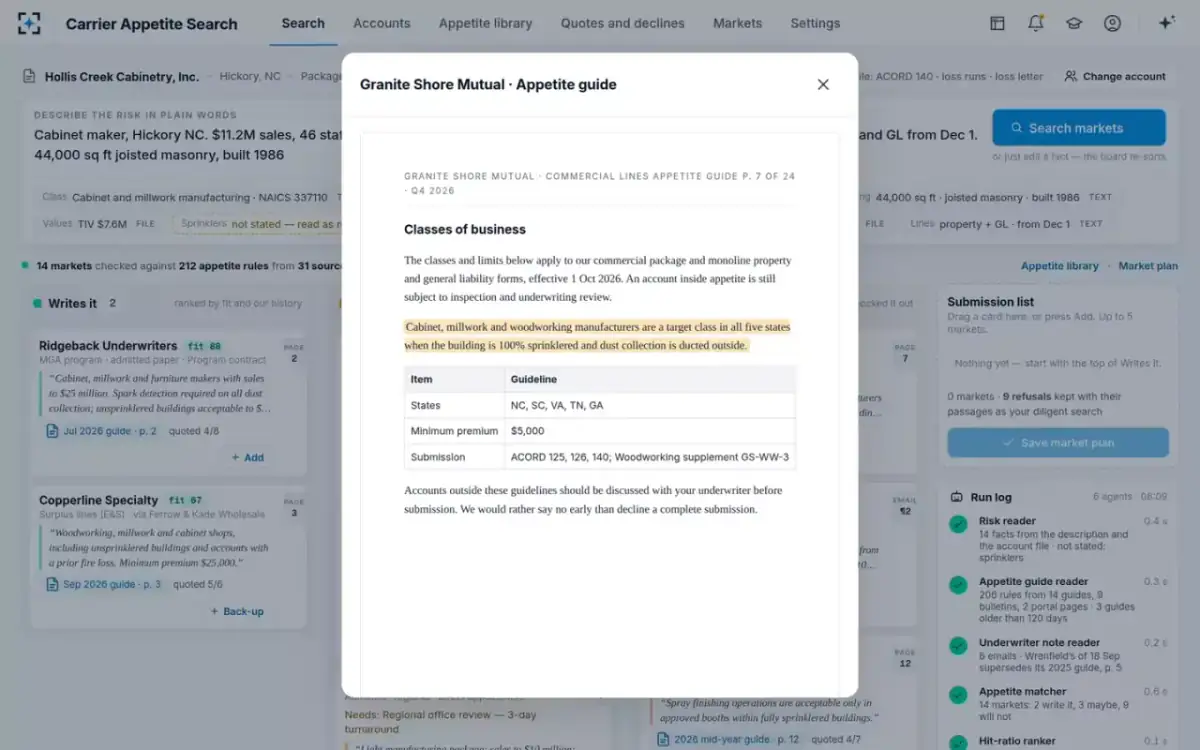
The guide's own footer is worth reading too: “We would rather say no early than decline a complete submission.” That sentence is an underwriter asking agents to check appetite first.
What does out of appetite mean, and what is a declination?
"Out of appetite" means the risk is outside what the market has said it wants, so it is declined without being underwritten. A declination is the market's refusal, of any kind, and in surplus lines placements the word has a legal job: it is the evidence of the admitted-market search. Out of appetite insurance covers how to code and replay declines.
A declination counts toward a diligent search only from the right kind of insurer. North Carolina, for example, requires the search to be made among admitted insurers that actually write that kind and class of insurance in the state (N.C. Gen. Stat. § 58-21-15). A refusal from an insurer that does not write the class there was never part of the search.
What does admitted carrier mean, and what is surplus lines?
An admitted carrier is one licensed in the state. Federal law puts it in one line: an admitted insurer is "an insurer licensed to engage in the business of insurance in such State", and a nonadmitted insurer is "an insurer not licensed to engage in the business of insurance in such State" (15 U.S.C. § 8206). Admitted insurers file forms and, for many lines, rates with the state; nonadmitted insurers write through surplus lines brokers, mainly for risks the admitted market will not take.
Some states shortcut the admitted search for classes everyone knows the admitted market avoids. The NAIC's model on nonadmitted insurance allows a regulator to keep an export list of kinds of insurance for which no admitted market exists, on which a surplus lines licensee may place without first collecting declinations (NAIC Nonadmitted Insurance Model Act #870). Whether a state uses one, and what is on it, is a question for that state's law. Botminds' Surplus Lines Filing Compliance covers the filing side.
Licensed is not appointed, appointed is not willing, and willing is not quoted. Most mistakes in market selection come from treating one of those as another.
What does appointed mean for an insurance agent?
Appointed means the insurer has authorised the producer to act as its agent and notified the state. A licence alone does not do this: in the NAIC model, a licence gives its holder no authority to represent or commit an insurer, and a producer may not act as an insurer's agent unless appointed (NAIC Model #218, §2F and §14). For an appetite search, appointment is the line between a market the agency can send to today and one it reaches only through a wholesaler.
The difference between a contract and an appointment matters in practice. The agency agreement sets commission, authority and production terms; the appointment is the filing with the state that makes the relationship lawful.How to get appointed with insurance carriers covers both, and why the market list that matters is appetite crossed with appointment.
What is binding authority?
Binding authority is the power to accept a risk and put cover in force on an insurer's behalf, within written limits. Insurers grant it to some agents for small, standard risks and, much more widely, to MGAs and coverholders for whole programs. The NAIC's model on managing general agents treats underwriting itself as the authority to accept or reject risk for the insurer, and requires the insurer's contract with an MGA to state the types of risk, limits, territories and exclusions it may write (NAIC Model #225).
For a retail agent, an MGA's binding authority is its appetite in its most exact form: the classes and limits it may write without asking anyone. Anything outside it is referred to the insurer or declined. How an MGA underwriter reads those limits on the day is the subject of binder underwriting guidelines.
Target market: the UK's legal word for appetite
In the United Kingdom, appetite has a regulated counterpart. An insurer that manufactures a product within the FCA's product governance rules must identify its target market, which the FCA explains "should be understood as describing a group of customers sharing common characteristics at an abstract and generalised level" (FCA Handbook, PROD 4.2.19G). The distributor must understand it. A US appetite guide is the closest thing to that document, written for agents instead of a regulator. The FCA target market assessment sets out what UK brokers must hold.
Questions people ask
What does "market" mean in insurance placement?
A market is any insurer, MGA program, syndicate or wholesaler-reached insurer that could write a risk. "Marketing an account" means sending it to several markets for terms. The word covers capacity the agency reaches directly and capacity it reaches only through another broker, which is why a market list should show the route as well as the name.
What is a market of last resort?
A plan or insurer that accepts risks the voluntary market will not, often set up or required by the state. California calls its FAIR Plan the state's insurer of last resort for property. These plans have their own eligibility rules and limits, and they are not a substitute for checking the voluntary market's appetite first.
Is appetite the same as capacity?
No. Capacity is how much risk a market can take, set by its capital and reinsurance; appetite is how much of a kind it wants. A market can have appetite for a class and no capacity left in a region this year, which is why underwriters' notes about filled quotas matter as much as guides.
Why do markets change their appetite?
Because the board's risk appetite, the line's results and the reinsurance behind it change. When a line runs at a loss or reinsurance costs rise, limits tighten and guides follow; when results improve, classes reopen. The underwriter's email usually arrives before the new guide does.
What is a refer class?
A class the market will consider only with an underwriter's approval, usually because it carries a hazard the market wants to look at case by case. For an MGA, "refer" often means the risk is above its binding authority and must go to the insurer. A refer class is inside appetite, but slower.