To get appointed with an insurance carrier, an independent agency first agrees an agency contract with the carrier, usually after the carrier's marketing team has reviewed the agency's licences, errors and omissions cover, book of business and plans for the carrier's target classes. The carrier then files a notice of appointment with each state where the agency's producers will act for it. Only then may those producers act as the carrier's agents. The work takes weeks, which is why it has to be done before a risk needs the market, not after. Botminds' Carrier Appetite Search shows the other half of the picture: which carriers' written appetite fits the risks the agency actually writes, so the agency can see which appointments it lacks and which markets it already reaches only through a wholesaler.
The legal rule is short. In the NAIC's producer licensing model, a producer may act as an insurer's agent only once that insurer has appointed it, and a producer who is not acting as an insurer's agent needs no appointment at all (NAIC Model #218, §14A). Everything else on this page follows from that rule.
Appetite crossed with appointment: the gaps, and the route for each
Markets the agency wants: Writes it, at good terms, with an underwriter who knows the area
How it can reach them today: Not appointed. Route: ask for an appointment, with a book of that class to show; meanwhile, nothing direct
Markets the agency wants: Writes some of your classes; excludes others it wrote last year
How it can reach them today: Appointed. Route: direct, but only for the classes its current guide includes
Markets the agency wants: Writes exactly that class, on an insurer’s paper
How it can reach them today: Program contract, or through a wholesaler that holds one
Markets the agency wants: Writes what the admitted market will not
How it can reach them today: Through a wholesaler or surplus lines licensee, after the admitted search
Markets the agency wants: Still writes the class
How it can reach them today: Not appointed. Route: a wholesaler or an aggregator with access; or rebuild the relationship
How do I get appointed with insurance carriers?
In four steps: make the case, sign the contract, get the appointment filed and keep the production the contract expects. The case is the part agencies underestimate. A carrier appointing an agency is choosing a distributor for its appetite, and its marketing representative will want to see that the agency already writes, or can bring, the risks the carrier's guide targets, in the states it writes, with a loss history it can live with.
That is where an appetite library helps before any carrier is approached. Cross the agency's book (the classes and states it writes most) against every carrier's written appetite, and two lists fall out: carriers the agency is appointed with whose appetite no longer fits its book, and carriers it is not appointed with whose appetite fits it well. The second list is the appointment plan, and the first explains why some appointments produce nothing.
What is the difference between a contract and an appointment?
The contract is between the carrier and the agency; the appointment is the carrier's notice to the state. The agency agreement sets commission, binding authority if any, production expectations and termination terms. The appointment is the regulatory filing that makes the producer the carrier's agent in that state. Under the NAIC model the carrier must file it within 15 days of the agency contract or the first application (NAIC Model #218, §14B), and the NAIC's State Licensing Handbook reads that as whichever comes first, noting that Pennsylvania's version differs (NAIC State Licensing Handbook, §14 answers). The window is read state by state in just in time appointment states.
Not every state requires appointments. The Handbook explains that the model's appointment section was labelled optional only so that states without appointments, Colorado among them, could adopt the rest. And appointments attach to agents, not brokers: since a producer acting for the customer is not acting for the insurer, the Handbook's answer is that brokers are not appointed. The three permissions behind a sale are set side by side in insurance license vs appointment.
From first call to first submission: where the weeks go
- Build the case: book, classes, loss history2 wk
- Carrier review and visit4 wk
- Contract signed2 wk
- Appointment filed (law: within 15 days)≤ 2 wk
How long does it take to get contracted with insurance carriers?
Weeks, sometimes months, and most of it is the carrier's review, not the filing. No public source measures it, so ask the carrier's marketing representative for their own process and time it on your next two appointments. The filing at the end is bounded by law in states that follow the NAIC model; the review before it is bounded only by the carrier's interest in the agency.
The delay is the argument for working on appointments before a risk needs them. A non-renewal with 60 days' notice cannot wait for a 10-week contracting process, so the market that would have fitted is reached through a wholesaler or not at all. What a wasted week costs on a hard renewal shows why that matters.
Can I quote a carrier I am not appointed with?
Not as its agent. A producer who submits business to a carrier it is not appointed with, as that carrier's agent, is doing what the model law forbids, and regulators test for it in examinations: one of the NAIC's producer licensing standards checks that each producer was licensed, appointed and current on continuing education in the state where the application was taken (NAIC Market Regulation Handbook, examination standards, 2024). In states that let the carrier file within 15 days of the first application, a carrier may appoint a producer on its first submission, but that is the carrier's choice, not the agency's right.
The practical routes are a wholesaler or program administrator that holds the contract, or an aggregator that lends its appointments to member agencies. Each route works; each costs a share of commission and a step of distance from the underwriter.
What unappointed sales cost the carriers that allowed them
670
policies issued through 161 producers not appointed at the time of sale, one insurer in Kansas, 2016–2019
$60K
penalty in the Kansas consent order; the insurer neither admitted nor denied the violations
0%
error tolerance North Carolina examiners applied to unappointed or unlicensed producers
$41M
Connecticut collected from biennial producer appointment fees in fiscal 2026
The Kansas case shows where the risk lands: on the carrier as well as the producer. Over three years, the insurer issued 670 policies through 161 producers who were not appointed when they sold them, and its fix was a system that issues a policy only when licensing and appointment are both in place (Kansas consent order, 2020; the order is read in full in insurance license compliance). Carriers that have been through that will check an agency's appointment before they accept its submission. An agency that knows its own appointment map avoids the awkward phone call.
What do carriers require for an agency appointment?
Each carrier sets its own conditions, and they are usually in the agency agreement or the marketing team's application. Prepare for the items below; most are things the carrier must check anyway, because its regulator examines whether its producers are licensed and appointed, and because a new agency is a new channel for its appetite.
What to have ready before asking for an appointment
- The agency’s own licence, and its responsible licensed producer
An agency acting as a producer needs its own licence and a licensed person responsible for its compliance, under the NAIC model.
- Every producer’s licences, by state and line
The carrier will check them against state records before filing.
- Errors and omissions insurance
Limits and the insurer, current, with the renewal date.
- The book in the carrier’s target classes
Premium, policy count and loss history by class and state, matched to the carrier’s current guide.
- A premium plan
What the agency expects to place with the carrier in the first two years, and from which accounts.
- Systems and connectivity
How the agency will submit, quote and service: portal, upload or comparative rater.
- References and history
Years in business, other appointments, any regulatory actions or terminations.
What is a production requirement for a carrier appointment?
It is the premium or policy volume the carrier expects the agency to place, written into the agency agreement or applied at review. It is the carrier's way of rationing appointments: each appointment costs it filing fees in every state and support time, and in Connecticut alone those fees came to about $41 million in fiscal 2026 (Connecticut Insurance Department, 5 October 2026). An agency that misses the requirement for long enough may lose the appointment, which is why appointments with little production are fragile.
The London market shows the same economics in a different form. The FCA's study of wholesale broking found that retail brokers usually need a terms of business agreement with each insurer, carrying fixed costs and conditions such as a minimum amount of business that deter brokers without substantial volume (FCA, MS17/2.2, 2019). On both sides of the Atlantic, volume buys direct access; without it, the route runs through someone who has it.
Every market on the board shows how the agency reaches it
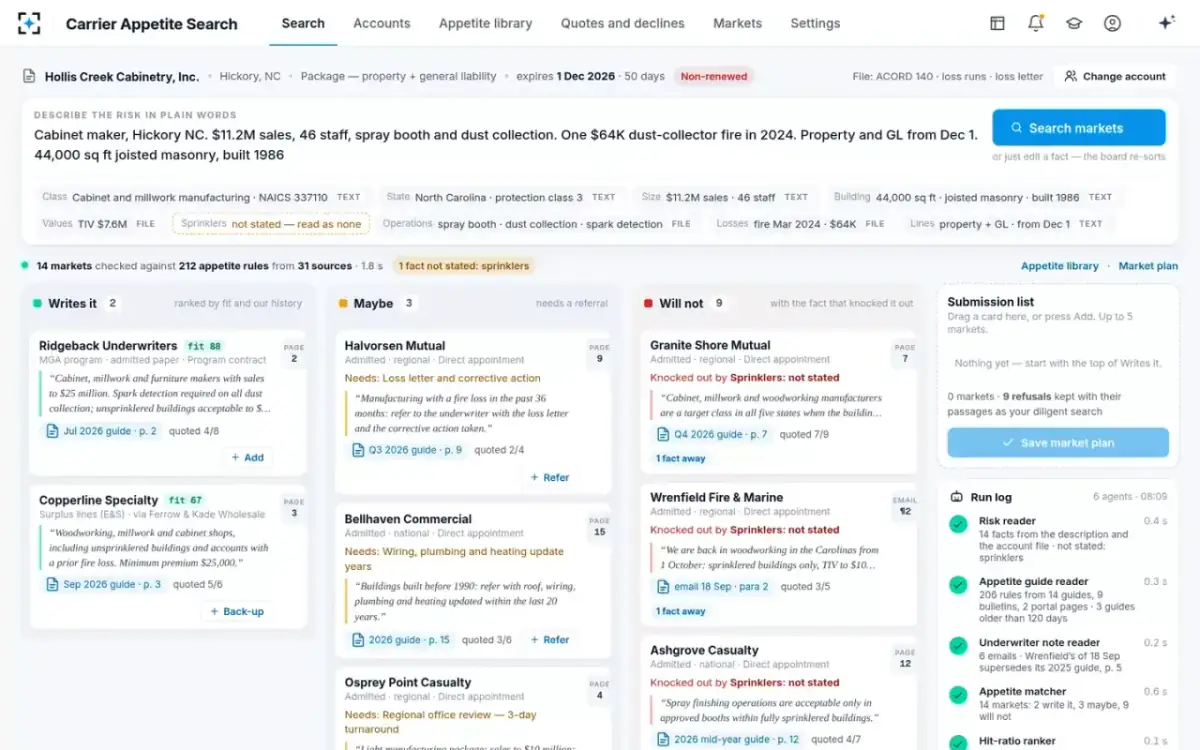
The surplus lines market in Writes it is marked as reached through a wholesaler. It can be used, but only after the admitted refusals are on file, and with a wholesaler's share of the commission.
How do independent agents get access to more markets?
Four ways, in rising order of independence: through wholesalers and program administrators, which hold contracts the agency does not; through an aggregator or network that lends member agencies its appointments in exchange for a share of commission; through direct appointments, earned with a book that fits the carrier's appetite; and through acquisition, by buying an agency that holds the appointments. Each has a cost, and the right mix depends on how much of the agency's book needs the market.
The appetite library answers that last question. Count, for the last year's submissions, how many went to each market through each route and how many of those fitted the market's written appetite. A carrier reached through a wholesaler forty times a year for risks inside its appetite is a candidate for a direct appointment; one reached twice is not. The appetite inventory lists what the library needs, starting with the appointment list itself.
Does a broker need a carrier appointment too?
Generally no, because appointment is about acting for the insurer. The NAIC Handbook's answer is direct: brokers are not appointed, so no appointment notice is filed for them (NAIC State Licensing Handbook). In practice US retail producers often act as the insurer's agent for some carriers and as the customer's broker for others, sometimes on the same day, and the appointment question turns on which role the producer is in for that placement. Check the state's law: some states keep separate agent and broker licences.
For an appetite search the distinction shows up as the route. A market the agency is appointed with is direct; a market it reaches as broker through a wholesaler is a referral. Wholesale broker vs MGA explains who acts for whom along that chain.
Questions people ask
Do I need an appointment in every state?
In states that require appointments, the carrier files one for each state where the producer will act as its agent. A producer licensed in many states but appointed in few can sell that carrier's products only where it is appointed. The National Insurance Producer Registry's systems carry these filings between carriers and states; it handled 185.9 million transactions in 2025 (NIPR).
Can a carrier terminate my appointment?
Yes. Under the NAIC model the carrier must notify the state within 30 days of terminating an appointment and send the producer a copy, and the agency agreement sets the commercial terms, including what happens to renewals. Low production, poor loss ratios and changes in the carrier's appetite are common reasons.
Is it better to join an aggregator or seek direct appointments?
It depends on volume. An aggregator gives a small or new agency access it could not earn alone, at the price of a share of commission and some control. Direct appointments pay better and bring a direct underwriter relationship, but only for agencies that can meet the production requirement. Many agencies do both.
Does a licence let me sell any carrier's products?
No. A licence lets a producer sell, solicit and negotiate the lines it covers; it gives no authority to act for any particular insurer. That authority comes from the carrier's contract and appointment, which is why the market list an agency can use is narrower than the list it is licensed to sell.
Will an appetite search show markets I am not appointed with?
It should, with the route. Carrier Appetite Search sorts every market in the agency's library, including wholesaler and program markets, and shows how each is reached, so an account manager sees a fitting market she cannot reach directly as a referral rather than a dead end.