Just in time appointment states are states where an insurer may file a producer's appointment after the producer has begun writing business for it, within a short window, instead of before the first sale. The phrase is industry shorthand, not a legal category, and no regulator publishes an official list. The rule behind it is the NAIC's Producer Licensing Model Act, which gives the insurer 15 days "from the date the agency contract is executed or the first insurance application is submitted", and the NAIC reads that as whichever of the two comes first. Some states copy those words, some count from a different event, and some allow 30 days. The window is generous on paper and unforgiving in practice: a policy bound on day one is lawful only if the filing lands in time, and nobody may notice the day it does not. Botminds' Producer Licensing & Appointment Management exists to watch that window for every sale, start the clock on the right date and put the filing in front of a person before it closes.
The rules below are quoted from the NAIC model and handbook and from state statutes and regulators' orders; the screens show the solution on a fictional sample agency.
The appointment window, drawn to scale in days
- Window opendays 0–15
- Window opendays 0–30
- 22 Sep–7 Oct: window runs out unseen15 d
- 7–12 Oct: late5 d late
What is a just in time appointment?
A just in time appointment is one the insurer files when it first needs it, triggered by the producer's first application, rather than in advance for every producer who might one day write. The model act allows it in a single sentence:
"To appoint a producer as its agent, the appointing insurer shall file, in a format approved by the insurance commissioner, a notice of appointment within fifteen (15) days from the date the agency contract is executed or the first insurance application is submitted."
NAIC Producer Licensing Model Act (#218), §14B
The NAIC's handbook settles how to read the "or". Asked whether a state could require the contract before the first application, the working group answered no: "The use of the word ‘or’ in the model clearly allows an insurer to notice appointment upon the earliest of the two events" (State Licensing Handbook, ch. 2, FAQ 3). The same answer flags the main exception: "Pennsylvania has adopted modified language and is not in complete agreement with this answer."
The opposite approach, often called pre-appointment, is to appoint a producer as soon as the contract is signed, whether or not business follows. It is simpler to police and more expensive to run, because states that renew appointments bill each one every cycle; the arithmetic is in insurance appointment fees by state.
How long does a carrier have to appoint an agent?
Fifteen days under the NAIC model, but the period and its starting event depend on the state. The table compares the wording of six jurisdictions with the model; read each statute itself before relying on a row.
When the appointment clock starts, and how long it runs
| Jurisdiction | Starts when | How long | Source |
|---|---|---|---|
| NAIC model | The agency contract is executed or the first application is submitted, whichever is earlier | 15 days | Model #218 §14B; Handbook FAQ 3 |
| New York | The agency contract is executed or the first insurance application is submitted | 15 days | N.Y. Ins. Law §2112(b) |
| North Carolina | The first insurance application is submitted | 15 days | N.C. Gen. Stat. §58-33-40(b) |
| Texas | The effective date of the appointment in the carrier’s record | 30 days | TDI form FIN507 |
| Kansas | The date the company appoints the agent | 30 days; late certification up to $25 a day | K.S.A. 40-4912, as quoted in a 2020 consent order |
| Pennsylvania | The appointment takes effect with the contract; filed after the effective date | 30 days | 31 Pa. Code §37a.21 (effective 12 Feb 2025) |
| Florida | Filed with its fee; the license must already be issued | No day count in §626.451 | Fla. Stat. §626.451(1) |
Texas spells out the practical effect of its 30 days. TDI's agency license application says "Written appointment verification from TDI is not required for an agent to be given supplies and allowed to accept business, if the appointment is filed within 30 days of its effective date in the carrier's record" (TDI, FIN507). Pennsylvania's rule works the other way round: where a contract exists, "the effective date of the appointment shall be the same as the effective date of the contract", and the filing follows within 30 days (31 Pa. Code §37a.21).
Which states are just in time appointment states?
There is no official list, and lists that circulate are someone's reading of 50 statutes on some date. The NAIC handbook describes the model's appointment section as optional only "to accommodate those states that do not require appointments (e.g., Colorado)" and recommends one appointment per producer per company, but it does not sort states into categories. The honest answer is to read each state's statute with three questions.
Three questions that place a state on the just in time spectrum
- Does the state require appointments at all?
If not, the question disappears; the NAIC handbook gives Colorado as the example. A license is then the only state permission.
- What event starts the clock?
The contract, the first application, the appointment’s own effective date, or whichever comes first. A first-application trigger is what makes a state “just in time”.
- How many days, and what happens on day one plus the window?
15 or 30 days in the states on this page; Kansas’s statute, as quoted in its 2020 order, adds a penalty of up to $25 a day for late certification.
Answered for every state where your producers write, those three questions give a rule table you can defend, with its source and date. That table, not a downloaded list, is what a licensing system should run on.
When does the 15-day clock start?
On the earlier of the two events, and for the application, on the day the insurer receives it. The NAIC's working group chose the insurer's receipt because it is the only date the insurer can know: "An application is submitted when it is dated received by the insurer" (Handbook, FAQ 2). A producer's mailing date, or the date a client signed, does not start the clock.
The clock also restarts. A producer who was appointed once, terminated and later sends a new application is treated as new: the handbook says the 15 days run "within 15 days of the date an insurer receives the first application submitted by a producer who is not currently appointed, even if that producer was previously appointed by that insurer" (Handbook, FAQ 17). In Pennsylvania a terminated appointment cannot be revived; the insurer files a new one with a new effective date.
Can an agent sell before being appointed?
In a just in time state, the first application can arrive before the appointment is filed; that is the point of the rule. The model's first sentence still applies, though: "An insurance producer shall not act as an agent of an insurer unless the insurance producer becomes an appointed agent of that insurer" (§14A). Read together with §14B, the producer may take the first application, and the insurer must make the appointment real within the window.
What the window never covers is the license. Florida's statute is blunt: "Every appointment is subject to the prior issuance of the appropriate agent's, adjuster's, service representative's, or customer representative's license" (Fla. Stat. §626.451(1)). A producer without a license for the line in the state cannot be cured by a fast appointment; that is the difference set out in insurance license vs appointment.
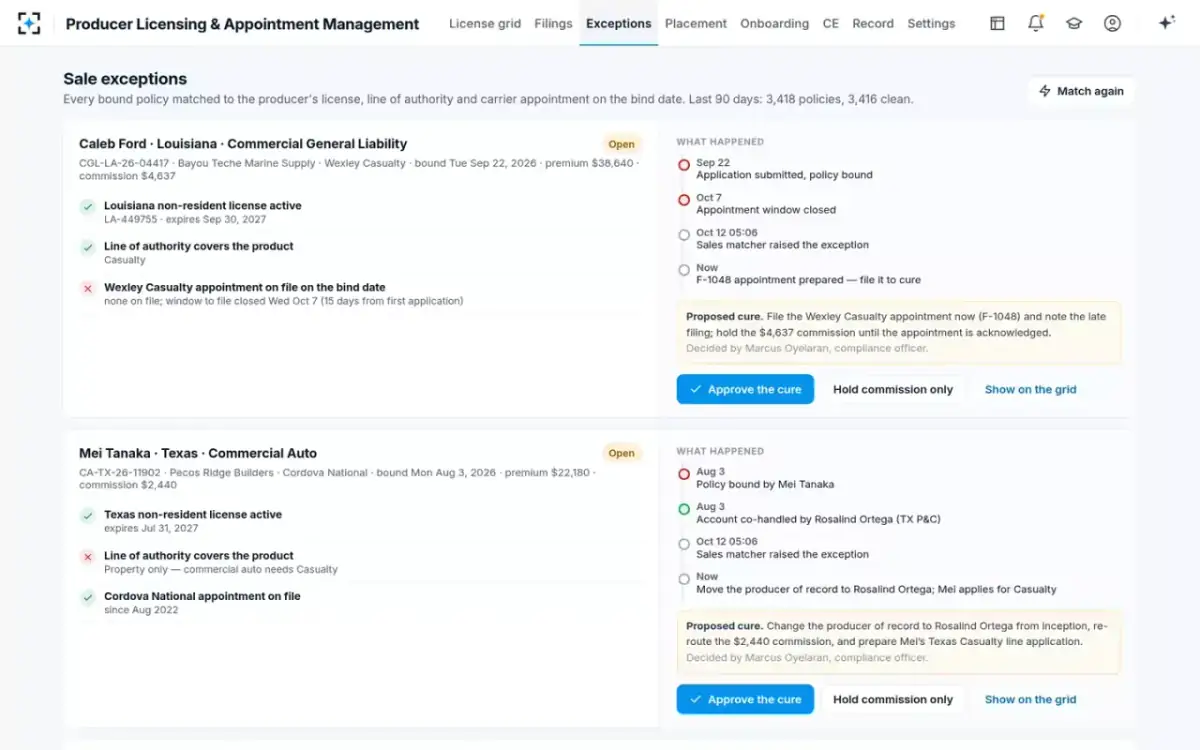
A late appointment, found on the morning after the run, with the cure proposed
What happens if an appointment is filed late?
Every policy written in the gap becomes a sale through an unappointed producer, and that is what examiners count. Kansas shows the scale it can reach. Its 2020 consent order with Employers Mutual Casualty Company, after an investigation of three years of Kansas sales, found that "670 policies were issued from 161 producers not appointed at the time of sale", and that "81 producers became appointed in Kansas after the date of sale" (Kansas Insurance Department, Docket 81589). The company neither admitted nor denied the allegations and agreed to a $60,000 penalty, half suspended, which included penalties for unpaid appointment fees.
Kansas, 2016–2019: producers behind sales without a license or appointment
The statute the order quotes adds a daily cost. Under K.S.A. 40-4912 as set out in the order, failure to certify an agent in time subjects the company "to a penalty of not more than $25 per calendar day" until the certification is recorded. North Carolina's exam of Builders Mutual shows the other route to a finding: producers not properly appointed on two of 50 commercial auto policies, a 4.0% error rate cited as a violation under a 0% tolerance (NCDOI, 2020). The examiner's side of that file is covered in insurance license compliance.
Do brokers need to be appointed?
Not when they act for the client rather than the insurer. The model act says so in its own section: "An insurance producer who is not acting as an agent of an insurer is not required to become appointed" (§14A). The NAIC's handbook draws the consequence: "Inasmuch as brokers are not appointed, notification of appointments of brokers is not required" (Handbook, FAQ 4).
The harder cases are producers who are both: an agent for the insurers that appoint them and a broker for business placed elsewhere. For those, each sale needs to carry the capacity it was written in, because the appointment test applies only to the agency sales. Federal law also bars any state other than the home state from imposing appointment requirements on members of the National Association of Registered Agents and Brokers created in 2015; whether that body is admitting members is a question to check before relying on it.
Watching the window sale by sale
The window is easy to keep for one producer and hard for thousands of policies, because the trigger is a document arriving, not a date on a calendar. The control that works is to tie the clock to the policy system: every application received by the insurer from a producer without an appointment on file starts a 15-day (or state-specific) clock, and the clock raises a prepared filing to a person long before it ends.
Two settings help. The model lets an insurer "elect to appoint a producer to all or some insurers within the insurer's holding company system or group by the filing of a single appointment request", in states with electronic appointments (§14B). And the NAIC's uniform appointment process says states "shall allow insurers to select the effective date of the initial appointment" (Handbook, ch. 11), which lets the filing reflect when the producer actually started.
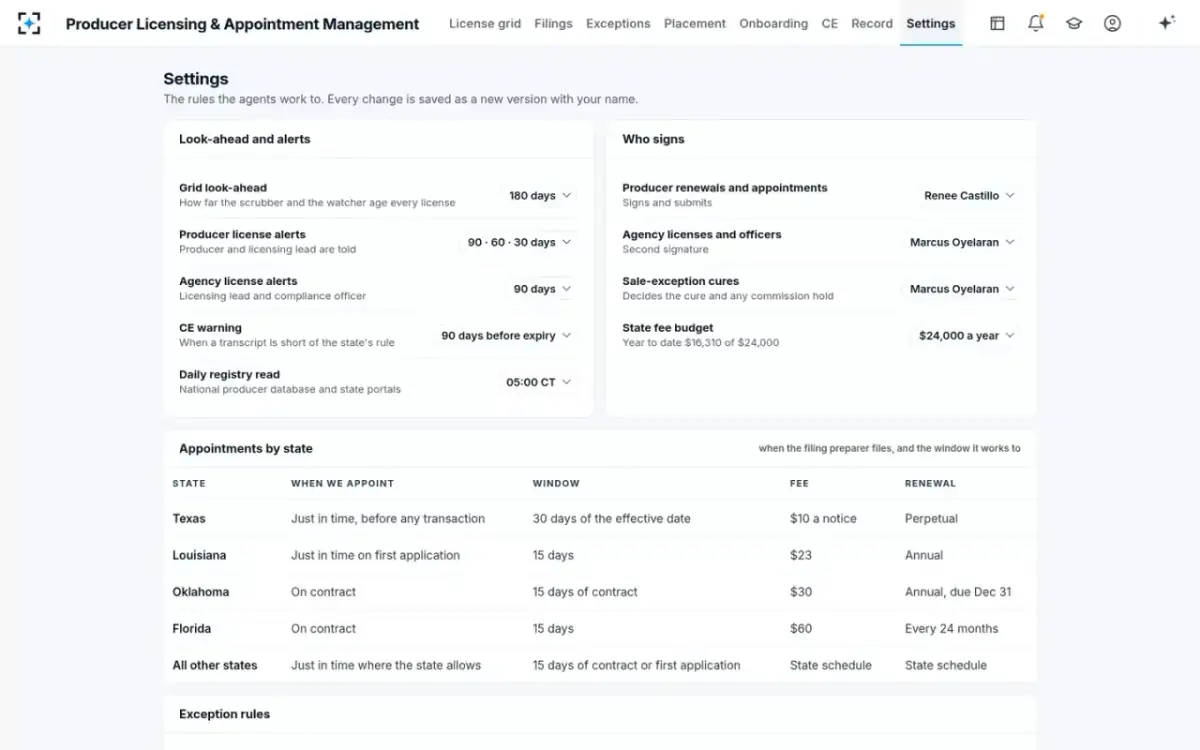
Appointment rules by state, set by the licensing lead and applied to every sale
How do I check if I am appointed with a carrier?
Run a producer report from NIPR's Producer Database, which lists appointments by state and insurer; NIPR says "Individual producers are entitled to one free report per year" (NIPR, reports and alerts). A state insurance department's own license lookup and the insurer's agency department can confirm the effective date that was filed.
Check the date, not just the name. An appointment that appears today may have been filed after a sale you made last month, and in a 15-day state the gap matters. Producer Licensing & Appointment Management makes that comparison for every bound policy, on its bind date, and lists the result on the Producer Licensing & Appointment Management page's sale exceptions.
Questions people ask
Can a carrier backdate an appointment?
The NAIC's uniform process lets insurers choose the effective date of an initial appointment, and Pennsylvania sets it equal to the contract's effective date. That is not the same as filing late: the filing deadline still runs from the contract, the first application or the effective date, depending on the state.
Does the 15-day window apply to appointment renewals?
No. The window governs the first appointment of a producer by an insurer. Renewals, in states that have them, run on the state's invoice calendar; Massachusetts, for example, bills every appointment active on 1 July and lets companies backdate terminations by up to 15 days (NIPR, Massachusetts renewals).
Do agencies need their own appointments?
Some states appoint business entities as well as individuals. The NAIC discourages it and recommends that a state requiring entity appointments ask for only one per entity per company, however many products the entity sells for that company.
Is a just in time appointment riskier than appointing in advance?
It moves the risk from cost to timing. Appointing in advance pays fees for producers who may never write; appointing on first application pays only for real business, but only works if every application is seen and the filing lands inside the window.
What counts as the first insurance application?
The first one the insurer receives from a producer who is not currently appointed by it, dated on receipt. That includes a producer the insurer appointed in the past and later terminated.