Insurance license management software keeps track of every producer's licenses, lines of authority, carrier appointments and continuing education across the states, warns before anything lapses and prepares the filings that keep it current. The best of it does not keep its own version of the truth. The authoritative license data already sits in the Producer Database run by the National Insurance Producer Registry (NIPR), the NAIC's non-profit affiliate, and in the states' own systems; the sales data sits in the agency or policy administration system; the filings travel through NIPR's gateway or a state portal. Software that reads those sources and files through the same channels adds something; software that asks a team to re-key them into a new database adds a fourth copy to keep in line. Botminds' Producer Licensing & Appointment Management is built as that reading layer: its agents read the national producer database every morning, read the agency system's bound policies, prepare filings for a person to sign, and keep the evidence.
Facts about NIPR come from NIPR's own pages and the NAIC; screens show the solution on a fictional sample agency.
Where a license layer sits: between the state side and your side, reading both
State side
NIPR Producer Database
Licenses, lines of authority, appointments and regulatory actions from every participating state
read daily
NIPR gateway and state portals
Applications, renewals, appointments and terminations, sent in the state’s format
send, after signature
CE transcripts
Hours and ethics posted by course providers, held by each state or its vendor
read
The license layer
Each state’s rules, versioned
Every license aged forward
Filings prepared and held
Each sale matched on its bind date
Evidence kept for the examiner
Your side
Agency or policy system
Bound policies by producer, state, line and insurer, with dates
read
Roster and onboarding
Producer numbers, home states, agreements, new hires and leavers
read
People
Licensing lead signs filings; compliance officer decides cures
decide and sign
What is insurance license management software?
It is the system a carrier, MGA or agency uses to answer one question every day: can each producer still lawfully sell, in each state, for each insurer? People search for it as license tracking software, producer compliance software or license management; the products range from reminder calendars to systems that read state data, prepare filings and match sales.
What makes the category confusing is that the industry already has a national system. NIPR "is a not‐for‐profit technology company that provides cost‐effective, streamlined, and uniform licensing data and compliance services for insurance professionals", in its own words (NIPR, about us), and it is governed by a board "that includes six state Insurance Commissioners, six members representing producer and insurance industry trade associations and the NAIC's CEO" (NIPR, annual report). License management software is worth buying only for what it adds on top of that rail.
What is the NIPR Producer Database, and what can software read from it?
The Producer Database (PDB) is the national record of producer licenses. The NAIC describes it as the repository NIPR built with the states, which "includes licensing information from 50 states, Washington, DC and Puerto Rico, utilized by the industry for licensing and appointment information" (State Licensing Handbook, ch. 1). It also carries data from the NAIC's database of regulatory actions, so a producer's report shows discipline as well as licenses (NAIC, Insurance Department Resources Report).
Access has rules. NIPR states that "The information contained in the PDB is subject to the Fair Credit Reporting Act (FCRA). Only entities with a ‘permissible purpose’ will be allowed to access this information" (NIPR, reports and alerts). In practice that means a subscription held by the carrier or agency, used for its own producers. A license management layer should read through that subscription, for that roster, and show which record every status came from.
Subscribers can pull reports in bulk: NIPR says they "can run batch producer reports by entering producer data in a CSV or as typed entries", delivered "in .pdf or .xml format for easy updates and integration into your system". That is the structured feed a layer reads each morning, instead of a person opening reports one producer at a time.
What are NIPR PDB alerts, and where do they stop?
PDB alerts tell a subscriber when something changes on a producer's record. NIPR lists what they cover: "Alerts include appointment and termination updates, address changes, license updates and regulatory actions." For a licensing desk it is one of the most useful feeds available, and software should consume it rather than reinvent it.
Alerts stop at the edge of the PDB, which leaves three gaps. They report a change after it has happened, not a renewal that will fail in 90 days because CE is short. They do not hold CE transcripts, which states keep themselves or through vendors; Texas, for instance, tells licensees to check their transcript on its CE vendor's site (TDI, agent questions). And they know nothing about sales, so they cannot say that a policy was bound through a producer whose appointment was filed late.
What NIPR already gives you, and what a license layer adds
NIPR Producer Database, alerts and gateway: Every participating state’s record for each producer, in one report.
A license layer on top: The same record aged forward, so a lapse shows weeks before it happens.
NIPR Producer Database, alerts and gateway: Alerts for appointments, terminations, addresses, licenses and regulatory actions.
A license layer on top: Each alert turned into the filing it calls for, prepared and held for a signature.
NIPR Producer Database, alerts and gateway: Not held in the PDB.
A license layer on top: Transcripts read against each state’s hours, ethics and classroom rules.
NIPR Producer Database, alerts and gateway: Gateway for applications, appointments, terminations; renewals in many states.
A license layer on top: Decides what to file, prepares it, shows the fee, files after signature.
NIPR Producer Database, alerts and gateway: No view of policies.
A license layer on top: Every bound policy matched to the license, line and appointment on its bind date.
Does license management software connect to NIPR?
It should, in both directions, and NIPR allows it. For appointments, NIPR invites companies to "Process appointments and terminations through NIPR's secure application or program your own system to connect to NIPR. Transactions must adhere to NIPR's data standards. Fees vary based on the method" (NIPR, appointments and terminations). Software that cannot send through that route ends up generating work for a person to re-key.
Some states require the electronic route. Pennsylvania wants appointments and terminations submitted electronically, "through an authorized business partner via National Insurance Producer Registry (NIPR)", and accepts a paper monthly report only case by case, from insurers with 50 or fewer transactions a year (Pennsylvania Insurance Department). For appointment renewals in states NIPR bills, the Connecticut page is typical: "Electronic processing through NIPR is mandatory and renewal invoices cannot be paid directly to the state's insurance department" (NIPR, Connecticut renewals).
Carriers have one more feed. NIPR notes that "Insurance carriers with an NAIC CoCode can obtain a Company Appointment Report (CAR) to review appointments with the state insurance division before renewal invoices are created" (NIPR, company appointment renewals). Reconciling that report with the producers who actually write business is how unused appointments are found before they are billed; the fees involved are in insurance appointment fees by state.
A license layer, not another database of record
The design choice that matters most is where the truth lives. If the software becomes the record, every state change has to be typed into it, and the day someone forgets, the software is confidently wrong. If the state records stay the record and the software reads them, the worst case is a stale read that the next morning's run corrects.
One morning in the layer: from state records to a decision, in order
Agent
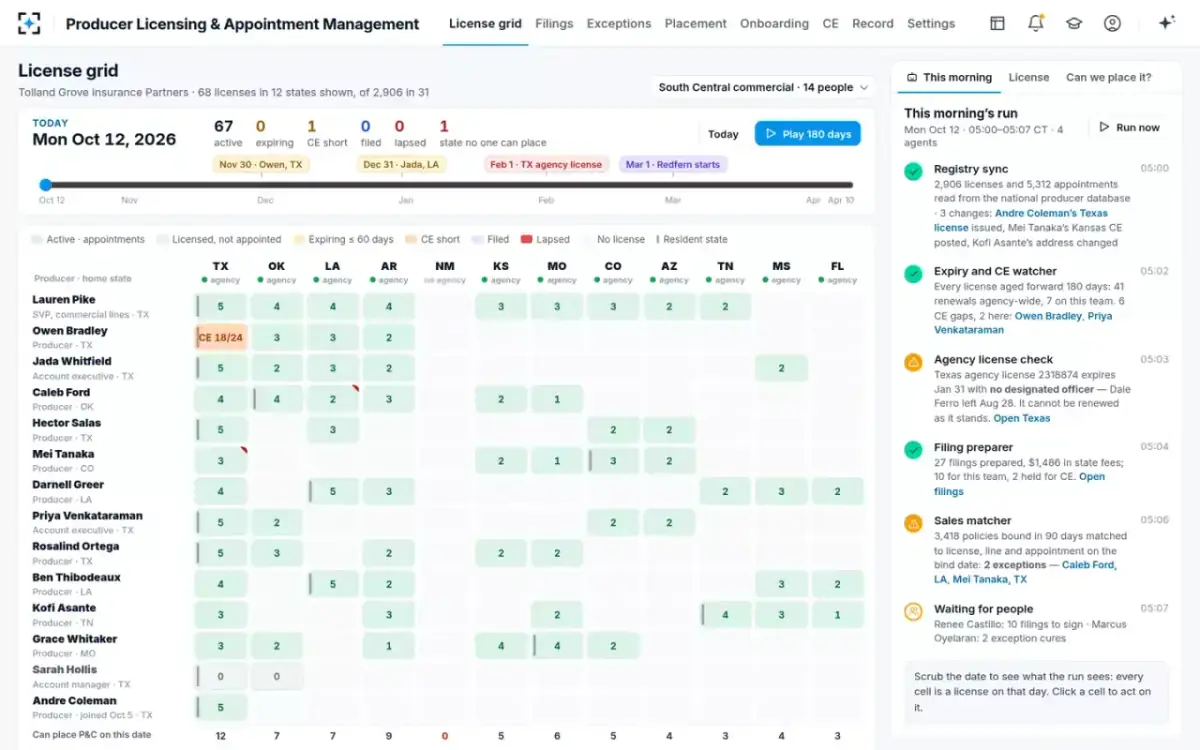
Registry syncReads every license, line and appointment for the roster from the producer database and state portals at 05:00, and records three changes.
Never: writes to a state record.
Agent
Expiry and CE watcherAges each license and appointment 180 days forward and reads CE transcripts against each state’s rule.
Agent
Sales matcherReads the last 90 days of bound policies from the agency system and checks each against the license on its bind date.
Agent
Filing preparerPrepares the filings the changes call for, with fees, and holds those that are blocked.
A person decides
Licensing lead and compliance officerSign the ready filings; decide the cures for any sale exceptions.
The same principle applies to rules. Each state's appointment window, renewal cycle and CE requirement should be a setting someone can read and change, with the date and the name of whoever changed it. That is what lets an examiner see which rule the system applied on the day it prepared a filing, and what lets a licensing lead fix a rule without a software release.
Can license software read my agency management system?
It has to, because the sales are what regulators examine. A license grid that is perfect today still cannot say whether the policy bound in July went through a producer licensed for that line in that state, with the insurer's appointment on file. Only the policy data can.
The fields needed are few: policy number, insured state or risk location, line of business, insurer, producer, application date and bind date. Most agency and policy systems can export them. The Kansas consent order of 2020 shows why the link matters: the insurer's remedy, after 670 policies were found issued through unappointed producers, was a system that checks licensing and appointment before a policy issues. How that evidence is assembled for an examiner is in insurance license compliance: the file an examiner asks for.
The layer's output: a producer-by-state grid read this morning, with the run beside it
What data do you need to start license tracking?
Less than most projects assume, because the states already hold most of it. What the software cannot get from the state side is what your organization knows about its own people and its own business.
What to gather before go-live
- The roster, with National Producer Numbers and home states
The key every state record hangs on. Include agency staff who hold licenses but do not sell.
- Producer database access for that roster
Your own subscription, used under its permissible purpose, so the layer reads with your credentials.
- Your agency or entity licenses and their designated responsible producers
One per state; the person named must hold a license.
- The insurers you are appointed with, by state
For a carrier, the Company Appointment Report from NIPR; for an agency, the carriers’ lists.
- Three to six months of bound policies
Policy, state, line, insurer, producer, application and bind dates, to replay the sales check.
- Your state rules and signers
Appointment timing, renewal cycles, alert windows, who signs which filing and who decides a cure.
- Where CE transcripts live for your resident states
The state site or the state’s CE vendor, and how to read it.
Is license management software worth it for a small agency?
Not always. A five-person agency licensed only in its home state, appointed with a handful of insurers, can keep up with the renewal dates and CE on a calendar, and each individual producer is entitled to one free NIPR report a year. The case changes with states, carriers and new accounts: a ten-person agency writing in 20 states is several hundred licenses and appointments, each on its own clock.
The deciding question is not the number of reminders but the cost of one miss. A lapsed license stops a producer selling; a sale through an unappointed producer is an exam finding; an agency license whose responsible producer has left can stop the whole agency in a state. If any of those has happened in the last two years, the spreadsheet has already been tested. What a lapse sets off is set out in insurance CE requirements by state and its sibling guides.
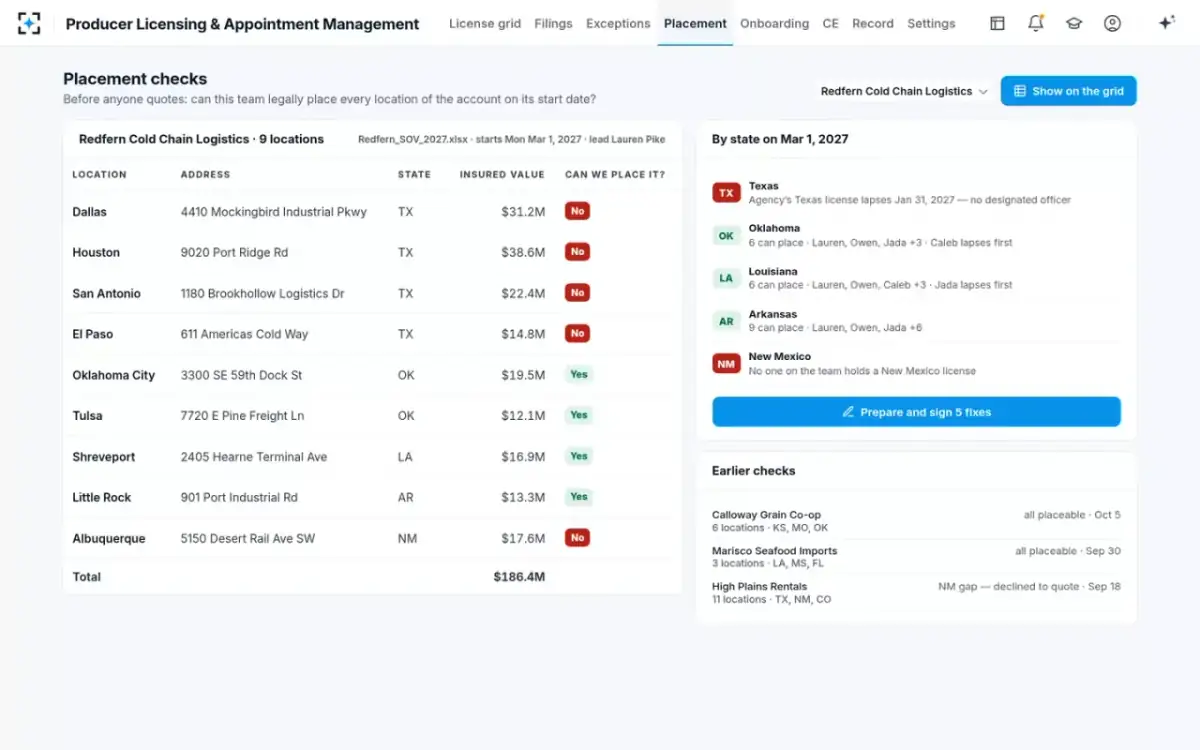
Before anyone quotes: which states of a new account the team can place on its start date
Questions to ask before you buy, and where Producer Licensing & Appointment Management fits
Put these to any vendor, including us: Does it read the producer database with your subscription, or ask you to upload exports? Does it send through NIPR or the state's channel, or produce PDFs for someone to re-key? Can it show the record behind every status? Can it replay last quarter's sales against licenses as of each bind date? Are state rules settings you can read, with a change history? Who signs, and is the meaning of the signature kept?
Producer Licensing & Appointment Management answers those by design: it reads state records and never changes them, prepares filings that a named person signs, matches each sale on its bind date, and keeps rules as versioned settings. It does not replace NIPR, a state portal or your agency system, and it does not replace the people who sign. We run it first on a sample of your own roster and states, so the prepared filings can be checked against what your team would have done. The filing-by-filing boundary is in licensing compliance software; the full workflow is on the Producer Licensing & Appointment Management page.
Questions people ask
What is the difference between NIPR's PDB and the SPLD?
The NAIC describes two databases NIPR helped build: the Producer Database, used by the industry for license and appointment information, and the State Producer Licensing Database, used by state regulators. The NAIC's handbook says states should rely on the SPLD record for regulatory purposes, which is why nonresident applications no longer need a paper letter of certification.
Can an agency use the PDB to screen job candidates?
Only within the Fair Credit Reporting Act. NIPR says PDB information is subject to the FCRA and only entities with a permissible purpose may access it, so use it for licensing producers you appoint or employ, under your subscription's terms, and run any employment background check through the FCRA process.
How much does NIPR charge?
NIPR's fees vary by service and method, and its pages state the appointment renewal processing fee as 1% of the state fees on each invoice, between $5 and $1,000. State license and appointment fees are separate and are passed to the states; NIPR processed $1.38 billion for states and territories in 2025.
How busy is the national licensing rail?
NIPR handled 185.9 million transactions in 2025, up 29% on 2024, and reports a 150% rise over five years. Its database held 9.2 million producer records at the end of 2025.
Does license management software replace the licensing team?
No. It replaces the reading, counting and form-filling. The decisions that carry legal weight, such as signing an application, appointing a producer, finding cause in a termination or deciding what to do about a sale made without the right appointment, stay with named people.