An insurance agent onboarding checklist is the list of permissions and checks that must be in place before a new producer's first quote: a license in each state they will write, with the right line of authority; an answer to the federal 1033 question about felonies involving dishonesty; a background check run the way the Fair Credit Reporting Act requires; the agency's own license in each state; carrier appointments filed inside each state's window; and the paperwork for paying them. The order matters more than the speed, because a sale made before the license and line are confirmed cannot be undone. Most of the checking is reading state records against documents: slow by hand, and exactly the kind of work software can do. Botminds' Producer Licensing & Appointment Management exists to do that reading: its onboarding agent checks a new producer's packet against the national producer database and the agency's rules, its filing agent prepares the appointments, and a person approves the hire and signs.
Rules are from the NAIC, federal law, the FTC and state regulators, linked where they appear; the screens show the solution on a fictional sample agency.
Day-one checklist for a new insurance producer, and why each item matters
- National Producer Number, legal name and home state
Every state record hangs on the NPN; the home state decides CE and the nonresident licenses that follow.
- Resident license, read from the state record
Active, in the producer’s name, with the lines of authority the job needs. A copy of a license proves only that it existed once.
- Nonresident licenses for every state they will write
One per state, each with its own fee and renewal date; a nonresident license rests on good standing at home.
- The 1033 question, answered in writing
A felony involving dishonesty or breach of trust needs a regulator’s written consent before the person works in insurance.
- Background check, with FCRA notice and consent
A stand-alone written notice and written permission before an employer pulls a report.
- Regulatory history from the producer database
Actions in other states, which the producer had to report within 30 days, show on a NIPR producer report.
- CE status and the next deadline
A new hire can arrive with a CE shortfall that will lapse their license in weeks.
- The agency’s license in each state, with its responsible producer
A licensed producer cannot sell through an unlicensed agency.
- Carrier appointments, by insurer and state, with each clock
15 days from contract or first application under the NAIC model; 30 days in some states.
- Producer agreement, commission schedule and W-9
Commission may be paid only to a person licensed when the business was written.
What is on an insurance agent onboarding checklist?
The ten items above, in that order. The first three establish who the person is and where they may sell; the next three establish whether they may work in insurance at all and what their record shows; the last four connect them to the agency, the insurers and the pay system. A checklist that starts with the employment paperwork and ends with licensing has the order backwards: the licensing items are the ones that can stop a hire.
Each item has a source to check against, and the source is never the candidate's own copy. Licenses and lines come from the state record through NIPR's producer database or the state's lookup; regulatory actions from the same report; CE from the state's transcript; consent orders and 1033 waivers from the issuing regulator. A copy in the packet is a pointer to where to look.
Insurance agent onboarding process: the order that makes the first quote lawful
The process has one rule: nothing that depends on a permission happens before the permission is confirmed. The flow below is how the sample agency runs it; the people steps are where an agency decides, the agent steps are reading and preparing.
From signed offer to first quote, in the order the law needs
Agent
Onboarding readerReads the packet (license, E&O certificate, background check, producer agreement, W-9) and checks each against the producer database and the agency’s rules.
Never: approves a hire or a contract.
A person decides
ComplianceReviews any “yes” on a background question, any regulatory action and any 1033 issue before anything else moves.
Agent
Placement check and filing preparerList the states the producer will write and the licenses and lines still missing, and prepare the nonresident applications and carrier appointments, with fees.
A person decides
Licensing lead and the producerThe producer signs their own license applications; the licensing lead signs the appointments.
A person decides
Agency principalApproves the packet and the first quote once license, line, agency license and appointment are in place.
What is an 18 USC 1033 check?
It is the check that a new hire has not been convicted of a felony involving dishonesty or breach of trust, or, if they have, that they hold a regulator's written consent to work in insurance. The statute makes working without consent a federal crime, and it reaches the employer too:
"Any individual who is engaged in the business of insurance whose activities affect interstate commerce and who willfully permits the participation described in subparagraph (A) shall be fined as provided in this title or imprisoned not more than 5 years, or both."
18 U.S.C. §1033(e)(1)(B)
Subparagraph (A) covers anyone "convicted of any criminal felony involving dishonesty or a breach of trust" who "willfully engages in the business of insurance". The way out is paragraph (2): such a person may work "if such person has the written consent of any insurance regulatory official authorized to regulate the insurer, which consent specifically refers to this subsection" (18 U.S.C. §1033(e)). The NAIC's handbook adds that "When one state grants a written consent waiver to an individual pursuant to 18 U.S.C. §1033, the consensus of legal opinion is that this written consent waiver is effective nationwide", and that producers with waivers must attach them to nonresident license applications (State Licensing Handbook).
The uniform license application asks the question directly: "If you have a felony conviction involving dishonesty or breach of trust, have you applied for written consent to engage in the business of insurance in your home state as required by 18 USC 1033?" (NAIC uniform application, question 1b). The statute's definition of the business of insurance reaches insurers' officers, directors, agents and employees and others authorized to act for them, so it is prudent to ask the same question of staff who do not need a license.
What background checks do insurance agencies run?
Two different checks, run by two different parties. The state checks license applicants: the NAIC's standards call for states to review the background answers on the uniform application, search the NAIC's regulatory and 1033 databases, and "fingerprint their resident producer applicants and conduct state and federal criminal background checks on new resident producer applicants" (Handbook, background checks). The employer then runs its own check as a hiring decision, under federal consumer reporting law.
The employer's check has procedural rules that are easy to get wrong. The FTC's guidance tells employers to give notice that a report may be used for employment decisions, adding "This notice must be in writing and in a stand-alone format", and to "Get the applicant's or employee's written permission to do the background check" before pulling it; an employer that then relies on the report to take adverse action must give the person notice first (FTC, Background Checks: What Employers Need to Know). NIPR's producer database is also governed by the same law and open only to users with a permissible purpose, so it supplements the employer's check rather than replacing it (NIPR).
What documents does a new insurance agent need?
Fewer than most packets contain, provided each is checked against its source. The table lists the documents and what each must be checked against.
The new-producer packet: each document, what it proves and what to check it against
| Document | What it proves | Check it against |
|---|---|---|
| License (resident and each nonresident) | Permission to sell the listed lines in each state | The state record via NIPR’s producer database or the state lookup, on the day |
| Uniform application background answers | What the producer disclosed to the states | The producer database’s regulatory actions; any 1033 consent on file |
| 1033 written consent, if applicable | Regulatory permission to work in insurance | The issuing regulator; it must refer to the statute |
| Background check report | The employer’s own hiring check | The FCRA notice and written permission obtained first |
| CE transcript | Hours and ethics toward the next renewal | The state’s transcript, not certificates |
| Producer agreement and commission schedule | Terms of pay and whom the producer represents | The licenses and appointments the commission depends on |
| W-9 | Tax identification for commission payments | The name and number on the agreement |
| Proof of errors and omissions cover, where required | That the producer is covered under the agency’s or their own policy | The policy period and limits your carriers require |
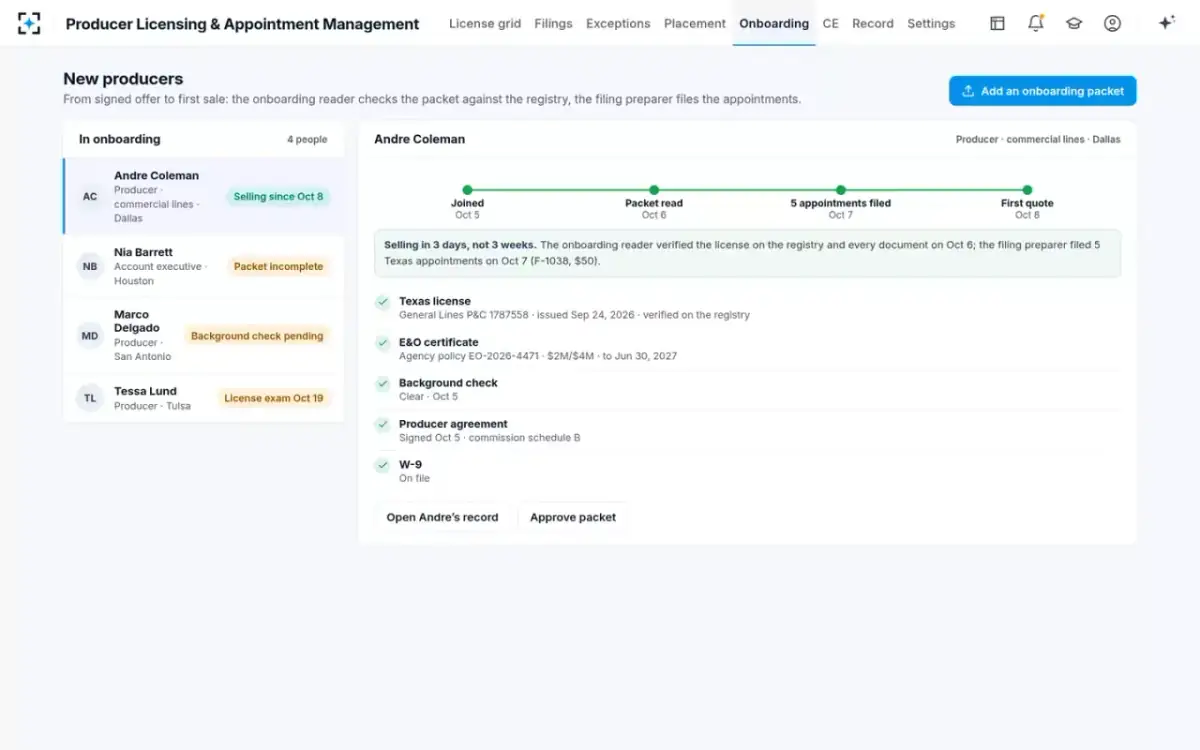
A new producer's packet, checked against the registry: selling three days after joining
When can a new insurance agent start quoting?
When four things are true for the state and the product: the producer holds an active license there with the right line of authority; the agency, if business goes through it, holds its own license in that state with a responsible producer named; the producer has a contract with the insurer; and the insurer's appointment is on file or still inside the state's filing window. The first three have no window at all.
The appointment is the only permission that can trail the first sale, and only in states that allow it. Under the NAIC model the insurer has 15 days from the contract or the first application, whichever comes first; Texas allows 30 days from the appointment's effective date and lets an agent accept business meanwhile (TDI, FIN507). Florida, by contrast, makes every appointment subject to the prior issuance of the license. The window and its traps are in just in time appointment states.
How long does it take to onboard an insurance agent?
For an already-licensed producer, days rather than weeks, if the checks run in parallel and nothing in the background needs review. No regulator or research body publishes an industry benchmark, so measure your own: time from signed offer to first lawful quote, by step. For a new licensee, add the exam and the state's application time; Texas, for example, treats an insurance exam score as valid for 12 months (NIPR, Texas).
One already-licensed producer, from joining to first quote, in the sample agency
- Joined, checkedday 1
- Packet readday 2
- 5 appointmentsday 3
- First quoteday 4
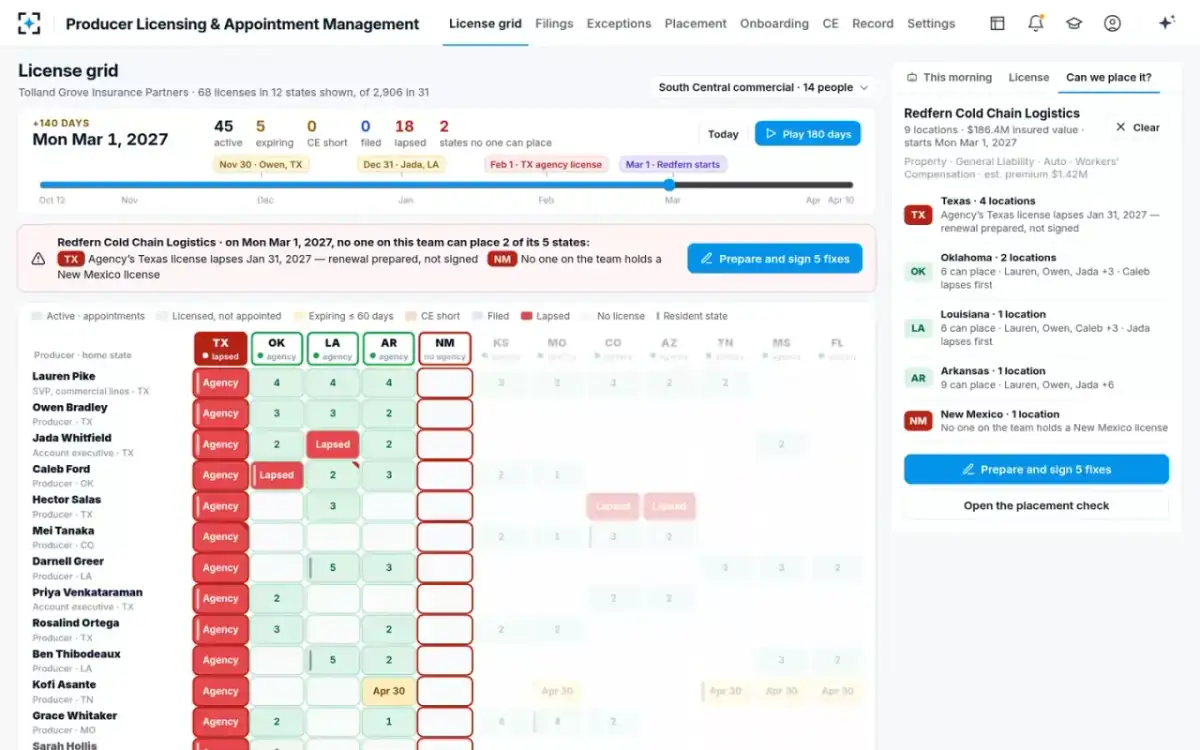
Three things stretch the timeline in practice: a background answer that needs compliance review, a state where the producer is not yet licensed, and an agency license with no responsible producer named. The sample agency's placement check exists for the second: before anyone quotes a new account, it shows which states the team can place on the start date and which filings would close the gaps.
Before the first quote on a multi-state account: two states no one on the team can place
Onboarding a producer who is moving from another agency
The licenses move with the producer; most of the rest does not. Appointments are between the producer and each insurer, so the previous agency's insurers will terminate them and must tell the state within 30 days of the termination's effective date under the model act; your insurers then file new appointments, each on its own clock, and an insurer that appointed the producer before treats them as new.
Three other items are easy to miss. If the producer moves home state, the model lets them get the new resident license without an exam, "so long as the producer applies for a resident license within 90 days of the cancellation of the producer's previous license" (Handbook, ch. 2). Every state that licenses them needs the new address within 30 days. And if the producer was the previous agency's designated responsible producer somewhere, that agency must replace them, which is the previous agency's problem but can stall your appointments if the records lag. How the three permissions fit together is in insurance license vs appointment.
What is producer onboarding software, and what should it never decide?
Producer onboarding software reads a new producer's documents, checks them against the state records and the agency's rules, and prepares the license applications and appointments the producer needs. It is worth having when onboarding is frequent or multi-state, because each check is mechanical and each miss is expensive. What it must not do is decide anything that carries legal weight.
Florida's statute shows why the hiring decision stays with people even after the appointment is filed. Each appointing entity must tell the department "within 15 days after it or its general agent, officer, or other official becomes aware that an appointee has pleaded guilty or nolo contendere to or has been found guilty of a felony after being appointed" (Fla. Stat. §626.451(4)). Onboarding does not end on day one; the duty to know continues.
Producer Licensing & Appointment Management's onboarding agent reads the packet, verifies the license on the registry and flags expired documents with their dates; it never approves a hire or a contract. The producer signs their own applications, the licensing lead signs appointments and the compliance officer decides anything a background answer raises. Who signs which filing, and why, is in licensing compliance software; the workflow is on the Producer Licensing & Appointment Management page.
Questions people ask
Can a new agent use a license from another state?
Not directly: they need a nonresident license in each state where they will sell. Under the NAIC model, a producer licensed and in good standing in the home state must be granted a nonresident license unless there is cause to deny it, and states verify home-state standing electronically rather than by letter.
Does 1033 apply to staff who are not licensed?
The statute is not limited to licensed producers. Its definition of the business of insurance covers the activities of people who are officers, directors, agents or employees of insurers, or are authorized to act for them, which is why it is worth asking every new hire the 1033 question.
What happens if a new producer answers yes to a background question?
The uniform application requires a written statement and the court or agency documents for each incident, and the states decide. Documents can be loaded once to the NAIC/NIPR attachment warehouse, which alerts each state the producer applies to.
Who files the appointment, the agency or the insurer?
The insurer, under the model act; it also pays the fee. Florida's fee schedule also lets an unaffiliated agent that makes an appointment be the payer. An agency's job is to make sure each insurer knows a new producer is writing for it, in time for the insurer's clock.
What should happen on the producer's first day, before any quote?
Confirm license and lines on the state record, the 1033 answer, the agency license and the appointment plan for each state and insurer. In the sample agency that took one day of reading and one of filing; the first quote followed on day four.