Insurance CE requirements by state start from one national baseline: under the NAIC's Uniform Licensing Standards, a producer completes 24 credits of continuing education in each two-year compliance period, 3 of them in ethics, with 50 minutes of instruction counting as one credit. Texas, California and Illinois require 24 hours with 3 of ethics; Florida builds its 24 from a 4-hour update course plus electives and cuts the total for long-licensed agents; New York's statute sets 15 credit hours. The differences that hurt are elsewhere: whether extra hours carry over, which product courses apply on top, whether a nonresident's home-state CE counts, and above all what happens on the day after a missed deadline, which ranges from a 90-day cure at $50 an hour to automatic termination of the license. Botminds' Producer Licensing & Appointment Management exists to make those differences visible early: its watcher reads each producer's CE transcript every morning against the rule of the state that holds the license, and holds any renewal that would fail until the hours post.
Every rule below is quoted from the state statute, regulation or insurance department page linked beside it, read on 27 October 2026; screens show the solution on a fictional sample agency. Check your own state's current rule before you rely on a row.
Insurance CE requirements by state: hours, ethics, cycle and carry-over
| Jurisdiction | Hours per cycle | Ethics and required content | Carry-over and other rules |
|---|---|---|---|
| NAIC baseline (Uniform Licensing Standards) | 24 credits every two years; 50 minutes = 1 credit | 3 of the 24 in ethics | No retaking a course for credit in the same period; classroom and verifiable self-study both accepted |
| Texas | 24 hours per two-year license period | 3 hours of ethics | At least half classroom or classroom-equivalent; up to 4 hours for active association membership |
| California | 24 hours before each renewal | 3 hours of ethics, including 1 hour on insurance fraud since 1 March 2023 | Exemption at 30 continuous years licensed and age 70, for those first licensed before 2010 |
| Florida | 4-hour update course plus 20 elective hours every two years (16 after 6 years licensed) | Ethics is a required topic of the update course | Excess hours carry forward; extensions of up to one year |
| Illinois | At least 24 hours before each renewal of a two-year license | 3 hours of classroom or webinar ethics | Up to 4 hours for association service, not for ethics |
| New York | 15 credit hours each full biennial licensing period | Set by the superintendent | Excess credits do not carry forward; $10 biennial filing fee per license |
| North Carolina | Set by the Commissioner, not more than 24 credit hours every two years | Set by rule | Late CE: license lapses, unless an extension or a $75 fee is granted instead |
| Pennsylvania | A minimum of 24 credits in the two-year licensing cycle | Not stated on the department’s CE page | Waivers only for military service or documented extenuating circumstances |
| Washington (long-term care sellers) | One-time 8-hour long-term care training, then 4 hours of LTC CE | Long-term care content | Counts toward the general CE requirement for residents |
How many CE hours do insurance agents need?
Twenty-four every two years is the baseline, and it is one requirement per producer, not one per line. The NAIC's handbook explains that CE "is required if the producer holds one of the six major lines of authority (LOAs) contained in Model #218, but it is not required for each LOA. For example, if a producer holds a life and property LOA, the requirement for renewal is 24 credits" (State Licensing Handbook, ch. 14). Limited lines licenses generally carry no CE.
The same chapter sets the standards states are meant to share: 50 minutes equals one credit; producers may repeat a course in a later period "but they are not permitted to take a course for credit more than once in the same license continuation period"; and states "must accept both classroom study and verifiable self-study." Texas then adds its own condition that at least half the hours be classroom or classroom-equivalent (TDI), and Illinois counts a mixed course as classroom only where at least two-thirds of the hours are given that way (215 ILCS 5/500-35).
How many ethics hours are required for insurance CE?
Three, in the NAIC baseline and in the states that follow it closely. Texas requires 3 hours of ethics in the 24; California requires 3, and since 1 March 2023 "the three-hour ethics course shall include one hour of study on insurance fraud" (Cal. Ins. Code §1749.3(a)); Illinois requires that "Three of the 24 hours of course study must consist of classroom or webinar ethics instruction" (215 ILCS 5/500-35(b)(1)).
Florida builds ethics into its update course instead: every licensee completes a 4-hour course specific to the license held, whose subjects include "insurance law updates, ethics for insurance professionals, disciplinary trends and case studies" among others (Fla. Stat. §626.2815(3)). New York's statute sets the hours and leaves content to the superintendent, and Pennsylvania's CE page states only the total. For a producer licensed in several states, the safe course is to take ethics hours that satisfy the strictest home-state rule, since home-state CE is what nonresident states usually rely on.
Do nonresident agents need to complete CE in every state?
Usually not: a nonresident who meets the home state's CE generally meets every reciprocal state's. The model act puts it in one sentence: "A nonresident producer's satisfaction of his or her home state's CE requirements for licensed insurance producers shall constitute satisfaction of this state's CE requirements if the nonresident producer's home state recognizes the satisfaction of its CE requirements imposed upon producers from this state on the same basis" (NAIC Model #218, §16B, as quoted in the handbook).
States phrase the exceptions differently. Texas tells nonresident licensees "You must follow your home state's rules", and that a producer whose home state has no CE must follow Texas's (TDI, agent questions). Florida accepts home-state CE where the home state reciprocates, and lets a producer from a no-CE state use another reciprocal state's CE instead (§626.2815(6)). New York accepts it "provided the superintendent deems them equivalent to New York continuing education requirements" (N.Y. Ins. Law §2132(d)(1)(B)). And product-specific courses can apply to nonresidents regardless, which is the next question.
Are there special CE requirements for long-term care or flood?
Yes, and they apply on top of the general hours, even to nonresidents. The NAIC's handbook notes that a specific CE standard "derived from federal mandates, may be imposed on nonresidents, such as for long-term care (LTC), flood, or crop insurance, and it would not violate the Uniform Licensing Standards (ULS)" (ch. 14).
Washington's rule shows the shape: all producers who sell long-term care are subject to "the eight-hour, one-time long-term care training and the four-hour long-term care continuing education requirements of RCW 48.83.130", and an LTC course approved in Washington can count toward the general requirement (WAC 284-17-264). Texas warns that a producer exempt from general CE is still subject to its rules for annuities, long-term care partnership products and Medicare-related products (TDI). A CE tracker that counts only total hours will miss these.
What happens if I miss my insurance CE deadline?
It depends entirely on the state, and the range is wide: from a paid cure period to the end of the license. In most of the states below, the license, not just the renewal, is what is at stake.
The day after a missed CE deadline, state by state
| State | What happens | Way back |
|---|---|---|
| Texas | 90 days to finish the hours and pay $50 per deficient hour; after that the license is inactivated | Apply for a new license; it will not issue until the hours are done and the fine paid |
| Illinois | The license “automatically terminates” | Reinstatement within 12 months of the renewal due date at double the renewal fee, no exam |
| North Carolina | The license lapses | An extension for good cause, a $75 administrative fee, or both, instead of the lapse |
| New York | Not eligible to renew the license | No relicensing in the next period until the last period’s CE is shown |
| Pennsylvania | “voluntary termination of your license” | Waivers only for military service or documented extenuating circumstances |
| Florida | The department may terminate or refuse to renew the producer’s appointments | Extension of up to one year for good cause |
Florida's version deserves a second look because it hits the insurer as well as the producer. The statute makes CE "a condition precedent to the issuance, continuation, reinstatement, or renewal of any appointment subject to this section" (§626.2815(4)), so a CE shortfall becomes an appointment problem for every insurer the producer writes for. What follows a lapse, rung by rung, is set out in what happens if your insurance license expires.
Texas: the CE deadline is not the expiry date
- Last 30 days: let the provider post the hours30 d
- Cure period: finish the hours, $50 per short hour90 d
Do extra CE hours carry over to the next renewal?
Some states say yes, some say no, and the difference is written into statute. Florida: "Excess hours accumulated during any 2-year compliance period may be carried forward to the next compliance period" (§626.2815(3)(g)). New York: "Excess credit hours accumulated during any biennial licensing period shall not carry forward to the next biennial licensing period for that same class of license" (§2132(c)(3)).
Texas handles a related question in a way that surprises producers with several Texas licenses: credit posted to the transcript "will be applied to every license that you hold on the day that you finished the course" (TDI, agent questions), so a course taken before a second license was issued does not count toward it. TDI's summary of the principle is short: "CE obligations apply to the individual, not the license."
How do I check my insurance CE credits?
On the transcript the state or its vendor keeps, which approved course providers update. Texas licensees view theirs on the site of the state's licensing vendor; providers post the credit, and TDI says licensees "don't need to send course certificates" but should check the transcript, and keep certificates for at least four years because TDI can audit the past two license periods (TDI).
The NAIC recommends that states require providers to report attendance electronically and give producers and insurers access to the records (Handbook, ch. 14). For a licensing team, that means CE can be read, not chased: the transcript is the source, and the question is only whether it is read early enough to act.
Transcripts read every morning against each state's rule, with the renewals they hold
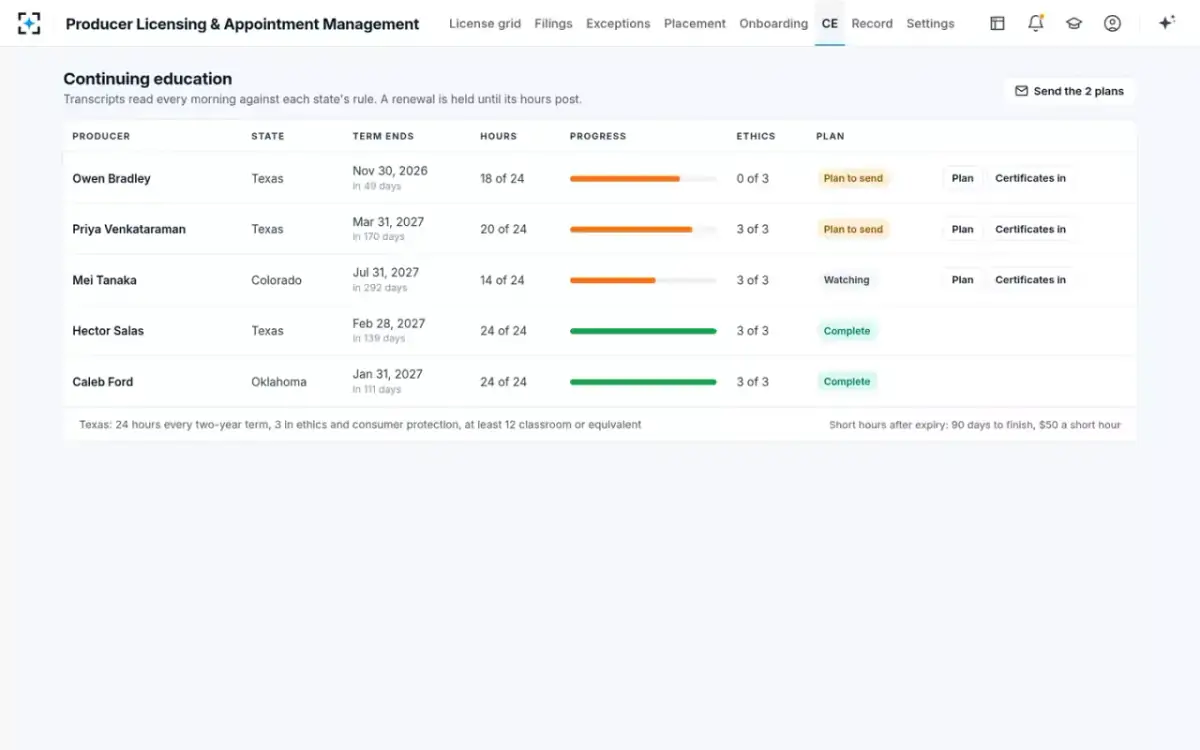
Tracking CE across a multi-state roster
For one producer, CE is a calendar entry. For a roster, it is a matching problem: each producer's resident state sets the hours, each nonresident state decides whether to accept them, product rules add hours on top, and each state treats a miss differently. The checklist below is what a licensing team needs to know about every producer, every morning.
Six things to know about every producer's CE
- Home state and its rule
Hours, ethics, classroom share and the cycle end date, tied to the resident license’s renewal.
- Hours and ethics posted so far
From the state transcript, not the producer’s certificates: the transcript is what the state renews from.
- Days left before the provider cut-off
Texas suggests finishing 30 days early so the hours post before expiry.
- Product courses owed
Long-term care, flood, annuity or Medicare-related training, wherever the producer sells those products.
- What a miss would do in that state
A cure period, a fee, a lapse or termination of the license or the appointments.
- Which renewals and appointments depend on it
In Florida, the producer’s appointments; elsewhere, every nonresident license that relies on home-state CE.
In the fictional sample agency, the morning read finds a producer whose Texas license expires on 30 November with 18 of 24 hours and none of the 3 ethics hours posted. The renewal is prepared and held; one click sends the producer a plan for the missing six hours. The licensing coordinator's wider calendar is set out in insurance licensing coordinator job description.
One license on a future date: six hours short, renewal prepared and held
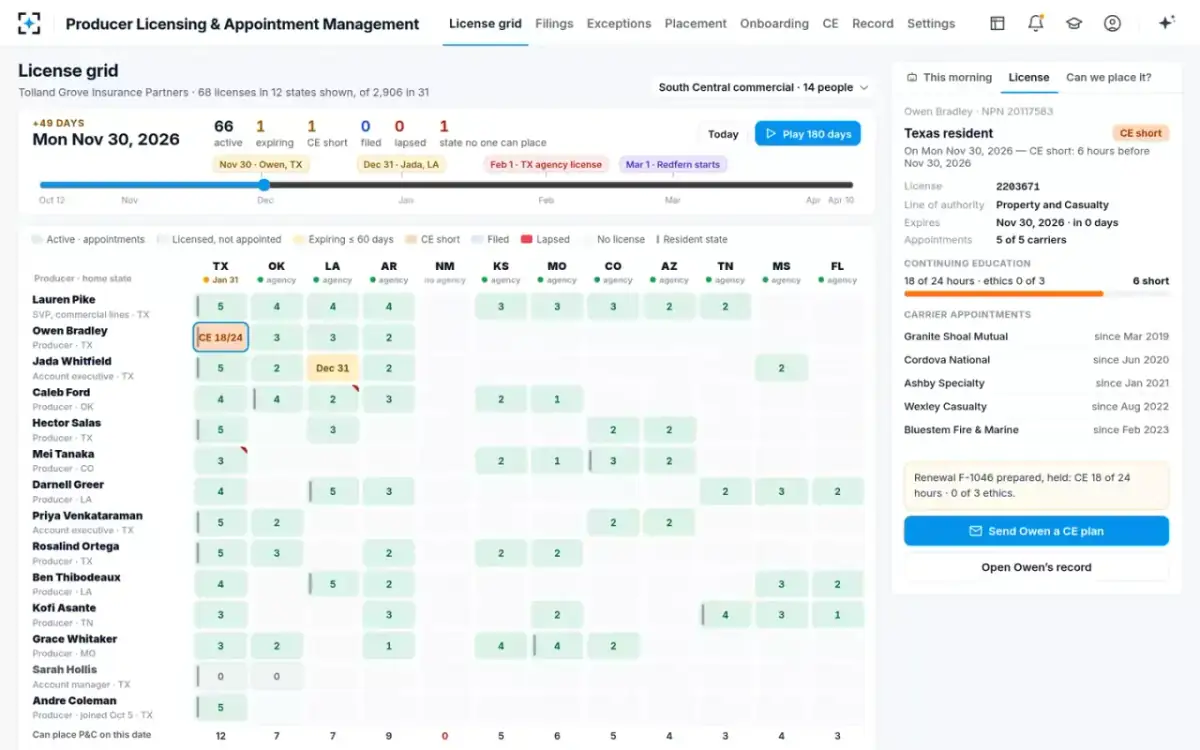
How Producer Licensing & Appointment Management watches CE
The solution's watcher reads every CE transcript each morning against the rule of the state that holds the license, including ethics and classroom shares, warns the producer and the licensing lead 90 days before expiry by default, and holds any renewal that would fail. It never extends or waives a deadline; extensions and waivers are the state's to grant and the producer's to request. The rules it applies are settings the licensing team can read and change, with a record of who changed what. The workflow is on the Producer Licensing & Appointment Management page.
Questions people ask
Can I take the same CE course twice?
Not for credit in the same license period, under the NAIC's standards; you may repeat it in a later period. Check the state's rule as well, because course approvals and credit hours are assigned state by state.
Does online CE count?
The NAIC's standards say states must accept both classroom study and verifiable self-study. Some states limit the mix: Texas wants at least half of the hours in classroom or classroom-equivalent courses, and Illinois treats a combined course as self-study unless two-thirds of its hours are classroom, seminar or webinar.
Can association membership count toward CE?
In some states. Texas allows up to four hours for an active member of a state or national insurance association; Illinois allows up to four hours a biennium for board, committee or task force service, but not toward ethics; Florida allows two elective hours a calendar year for active participants.
Is anyone exempt from insurance CE?
A few, by long service. California exempts licensees in good standing for 30 continuous years who are 70 or older, if first licensed before 2010; Texas exempts licensees with 20 years of continuous licensure, though specialty product CE still applies. Military service and serious illness are grounds for extensions or waivers in most of the statutes on this page.
When is my insurance license renewal due?
On the expiry date your state printed on the license, which the state's lookup and a NIPR producer report both show. The NAIC's standards recommend tying the license term to the producer's birth date or birth month, and tying the CE period to the same renewal.