Insurance license compliance means being able to show, for every policy, that the producer who took the application held a license for that line in that state and, where the state requires it, the insurer's appointment, on that date, and that the company's own list of licensed and appointed producers agrees with the state's. Those two tests are the first standards of the producer licensing review in the NAIC's Market Regulation Handbook, which state examiners work from, and at least one state applies them with no tolerance for error. The work is hard because the proof has to be dated: today's license grid says nothing about a policy bound in March. Botminds' Producer Licensing & Appointment Management keeps that dated proof as it goes, matching each bound policy to the license, line and appointment on its bind date and assembling the state's licensing file before an examiner asks for it.
The screens show the solution running on a fictional sample agency. The standards, tolerances and enforcement records are from the NAIC and state insurance departments, linked where they appear.
The six producer licensing standards in a market conduct exam, and the proof each one needs
- 1. Your producer records agree with the insurance department’s
Every licensed and appointed producer on your list matches the state’s record, and nobody is on one list only. Proof: a reconciliation of your appointment list against the producer database, dated.
- 2. Each producer was licensed, appointed and CE-current where the application was taken
Tested policy by policy, in the state where the application was taken. Proof: license, line of authority and appointment as of the application date, from the state record.
- 3. “Termination of producers complies with applicable standards, rules and regulations regarding notification to the producer and notification to the state, if applicable.”
Proof: the termination date, the state notice date and the producer copy date, for every termination in the period.
- 4. “The regulated entity’s policy of producer appointments and terminations does not result in unfair discrimination against policyholders.”
Proof: the written criteria for appointing and terminating, applied consistently.
- 5. “Records of terminated producers adequately document reasons for terminations.”
Proof: a reason on every termination, and the evidence behind any termination for cause.
- 6. Producer account balances agree with each producer’s contract with the insurer.
Proof: commission and balance records that tie to each producer agreement.
What does insurance license compliance mean for an insurer?
For an insurer, license compliance is a property of every policy, not of the producer roster. A roster can be 99% current and still fail an exam, because the examiner samples policies, not people, and asks about the date each application was taken.
The checklist above is the full list of what the producer licensing review tests. Standards 1 and 2 are the heart of it. Standard 1 asks whether the company's record of licensed and appointed producers agrees with the department's record; standard 2 asks whether each producer was properly licensed and appointed, with any CE the state requires, in the jurisdiction where the application was taken. The other four cover terminations, fairness in appointment decisions, the reasons on file for terminations and whether producer balances match the contracts.
Agencies have the mirror image of the same duty. The model act lets a state suspend or revoke a business entity's license where an individual licensee's violation "was known or should have been known" by its partners, officers or managers and "was neither reported to the insurance commissioner nor corrective action taken" (Model #218, §12C). An agency that lets an unlicensed producer write business is not a bystander.
What do insurance examiners check for producer licensing?
Examiners check the standards by sampling, and a published exam report shows how. The company hands over its lists of appointed and terminated producers for the exam period, the examiners draw random files from each, and they test standard 2 against real sales by checking the producer on policies pulled for the underwriting review.
North Carolina's 2020 market conduct exam of Builders Mutual Insurance Company and Builders Premier Insurance Company shows the method. The insurers provided "listings of 536 appointed and 109 terminated producers"; examiners reviewed 50 appointed and 50 terminated producer files. All appointment forms reviewed had been filed on time. Termination notices were late for five of the 50 terminated producers. Separately, in a sample of 50 active commercial auto policies, the producers on two had not been properly appointed (NCDOI, Builders Mutual report, 2020).
The exam period mattered as much as the sample. The examination began on 27 April 2020 and covered policies from 1 January 2016 to 31 December 2018, so the company had to prove licenses and appointments as they stood up to four years earlier. A license grid that only shows today's status cannot answer that.
What is the error tolerance for unlicensed sales in a market conduct exam?
In North Carolina it is zero. The department cites a violation when a sample's error rate falls outside a tolerance, and it set those tolerances out plainly: a "0% tolerance level for consumer complaints, producers/adjusters who were not appointed and/or licensed, and the use of forms and rates/rules that were neither filed with nor approved by the Department; 7% for claims; and 10% for all other areas reviewed" (NCDOI, 2020). Below the threshold, the company gets a reminder; at or above it, a violation.
Same exam, different tolerances: what each error rate earned
The two 4.0% bars are the lesson. Two unsigned applications in fifty earned a reminder; two policies written through producers not properly appointed earned a violation of two statutes, because licensing sits in the zero-tolerance band. The 10.0% on terminations is the other trap: the tolerance was 10%, and a rate that only reaches the threshold still counts as a violation.
What happens if an exam finds an unappointed producer?
Usually a finding, a penalty and an order to fix the system that let it happen. The clearest public example is Kansas. In June 2020 the Kansas Insurance Department entered a consent order against Employers Mutual Casualty Company after a market conduct investigation of its Kansas sales from 13 August 2016 to 13 August 2019; the company neither admitted nor denied the allegations (Kansas Insurance Department, Docket 81589).
One Kansas investigation, three years of sales
670
policies issued through 161 producers not appointed at the time of sale
170
policies issued through 58 producers not licensed in Kansas at the time of sale
$60K
penalty ($60,000), including penalties for unpaid appointment fees; half suspended for five years
2×
a year: the internal licensing and appointment assessments the insurer committed to
The remedy is the instructive part. The order records that the insurer replaced manual checks with a system that "will only allow policies to be issued if respective licensing and appointment requirements are met in the state for which the potential insured is a resident", and that it would conduct "internal compliance assessments on the licensing and appointment requirements at a minimum of two times per year" (Docket 81589). In other words: check every sale, and test the checking. The appointment window itself, and the 30-day Kansas rule the order quotes, are covered in just in time appointment states.
How do you prove a producer was licensed at the time of sale?
With a record for each policy that ties the sale to the state's own data as of the right date. The examiner needs to see the license, the line of authority and the appointment, each with its effective date, next to the date the application was taken, and to be able to trace each one to its source.
The per-policy proof: what each line of the licensing file holds
| Field | What it shows | Where it comes from |
|---|---|---|
| Policy, insured and state | Which sale, and the jurisdiction where the application was taken | The policy or agency system |
| Application received date and bind date | The dates every other field is tested against | The policy file; the NAIC counts an application as submitted when the insurer dates it received |
| Producer and National Producer Number | Who sold it, as the state identifies them | The policy file, matched to the producer database |
| License number, status and expiry on that date | That a license for the state was in force | The producer database or state record, read as of the date |
| Line of authority | That the license covered the product, such as casualty for commercial auto | The same state record |
| Appointment: effective date and date filed | That the insurer’s appointment was on file, or filed inside the state’s window | The appointment notice and the state’s acknowledgment |
| CE status, where the state ties it to the license | That no CE lapse had suspended or terminated the license | The state’s CE transcript |
| Exception and cure, if any | What went wrong, what was done and who decided | The compliance decision, signed |
The source column is what makes the file defensible. A spreadsheet that says "licensed" is an assertion. A row that links to the state's record of the license and to the appointment notice is evidence, and it survives the people who built it.
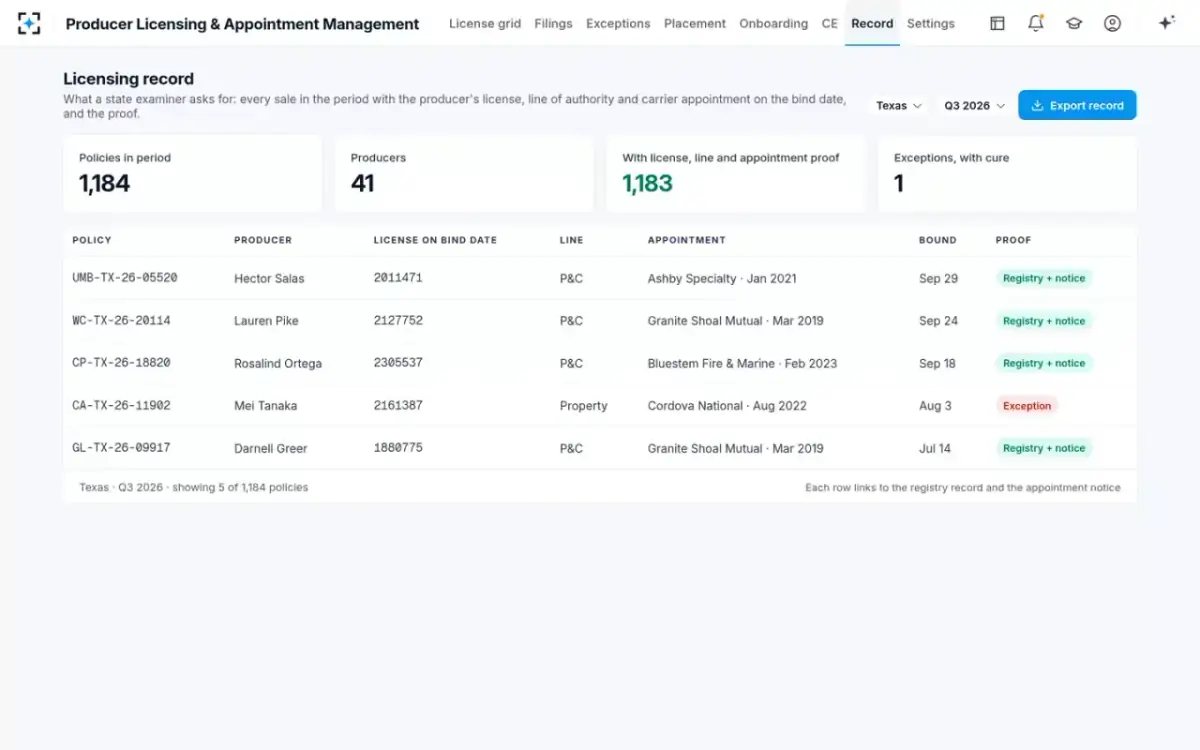
A state's licensing file for one quarter: every sale with the license, line and appointment on its bind date
What records must an insurer keep on producer licensing?
Enough to answer all six standards for the whole exam period, which can reach back several years. States set the detail. Pennsylvania's appointment rule, effective 12 February 2025, says "An insurer shall maintain termination records for 7 years after termination is effective" and requires appointment and termination activity to reach the department within 30 days of the effective date (31 Pa. Code §37a.21).
The minimum set is the appointment list with effective and filing dates, the termination list with effective, state-notice and producer-copy dates, the reason for each termination, the license and line evidence behind each sampled policy, and the producer agreements behind each commission balance. Standard 5 is easy to fail on paper alone: a termination with no recorded reason is a finding even when the reason was innocent.
Terminations: the half of the licensing file most often thin
Appointments get attention because a missing one stops a sale. Terminations do not stop anything, so they drift, and the North Carolina exam shows the cost: every appointment in the sample was filed on time, while one in ten terminations reached the state late.
The model act sets the clock at 30 days after the effective date, with a copy to the producer within 15 days after the state notice. Pennsylvania adds a duty that catches quiet departures: "An insurer shall file a termination of an appointment when the appointee ceases to act as the representative of the insurer" (31 Pa. Code §37a.21(b)(8)). The practical fix is a trigger, not a reminder: a producer who leaves the agency, loses a license or stops writing should start a prepared termination on the day the change is known.
How do you prepare for a producer licensing audit?
Run the examiner's tests on yourself before the examiner does. Reconcile your appointment list with the producer database; replay the period's sales against the licenses and appointments as they stood on each date; check every termination's dates and reason; and decide, in writing, what you did about each exception you find.
The NAIC's 2022 figures show why a regulator's question about a producer is not rare: states levied 44,876 fines and 203 restitutions against producers that year, suspended 1,302 licenses and revoked 4,663 (NAIC, Insurance Department Resources Report, 2022 data). Preparing the wider exam, from the request letter to the response, is covered in the guide on how to prepare for a market conduct examination. The producer licensing part is the one that can be kept ready all year, because its evidence is created at the moment of each sale.
Keeping the exam file all year with Producer Licensing & Appointment Management
The solution keeps the licensing file as a by-product of daily work rather than as an exam project. Its sales matcher checks each bound policy against the license, line and appointment on its bind date and raises an exception with the evidence and a proposed cure; the compliance officer decides the cure; the licensing record for any state and period is then a filter, not a rebuild. In the sample agency's Texas third quarter, 1,183 of 1,184 policies carry license, line and appointment proof, and the one exception carries its decision.
It does not replace the examiner's judgment, the company's response to findings, or counsel's reading of a state's variant of the model act. It is the evidence base those people work from. How the filings behind that evidence are prepared and signed is set out in licensing compliance software, and the difference between the license and appointment tests in insurance license vs appointment; the workflow is on the Producer Licensing & Appointment Management page.
Questions people ask
How far back do examiners look at producer licensing?
As far as the exam period, which the department sets. North Carolina's Builders Mutual exam began in April 2020 and covered 2016 to 2018; the Kansas investigation of Employers Mutual looked at three years of sales. Keep dated license and appointment evidence for at least the longest period your states examine.
Is producer licensing tested on agencies as well as insurers?
The exam standards are written for the regulated entity, usually the insurer, which tests the producers it appoints. Agencies carry their own exposure: a state may act against an agency's license where a producer's violation was known or should have been known by its managers and was neither reported nor corrected.
What is the difference between a reminder and a violation in an exam report?
A reminder records errors below the department's tolerance for that area; a violation records errors at or above it. In North Carolina's 2020 report, an 8.0% rate of rating errors earned a reminder at a 10% tolerance, while a 4.0% rate of unappointed producers earned a violation at 0%.
Does the exam check continuing education?
Yes, where the state requires CE: standard 2 asks whether producers were licensed, appointed and CE-compliant in the jurisdiction where the application was taken. In states where a CE shortfall terminates or suspends a license, a missed CE deadline becomes a licensing failure for every sale after it.
What counts as the date of sale for licensing?
The standard tests the jurisdiction where the application was taken, and the NAIC treats an application as submitted when the insurer dates it received. Keep the application date and the bind date on every policy, and test the license and appointment against both.