If your insurance license expires, you must stop selling, soliciting and negotiating insurance in that state on that day: an expired license is no license, and no commission may lawfully be paid for business written without one. What happens next is a ladder rather than a cliff. Under the NAIC's Producer Licensing Model Act, which Illinois follows almost word for word, a lapsed individual license can be reinstated within 12 months of the renewal due date without an exam, at double the unpaid renewal fee. Texas gives a producer 90 days after expiry to finish missing CE at $50 an hour before it inactivates the license. Below the last rung, the producer applies for a new license. Along the way the insurers' appointments can end, while renewal commissions on business written while licensed are not lost. Botminds' Producer Licensing & Appointment Management exists to keep producers off the ladder altogether: its watcher ages every license 180 days ahead, warns at 90, 60 and 30 days, and prepares each renewal, holding it until the CE hours post.
Rules below are quoted from the model act, the NAIC handbook and state law, linked where they appear; the screens show the solution on a fictional sample agency.
The lapse ladder, drawn to scale
- Reinstate without an exam, double the renewal fee0–12 months
- New applicationafter 12 months
- CE cure, $50 an hour0–90 days
- New licenseafter 90 days
What happens if your insurance license expires?
The permission to sell ends, and the rest follows from that. The model act states the condition for staying licensed: a license "shall remain in effect unless revoked or suspended" as long as the state's fee is paid and "education requirements for resident individual producers are met by the due date" (Model #218, §7B). Miss either by the due date and the license is no longer in effect.
Three things then happen at once. You cannot sell in that state. Your carriers' appointments there may be terminated or left unbilled. And any renewal of the nonresident licenses that rely on your resident license becomes harder, because nonresident states license you on the strength of your home state's good standing. Which of these bite first depends on the state, and on whether the lapse was over a fee, over CE or over something else.
The lapse ladder, rung by rung
The first rung is late renewal or reinstatement at a penalty. The model act sets it out in two sentences:
"An individual insurance producer who allows his or her license to lapse may, within twelve (12) months from the due date of the renewal fee, reinstate the same license without the necessity of passing a written examination. However, a penalty in the amount of double the unpaid renewal fee shall be required for any renewal fee received after the due date."
NAIC Producer Licensing Model Act (#218), §7C
Illinois enacted the same rule: a producer may "within 12 months after the due date of the renewal fee, be issued a license without the necessity of passing a written examination", with "a penalty in the amount of double the unpaid renewal fee" (215 ILCS 5/500-35(d)). Other states price the rung differently. California's late renewal fee for a property and casualty broker-agent is $282 against a $188 renewal, the difference being the penalty (CDI fee schedule). On its agency license application, Texas charges $75 rather than $50 for a license expired more than 90 days but less than a year (TDI, FIN507).
Where the lapse is about CE, the ladder is the CE cure. Texas's is the clearest: a licensee short of hours at expiry has 90 days to complete them and pay $50 per hour, and "If these two conditions are not met within 90 days of the license expiring, the license will be inactivated, and the licensee will have to apply for a new license. A new license will not be granted until the deficient CE hours are completed and the fine is paid" (TDI). North Carolina lets the department charge a $75 administrative fee or grant an extension instead of letting the license lapse (N.C. Gen. Stat. §58-33-130(c)). Each state's version of the CE rung is compared in insurance CE requirements by state.
Can I sell insurance with an expired license?
No. The license must be in force for the line, in the state, at the time of the sale, solicitation or negotiation; a reinstatement window lets you recover the license, not use it in the meantime. The exposure also reaches the people around you: among the 14 grounds on which the model act lets a state discipline a producer is "Knowingly accepting insurance business from an individual who is not licensed" (Model #218, §12A(12)).
Regulators do find these sales. Kansas's 2020 consent order with one insurer recorded that over three years "170 policies were issued from 58 separate producers not licensed in Kansas at the time of sale", and that six of those producers were licensed only afterwards (Kansas Insurance Department, Docket 81589); the insurer neither admitted nor denied the allegations. A license that comes back next week does not reach back to cover a sale made this week.
Is there a grace period for insurance license renewal?
There is a grace period for renewing, not for selling. The model act's 12 months, Texas's 90 days and California's late fee all describe how a producer can get the same license back on payment of a penalty. None of them treats the license as active in the gap, so a producer who keeps writing during it is writing without a license.
The practical grace period is the one before the expiry date. Texas encourages licensees to finish CE at least 30 days before expiry so that providers can report it in time, and many states accept renewals electronically through NIPR once the hours have posted. Most of what prevents a lapse happens before the date, not after it.
Do I have to retake the exam if my insurance license lapses?
Not within the reinstatement window. The NAIC's handbook says "No examination is required as long as the producer was otherwise eligible to renew", and it limits fingerprinting the same way: "only resident producers who are reinstating a license lapsed over 12 months should be required to submit fingerprints" (State Licensing Handbook, chs. 16 and 7).
The words matter. The handbook distinguishes reinstatement, in which "the producer's previous license is re-activated and will expire at the end of the license term", from reissuance, "the issuance of a new license with a full license term" (ch. 17). Beyond the window, or where a state inactivates the license as Texas does after its 90-day CE period, the producer applies again, and the state decides what that application requires.
What happens to commissions if my license lapsed?
Commission for new business written while unlicensed may not be paid; renewal commissions on business written while licensed may. The model act's §13A bars an insurer or producer from paying commission to anyone who needed a licence for the sale and did not hold one. Its §13C keeps the earlier book intact: renewal and other deferred commissions may still be paid to a person who was licensed at the time of the sale, solicitation or negotiation, as commission split rules for insurance agents sets out in the model's words (Model #218, §13).
The NAIC's handbook goes further for producers who leave the business: "The person's receipt of renewal or other deferred commissions does not result in any licensing requirement" (Handbook, ch. 2, FAQ 7). The cost of a lapse is therefore the new business, week by week, and it scales with the producer's book.
Commission and brokerage at stake for each week a producer cannot write, at the 2024 national ratio
Does a lapsed license cancel my appointments?
Often, and sometimes automatically. New York's statute says a certificate of appointment is valid until it is terminated, the license is suspended or revoked, or "the license expires and is not renewed" (N.Y. Ins. Law §2112(c)(3)). In states where NIPR bills appointment renewals, a lapsed license drops off the bill; Connecticut's page says "For an appointment to be invoiced, appointees must have an active license. Active appointments on an inactive license will not be invoiced" (NIPR, Connecticut renewals).
Getting the license back does not always bring the appointments back. Pennsylvania's rule is explicit: "If an appointment has been terminated on the records of the department, it may not be revived. The insurer shall issue a new appointment with a new effective date in the standard appointment format" (31 Pa. Code §37a.21(b)(7)). A new appointment starts a new filing clock, as just in time appointment states explains, and every sale before it is filed is a sale through an unappointed producer.
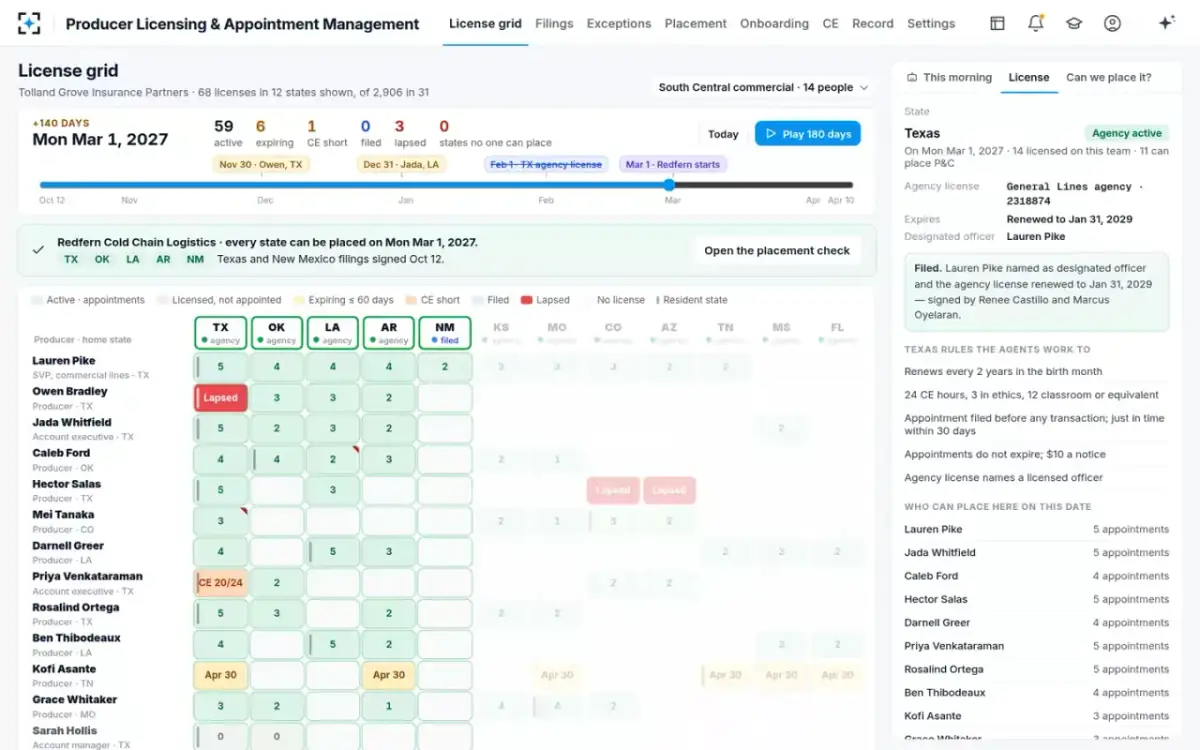
A lapse the grid saw coming: the license still shows lapsed until the CE hours post
Reinstate or reactivate: does a lapse go on my record?
A lapse for a missed fee or missed CE is not, by itself, a disciplinary action, and the NAIC's uniform application treats it that way. Its question about administrative proceedings tells applicants: "You may EXCLUDE terminations due solely to noncompliance with continuing education requirements or failure to pay a renewal or late filing fee" (NAIC Uniform Application, background question 2).
A lapse does not end a regulator's reach, though. The model act keeps the commissioner's power to pursue a violation "even if the person's license or registration has been surrendered or has lapsed by operation of law" (§12E). And a license lost through discipline is a different ladder: the handbook says reinstatement after disciplinary action "is usually not automatic" and must be requested in writing under the terms of the order (ch. 17).
How do I avoid my insurance license expiring?
Treat the renewal as a filing with dependencies, not a date. A renewal needs the fee, the CE posted to the state's transcript, the answers to the renewal application's questions, and, for an agency, a designated responsible producer who is still there. Each dependency has its own lead time.
Keeping a license off the lapse ladder
- Know the date the state knows
The expiry on the state record, not the one in a spreadsheet; check it on a NIPR producer report or the state lookup.
- Finish CE early enough to post
Texas suggests 30 days before expiry. Ethics hours are the usual gap, and they are often the last courses taken.
- Renew the resident license first
Nonresident licenses depend on good standing at home.
- Watch the agency’s license as well as your own
An agency whose responsible producer has left can stop every producer in the state.
- Keep the address current
The model act gives licensees 30 days to report a change; renewal notices go to the address on record.
- If it lapses, stop writing and fix the order
Reinstate the license, then the appointments, and only then write again in that state.
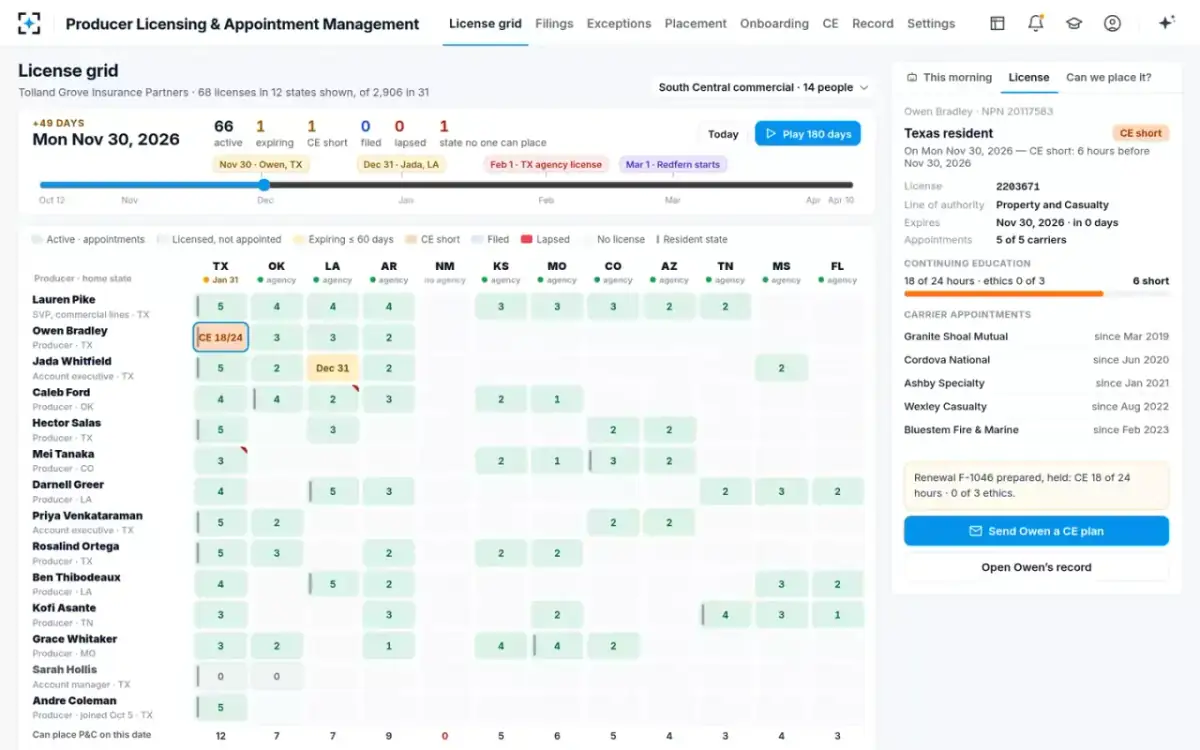
In the fictional sample agency, the watcher flags a producer's Texas license 49 days before it expires, six CE hours short with no ethics hours posted; the renewal is prepared and held, and a CE plan is one click away. The same grid turns a whole Texas column red on the day the agency's own license would lapse, months ahead, because its designated officer left. Who owns those three permissions, and how they differ, is in insurance license vs appointment.
49 days out: the renewal is prepared and held, and the gap is named
Questions people ask
How long can an insurance license be expired before I need a new one?
Under the NAIC model and in Illinois, 12 months from the renewal due date; after that, reinstatement without an exam is no longer available. In Texas a license short of CE is inactivated 90 days after expiry, and the producer must apply for a new license once the hours are done and the fine paid.
Does a lapsed resident license affect my nonresident licenses?
Yes. Nonresident licenses are issued on the strength of an active resident license in good standing, so a lapse at home undermines every nonresident renewal. Renew the resident license first and confirm it shows as active before renewing elsewhere.
Can I keep receiving renewal commissions if I let my license go?
Under the model act, yes, for business you wrote while licensed: renewal and deferred commissions may be paid if you were licensed at the time of the sale. The NAIC's handbook says receiving them creates no licensing requirement, though your agency agreement may set its own conditions.
What if I could not renew because of military service or illness?
The model act lets a producer who cannot comply with renewal procedures because of military service or another extenuating circumstance, such as a long-term medical disability, ask for a waiver of those procedures and of any exam, fine or sanction for not complying. Ask the state before the due date if you can.
Is an agency license lapse treated the same way?
The fee and renewal rules are similar, but the trigger is often different: an agency license can go inactive because its designated responsible producer left or lost their own license. The NAIC recommends that states give the agency a reasonable number of days to name a new one before the license goes inactive.