An insurance license is the state's permission for a person to sell, solicit or negotiate a particular line of insurance in that state; an appointment is the insurer's registration with the state that the licensed producer acts on its behalf. The license comes first, belongs to the producer and follows them from job to job. The appointment is per insurer and per state, filed and paid for by the insurer, and required only in states that use appointments. A third permission sits behind most sales: the agency's own license, with a licensed producer named as responsible for its compliance. A sale needs every one that applies, and having one says nothing about the others, which is why licensing teams check grids, not names. Botminds' Producer Licensing & Appointment Management keeps all three on one grid, for every producer and state, and checks each bound policy against all three on its bind date.
The rules are from the NAIC's Producer Licensing Model Act (#218), the NAIC State Licensing Handbook and state law, linked where they appear. The screens show the solution on a fictional sample agency.
License, appointment and agency license, row by row
| Individual license | Carrier appointment | Agency license | |
|---|---|---|---|
| Who grants it | The state insurance department | The insurer files it; the state records it | The state insurance department |
| Who applies and pays | The producer (fees by contract) | The insurer pays the appointment fee | The business entity |
| What it allows | Selling, soliciting and negotiating the licensed lines in that state | Acting as that insurer’s agent in that state | The agency acting as a producer and taking commission |
| Scope | One person, one state, by line of authority | One producer, one insurer, one state (per line in North Carolina) | One entity, one state |
| Lasts until | The renewal date, if fees and CE are current | Terminated, or renewed on the state’s cycle where it has one | The renewal date, and only while a responsible producer is named |
| Where to check it | NIPR Producer Database, state lookup | NIPR Producer Database; the insurer’s list | NIPR Producer Database, state lookup |
| If it is missing | No sale is lawful and no commission may be paid for it | A sale through an unappointed producer: an exam finding | The agency cannot sell or be paid in that state |
What is the difference between an insurance license and an appointment?
A license answers whether this person may sell this kind of insurance in this state; an appointment answers whether this insurer has told the state the person sells for it. The NAIC's handbook defines the second plainly: "An appointment is a registration with the state insurance department that a producer is acting on behalf of an insurer" (State Licensing Handbook, ch. 11).
The model act is equally plain about what a license does not do:
"The license itself does not create any authority, actual, apparent or inherent, in the holder to represent or commit an insurance carrier."
NAIC Producer Licensing Model Act (#218), §2F, the definition of “license”
That sentence is why the two exist separately. A licensed producer can quote and discuss coverage, but binding an insurer requires a relationship with that insurer: a contract and, in appointment states, the appointment on file. Appointed vs licensed is therefore not a ranking but two different questions, asked of two different parties.
Three permissions behind one sale
Every policy sold through an agent has to clear three permissions, and a licensing check should test each one as of the date the application was taken. The sample below shows the order; the second step is where many real exceptions come from, because a license for the state is not a license for the line.
One commercial auto sale, checked against three permissions
Agent
License for the stateIs the producer’s license in the risk’s state active on the bind date? In the sample, yes: a Texas license valid to July 2027.
Agent
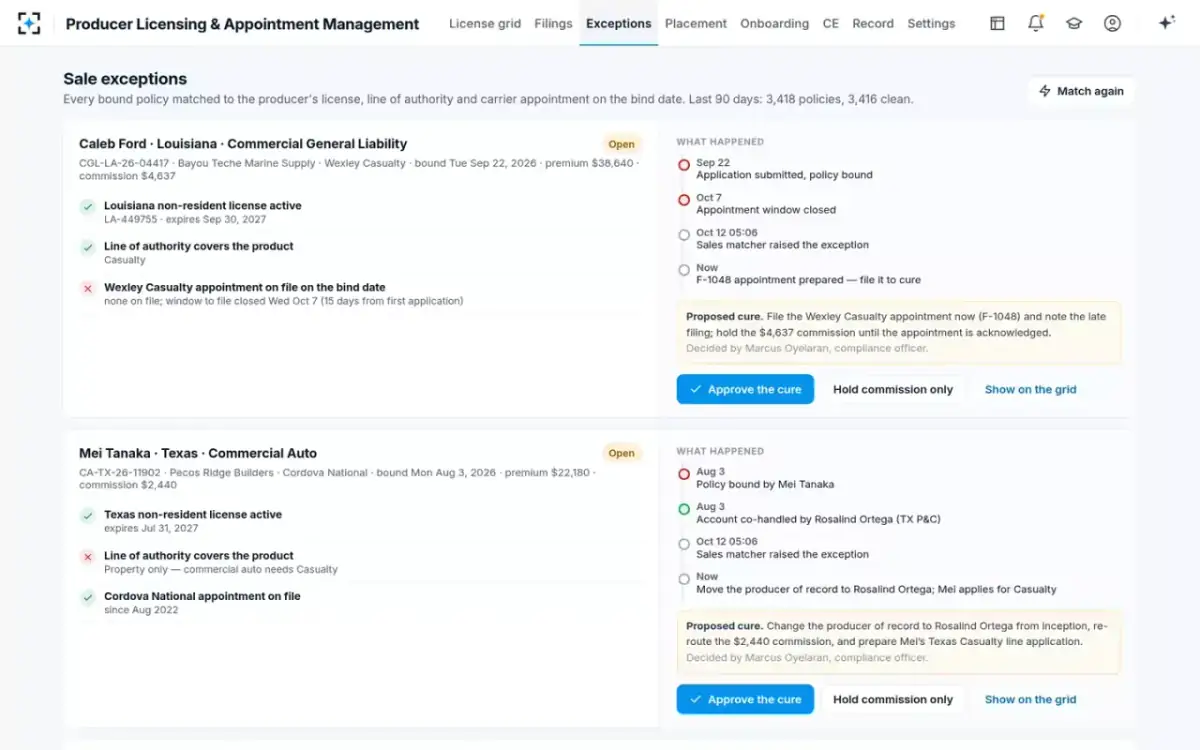
Line of authorityDoes the license cover the product? Commercial auto needs Casualty; this license is Property only. The check fails.
Agent
AppointmentIs the insurer’s appointment on file, or still inside the state’s window? Yes, since August 2022.
Agent
Agency licenseIs the agency licensed in the state, with a responsible producer named? Yes, on that date.
A person decides
Compliance officerDecides the cure: here, move the policy to a colleague licensed for Casualty from inception, re-route the commission, and have the producer apply for the line.
The NAIC's 2022 counts show how many permissions are in play nationally. States licensed 2.3 million resident and 9.5 million nonresident individual producers, plus business entities on top (NAIC, Insurance Department Resources Report); the NAIC's report counts licenses, not appointments, which sit in each state's records insurer by insurer.
Agencies are licensed producers too: business entity licenses, 2022
241,756
resident business entity producer licenses
579,063
nonresident business entity producer licenses
33,827
business entity licenses in Texas alone, 19,830 of them nonresident
Do I need to be appointed to sell insurance?
Only if you are acting as an insurer's agent in a state that requires appointments. The model act's appointment section is optional for states, the NAIC's handbook names Colorado as a state without appointments, and the model excuses a producer who is not acting as an insurer's agent, such as a broker placing business for a client.
Where appointments are required, the timing varies: 15 days from the contract or first application under the model, 30 days in Texas from the appointment's effective date. That window, and what late filing has cost insurers, is covered in just in time appointment states. The license, by contrast, has no window: it must be in force before the first sale.
Can a licensed agent sell for any insurance company?
No. A license qualifies the person; it does not give them authority from any insurer. To sell for a company as its agent, the producer needs that company's contract and, in appointment states, its appointment on file. The NAIC is explicit that the two are independent: "Do not require an appointment as a condition of licensure. Model #218 and the ULS provide that a producer can hold a license without holding an active appointment" (State Licensing Handbook, ch. 11).
The reverse also holds. An appointment is worthless without a license for the line: the NAIC's recommended practice is that states "Automatically terminate appointments if a license goes inactive for any reason" (same chapter), and some states bill appointment renewals only where the license is active. A producer who moves to a new state, or lets a line lapse, can still show appointments on a carrier's list that no longer authorize anything.
Can I get paid commission without an appointment?
The model act ties commission to the license, not the appointment. Section 13 forbids an insurer or producer to pay, and forbids anyone to accept, commission for selling, soliciting or negotiating insurance by a person who must be licensed and is not: "A person shall not accept a commission, service fee, brokerage or other valuable consideration for selling, soliciting or negotiating insurance in this state if that person is required to be licensed under this Act and is not so licensed" (Model #218, §13B).
Appointments bite through contracts and enforcement instead. Insurers pay commission under agency agreements with the producers they appoint, and a state that finds sales through unappointed producers can penalize the insurer; Kansas's 2020 order against one insurer included penalties for unpaid appointment fees. Whether to hold commission on an unappointed sale until the appointment is filed is the insurer's or agency's decision, and in the sample agency it belongs to the compliance officer, never to software. The same section lets commission be paid to the agency itself: §13D allows payment to an insurance agency, or to people who do not sell, solicit or negotiate, subject to the state's anti-rebating law (see commission split rules).
Does an insurance agency need its own license?
Yes, in states that license business entities, and the model makes it a requirement: "A business entity acting as an insurance producer is required to obtain an insurance producer license" (Model #218, §6B). The NAIC handbook adds that business entities "are considered to be producers under Model #218", so reciprocity, nonresident licensing and renewals apply to them as to people.
States add their own conditions. Texas, for instance, requires that "At least one officer or one active partner of the applicant entity must be individually licensed by the Texas Department of Insurance to act as an agent under the applicant entity", and wants changes to officers, directors, partners, members or managers reported within 30 days (TDI, agency license application FIN507). An agency licensed in 31 states holds 31 entity licenses, each with its own renewal date and its own named person.
What is a designated responsible licensed producer?
The designated responsible licensed producer, or DRLP, is the licensed individual an agency names as answerable for its compliance in a state. The model act requires the agency to have "designated a licensed producer responsible for the business entity's compliance with the insurance laws, rules and regulations of this state" before the state approves its license (§6B(2)). The NAIC calls the role the designated responsible producer, and notes "There is no provision in Model #218 to require multiple DRPs" for an agency that writes several lines.
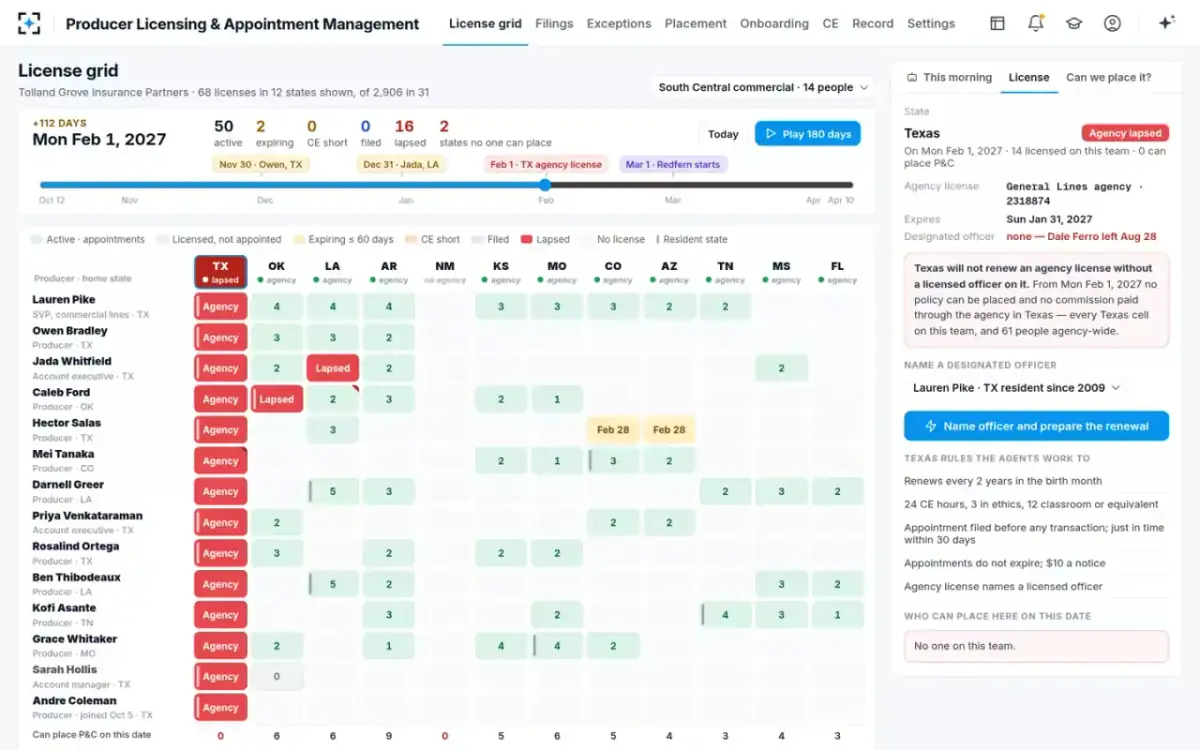
The role becomes urgent when the person leaves. The model is silent on what happens then; the NAIC's recommended practice for states is "to send a notification to the BE and inform it that the BE license will go inactive unless a new DRP is named and approved within a reasonable number of days" (Handbook, ch. 12). An agency whose DRLP left in August and whose license renews in January may find out on the renewal, when every producer in the state stops being able to sell through it.
The agency's own license: a whole state column turns red when no responsible officer is named
What happens to my appointments when I change agencies?
Your license goes with you; your appointments do not necessarily. Appointments are between you and each insurer. If the insurer ends the relationship when you leave, it must notify the state within 30 days of the termination's effective date and send you a copy within 15 days after that, under the model act; New York's statute uses the same 30 and 15 days for terminations for cause (N.Y. Ins. Law §2112(d)).
The new agency's insurers then appoint you, each on its own clock, and an insurer that appointed you before treats you as new. What travels with you is your own paperwork: the model gives you 30 days to report a change of address to each state that licenses you, and if you move your home state, 90 days to apply for the new resident license without an exam. Agencies onboarding a producer from a competitor should check each of these on day one, as set out in the insurance agent onboarding checklist.
Unlicensed staff, and where Producer Licensing & Appointment Management fits
The fourth line is the people who hold no license at all. Agency staff may handle much of the service work without one, but the line between service and selling is drawn by each state; the guide to what an unlicensed insurance CSR can do works through Florida, Texas and California. For producers, the three permissions above are the whole test.
Producer Licensing & Appointment Management keeps the three on one grid: each cell is a producer's license in a state, the number in it is the carrier appointments on that license, and each state column carries the agency's own license and its responsible officer. Its sales matcher checks license, line and appointment for every bound policy on its bind date, and the compliance officer decides the cure for anything that fails. The workflow is on the Producer Licensing & Appointment Management page.
Each failed permission, named: wrong line here, late appointment there
Questions people ask
Is a line of authority part of the license or the appointment?
The license. The model act lists the major lines a license can carry: life, accident and health or sickness, property, casualty, variable life and variable annuity, and personal lines. An appointment authorizes acting for an insurer within the lines the producer is licensed for.
Can one producer be appointed by many insurers in the same state?
Yes, and independent producers usually are. Each insurer files and pays for its own appointment, and the NAIC recommends one appointment filing per producer per insurer in each state, whatever the number of products.
Does a captive agent need appointments?
Yes, with the one insurer, or its group, that the agent represents. The model lets an insurer appoint a producer to all or some insurers in its holding company group with a single filing, in states with electronic appointments.
Can an appointment exist without a license?
It should not. Florida makes every appointment subject to the prior issuance of the license, and the NAIC recommends that states terminate appointments automatically when a license goes inactive. A carrier list that shows an appointment for a lapsed license is showing a record, not a permission.
Do renewal commissions need a current license?
Under the model act, renewal and other deferred commissions may be paid to someone who was licensed at the time of the sale, even if they are no longer licensed. The handbook says states should not require a license just to keep receiving them.