What can an unlicensed insurance CSR do? In most states, an unlicensed customer service representative employed by an insurer or agency can answer the phone, verify callers, take premium payments, record requests and changes for a licensed person to process, send documents, and tell a policyholder factually what their records show: which coverages are in force, their limits and any balance due. What they cannot do is sell, solicit or negotiate insurance, and the states define those acts broadly enough to include describing the benefits or terms of coverage, interpreting a policy and recommending a product. On a service call the line runs through the middle of ordinary questions: "what is my deductible" is usually service; "is my son's laptop covered at college" is usually not. Botminds' Real-Time Agent Assist for Insurance, a contact-centre solution that answers coverage questions live from the customer's own forms, has to respect that line on every answer. This guide compares three states' rules, splits one real-looking call by licence, and sets out a script rule for each side.
It is general information on the rules quoted, not legal advice. The worked call is the solution's fictional sample call; its people, insurer and amounts are invented.
One five-minute service call, split by what the law calls it
The sample call · 322 seconds
- Greeting and identity: service · 8%
- Cancellation letter and payment: service · 30%
- Renewal increase: depends on the words · 11%
- Stolen laptop: interpreting coverage · 22%
- New boat: describing cover and quoting · 29%
What can an unlicensed insurance CSR do? The short answer from three states
About two-fifths of the sample call is plainly service, half is licensed activity, and the rest depends on how it is said. That is the normal shape of a personal-lines service call, which is why a floor of unlicensed representatives transfers so many calls, and why a floor of licensed ones costs more. The three states below draw the line in different words that land in similar places.
What unlicensed insurance staff may and may not do, in three states
| State | Unlicensed staff may | Unlicensed staff may not | The rule |
|---|---|---|---|
| Florida | Full-time clerical work, with incidental taking of applications or quoting or receiving premiums on incoming inquiries in the office, if paid no commission | Solicit: describe benefits or terms of coverage, recommend, complete applications, compare products, advise or interpret coverages; at a branch, bind or initiate sales contact | Fla. Stat. §626.112(1)(b), §626.0428 |
| Texas | Salaried, full-time clerical and administrative work in an agent’s office, including incidental taking of information and receipt of premiums, with no commission or premium-based pay | Solicit or negotiate; a referral to an agent becomes an agent’s act if the unlicensed person discusses specific policy terms or conditions | Tex. Ins. Code §4001.002(b)(5), §4001.051(d) |
| California | Tell insureds factually the category and limits of coverage in policy records, whether coverage is in effect and premium due; record change requests; accept premiums for licensees | Explain, interpret or offer opinions on coverages or limits; analyse, advise or recommend | Cal. Code Regs. tit. 10, §§2193.1–2193.2 |
Describing coverage is selling: the Florida definition
Florida's statute is the clearest example of why coverage questions are licensed territory. It requires a licence to engage in the solicitation of insurance, and defines solicitation as "the attempt to persuade any person to purchase an insurance product by: 1. Describing the benefits or terms of insurance coverage, including premiums or rates of return;" followed by distributing an invitation to contract, recommending products, completing applications, and comparing products, advising on insurance matters or interpreting policies or coverages.
Read literally, the definition turns on persuasion to purchase, and a service call about an existing policy is not always an attempt to persuade anyone to buy. But two of the acts listed, interpreting policies and advising on insurance matters, are exactly what a caller asks for when they ask whether a loss is covered, and an explanation of coverage on a service call can turn into an offer in the next sentence, as the boat does on the sample call. Florida's answer for agency staff who need to cross that line is a licence of its own, the 4-40 customer representative licence. For an unlicensed employee, Florida adds that at an agency branch they may not bind coverage, and may not initiate contact with anyone to solicit insurance (§626.0428(2)–(3)).
What can an unlicensed insurance agent do in Texas?
Texas exempts a salaried employee who is not involved in soliciting or negotiating insurance and works full time on clerical and administrative services in an agent's office, including incidental taking of information from customers and receipt of premiums, provided they receive no commission and their pay does not vary with premium volume (§4001.002(b)(5)). Its list of acts that make a person an agent is broad: it includes soliciting insurance, receiving or transmitting an application, receiving or transmitting a premium, and aiding in adjusting a loss (§4001.051(b)).
The most useful Texas sentence for a service floor is about referrals, because the referral is what an unlicensed representative should do with a coverage question:
"The referral by an unlicensed person of a customer or potential customer to an agent is not an act of an agent under this section unless the unlicensed person discusses specific insurance policy terms or conditions with the customer or potential customer." Tex. Ins. Code §4001.051(d)
The test, in other words, is not whether the representative passed the call on, but what they said before passing it. "Let me transfer you to a licensed colleague who can go through your coverage" is a referral. "I think your policy covers that, but let me transfer you" has already discussed terms.
What can an unlicensed insurance agent do in California?
California is the most specific, because its regulations list what unlicensed staff may do rather than only what they may not. Among the clerical activities exempt from licensing is "Informing insureds factually, in response to their inquiries, as to the category and financial limits of insurance coverages indicated in policy records, whether coverages are in effect and any premium balances due", provided the person does not otherwise explain, interpret or offer opinions on those coverages or limits.
The same list allows unlicensed staff to receive and record requests to add to or delete from a policy and prepare endorsement forms for a licensee to review and sign; to accept premiums for delivery to licensees; to answer calls, open mail and do general administrative work; and to communicate with policyholders to obtain factual information a licensee has asked for, always without analysing, advising or recommending (§2193.2). A companion section covers preparing binders, certificates and policies for a licensee's signature (§2193.1). The design is clear: unlicensed staff may move facts and paper; the licensee does the explaining. The same line, drawn for mid-term changes, is set out in who has authority to make changes to an insurance policy.
The NAIC model line behind the state rules
Behind the state wording is the NAIC's Producer Licensing Model Act, written by state insurance regulators, which requires a licence to sell, solicit or negotiate insurance. It defines "Solicit" as "attempting to sell insurance or asking or urging a person to apply for a particular kind of insurance from a particular company." Negotiation, in the model, is conferring with or advising a purchaser about the substantive benefits, terms or conditions of a contract. Insurer and producer employees doing administrative or clerical work only indirectly related to a sale, without commission, are exempt.
Examiners test the same line from the insurer's side. The NAIC's market conduct standards for producer licensing include that "The producers are properly licensed and appointed and have appropriate continuing education (if required by state law) in the jurisdiction where the application was taken." A boat application taken on a service call by an unlicensed representative fails that standard regardless of how good the quote was.
Can an unlicensed CSR explain coverage? Reading the declarations versus explaining them
An unlicensed CSR can usually read coverage facts from the records; explaining what they mean for the caller's situation is where the line falls in California, and the safer default elsewhere. The difference is easiest to see on one question answered both ways.
“Is my son’s laptop covered? It was stolen from his dorm.”
An unlicensed representative, staying on the service side: Your policy is in force. Personal property coverage is $218,350 and the deductible is $1,000.
A licensed representative, with the cited answer: The same facts, from the declarations.
An unlicensed representative, staying on the service side: A licensed colleague can go through how your policy treats property away from home. I’ll take the details now so nothing is lost.
A licensed representative, with the cited answer: Owen counts as an insured as a full-time student under 24 who lived at home before school. Property at his dorm is limited to 10% of personal property coverage, $21,835, after the $1,000 deductible.
An unlicensed representative, staying on the service side: I’ll record the theft and the police report for the claim report, and transfer you.
A licensed representative, with the cited answer: I’m starting the claim report; the adjuster decides the claim.
An unlicensed representative, staying on the service side: “That should be covered.”
A licensed representative, with the cited answer: “That is covered.”
Neither column says the loss is covered. That last row is not a licensing rule but a claims one: whether a reported loss is paid is decided by the adjuster on the facts, and a licensed representative who promises it is making a decision that is not theirs. How to score coverage answers on both counts is in insurance coverage questions answered live.
What Real-Time Agent Assist does when the representative is unlicensed
An assistant on the call has to change what it shows depending on who is listening. In the solution, coverage answers and life-event offers can be limited to licensed representatives, and an unlicensed representative is offered a warm transfer instead. The assistant still does the service work for them: the timeline of what happened to the policy, the billing answer with its sources, the payment, the drafted note.
On the sample call the representative is licensed, so the boat card appears once the reason for the call is resolved. It shows the gap in today's cover, every eligibility rule checked, and a quote pre-filled from the call and the household record: agreed value $46,900, $300,000 liability, a $500 deductible, $372 a year. Every word of that is solicitation. For an unlicensed representative, the same moment should produce a transfer, logged with the reason.
A quote in Real-Time Agent Assist: licensed activity from the first line
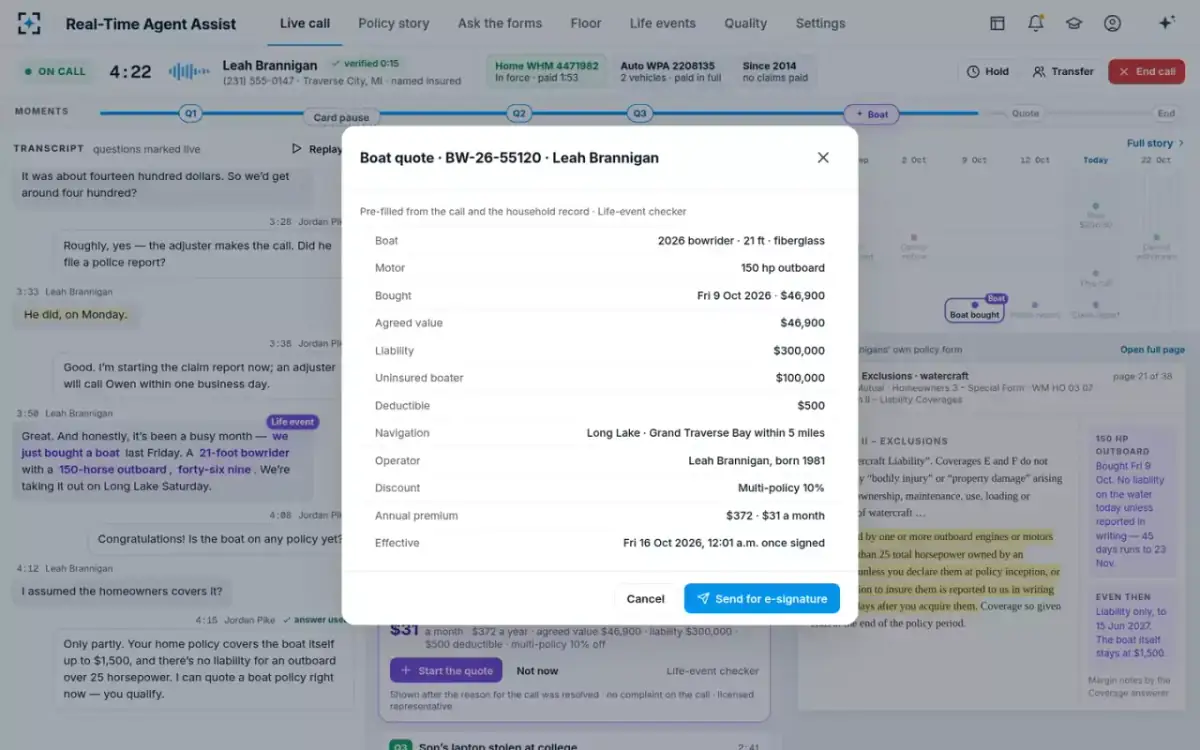
The renewal question sits in between. On the sample call the answer gives two reasons for a $258 increase, a filed rate change of $121 and an inflation-guard increase in the dwelling limit of $137, read from the renewal worksheet. Reading the figures is factual; explaining how the inflation guard works on the policy, or whether the customer should change their limit, moves toward advice. A floor that is unsure where its states draw that line should treat the explanation as licensed and the figures as service.
Unlicensed insurance CSR requirements: a script checklist
The safest script for an unlicensed representative gives every fact the records hold and none of the opinions, and hands off cleanly before the conversation turns to what the policy means or what to buy.
Script rules for an unlicensed insurance service representative
- Read facts; do not interpret them.
Coverages in force, limits, deductibles, premium due, dates, notices sent: yes. What they mean for this loss or this purchase: transfer.
- Never say whether a loss is covered.
Neither “yes” nor “probably”. Record the loss and start the claim report.
- Refer before discussing terms, not after.
Texas makes the referral an agent’s act if specific terms were discussed first.
- Take requests; let a licensee approve them.
Record additions and deletions and prepare the change for a licensed person to review.
- Take premiums; do not set them.
Accepting a payment is clerical; quoting a new policy is not, outside Florida’s narrow incidental-quote exemption.
- Do not raise new products.
If the caller mentions a boat, note it and offer a licensed colleague.
- Earn no commission on the business.
The exemptions in Florida and Texas depend on pay not tied to production.
- Write down what was said and what was transferred.
The note is the evidence that the line was kept.
Those rules are easy to state and hard to follow live, under a caller's pressure. That is where an assistant earns its place on an unlicensed desk: by showing the factual answer with its source, holding back the interpretation, and offering the transfer at the right moment. How the role divides once that is in place is in the insurance customer service representative job description.
Questions people ask
What can unlicensed insurance agency staff do?
Typically clerical and administrative work: answering calls, taking premium payments, recording change requests for a licensee, preparing documents for a licensee's signature and giving factual information from policy records. They may not sell, solicit or negotiate, and in most states that includes explaining or recommending coverage.
Can an unlicensed insurance employee in Florida give a quote?
Only incidentally. A full-time clerical employee paid no commission may take applications or quote or receive premiums on incoming inquiries in the agency's office without being treated as an agent. At an agency branch, an unlicensed employee may not bind coverage or initiate contact to solicit insurance.
Do insurance agents need to be licensed?
Yes. Anyone who sells, solicits or negotiates insurance needs a licence in the state for that line of authority; that is the core rule of the NAIC Producer Licensing Model Act, and state codes such as Florida's and Texas's apply it in their own words.
Can an unlicensed CSR tell me my deductible?
Generally yes. California's regulations expressly allow unlicensed staff to tell insureds factually the category and limits of coverage shown in policy records and whether coverage is in effect. Explaining how the deductible applies to a particular loss is a different matter.
What happens if an unlicensed CSR explains coverage?
The insurer or agency risks the employee being treated as acting as an unlicensed agent, and an examiner testing producer licensing will look at who took each application. In Texas, a referral becomes an agent's act once specific policy terms have been discussed.
Can an AI assistant explain coverage to the caller?
An assistant that speaks to the caller would face the same question in a sharper form. In the solution it never speaks; it shows the cited answer only to licensed representatives and offers others a warm transfer.