To reduce after call work time, stop asking representatives to write the record from memory once the call has ended, and instead have it drafted while the call happens, from the transcript and the systems, for the representative to read, correct and confirm in under a minute. After-call work is everything a representative does between hanging up and taking the next call: notes, disposition codes, follow-up tasks, payments to reconcile and requests to send. It is usually the largest single block of handle time that the customer never hears. But it is also where the record is made, and on an insurance service desk the record is what the next representative reads, what a complaint investigator pulls and what a market conduct examiner tests. Cutting the minutes by cutting the note is a false saving. Botminds' Real-Time Agent Assist for Insurance drafts the note in full sentences, with the numbers said on the call, and nothing is saved until the representative confirms it. This guide shows the difference between a typed note and a drafted one on the same call, what a good note contains, and how to measure after-call work without rewarding worse records.
Examples come from the solution's fictional sample call and service floor; people, insurer and amounts are invented.
After-call work on the sample floor
4:30min
centre average, notes typed by hand, for a call like the sample call
0:41min
on the sample call: a drafted note read and confirmed
94.6%
of the day’s notes confirmed within 2 minutes of the call (1,803 of 1,906)
4months
between a note that said “rates went up” and the same question asked again
What is after call work, and what does after call work time mean?
After call work, often shortened to ACW or wrap-up, is the work a representative completes after the customer hangs up and before becoming available again; after call work time is the minutes it takes. It counts toward average handle time but not toward talk time. On an insurance service desk it typically holds four jobs: writing the call note, choosing disposition codes, creating follow-up tasks such as callbacks and letters, and finishing requests that were started on the call, such as a claim report or a payment adjustment.
The BLS counts recording the details of each contact, and the action taken, among the core duties of every customer service representative (BLS). In insurance that duty carries more weight than in most industries, because the record is a regulated document. The NAIC's market conduct examination standards ask, among other things, whether policy transactions are processed accurately and completely and whether complaints reach the complaint register in the required form (NAIC examination standards). Both are tested from the records representatives write.
Average after call work time: what to measure before you cut it
There is no regulator's benchmark for after-call work on an insurance desk, and published figures from software vendors measure different things, so measure your own, by call type, before setting a target. On the sample floor the centre average for a call that combines billing, a coverage question and new business is 4:30 of notes typed by hand, against 11:40 of talking: after-call work is 28% of the whole call.
Measure three things together: the minutes, the share of notes that contain what the note standard requires, and the repeat-contact rate on the same issue within 30 days. A floor that measures only the minutes will get shorter notes. One that measures all three will see whether the minutes saved are coming out of the record. Average handle time and the cost of the repeat call are worked through in average handle time at an insurance company.
How to reduce after call work time: draft the note, do not skip it
The note is fastest when the representative does not write it at all, only checks it. The difference is easiest to see on one call. Below, the left column is our illustration of the kind of note a representative types in a hurry at the end of a five-minute call with four topics; the right column is the note the solution drafted for the same call.
The same call, as a note typed in a hurry and as Real-Time Agent Assist’s draft
Typed after the call (our illustration): Cust called re cancel letter.
Drafted by the solution, confirmed by the representative: Notice of cancellation for nonpayment (WM-NC-12, mailed 2 Oct). Autopay declined 28 Sep: card ending 4417 expired 09/26.
Typed after the call (our illustration): Pmt taken, autopay updated.
Drafted by the solution, confirmed by the representative: Took $206.50 by card ending 8806, conf. 88213-B; autopay moved to 8806 from 28 Oct; cancellation of 22 Oct withdrawn. Card details not recorded (transcription paused 1:14–1:52).
Typed after the call (our illustration): Asked about increase, explained.
Drafted by the solution, confirmed by the representative: Explained the 15 Jun renewal increase of $258: Michigan rate change +$121; inflation guard on Coverage A (+6% to $436,700) +$137. Closes her question from 18 Jun.
Typed after the call (our illustration): Son laptop stolen, claim started.
Drafted by the solution, confirmed by the representative: Son Owen, full-time student, laptop about $1,400 stolen from his dorm; police report filed 12 Oct. Read the definition of insured and the Coverage C limit at other residences ($21,835); $1,000 deductible; told customer the adjuster decides. Claim report CLM-26-118407.
Typed after the call (our illustration): Interested in boat, quote sent.
Drafted by the solution, confirmed by the representative: Boat application BW-26-55120 sent for e-signature, $372 a year, effective 16 Oct once signed.
The typed note is not wrong. It is just useless to the next person. "Asked about increase, explained" does not say what was explained, so the next representative has to explain it again; "claim started" does not say what the customer was told about coverage, so a later complaint becomes one person's memory against another's. The drafted note carries the numbers that were said, the documents that were read, and what the customer was told about who decides the claim.
The note the next call reads
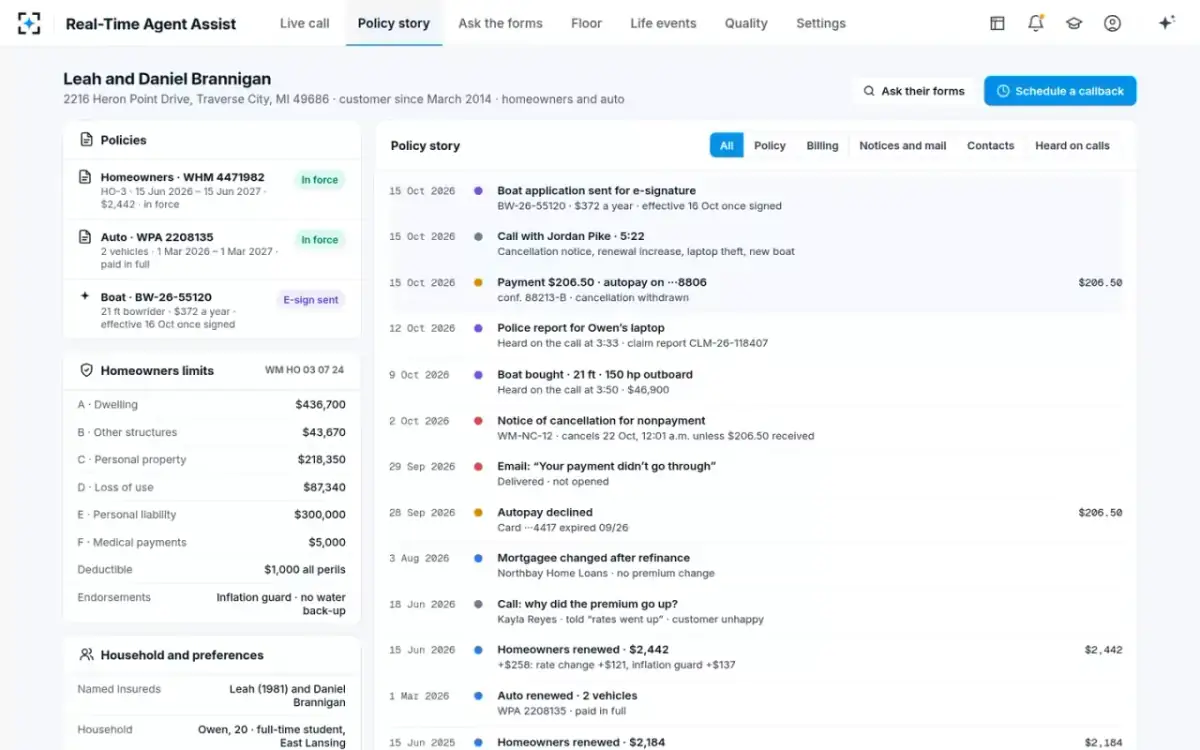
The best test of a call note is the next call. The sample customer had called on 18 June to ask why her premium had gone up, and the note from that call said only "rates went up". Four months later, on 15 October, she asked the same question. Between the two calls her policy story shows a mortgagee change after a refinance, an autopay decline and a cancellation notice: three more reasons to call, none of which the June note would have helped with.
Four months between a vague note and the same question, asked again
- 18 Jun call: note says “rates went up”46 d
- 3 Aug: mortgagee changed56 d
- 28 Sep: autopay declined; 2 Oct: cancellation notice17 d
On 15 October the call ends with a line written for whoever takes her next call: "Paid 15 Oct after an expired card; renewal increase explained (rate +$121, dwelling limit +$137); laptop claim CLM-26-118407 open; boat application sent — check the signature." It is the first thing the next representative sees on the policy story. That line is the product of after-call work, and it is worth more than the minutes it saves.
The record the next representative opens: every event, every call, on one timeline
What a good call summary in customer service contains
A good call summary lets someone who was not on the call act on it without calling the customer back. For an insurance service desk that means eight elements, and a drafted note should be judged against all of them before anyone counts the minutes saved.
A call note standard for an insurance service desk
- Who called and how they were verified.
Named insured or authorised person, and the method and time of verification.
- Why they called, in their words and in the record’s.
The question asked and the document or event behind it, with its reference.
- What was explained, with the numbers.
Amounts, dates, limits and reasons as they were said, not “explained”.
- What was read, by name and page.
The notice, worksheet or clause the answer came from.
- What was done, with confirmations.
Payments, changes, claim reports, applications, each with its reference number.
- What the customer was told about decisions that are not ours to make on the call.
For example, that the adjuster decides the claim.
- What is still open, and who owns it.
Follow-ups with their trigger: sent on the call, sent on save, waiting for a signature.
- What was deliberately not recorded.
Card details, with the paused interval, so a reviewer knows the gap is intended.
The after call work process with a drafted note, step by step
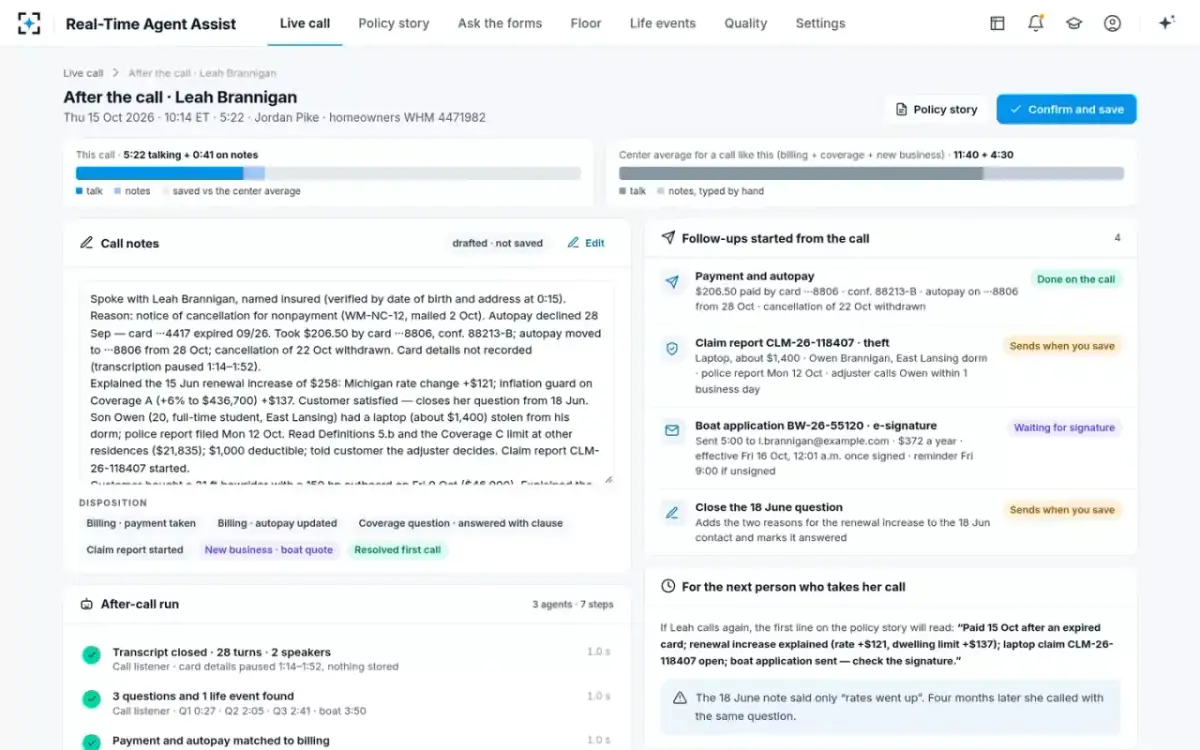
With an assistant, after-call work becomes a short review rather than a writing task. On the sample call the after-call run shows three agents and seven steps; the last waits for the representative.
Real-Time Agent Assist’s after-call run, from hang-up to save
Agent
Call listenerCloses the transcript: 28 turns, two speakers, card details paused 1:14–1:52, nothing stored.
Agent
Call listenerLists what was asked: three questions and one life event, with their times.
Agent
Service request starterMatches the payment to billing, drafts claim report CLM-26-118407 and tracks the boat application.
Never: Binds, cancels or changes coverage.
Agent
Call notes writerWrites the note and disposition codes, and four follow-ups with their triggers.
Never: Writes what was not said.
A person decides
Service representativeReads the draft, edits anything wrong, confirms and saves. Nothing is written to the account before this.
The four follow-ups show why the save matters. Two were done or sent on the call: the payment and autopay, and the boat application, which is waiting for the customer's signature. Two send only when the representative saves: the claim report to claims intake, and a note closing the 18 June question. If the representative never confirms, neither goes.
After-call work as a review: the draft, the codes and the follow-ups waiting for one click
Who should confirm an AI call summary, and why it must be the representative
The representative who took the call should confirm the summary, because they are the only person who heard it and the person accountable for what the record says. A summary saved automatically puts the software's account of the call on the record under the representative's name, and a summary confirmed by someone else, such as a supervisor clearing a queue, puts it there under no one's.
Confirmation is also how the tool improves the representative, not just the record. In the NBER study of an AI assistant for support agents, the authors note that before the tool "by necessity, managers can only provide feedback on a small fraction of the conversations that an agent conducts." A representative reading a well-drafted note after every call sees, every time, what a complete record of their call looks like. On the sample floor the quality screen also shows how much each note was edited; a representative who confirms every draft untouched may not be reading them, which is the coaching conversation to have.
After call work in call center metrics: measuring it without rewarding worse notes
Report after-call minutes next to two quality measures and never alone: the share of notes meeting the standard above, and repeat contacts on the same issue within 30 days. Add a third if you have the data: how much representatives edit drafted notes, because zero edits on every call is as suspicious as heavy edits on every call.
On the sample day, 94.6% of notes were confirmed within two minutes of the call ending. That is the number to watch: not how short the after-call work is, but whether the record is complete and confirmed while the call is fresh. Once it is, the minutes take care of themselves. How the same drafted record feeds coaching and every-call quality checks is covered from the trust side in AI copilot for call center agents, and the listener that writes the transcript underneath it in real time agent assist software.
Questions people ask
What is after call work in a call center?
The work a representative does after the customer hangs up and before the next call: the call note, disposition codes, follow-up tasks and finishing any request started on the call. It is part of average handle time but not of talk time.
What is a normal average after call work time?
There is no regulator benchmark, and published figures vary with what each centre counts. Measure your own by call type; on the solution's sample floor, a centre-average call combining billing, coverage and new business carried 4:30 of after-call work typed by hand.
Can AI write call notes automatically?
It can draft them from the transcript and the systems, and that is where the time saving comes from. It should not save them: the representative who took the call should read and confirm the note, which in the solution is a fixed rule.
What should be in an insurance call note?
Who called and how they were verified, why, what was explained with the numbers, which documents were read, what was done with reference numbers, what the customer was told about decisions such as claims, what remains open, and what was deliberately not recorded.
Does reducing after call work increase repeat calls?
It can, if the minutes come out of the note. On the sample call a June note that said only "rates went up" was followed four months later by the same question. Measure repeat contacts alongside after-call minutes so a shorter wrap-up does not hide a longer next call.
How long should a representative take to confirm a drafted note?
Long enough to read it. On the sample call it took 41 seconds; on the sample day 94.6% of notes were confirmed within two minutes. Confirmation far faster than reading speed suggests notes are being approved unread.