Average handle time at an insurance company is the average time a representative spends on one contact from the moment it is answered to the moment the representative is free for the next: talk time, plus hold time, plus after-call work such as notes and follow-ups. There is no published industry benchmark from a regulator or statistical agency, and figures quoted in marketing vary with what each centre counts, so the useful number is your own, by call type. For a servicing call it is also an incomplete number. The full cost of a call includes the repeat call that happens when the first one left a vague note or a half-answered question, and that cost never appears on the handle-time dashboard. Botminds' Real-Time Agent Assist for Insurance is built to shorten both halves of handle time and to prevent the repeat call. This guide sets out how to calculate the cost of one call, where the minutes go, and what an assistant can and cannot change in the sum.
The worked example is a fictional sample call and its sample centre averages in the solution. People, insurer and every figure describing the call are invented; the arithmetic and the research cited are real.
One servicing call, timed: the sample call against its centre average
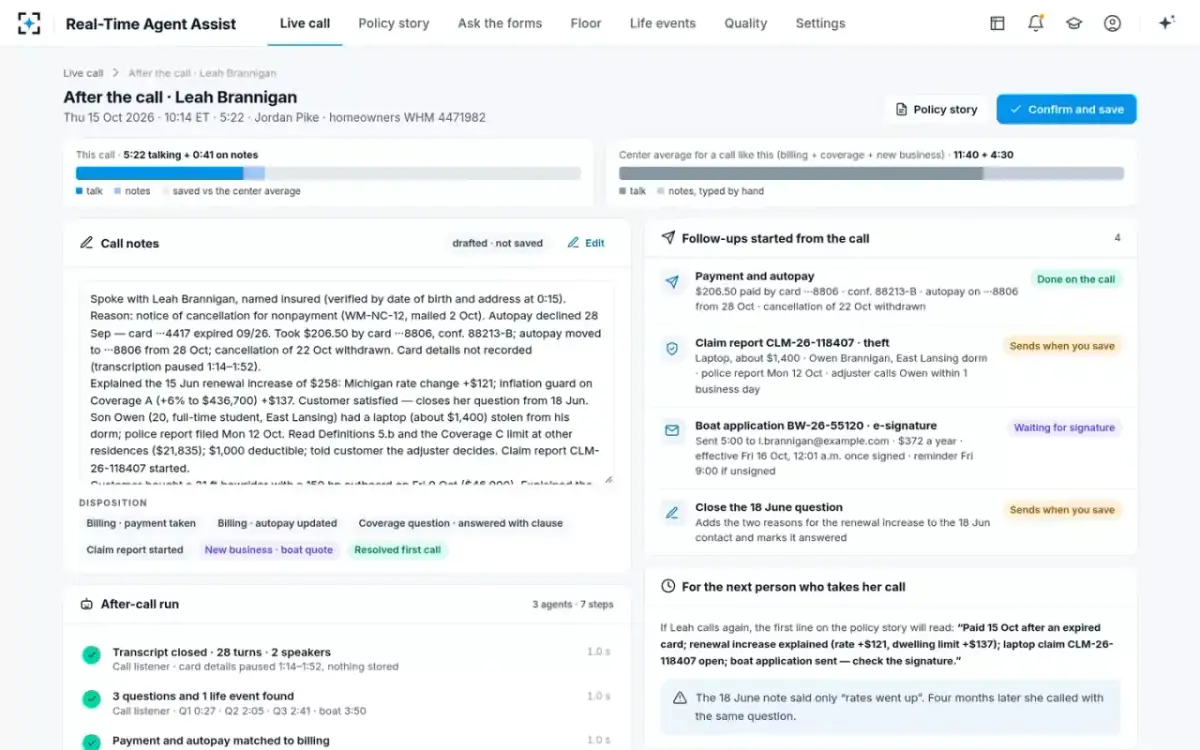
11:40min
centre average talk time for a call like it
billing, coverage and new business
4:30min
centre average after-call work, notes typed by hand
5:22min
talk time on the sample call with the assistant
0:41min
after-call work: a drafted note read and confirmed
What is a typical average handle time at an insurance company?
There is no regulator's benchmark, so the honest answer is: whatever your mix of calls makes it. A billing call that ends with a payment is short; a call that combines a cancellation notice, a renewal question, a claim report and a new quote, like the sample call, is long. A single centre-wide average blends those together and moves whenever the mix moves, which is why it is a poor target and a reasonable diagnostic.
The one rigorous public measurement of handle time under an AI assistant comes from outside insurance. In the NBER study of a support desk at a software firm, chats averaged about 40 minutes, and access to the assistant cut handle time by "a 3.8 minute decrease in the average duration of customer chats, a 9% decline from the baseline mean". Those were chats about technical problems, sometimes handled several at once. They tell you the direction of the effect, not the size it will have on a policyholder's call.
For an insurer, the practical step is to measure handle time by call type and by its parts. The sample centre does this: its average for a call that combines billing, coverage and new business is 11:40 of talk and 4:30 of notes, 16:10 in all, and that is the figure the sample call is compared with on the after-call screen.
Average handle time calculation and formula
The standard formula is total talk time plus total hold time plus total after-call work, divided by the number of calls handled, for the same period and call type. Each term needs a definition before it means anything: whether talk time starts at answer or at greeting, whether a transfer counts as one call or two, and whether after-call work stops when the representative closes the screen or when the last follow-up is sent.
Two choices change the answer more than any tool. If after-call work is capped by the phone system, representatives finish notes during the next call or not at all, and the average looks good while the record gets worse. If transfers count as new calls, a desk that sends coverage questions to a licensed colleague shows two short calls instead of one long one. Settle both before comparing any figure, including the ones in this guide.
Average handle time vs average talk time
Average talk time is only the conversation; average handle time adds hold and after-call work. The difference between them is where most of the cost hides on an insurance desk, because servicing calls generate records: a note, disposition codes, a payment reconciliation, a claim report, a callback. On the sample centre average, after-call work is 4:30 of a 16:10 call, more than a quarter of the total.
It also hides inside talk time, as dead air. A representative searching four systems for the reason a policy is cancelling is talking time on the dashboard and silence on the line. The solution's estimate splits one centre-average call by what the minutes are spent on, and searching plus finding the clause comes to more than talk with the customer.
One call's minutes by stage, by hand and with Real-Time Agent Assist
Centre average · 16:10
- Searching systems · 24%
- Finding the clause · 18%
- Explaining, answering · 22%
- Starting requests · 8%
- Notes, follow-ups · 28%
Sample call · 6:03
- Searching · 11%
- Clause · 11%
- Explaining, answering · 50%
- Requests · 17%
- Notes · 11%
One call, minute by minute
Timing a real call by stage shows where an assistant's minutes come from. The sample call is unusually full: a cancellation letter, a card payment, a renewal increase, a stolen laptop and a new boat. With the assistant it takes 5:22 of talk and 0:41 of notes.
The sample call, stage by stage, in seconds
- Greeting, recording notice, identity27 s
- Cancellation letter answered47 s
- Card payment: transcript paused, then confirmed51 s
- Renewal increase explained36 s
- Laptop, claim report started69 s
- Boat: gap, eligibility, quote sent92 s
- Drafted note read and confirmed41 s
Two things stand out. The cancellation question took 22 seconds from question to answer, because the four events behind it were already on the timeline. And the longest stage is the one that earns revenue: 92 seconds on a boat the customer mentioned in passing, from the gap in her current cover to a quote sent for signature. A desk measured only on handle time would want that stage gone. A desk measured on cost per resolved call, and on revenue, would not.
What one minute costs, and what one call costs
Price a call from your own loaded cost per paid minute, not from a benchmark. The BLS median pay for customer service representatives was $21.53 an hour in 2025 (BLS), which is about 36 cents a minute in wages alone. Your loaded figure adds benefits, supervision, quality, systems, facilities and the minutes representatives are paid but not on a call, and it will be a multiple of that.
At wages alone, the sample centre average of 16:10 is about $5.80 of representative time and the sample call's 6:03 about $2.17 (our arithmetic at the BLS median). Neither is the cost of the call. Multiply by your loaded rate, and then add the term most models leave out.
The cost of one servicing call, written as a sum
Talk and hold
minutes × loaded cost per minute
Includes dead air while systems are searched.
Operations
After-call work
minutes × loaded cost per minute
Notes, dispositions, follow-ups, reconciliations.
Operations
The repeat call
chance of a callback × cost of that call
Driven by vague notes and half-answered questions.
Quality
The complaint
chance of a complaint × cost to handle it
Register entry, response, any regulator inquiry.
Compliance
The cost no dashboard shows: the repeat call
The repeat call is the most expensive minute on a servicing desk because it is paid twice and fixes nothing new. The sample call shows how it starts. On 18 June the customer called to ask why her premium had gone up, and the note said only "rates went up". Four months later, on 15 October, she asked the same question again. This time the answer gave the two reasons for the $258 increase, a filed rate change of $121 and an inflation-guard increase in her dwelling limit of $137, and the note recorded both.
Repeat contacts become complaints, and complaints are counted. By our count of the Texas Department of Insurance's open complaint data, 3,088 of the 22,564 complaints closed in 2025 carried the reason for customer service on policyholder services, and 1,624 cited delays in policyholder service; a complaint can carry several reasons (TDI data). Each one is an entry examiners can read, and answering policyholders in a timely and responsive way is itself one of the policyholder service standards in the NAIC's market conduct examination standards.
Servicing reasons on Texas insurance complaints closed in 2025
The record is what decides whether the next call is a repeat. A note that says what was explained, with its numbers, lets the next representative say "on 15 October we explained the two reasons" instead of starting over. Why the note matters more than the minutes saved writing it is the argument of how to reduce after call work time.
How to reduce average handle time in a call center without making the next call longer
Cut the minutes that do not reach the customer, and leave the ones that do. Searching systems, finding the clause and typing notes are the three stages an assistant can shorten without changing what the customer hears. On the solution's estimate they are 70% of a centre-average call by hand and about a third of the sample call. Explaining is the stage that should not shrink; on the sample call it is half of what remains.
Avoid the cuts that move cost rather than remove it: capping after-call work so notes get shorter, transferring coverage questions so each call looks shorter, or hurrying explanations so the customer calls back. Each improves average handle time and raises the cost per resolved call. The NBER study found the opposite pattern under an assistant: handle time fell while resolution rates held, rising by 1.3 percentage points from a baseline of 82%. That is the shape to look for in a pilot.
Real-Time Agent Assist’s after-call screen: handle time beside the centre average
What an assistant changes in the sum, and what it does not
An assistant changes the first two terms directly and the last two indirectly. It shortens talk by removing dead air and shortens after-call work by drafting the note. It lowers the chance of a repeat call only if the drafted note is better than the typed one, and it lowers the chance of a complaint only if coverage answers are more accurate, which is a separate thing to measure; the four tests for that are in insurance coverage questions answered live.
It does not change call volume. Real-Time Agent Assist never speaks to the customer, so every call still reaches a person. A business case built on fewer calls belongs to a self-service product, and the trade-offs between the two are in contact center AI software compared. For the assist case, the numbers to bring to a pilot are your own: handle time by call type and by stage, repeat-contact rate within 30 days, and complaints per thousand calls, measured before and after on the same call types.
Questions people ask
What is a good average handle time for an insurance agent?
There is no regulator or statistical-agency benchmark, and the right figure depends on the call type: a payment call and a coverage-plus-quote call differ several times over. Measure by call type and track cost per resolved call alongside it, so a shorter average does not hide repeat calls.
How do you calculate average handle time in a call center?
Add total talk time, total hold time and total after-call work for a period, and divide by the number of calls handled in that period. Define each term first, including when after-call work ends and whether a transfer counts as a new call.
Is after-call work part of average handle time?
Yes. Average handle time includes talk, hold and after-call work; average talk time includes only the conversation. On the solution's sample centre average, after-call work was 4:30 of a 16:10 call.
Does reducing handle time hurt quality?
It can, if minutes are cut from explaining or from the note. In the NBER study of an AI assistant at a support desk, handle time fell 9% while resolution rates held, rising 1.3 percentage points from a high baseline; the authors read that as speed not coming at the expense of problem solving.
What does one service call cost an insurer?
Your loaded cost per minute times talk, hold and after-call minutes, plus the expected cost of a repeat call and of a complaint. At the BLS median wage alone, a minute of representative time is about 36 cents before benefits, supervision and systems.
Can an AI assistant reduce the number of calls?
An assistant that helps representatives does not deflect calls; that is the job of self-service. It can reduce repeat calls if it leaves a better record and answers questions fully the first time.