Insurance coverage questions are the questions policyholders ask about what their policy pays for: is my son's laptop covered at college, does my home policy cover a new boat, is a flooded basement covered, what is my deductible. On a service line they are answered live, in a few seconds, by a representative who did not write the policy, and the answer is remembered by the customer long after the call. An accurate answer has four parts: it comes from this customer's own declarations, forms and endorsements; it cites the clause and page; it states the numbers correctly; and it stops short of deciding a claim. Botminds' Real-Time Agent Assist for Insurance is built to produce answers with all four and to check every call for them. This guide sets out the four tests as a scoring framework that quality analysts and compliance reviewers can apply to any coverage answer, with or without an assistant.
The examples come from a fictional sample call and service floor in the solution, with invented people, insurer and amounts. The forms quoted are the sample insurer's own homeowners form, modelled on a standard special form.
Four tests every live coverage answer must pass, scored separately
- Source: from this customer’s own forms.
The declarations, forms and endorsements attached to this policy, in the edition in force, not a specimen form or what policies usually say. Fail: “Most home policies cover that.”
- Citation: the clause and the page.
The representative can say where the answer comes from and open it. Fail: an answer nobody can find in the form afterwards.
- Numbers: limits and deductibles, worked from the declarations.
The percentage, the limit it applies to, the dollar result and the deductible. Fail: “up to 10%” with no dollar amount, or the wrong base.
- Boundary: stops short of the claim decision.
States what the policy says and who decides. Fail: “That should be covered” on a reported loss.
Which insurance coverage questions callers actually ask
Coverage questions cluster around a short list, and the state regulators' own consumer guidance names most of them. The NAIC's consumer guide to home insurance tells buyers to ask an agent "What does the policy cover? What doesn't it cover? What are the limits to the coverages?", how much personal property and liability coverage they need, whether to buy flood or earthquake cover, and "What types of water damage are not covered? Is mold damage covered?" The same questions come back on service lines after the sale, usually attached to a specific loss or purchase.
The sample insurer's question bar for its representatives shows the pattern: "Is my son's laptop covered if it was stolen from his dorm?", "Does our home policy cover a new boat?", "Will my policy cancel if I pay late?", "Is a flooded basement from a sump pump covered?" and "Is my engagement ring covered if it is stolen?" Each one has a different home in the policy, and the table below shows where an accurate answer has to look.
Common insurance coverage questions, and where the answer lives
| The question | Where the answer lives | What makes it hard live |
|---|---|---|
| Is my child’s laptop covered at college? | Definition of an insured; the personal property limit at other residences | Two clauses must be read together, and the limit is a percentage of another limit |
| Does my home policy cover a new boat? | Property special limits; the watercraft liability exclusion | Property and liability answer differently; a reporting deadline may apply |
| Is water in my basement covered? | Water damage exclusions; any sewer, drain or sump back-up endorsement | Many policies give limited or no cover without an endorsement the customer may not have bought |
| Is my engagement ring covered if it is stolen? | Special limits for jewellery; any scheduled personal property endorsement | A ring can be worth more than the policy’s normal limits unless it is scheduled |
| Will my policy cancel if I pay late? | Cancellation condition; billing record; notices sent | Not a form question alone: the billing and notice history decides the answer |
| What is my deductible? | Declarations page | Easy, unless a separate wind, hail or percentage deductible applies |
Is it covered by insurance? Why it is the hardest question on the line
"Is it covered?" is the hardest question because two different people own two different answers. The policy answers what it covers, under which conditions, up to which limit and after which deductible. The adjuster answers whether this loss, on these facts, is paid. A representative who says "yes, that's covered" has quietly answered the second question while only able to see the first.
It is also a licensing question. California's regulations let unlicensed staff tell insureds, factually, the category and limits of coverage shown in policy records, but only so long as they are not "otherwise explaining, interpreting, or offering opinions on such coverages or limits". Interpreting what a clause means for a stolen laptop is on the licensed side of that line in California, and similar lines exist elsewhere; what an unlicensed insurance CSR can do works through three states. A floor that scores coverage answers should therefore know who gave each one.
Test one: the customer's own forms, not a generic one
The first test fails most quietly, because a generic answer often sounds right. Homeowners policies share a common structure, so a representative who answers from memory, or an assistant trained on specimen forms, will be correct most of the time. The failures sit in exactly the places customers ask about: endorsements that add or remove cover, special limits the insurer changed, and form editions that differ in one sentence. Why the edition matters is worked through in what are insurance policy endorsements, from the claims side.
The fix is a rule, not a model: answer only from the forms attached to this policy. In the solution that is a setting, "Answer only from forms on this policy", with the note "never from a generic form". Scoring it is simple once the answer carries its source: the form number in the citation either matches the declarations or it does not.
Test two: the clause, cited to the page
A citation is what turns an answer into something a reviewer can check and a representative can defend. On the sample call the laptop answer cites three places in the household's form: the definition of "insured" on page 2, Coverage C on page 5 and theft on page 8, and page 5 opens beside the answer with the clause highlighted: the limit for personal property usually located at an insured's residence other than the residence premises is 10% of the limit for Coverage C, or $1,000, whichever is greater.
A Real-Time Agent Assist coverage answer that passes all four tests
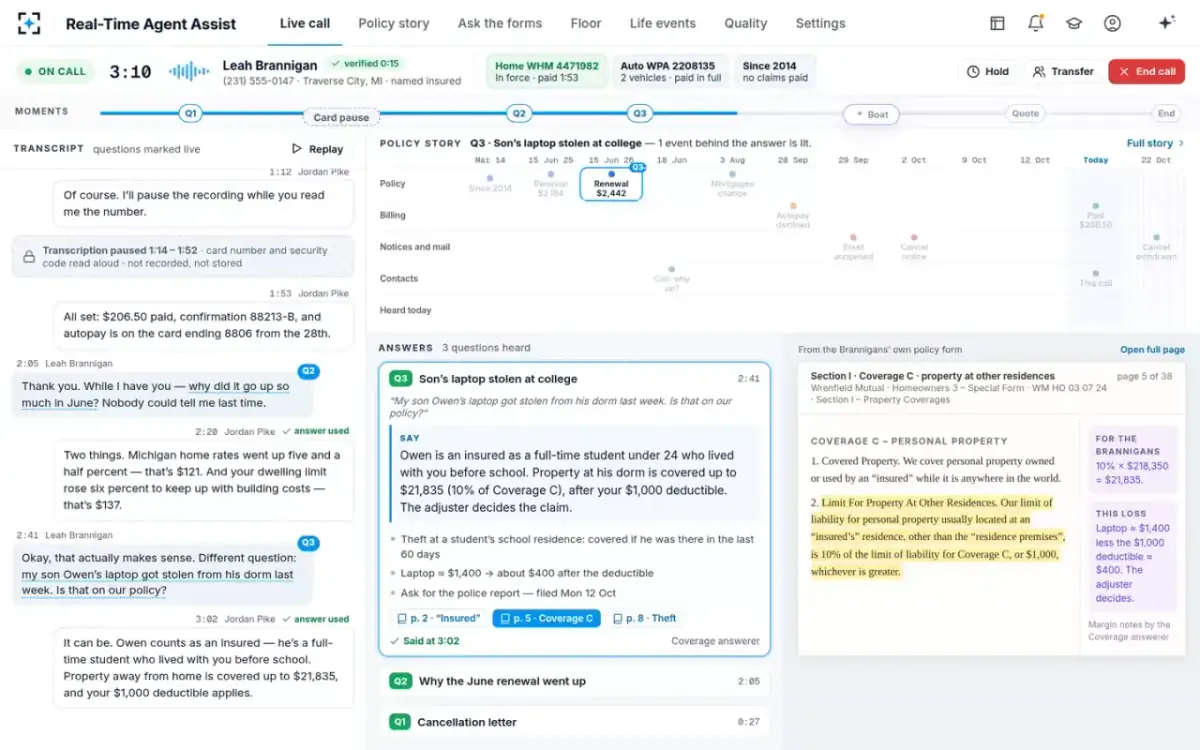
The solution enforces the second test as "no clause, no answer": if the agent cannot cite a clause, it shows nothing rather than something plausible. For scoring purposes the useful measure is the share of coverage questions answered with a clause. On the sample floor's quality screen, 338 of 347 coverage questions that day, 97.4%, were tied to a clause; the design target is all of them.
Test three: the numbers, worked from the declarations
Most coverage limits are not stated as dollars where the customer asks about them. They are percentages of other limits, and the declarations page supplies the base. The NAIC guide explains the structure plainly: limits for other structures, personal property and loss of use are "expressed as percentages of your dwelling limit", with personal property typically 50%. The sample household's figures follow that pattern: dwelling $436,700, personal property $218,350, and the limit at another residence 10% of that, $21,835.
The number test therefore has three parts: the right percentage from the form, the right base from the declarations, and the deductible applied. It also has a trap. A representative who gives the arithmetic all the way to a payment amount has drifted into the fourth test, because the payment depends on the value of the loss, which the adjuster establishes. The NAIC defines the deductible as "the money you have to pay out-of-pocket on a claim before the policy pays the loss"; saying that the deductible applies is a fact about the policy, while predicting what a claim will pay is not.
Test four: stop short of the claim decision
The boundary test is the one most often failed under pressure, and it is binary: either the answer says who decides the claim, or it implies the answer itself. The solution builds it in as a wording check that stops "is covered" on a loss, and every coverage answer on a reported loss ends with the adjuster. The representative then starts the claim report from the call, which is the service the customer actually needs.
Same hail question, one answer that fails and one that passes
Said on the call: None given
An answer that passes all four: The customer’s own homeowners form and declarations
Said on the call: “Should be covered”
An answer that passes all four: The clause that addresses hail damage, with its page
Said on the call: None
An answer that passes all four: The applicable limit and deductible, from the declarations
Said on the call: Implies the claim will be paid
An answer that passes all four: States what the policy says; the adjuster decides; claim report started
That example is useful because the failure was not the assistant's. The answer with its clause was on screen; the representative, three weeks into the job, chose her own words. Scoring the four tests separately, and per representative, is what separates a tool problem from a coaching problem.
How do you measure the accuracy of coverage answers across a floor?
Measure every coverage answer, not a sample, and report the four tests separately. A small random sample of calls rarely contains enough coverage questions to say anything about one representative, and a single combined score hides which test is failing. The arithmetic of sampling is set out in the QA sample size calculator guide; the conclusion for coverage questions is that they are too rare and too consequential to sample.
Real-Time Agent Assist’s checks on the sample floor, one day
Examiners look at the same outcome from the other end. Among the complaint standards in the NAIC's market regulation handbook is that "All complaints are recorded in the required format on the regulated entity’s complaint register." A wrong coverage answer that becomes a complaint is then examined as a complaint. Scoring answers before they become complaints is cheaper, and the scoring needs the same four facts the examiner will ask for: what the customer was told, from which form, with which numbers, and who decided.
Insurance policy questions an assistant should not answer
Some questions should get no coverage answer at all. If the form does not address the situation, the right output is a referral, not an inference. If the question is about a loss already reported, the answer belongs to the adjuster. If the question is really advice on what to buy, for instance whether to add flood cover, it belongs with a licensed representative, and the NAIC guide is blunt that homeowners policies do not cover flood. And if the customer is in a dispute or complaint, the coverage answer should wait for the person handling the complaint.
An assistant that knows when to stay silent is worth more than one that always has something to say. In the study of a generative assistant for support agents published by the NBER, the system was designed not to make suggestions where it lacked the data to do so. For insurance, "no clause, no answer" is the same principle applied to a contract. How the agents behind each answer are limited is set out in real time agent assist software.
Questions people ask
What are the most common insurance coverage questions?
What the policy covers and excludes, the limits and deductibles, whether personal property is covered away from home, water damage and mould, flood and earthquake, and whether a new purchase such as a boat is included. The NAIC's consumer guide to home insurance lists most of these as questions to ask an agent.
Can a customer service representative tell you if something is covered?
A representative can usually read you the category and limits of coverage shown in your policy records. Explaining or interpreting what the coverage means for your situation may require a licence, depending on the state, and whether a specific loss is paid is decided by the claims adjuster.
How do you answer insurance policy questions accurately on a call?
Answer from the customer's own declarations, forms and endorsements, cite the clause and page, work the limits from the declarations, apply the deductible, and say who decides any claim. Anything without a clause behind it should be referred rather than guessed.
Does "full coverage" mean everything is covered?
No. "Full coverage" is an informal phrase, not a policy term. Every policy has exclusions and limits; the NAIC's home insurance guide notes, for example, that homeowners policies do not cover flood damage, which needs separate insurance.
How is personal property coverage calculated?
Usually as a percentage of the dwelling limit on the declarations page; the NAIC gives 50% as the typical figure. Some property has its own limits inside that figure: in the sample insurer's form, property at another residence is limited to 10% of the personal property limit, and the NAIC notes that valuables can exceed a policy's normal limits unless they are scheduled.
How should a quality team score coverage answers?
Separately on four tests: the source, the citation, the numbers and the claim boundary. Scoring every coverage answer rather than a sample, per representative, shows whether a floor's problem is the information on screen or how representatives use it.