An insurance customer service representative job description usually lists the same core: answer policyholder calls and messages about billing, coverage, policy changes and claim status; verify the caller; take payments and process changes; explain notices and renewals; document every contact; and escalate what the representative may not decide. What the standard description leaves out is where the time actually goes. On a typical call much of it is spent searching the policy, billing and document systems, and then typing a note afterwards. Botminds' Real-Time Agent Assist for Insurance is a contact-centre solution that listens to the call, lays the policy's history on one timeline, answers coverage questions from the customer's own forms with the clause, and drafts the notes for the representative to confirm. This guide rewrites the job description for that world, seat by seat, and shows which parts of the role stay human by law, not by habit.
The reader we have in mind is the contact-centre leader, the HR partner and the team supervisor who own the role. Examples come from a fictional sample call in the solution: Jordan Pike, a licensed personal-lines representative at a fictional mutual insurer, takes a call from a policyholder, Leah Brannigan, about a cancellation letter. The people, insurer and amounts are invented; the regulations and labour statistics are real and linked.
The job behind the insurance customer service representative job description
2,666,000
customer service representatives in the US in 2025, all industries
12%
of them employed by insurance carriers and related activities
$44,770
median annual pay, 2025 ($21.53 an hour)
−5%
projected change in employment, 2025 to 2035
What an insurance customer service representative does all day
An insurance customer service representative listens to a policyholder's question, finds the answer in the insurer's systems, resolves what can be resolved on the call, records it, and passes on what cannot. The Bureau of Labor Statistics describes the occupation in seven duties, and every one of them shows up on an insurance line: "Listen to customers' questions and concerns and provide answers or responses", "Take orders, calculate charges, and process billing or payments", "Review customer accounts and make changes, if necessary", "Handle returns or complaints", "Record details of customer contacts and actions taken" and "Refer customers to supervisors or more experienced employees".
Insurance gives each duty a regulated edge. A payment on a policy in its grace period can be the difference between a lapse and continuous cover. An account change can be an endorsement that alters premium. A complaint must reach the insurer's complaint register in the form a state examiner will check. And the most common question on a personal-lines service line, some version of "am I covered for this?", sits on the border between service and licensed insurance activity, which is why the licence appears in most insurance job descriptions and almost never in a retail one.
Insurance is one of the largest employers of the role. The BLS counts 2,666,000 customer service representatives in 2025, and puts 12% of them in insurance carriers and related activities, second only to retail trade (BLS Occupational Outlook Handbook). That makes the insurance service desk one of the places where a change in how the job is done reaches the most people.
Insurance customer service representative duties and responsibilities, line by line
A useful job description lists duties as outcomes the representative owns, with the system or rule behind each, rather than as a list of screens to operate. The template below is written that way. It is the version we would hand an HR partner for a personal-lines service desk that answers both carrier and agency questions; a commercial-lines desk adds certificates of insurance and additional-insured requests, and a claims line adds first notice of loss.
A job description template for an insurance service representative
- Verify the caller before any account detail is read out.
Name, date of birth and address on the policy, or the insurer’s own method. The order matters: identity first, then the balance.
- Resolve billing questions and take payments.
Explain declined payments, installment fees and reinstatement terms from the billing record; take card or bank payments without recording card digits.
- Explain notices, renewals and premium changes.
Cancellation and nonrenewal notices, renewal increases and their reasons, read from the notice and the rating worksheet.
- Answer questions about the policy from the policy itself.
Limits, deductibles and what a form says, from the declarations and forms attached to that customer’s policy; licensed representatives only where state law requires it.
- Start service requests the caller asks for.
Policy changes for underwriting review, claim reports to claims intake, callbacks and documents.
- Record every contact accurately and completely.
Who called, why, what was said with its numbers, what was done and what is still open, written so the next representative can act on it.
- Recognise complaints and escalate them.
Log expressions of dissatisfaction as complaints where the insurer’s procedure says so, and bring in a supervisor when a caller asks.
- Refer what the representative may not decide.
Coverage on a loss to the adjuster, underwriting exceptions to underwriting, advice on new cover to a licensed colleague.
Two lines in that template are where most desks fall short in practice. The first is the record: notes typed in a hurry after the call tend to say what the representative remembers, not what was said. The second is the referral line, because a representative under time pressure is tempted to answer a coverage-on-a-loss question rather than send it on. Both are places where an assistant on the call changes what the job looks like, in different ways.
Does an insurance customer service representative need a license?
It depends on what the representative says, and on the state. The BLS puts it carefully: "Customer service representatives who provide information about finance and insurance may need a state license." The test in most states is whether the person is selling, soliciting or negotiating insurance, the three acts the NAIC Producer Licensing Model Act reserves to licensed producers. The model exempts insurer and agency employees whose work is administrative or clerical and only indirectly related to a sale, provided they take no commission.
States draw the clerical line in their own words. Texas exempts a salaried employee in an agent's office who takes no part in soliciting or negotiating insurance and works full time on clerical and administrative services, as long as the pay does not vary with premium (Tex. Ins. Code §4001.002; what such an employee may say on a call is set out in what an unlicensed insurance CSR can do). Florida's statute lists what counts as solicitation, and the list includes interpreting policies or coverages (Fla. Stat. §626.112). Florida also has a licence designed for exactly this seat, the customer representative licence known by its code 4-40; the Florida 4-40 customer representative licence guide reads it in full.
For the job description, the practical consequence is a split role. Unlicensed representatives handle billing, documents and factual policy information; licensed representatives also explain coverage and offer new cover. The split is where most service floors already sit. What is new is that an assistant on the call makes the split enforceable: it can show coverage answers and life-event offers only to licensed representatives and route the rest to a warm transfer. Exactly which answers fall on which side is the subject of what an unlicensed insurance CSR can do.
Where a representative's week goes, and what an assistant takes
On the sample desk, most of a representative's call time goes to finding things and writing them down, not to talking with the customer. The split below is the solution's own estimate for a week of calls like Leah Brannigan's, scaled from the centre average for that kind of call, 11:40 of talking plus 4:30 of notes, and from the sample call itself, 5:22 plus 0:41.
A week of service calls, by hand and with Real-Time Agent Assist
By hand · 5.0 days
- Searching policy, billing, notices · 24%
- Finding the clause · 18%
- Explaining and answering · 22%
- Starting requests · 8%
- Notes and follow-ups · 28%
With the assistant · 1.8 days
- Searching · 11%
- Clause · 11%
- Explaining and answering · 50%
- Requests · 17%
- Notes · 11%
The interesting number is not the shorter total. It is that explaining and answering grows from about a fifth of the week to half of what remains. Searching, finding the clause and typing notes are the parts of the job an assistant can take; explaining a renewal increase to a customer who is upset about it is not. A job description written for the assisted desk should be weighted the same way: fewer lines about systems, more about conversation and judgement.
In the sample call the shift is visible minute by minute. Asked about the cancellation letter at 0:27, Jordan sees the four events behind it lit on the timeline: autopay declined on 28 September because the card had expired, a reminder email delivered but never opened, the notice mailed on 2 October and the date the policy would cancel. He says the answer at 0:49. By hand, those 22 seconds are a tour of four systems with the caller on hold.
The job description after agents: four roles, rewritten
An assistant on the call does not only change the representative's job. It changes the three roles around it: the supervisor who watches the floor, the quality analyst who reviews calls, and the trainer who gets new hires to their first unaided coverage question. Each loses a mechanical task and gains a decision.
Four seats on the service floor, before and after Real-Time Agent Assist
Today
Searches four systems while the caller waits, answers coverage from memory or escalates it, types the note afterwards.
With agents
Hears the question, sees the events and the clause from the customer’s own form, says the answer in plain words, confirms a drafted note.
Still theirs: Every word said to the caller, every request started and every note saved
Today
Learns a call went wrong from a complaint, days later.
With agents
Sees complaint words, long silences and unused answers on live calls and chooses whether to listen, whisper or join.
Still theirs: The decision to step in, and coaching
Today
Listens to a small sample of calls by hand and scores them.
With agents
Sees every call checked against the same list, with the reason a check failed, and sends the ones that need it to coaching.
Still theirs: What counts as a failure, and the coaching call
Today
Waits weeks before a new representative handles a coverage question alone.
With agents
Gives new representatives the clause, the page and the words on every coverage question, and sees when one goes unused.
Still theirs: When a new hire is ready to work without it
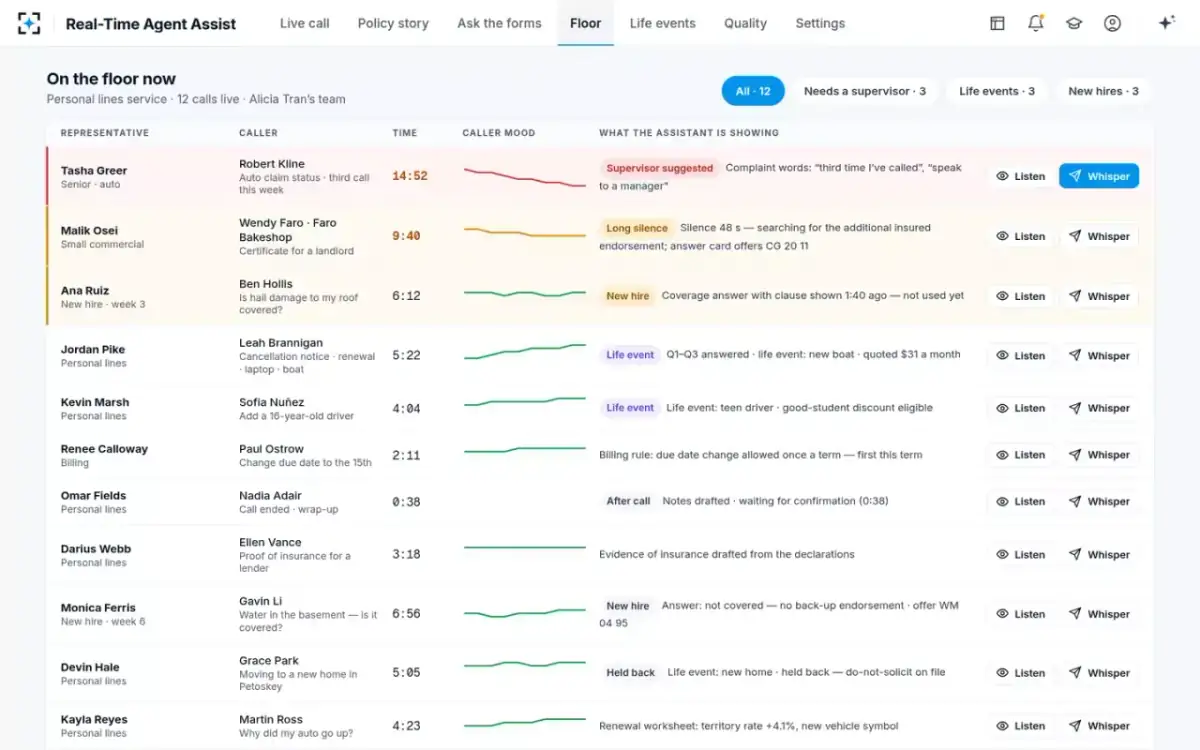
The supervisor's rewrite is the largest. On the sample floor Alicia Tran watches 12 live calls, each with talk time, a caller-mood line and what the assistant is showing. One call has run 14:52 with complaint words, "third time I've called" and "speak to a manager". On another, a representative has been silent for 48 seconds looking for an additional insured endorsement. The job description for that supervisor is no longer "monitor calls"; it is "decide which three of twelve calls need you now".
The supervisor's job, rewritten: three of twelve calls need her now
What stays with the representative, by design and by law
Three things stay with the person on the phone: speaking, deciding and signing off the record. The design of the assistant matters here, because a tool that speaks to the caller or saves notes on its own changes who is accountable. In the study that measured these tools most carefully, the assistant was built the same way as this one. Its suggestions went only to the agent, and the authors note the system stayed silent where it lacked the data to help: "the system does not provide suggestions when it has insufficient training data for that situation. In these situations, the agent must respond on their own."
In the solution each limit is a fixed rule. The coverage answerer never says a loss is covered, because the adjuster decides the claim. The service request starter never binds, cancels or changes coverage on its own. The call notes writer never saves without the representative, and never writes what was not said. On the sample call, the after-call screen holds the drafted notes until the representative confirms them; nothing reaches the account before that (the screen is shown in how to reduce after call work time).
Old job description lines against the lines that replace them
Written for a desk without an assistant: Navigate policy, billing, document and notes systems quickly.
Written for a desk with Real-Time Agent Assist: Check the events and sources the assistant shows against what the caller says.
Written for a desk without an assistant: Answer coverage questions accurately; escalate when unsure.
Written for a desk with Real-Time Agent Assist: Explain the cited clause in plain words; never decide a loss; refer to the adjuster.
Written for a desk without an assistant: Type complete call notes within the wrap-up time.
Written for a desk with Real-Time Agent Assist: Read, correct and confirm the drafted note before it is saved.
Written for a desk without an assistant: Identify cross-sell opportunities on every call.
Written for a desk with Real-Time Agent Assist: Offer cover only after the reason for the call is resolved, never on a complaint call, and only if licensed.
Written for a desk without an assistant: Meet the QA score on sampled calls.
Written for a desk with Real-Time Agent Assist: Act on the check that failed on any call, with the reason shown.
Insurance customer service representative salary, and what the data can and cannot say
The best public benchmark is the BLS median for all customer service representatives: $44,770 a year, or $21.53 an hour, in 2025 (BLS). O*NET reports the same national median from BLS data (O*NET 43-4051.00). Neither figure is specific to insurance, and neither separates licensed representatives, whose job descriptions carry more responsibility, from unlicensed ones.
That gap matters for anyone redesigning the role. If an assistant moves work from searching and typing to explaining and deciding, the licensed share of the job grows, and a desk that wants more of its representatives to answer coverage questions will need more of them licensed. Florida's customer representative licence is one route; the general producer licence is the other. Pay bands should follow the licence, not the tool. We found no government or independent study that measures the pay difference in insurance specifically, so set it from your own payroll and state licence requirements rather than a survey.
Will AI replace call center agents?
The official projection is a slow decline, not a replacement. The BLS projects employment of customer service representatives to fall 5% from 2025 to 2035, a loss of 141,800 jobs, and attributes it to self-service systems that let customers do simple tasks themselves; despite the decline, it still expects about 289,500 openings a year over the decade (BLS). The decline is concentrated where questions are simple. Insurance service questions often are not.
The research on assistants supports a narrower conclusion than the headlines. In the NBER study of 5,179 customer support agents, access to a generative AI assistant raised issues resolved per hour by 14% on average and by 34% for novice and low-skilled agents. The authors are explicit about what their data cannot show: "our paper is not designed to shed light on the aggregate employment or wage effects of generative AI tools." Its setting was a software firm's help desk rather than an insurer, and it measured a tool that advised agents, not one that replaced them. How an assistant earns representatives' trust in practice is covered in AI copilot for call center agents.
Hiring for the rewritten job: what to test in an interview
If the job is mostly explaining and deciding, the interview should test explaining and deciding. Give a candidate a renewal worksheet with two reasons for an increase and ask them to explain it in under a minute to a caller who has already been told "rates went up". Give them a clause about property at another residence and a question about a student's stolen laptop, and listen for whether they explain the limit and the deductible and then say who decides the claim. Give them a drafted call note with one wrong number in it and see whether they catch it.
Those three exercises map to the three things an assistant cannot do for the representative: hold the conversation, stop at the edge of their authority, and own the record. A candidate who is quick at navigating systems but weak at all three was a good hire for the old desk. On a desk with an assistant, the order reverses.
Questions people ask
What are the main duties of an insurance customer service representative?
Answering policyholders about billing, coverage, policy changes and claim status; verifying identity; taking payments; starting service requests; recording each contact; and escalating complaints and decisions they may not make. The BLS lists seven duties for the occupation, from answering questions to recording contacts and referring callers to supervisors.
What is the difference between an insurance call center job description and a general one?
The licence and the record. An insurance representative who explains or interprets coverage may need a state licence, and every contact can be examined later by a state regulator through the insurer's complaint and service records. A general contact-centre role has neither constraint.
Do insurance customer service representatives need a license?
Representatives who only handle billing, documents and factual policy information usually do not; those who explain coverage, compare products or offer new cover usually do. Texas exempts salaried clerical staff who do not solicit or negotiate, and Florida lists interpreting coverages among the acts of solicitation.
How much does an insurance customer service representative make?
The BLS national median for all customer service representatives was $44,770 a year in 2025, or $21.53 an hour. It does not publish a separate figure on that page for insurance, or for licensed against unlicensed representatives, so local payroll data is the better guide.
Will AI replace insurance customer service representatives?
The BLS projects a 5% decline for the occupation over 2025 to 2035, driven by self-service for simple tasks, with about 289,500 openings a year still expected. The strongest study of AI assistants found the biggest gains for newer agents and was not designed to measure employment effects.
What does an assistant change in a representative's day?
It takes the searching and the typing: the events behind a question are shown with their sources, and the note is drafted for confirmation. On the solution's sample call, 0:41 went on notes against a centre average of 4:30 for that kind of call, and the time left over is spent explaining.