A call recording disclosure statement is the short announcement at the start of a call that tells every participant the call is being recorded, and often monitored, so that they can consent or choose not to continue. A good example for an insurance service line does four things: it gives the notice before anything substantive is said, it puts that notice inside the recording itself, it describes any live transcription honestly, and it tells the caller what will happen when they read out a card number. Federal law allows recording with one party's consent, but several states require all parties' consent, and an insurer rarely knows which state its caller is standing in, so the statement has to work in the strictest of them. Botminds' Real-Time Agent Assist for Insurance transcribes service calls live to put answers in front of the representative; it pauses on card numbers and checks every call for the notice. This guide gives an example statement line by line, the statutes behind each line, and how to check that every call actually carried it.
This is general information about the statutes quoted, not legal advice. Have counsel adapt the wording to the states you serve. The examples use the solution's fictional sample call and sample day; the people, insurer and figures are invented.
A call recording disclosure statement example, annotated
1
Recorded greeting, before the queue
“Thank you for calling. This call is recorded, and may be monitored, for quality and to keep an accurate record of your request.”
Why: Notice to every party before anything substantive is said. All-party states need everyone’s consent; Washington requires the announcement to be recorded, and Connecticut accepts a verbal notice recorded at the beginning.
2
Recorded greeting
“Software also transcribes the call so your representative can find your policy details while you talk.”
Why: Not required by the text of the statutes on this page, but the honest description of what happens to the caller’s words. Our recommendation.
3
Recorded greeting
“If you would rather not be recorded, tell your representative and we will help you another way.”
Why: Continuing after a clear notice is how consent is usually inferred; an alternative removes doubt for a caller who objects.
4
Representative, first words
“This is Jordan. This call is recorded. Who am I speaking with?”
Why: Repeats the notice on the representative’s own leg of the call, inside the recording, in case the greeting was skipped or the call was transferred.
5
Representative, before a card payment
“I’ll pause the transcript while you read me the card number and security code.”
Why: Card numbers and security codes are protected customer information; the transcript is paused and shows the gap.
A call recording disclosure script, line by line
Each line in the example exists for a reason a reviewer can name. The first line is the legal core: a clear statement that the call is recorded and may be monitored, made before the caller says anything that matters. "Monitored" covers a supervisor listening live, which on an assisted floor is a normal event: on the solution's sample floor the supervisor can listen to or whisper into any of the twelve live calls.
The second line goes beyond what the statutes on this page say in terms. They speak of recording, intercepting and eavesdropping, not of software that transcribes; we found no statute among them that names transcription. But a caller who consents to "recording for quality" may not expect their words to be turned into text and read by software in real time, and the safest assumption is that a regulator or court will treat a live transcript as a recording. Saying so costs one sentence.
The third line gives a caller who objects somewhere to go. The fourth repeats the notice on the representative's leg of the call, which matters when calls are transferred or when an outbound call never passed through the greeting. The fifth prepares the caller for the card pause, which is where privacy and payments meet.
Call recording disclosure laws: one-party, all-party, and why one script serves both
Federal law is the floor, and it is lenient: the federal wiretap statute allows a person who is a party to a call, or who has one party's prior consent, to record it, unless the purpose is criminal or tortious (18 U.S.C. §2511(2)(d)). An insurer recording its own representative's calls has that consent. Several states set a higher bar, and their rules apply to calls with people in those states. A disclosure that obtains every party's consent satisfies both regimes, which is why a national service line uses one.
The consent rules behind the script, in six jurisdictions
| Jurisdiction | Who must consent | What the statute says about notice | Consequence named in the statute |
|---|---|---|---|
| Federal | One party | Nothing beyond consent of a party | A fine, up to 5 years’ imprisonment, or both |
| Florida | All parties | Lawful when all parties have given prior consent | A felony of the third degree, with a lesser path for some first offences |
| California | All parties to a confidential communication | A call is not confidential where the parties may reasonably expect it to be recorded | Fine up to $2,500 per violation, or jail, or both |
| Maryland | All parties | Lawful where the person is a party and all parties have given prior consent | Felony: up to 5 years or $10,000, or both |
| Washington | All participants | An announcement to all parties counts as consent, and a recorded call must record the announcement | Unlawful to record without it |
| Connecticut | All parties, or notice | Consent in writing or at the start of the recording; a recorded verbal notification at the beginning; or a tone about every 15 seconds | A civil action for damages, costs and attorney’s fees |
The words matter. Florida makes interception lawful "when all of the parties to the communication have given prior consent to such interception." Maryland uses almost the same formula: recording is lawful for a party to the call only when every party has consented in advance (Md. Code, Cts. & Jud. Proc. §10-402; the full state-by-state list is in call recording consent by state). California's rule is narrower in one way and wider in another: it covers only a "confidential communication", defined to exclude a conversation in circumstances where the parties "may reasonably expect that the communication may be overheard or recorded", and a separate section, §632.7, requires all parties' consent to record calls involving cellular or cordless phones (Cal. Penal Code §632.7). A clear notice at the start does double duty in California: it creates the expectation that removes confidentiality, and it is the basis for consent.
States that require call recording disclosure, and what "disclosure" means in each
In an all-party state, disclosure is how consent is obtained; two states spell out what the disclosure must look like. Washington treats consent as obtained when one party announces to everyone that the call is about to be recorded, in any reasonably effective manner, and requires that the announcement itself be recorded when the call is (RCW 9.73.030(3)). Connecticut, in a civil statute aimed at telephone recording, gives three routes. A recording device may be used only if its use
"(1) is preceded by consent of all parties to the communication and such prior consent either is obtained in writing or is part of, and obtained at the start of, the recording, or (2) is preceded by verbal notification which is recorded at the beginning and is part of the communication by the recording party, or (3) is accompanied by an automatic tone warning device which automatically produces a distinct signal that is repeated at intervals of approximately fifteen seconds"
The common thread is that the notice belongs in the recording, at the beginning. A greeting played by the phone system before the recording starts may satisfy the caller's understanding but leaves no evidence. The full state-by-state map, written for a collections desk, is in call recording consent by state; the insurance-specific point is that a carrier's service line receives calls from every state it writes in, and policyholders move.
Outbound call recording disclosure
Outbound calls need the same notice, given by the representative, because there is no inbound greeting to carry it. The fourth line of the example is written for that case: the representative says the call is recorded in the first sentence, before asking anything. Callbacks are the common gap on a service floor. A representative promising to call a customer back about a coverage question has every reason to launch straight into the answer, and the notice is skipped.
The sample insurer's quality checks treat inbound and outbound alike: the first check on every call is "Recording notice at the start". On the sample day it passed on 1,902 of 1,906 calls.
Recording and card checks in Real-Time Agent Assist, one sample day
1,902of 1,906
calls with the recording notice at the start
412
card payments taken, card details never recorded on any
38sec
transcription paused on the sample call while the card was read
40sec
before transcription resumes, unless the representative resumes it
Pause and resume call recording laws, and the card number
No statute on this page requires a call to be paused while a card number is read; the reason to pause is data protection. The NAIC's model data security law, written by state insurance regulators for states to adopt, defines nonpublic information to include a consumer's identifying details together with an "Account number, credit or debit card number," or "Any security code, access code or password that would permit access to a Consumer’s financial account", and requires a written information security program to protect it. A transcript that contains a card number and its security code is that information, sitting in a place it need not be.
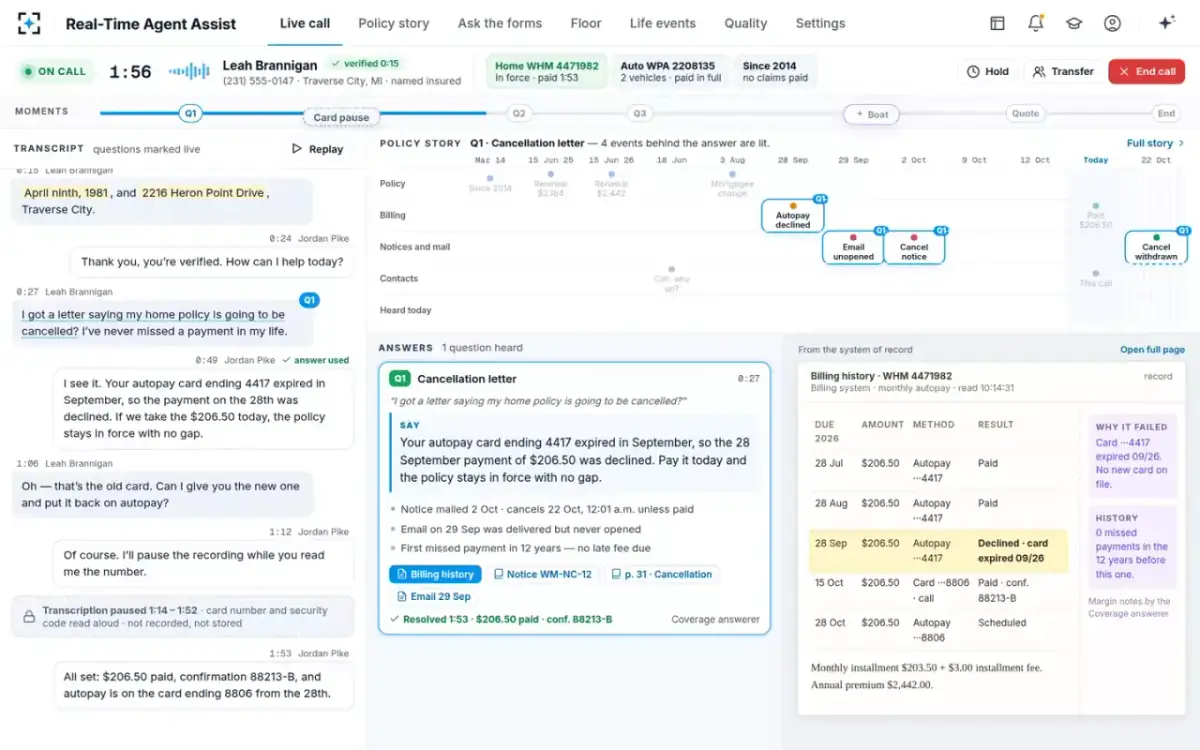
The solution's answer is to stop writing. When the caller reads a card number, transcription pauses on phrases such as "card number" and "security code", the transcript shows the band with its times, and it resumes after 40 seconds or on the representative's click. On the sample call the band runs from 1:14 to 1:52, and the payment of $206.50 is confirmed at 1:53. Never storing card digits cannot be switched off.
The paused band, with its times, in place of the card number
PCI call recording requirements: what is law and what is not
Payment card rules for recordings come from the card industry's own security standard, not from a statute, and this page covers only the law. The statutes above say nothing about card numbers, and the NAIC model treats them as one kind of nonpublic information among several. In practice the two point the same way: do not keep the card number and security code in the recording or the transcript.
Two cautions follow. Pausing the transcript is not the same as pausing the phone system's audio recording, and a buyer should ask which one a product pauses; the solution pauses its own transcription and stores no card digits. And a pause that depends on the representative remembering to press a button will fail on a busy day, which is why the solution listens for the phrases and pauses itself.
The first two minutes of a recorded call with Real-Time Agent Assist
A person decides
RepresentativeAfter the recorded greeting, repeats “This call is recorded” and verifies the caller before any account detail.
Agent
Call listenerTranscribes both speakers and marks the caller’s questions.
Never: Speaks to the caller.
Agent
Call listenerHears “card number” and pauses the transcript; shows the band with its times.
Never: Stores card digits or security codes.
A person decides
RepresentativeTakes the payment; resumes the transcript or lets it resume after 40 seconds.
Agent
Quality checkAfter the call, checks the notice at the start, identity before account details and no card digits recorded.
Call recording retention requirements
There is no single retention period for insurance service call recordings in the sources on this page; retention follows each state's record retention rules and the insurer's own schedule. What examiners test is the record as a whole: one of the NAIC's market conduct examination standards asks whether records are adequate, accessible and orderly and comply with state record retention requirements. The same NAIC data security model that defines card numbers as nonpublic information also requires procedures for securely disposing of nonpublic information in any format.
Recordings and transcripts are therefore kept for as long as your retention schedule says and then destroyed under the same program, and the less sensitive data they contain the easier both are. A transcript with the card number paused out is still a record of the call; it is just not a record of the card. The notes drafted from it, which are what the next representative actually reads, are discussed in how to reduce after call work time.
How to check that every call carried the disclosure
Check every call, automatically, and send exceptions to a person. A sampled review hears a handful of greetings a day and cannot say whether a new hire skipped the notice on outbound callbacks all week. On the sample floor the quality screen checks every call against the same list, starting with the recording notice and identity before account details, and shows the failures: on the sample day, four calls without the notice at the start, and calls such as one where a billing amount was read before identity was confirmed, 21 seconds in.
A disclosure checklist for an insurance service line
- The notice is given before anything substantive.
Greeting first, then identity, then the reason for the call.
- The notice is inside the recording.
Washington requires it there and Connecticut’s notice route depends on it; it is also your evidence.
- It mentions monitoring as well as recording.
Supervisors listening live are part of the call.
- It describes live transcription in plain words.
Our recommendation: treat the transcript as a recording.
- Outbound calls and callbacks carry it too.
Said by the representative in the first sentence.
- A caller who objects has an alternative.
A callback, written channel or other route that is not recorded.
- Card numbers and security codes are never kept.
Pause on the phrases, show the gap, resume automatically.
- Every call is checked for the notice.
And exceptions go to a person, with the call attached.
Transcript quality matters to that check, since a check is only as good as the words it reads; how to test transcription accuracy by speaker is worked through in speech analytics software: test transcripts by speaker first. How the listener fits among the other agents on the call is in real time agent assist software.
Questions people ask
What should a call recording disclosure statement say?
That the call is recorded and may be monitored, said before anything substantive and captured in the recording. If software transcribes the call, say that too, and offer callers who object another way to be helped.
Is "this call may be recorded for quality purposes" enough?
It is the common form, and in all-party states a clear notice that the caller continues past is how consent is usually obtained. It is weaker if the call is in fact always recorded, if it is not itself in the recording, or if the call is also transcribed by software and the notice does not say so.
Which states require all parties to consent to call recording?
Several, including Florida, California for confidential communications, Maryland and Washington; Connecticut has its own notice rules for telephone recording. Because an insurer cannot know where a caller is standing, a national line usually obtains every party's consent on every call.
Do you need consent to transcribe a call with AI?
The statutes quoted here speak of recording and interception and do not name transcription. The cautious course is to treat a live transcript as a recording, disclose it in the greeting, and keep sensitive data such as card numbers out of it.
Do you have to pause call recording for card payments?
No statute cited here requires it, but card numbers and security codes are nonpublic information under the NAIC's data security model, and the payment card industry's own standard addresses them too. Pausing the transcript, or keeping card entry off the call, avoids holding them at all.
How long should insurance call recordings be kept?
As long as your state record retention rules and your own schedule require, then securely destroyed. Examiners check that records comply with state retention requirements; the NAIC data security model calls for procedures to dispose of nonpublic information securely.