Call recording consent is not fifty rules; it is two regimes and a short list of local additions. Federal law makes it lawful, under its own chapter, for a party to a telephone call to record it. A minority of states require the consent of everyone on the line instead, at least one of them requires the announcement to be captured on the recording itself, and New York City has made the failure to disclose a recording a prohibited collection practice in its own right. For a collections desk this matters more than for anyone else, because a quality programme is never wider than its recordings: a conversation that was not lawfully recorded is a conversation nobody can check afterwards. Collections Compliance Monitoring is Botminds’ software for collections quality and compliance teams — it reads every call, voicemail, text, email and letter overnight and quotes the words behind every result, for the conversations the bank may lawfully hold.
The sample screens below come from one day at a fictional bank, Northmere Bank: its own collectors and three agencies had 41,286 conversations with borrowers on Monday 12 October. Every person, bank, agency and borrower named is invented. The four statutes and rules quoted are the shape of the question, not the answer for any particular book of business; the map a bank actually needs is built from where its own borrowers live.
Two regimes, and the announcement between them
One party’s consent is enough
“It shall not be unlawful under this chapter for a person not acting under color of law to intercept a wire, oral, or electronic communication where such person is a party to the communication or where one of the parties to the communication has given prior consent.”
18 U.S.C. § 2511(2)(d), shortened. The collector is a party to their own call, so the federal provision is satisfied without the borrower doing anything.
The announcement
In an all-party state it is how consent is obtained: told to everyone on the line, before the conversation. In a one-party state it is still the first thing a reviewer reads, because a notice that was never given is a different kind of problem on exam day.
Every party must consent
“It shall be unlawful … to intercept, or record any … private communication transmitted by telephone … without first obtaining the consent of all the participants in the communication.”
RCW 9.73.030(1), shortened. Washington is the example used throughout this guide because its statute also says what the announcement has to do.
Call recording consent by state: two regimes, not fifty rules
Every state’s wiretapping statute answers one question first: whose consent makes the recording lawful. In most states, the consent of one party does — and because a collector is a party to their own call, no separate permission is needed. In the remaining states, usually called all-party or two-party states, everyone on the line has to consent. That is the fork. Everything else is detail about how consent is obtained, what has to be said, and what happens when someone says no.
Two practical consequences follow for a collections desk, and they are easy to miss. The first is that the regime is decided by where the people on the call are, not by where the dialer sits, so a single campaign can cross the fork several times in an hour. The second is that a stricter state rule is not displaced by the federal one. The federal provision says only that a party’s recording is not unlawful “under this chapter”, and the collections rulebook says the same thing about its own field: Regulation F does not exempt anyone from complying with the laws of any State with respect to debt collection practices except where those laws are inconsistent with it, and a state law that gives a consumer more protection is not inconsistent.
What federal law allows, and what it leaves to the states
The federal exception is broader than most collections scripts assume. It covers a person who is a party to the communication or a recording made where one of the parties has given prior consent, and its only express carve-out is purpose: it does not apply where the communication is intercepted in order to commit a crime or a tort. A monitoring programme recording its own collectors’ calls to check them against the law is about as far from that carve-out as a recording can be.
What federal law does not do is tell a collections desk what to say. There is no federal script for a recording announcement, no federal requirement that one be given at all, and no federal rule about where in the call it belongs. Those come from state statutes, from city rules, and increasingly from the bank’s own policy — which is why the opening seconds of a collections call are governed by several texts at once.
Four rulebooks, all of them live on the same call
| The rule | Where it is | What it says | What it decides for a collections desk |
|---|---|---|---|
| Federal interception law | 18 U.S.C. § 2511(2)(d) | Makes it lawful, under that chapter, for a party to the call to record it, or for anyone to record it with one party’s prior consent — unless the purpose is criminal or tortious. | The floor the whole programme stands on. |
| Washington’s all-party rule | RCW 9.73.030(1) and (3) | Recording a private telephone conversation needs the consent of all participants; an announcement obtains it, provided the announcement is itself recorded. | Decides whether the call may be recorded at all, and what second zero has to contain. |
| New York City’s collection rule | 6 RCNY § 5-77(d)(20) | Failing to disclose, clearly and conspicuously and before any attempt to collect, that the communication is being recorded and may be used in collecting the debt. | Turns a missing notice into a prohibited collection practice, not only a recording problem. |
| Massachusetts’ identification rule | 940 CMR 7.04(1)(d) | A creditor, or anyone collecting for it, telephoning without disclosing the creditor’s business or company name and the caller’s first and last name, or a first name plus a consistent personal identifier. | A separate thing the opening seconds owe, on calls into that state. |
The Massachusetts row is in the table to make a point about crowding rather than about recording: the first ten seconds of a collections call can owe an identification, a recording notice and a debt-collector disclosure, each from a different rulebook, each with its own wording. They are not interchangeable, and a script that merges them into one friendly sentence usually satisfies none of them cleanly. The second of those, the disclosure that says the call is from a debt collector, is a rule of its own and is set out in the disclosure every collections call carries.
Do you have to tell someone you are recording a call?
In an all-party state, yes, and the announcement is how consent is obtained rather than a courtesy that sits beside it. Washington’s statute is explicit that an announcement will do the work: “consent shall be considered obtained whenever one party has announced to all other parties engaged in the communication or conversation, in any reasonably effective manner, that such communication or conversation is about to be recorded or transmitted”. Two phrases in that sentence carry weight. All other parties means a third person who joins at minute four has not heard it. About to be recorded means the announcement belongs at the front, before the conversation, not at the point someone objects.
In a one-party state there is usually no such obligation, and desks still give the notice, for three reasons that have nothing to do with wiretapping law. It makes a single national script possible. It is the kind of control an examiner expects to see described in policy. And it protects the recording’s usefulness: a borrower who disputes what was said is in a weaker position when the first thing on the file is a clear announcement they did not object to.
Does the recording notice have to be recorded?
In Washington, yes, and it is the detail most often missed. The statute’s proviso (RCW 9.73.030(3)) is a single clause at the end of the consent sentence, and it converts a training point into an evidence requirement: the announcement has to be on the recording. A notice played by the dialer before the recorder starts, or spoken by the collector while the system is still connecting, satisfies the policy and fails the statute, and nobody discovers it until someone goes looking for the proof.
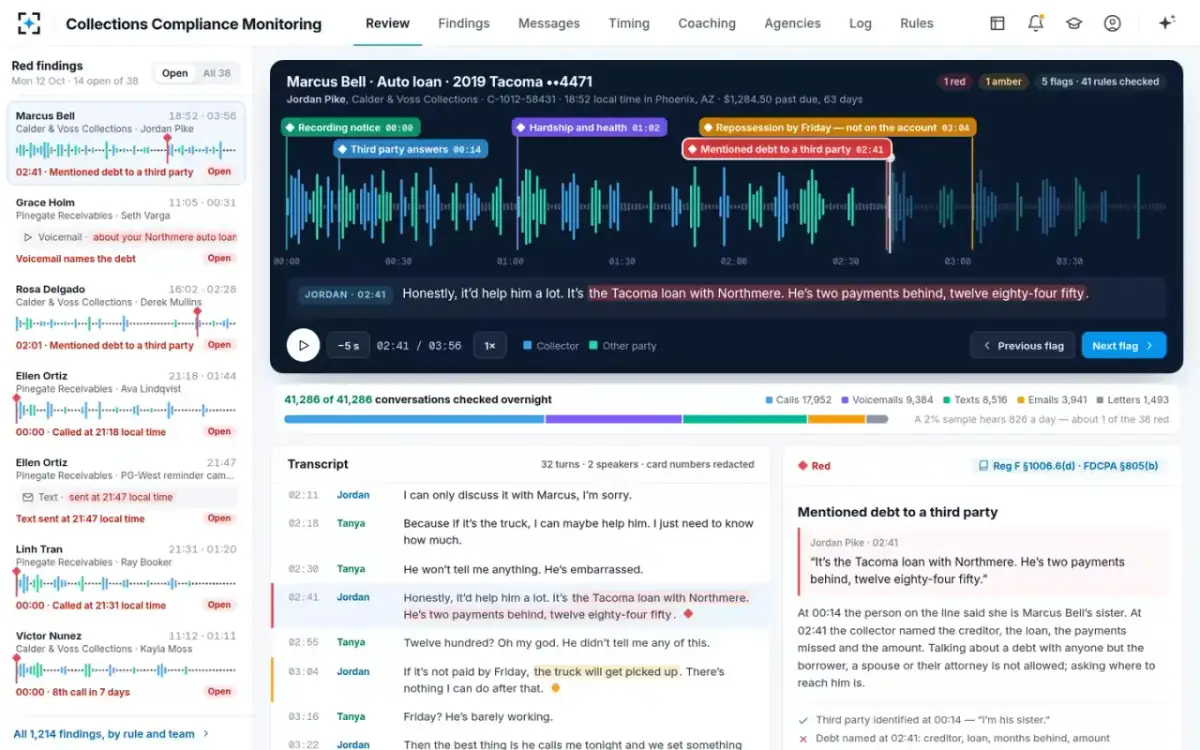
That is why the first thing the software reads on every recorded call is second zero. On the sample day’s call the check records the notice at 00:00 before anything else is assessed, with the words quoted. It is a small result, and it is the one that decides whether the rest of the review stands up: a finding drawn from a recording whose own lawfulness is in doubt is not a finding anybody wants to put in front of an examiner.
What the announcement at second zero has to do
- Come before any attempt to collect
New York City’s rule sets the moment: the disclosure is owed before the collection attempt, not after the borrower is identified.
- Be clear and conspicuous
The same rule’s words. A notice buried in a hold message or read at dialer speed is a notice a reader will argue about.
- Say what the recording may be used for
The city requires the disclosure to say the recording may be used in connection with collecting the debt — not merely that recording is happening.
- Reach everyone on the line
Washington’s consent is obtained by announcing to all other parties. A third person joining later has not heard it.
- Be on the recording itself
Washington’s proviso. If the announcement is not captured, the proof of consent is not captured either.
- Be findable afterwards
A notice nobody can retrieve for a given call is, on exam day, indistinguishable from a notice that was never given.
A city that made the notice a rule of its own
New York City’s debt-collector rules took the recording announcement out of wiretapping law and put it into collections law. Among the false or misleading practices a debt collector may not engage in, the city lists “except where expressly permitted by federal, state, or local law, the failure to clearly and conspicuously disclose, before any attempt to collect a debt, that the communication is being recorded and the recording may be used in connection with the collection of the debt”.
Read that against the two regimes and the difference is sharp. A wiretapping statute asks whether the recording was lawful. The city’s rule asks whether the collection was fair, and answers no when the notice is missing — even on a call that any one-party state would have been perfectly happy with. New York is itself a one-party consent state, so this is an obligation the recording law would not have produced.
Two things the rule does not do are worth saying plainly, because both are commonly assumed. It does not require anybody to record. And it does not require every call to be recorded: the city’s records rules let an agency choose between recording all of its oral communications with consumers and recording a randomly selected sample, provided it keeps the method and the monthly counts. The disclosure obligation attaches to the calls that are recorded.
How long must collection call recordings be kept?
Three clocks run at once, and they start from different events. Regulation F’s general rule is that a collector must keep records that are evidence of compliance or non-compliance from the start of collection activity on a debt until three years after the last collection activity on it. Call recordings get a rule of their own: “If a debt collector records telephone calls made in connection with the collection of a debt, the debt collector must retain the recording of each such telephone call for three years after the date of the call.” And in New York City, recordings of oral communications are kept “until three years after the date of the latest oral communication”, which is an account-level clock rather than a per-call one.
Three retention clocks, three different starting guns
- The callday 0
- Keep this recording3 years after the date of the call
- Collection activity on the debthowever long it runs
- Keep the file3 years after the last collection activity
- Oral communications on the accounthowever many there are
- Keep the recordings3 years after the latest oral communication
The practical reading is the longest clock wins per conversation, and the clocks are not interchangeable: a per-call rule and an account-level rule produce different deletion dates for the same recording, and a bank that applies only the first will delete a New York account’s early calls while the city rule still expects them. Industry practice has long run ahead of the floor anyway. When the regulator surveyed collection firms, it found that “all but three respondents that record calls retain the recordings for a year or more, and 33 of 48 keep them for two years or more” — and that survey predates the three-year federal rule.
Your agency’s recordings are your evidence too
A bank that places accounts with third-party agencies has the same exposure on the agencies’ calls as on its own, and usually less of the audio. The agency recorded the conversation, under its own policy, on its own platform, with its own announcement. If the bank cannot get those recordings, it cannot check them, and the compliance score it gives that agency is built from whatever the agency chose to share.
What examiners look at is not a summary. They are told to assess a firm’s communications from the documents and recordings themselves — letters on paper or on screen, the voice recordings of calls, and the notes made during or after them. The audio is the artefact, and the right place to settle access to it is the placement agreement, before the first account is placed — a feed of the recordings and the message text, not a monthly report about them.
Second zero, read before anything else
What happens if a borrower objects to being recorded
In an all-party state, an objection withdraws the consent the announcement was obtaining, and the lawful options narrow to two: stop recording, or end the call and continue in a channel the borrower accepts. Continuing to record over an objection is the fact pattern the statute exists for, and it is the one a plaintiff’s lawyer will find first on the audio.
In a one-party state the recording stays lawful, because the collector’s own consent is enough. That does not make the objection irrelevant. It is an instruction from the borrower, it sits in the same conversation as every other instruction they give, and a desk that logs “wants evening calls only” but not “asked not to be recorded” is keeping half a record of the same conversation.
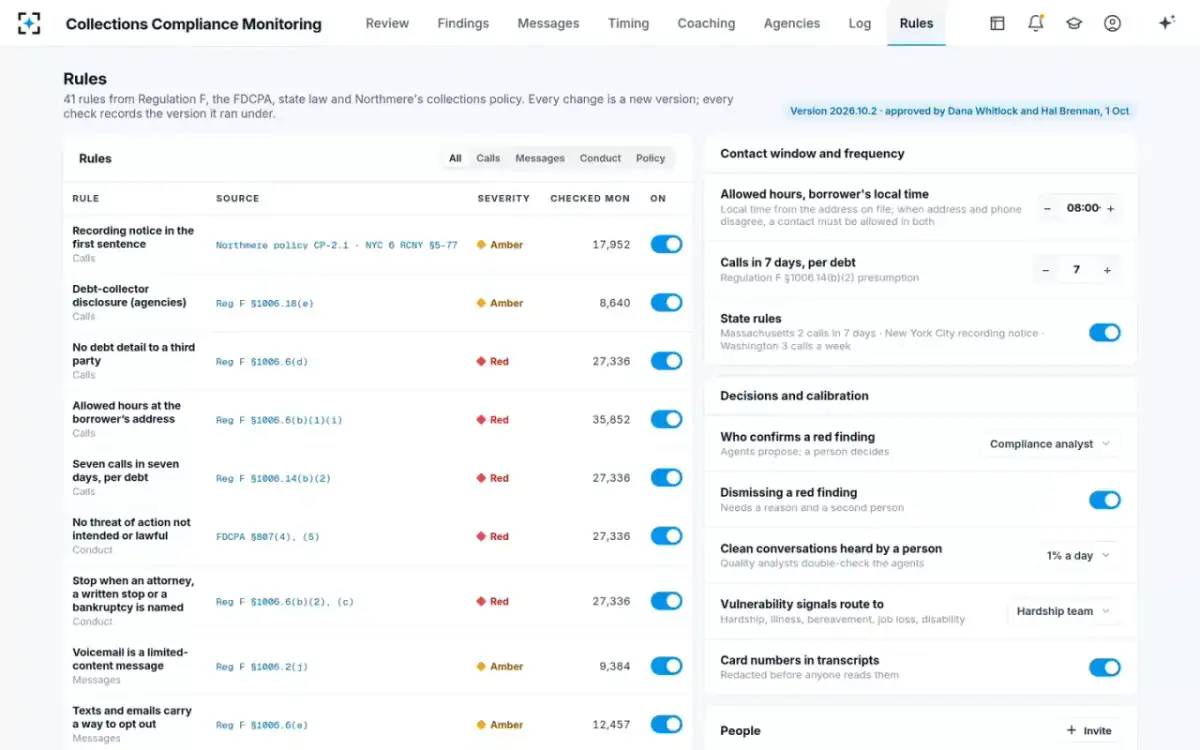
Either way the operational answer is the same: the objection has to be captured on the account, not only in the collector’s memory, and whatever the desk decides to do about recording has to be the same for every collector and every agency. That is a policy decision, and it belongs in the rulebook the checks run against rather than in a training note.
The rules the checks run under, and the version they ran under
Designing coverage around the map you actually have
Coverage is the number that decides what a quality programme can honestly claim, and it is set before any checking happens. Three things determine it: which calls may lawfully be recorded, which of those the bank or its agencies actually record, and which of the recordings the bank can reach. Every rule in the world applied to a conversation nobody kept is a rule nobody can show was followed.
The order of work follows from that. Build the map from where the borrowers are, not from where the call centre is, and settle the all-party states first because they decide the script. Put the announcement at the front, on the recording, in one wording that satisfies the strictest state the book touches. Then write down, per channel and per agency, what is captured and what is not — the texts and emails as well as the audio, since those channels carry their own rules and their own evidence. The gaps in that document are the real shape of the programme.
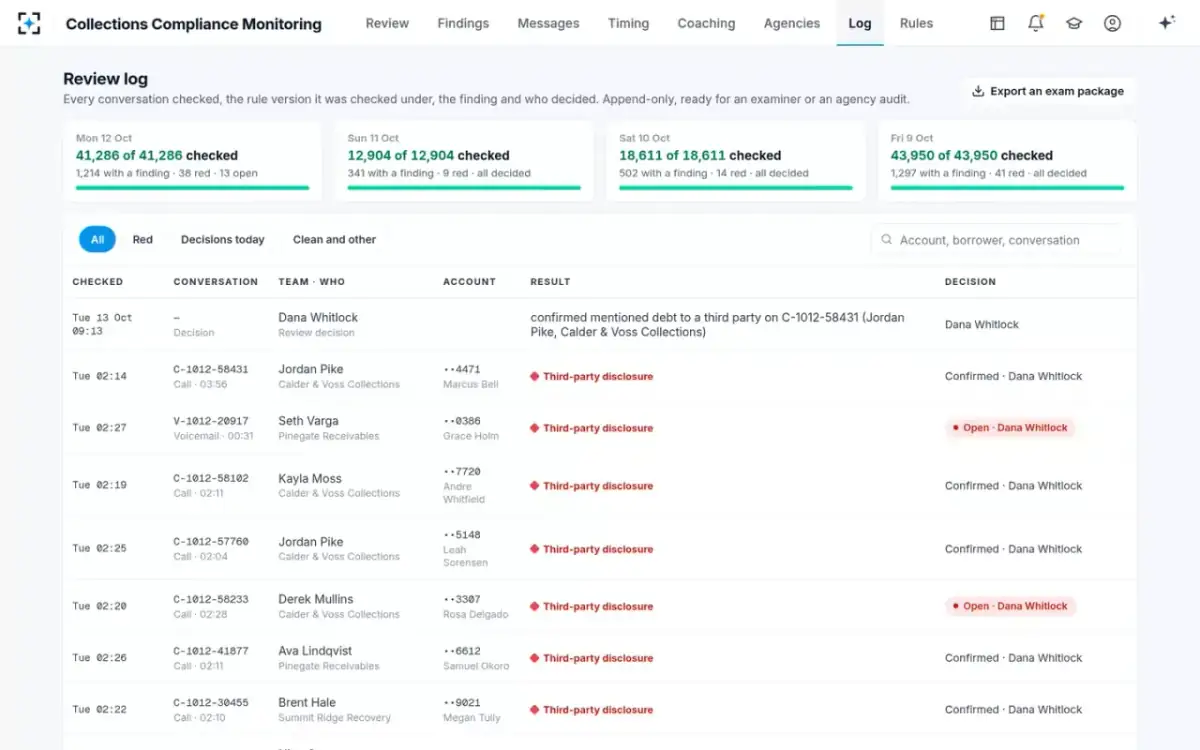
Only then does the checking question become interesting. With the recordings in hand, every one of them can be read rather than a few percent, which is what the night’s check does on the sample day: 17,952 calls and 9,384 voicemails alongside 8,516 texts, 3,941 emails and 1,493 letters, each result quoting the words it rests on, and every decision landing in an append-only review log that can be exported for an examination or an agency audit. Which breaches turn up in which channel is set out in what goes wrong, by channel; to see the coverage line and the log on a day of your own conversations, start from Collections Compliance Monitoring.
The log an examiner reads: every conversation, the rule version, the decision
Questions people ask
What is a two-party consent state for call recording?
It is a state whose statute requires the consent of every participant, not just one, before a private conversation may be recorded. The common name is misleading on a three-way call, which is why all-party is the better term: adding a supervisor or an interpreter adds a person whose consent is needed. In Washington, consent can be obtained by announcing the recording to all other parties, provided the announcement is itself recorded.
Is a recording notice required in New York City?
Where the communication is being recorded, yes, and it is framed as a collection rule rather than a recording rule. The city’s debt-collector rules make it a prohibited practice to fail to disclose, clearly and conspicuously and before any attempt to collect, that the communication is being recorded and that the recording may be used in connection with collecting the debt. The rule does not require a collector to record anything.
Can you record every collection call for compliance?
In a one-party state the collector’s own consent makes it lawful; in an all-party state it needs the announcement at the front of every call, captured on the recording. Nothing in the collections rules forbids recording everything, and the federal retention rule assumes some collectors do: it tells any collector who records calls to keep each recording for three years after the date of the call.
Can you monitor calls your agency recorded?
Yes, and it is the only way an agency’s conversations can be compared with your own on the same checks. What it needs is contractual: the right to receive the recordings and message text rather than a report about them, with the agency’s own announcement satisfying the states its collectors call into. A placement agreement that is silent on access leaves the bank scoring agencies on evidence the agencies selected.
Does a voicemail count as a recorded call?
For retention purposes it depends on the rule. Regulation F’s special rule is about recordings of telephone calls made in connection with collecting a debt, which covers an outbound attempt the collector recorded. New York City is explicit, requiring recordings of all oral communications with consumers, including limited-content messages. The safest reading for a desk is that a voicemail it leaves and keeps is a recording it must retain.
Does the federal one-party rule override a stricter state law?
No. The federal provision says only that such an interception is not unlawful under its own chapter, which leaves a state free to require more. The collections rulebook takes the same line in its own field: it does not exempt anyone from state debt collection law except where that law is inconsistent with it, and a state law that gives a consumer greater protection is not inconsistent.