Call center quality assurance software records conversations, scores them against a rubric and gives supervisors a queue to coach from. For a collections desk that description is true and badly incomplete, because the rubric is not a rubric — it is Regulation F, the FDCPA, state rules and your own collections policy — and what comes out of it is not a score but evidence someone may read back to you a year later. Choosing it is hard for the same reason: most of the market is built for service and sales calls, where the scorecard is an internal preference and the only consequence of a bad one is a bad coaching session. Botminds' Collections Compliance Monitoring is built for the collections case — every call, voicemail, text, email and letter checked overnight against the rules, each finding pinned to the second or sentence it happened, confirmed by a named person. This guide is the buyer's version: the questions that actually change a shortlist, and the ones that only look like they will.
The figures and screens come from a fictional sample day inside the solution — Northmere Bank, its own collectors and three agencies, on Monday 12 October. The bank, the agencies, the collectors and the borrowers are invented.
The buyer's questions, in the order that settles a shortlist
- Which rules does it decide against the account, and which does it only surface?
Ask for the list split in two. Rules that turn on an account fact — attorney of record, a refused medium, the amount owed, whether a repossession is actually assigned, a bankruptcy filing — cannot be decided from audio, so ask what the product reads and from where.
- What does it quote when it reports something?
A finding should carry the second of the call or the sentence of the letter, and the rule it is cited to. Ask to see one on a conversation you chose, not one from the library.
- Which channels does it cover?
Calls, voicemails, texts, emails and letters are all communications under the same rules. On the sample day the four non-call channels were 23,334 of the 41,286 conversations.
- What is retained, for how long, and can it be exported as it stood?
Regulation F sets three years for a recorded call and three years after the last collection activity for compliance records. Ask what the product keeps, in what form, and what an export contains.
- Whose conversations — yours, or your agencies’ too?
If the same checks do not run on the firms you place accounts with, your agency scores are not comparable and your oversight is a document review.
- Who confirms, and what does a dismissal take?
Ask who may close a serious finding, whether a dismissal needs a stated reason and a second person, and whether a proposed finding can reach a collector’s record before anyone has heard it.
- What does the record show an examiner?
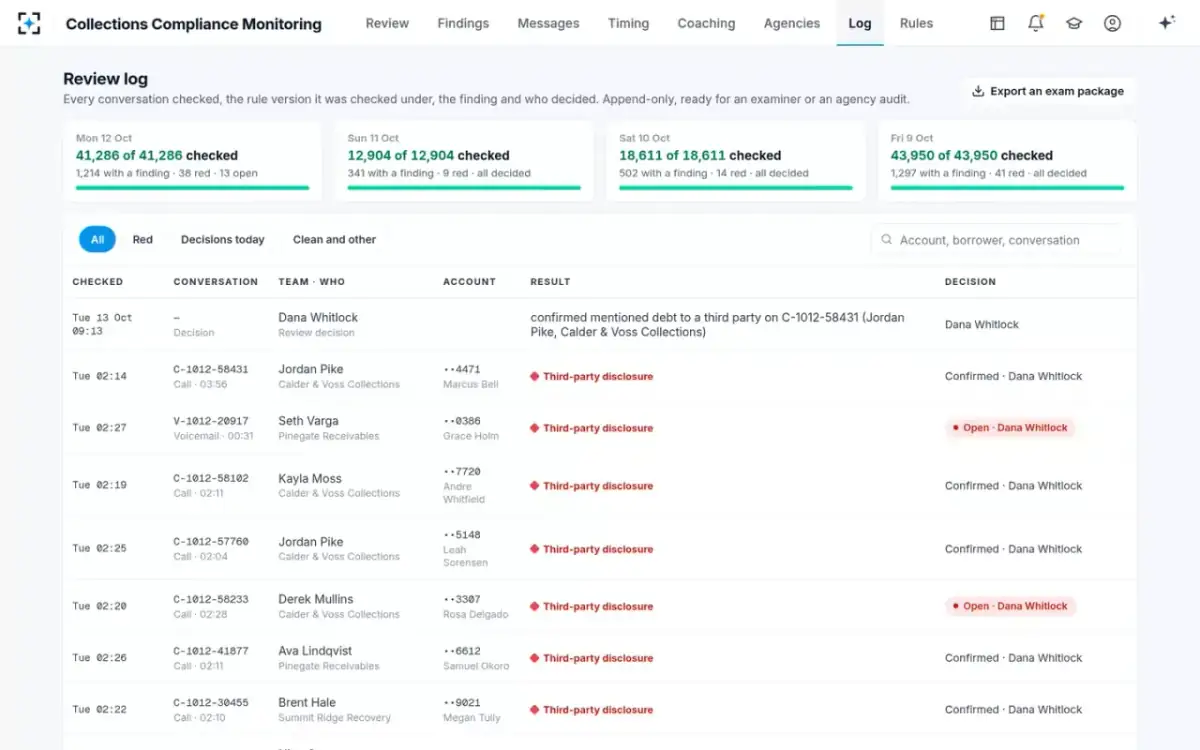
Every conversation checked, the version of the rule set it ran under, the finding, the decision and who made it — in one place, exportable, and not reconstructable only by asking people.
- What does it take to go live, and what do we have to bring?
Ask what the product needs from you on day one: the policy, the letter templates, the agency list, and a sample of recorded conversations. Ask what the first month produces before anyone is scored on it.
What is call center quality assurance software?
In general use it is a system that captures interactions, applies a scorecard, routes a sample to reviewers, and produces agent-level scores, trends and coaching. The honest description of what most of the category is optimised for is service quality: tone, adherence, first-contact resolution, customer satisfaction. The scorecard is written by the business, the sample is whatever the team has capacity for, and the output is internal.
A collections desk inherits none of those freedoms. The scorecard is a rule set with citations. The sample is whatever a borrower's lawyer or an examiner later chooses, not what you chose. And the output is read by people outside your organisation. The CFPB's own method for a debt collection examination is simply to do what a quality team does, with a different mandate: examiners sample the records and listen to a sample of the collection calls. If their sample finds something yours never heard, the question that follows is about your programme, not about that call.
The collections question no generic scorecard asks: which rule, on which account
A generic scorecard line reads "Used the required disclosure — yes/no". A collections rule reads differently: it names a section, and it often names a fact that lives outside the conversation. Whether a statement about repossession was false depends on whether a repossession is assigned. Whether a call at 19:40 was allowed depends on where the borrower lives, not where the phone number was issued. Whether a letter's figure was right depends on the servicing record on the day it was mailed.
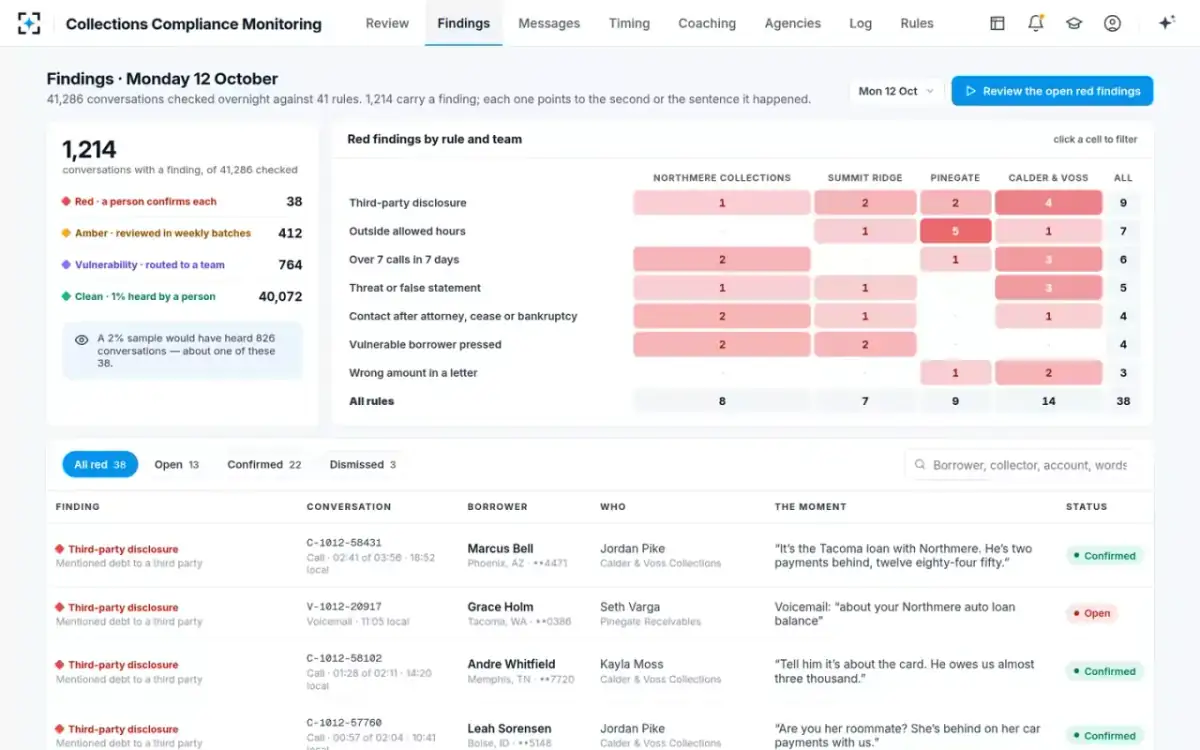
So the first requirement to write down is not a feature, it is a split: which rules does the product decide, with what evidence, and which does it merely surface for a person to decide? A product that surfaces everything and decides nothing has moved the work rather than done it. A product that decides things it cannot see is worse. The 41 rules in the solution carry their source on the screen — a Regulation F or FDCPA section, a state rule, or a clause of the bank's own collections policy — and each check records the rule set version it ran under, which is what makes a finding from eight months ago legible today.
One night's findings in Collections Compliance Monitoring, by rule and by team
What should a collections QA scorecard include?
Four families of rule, and a column that most scorecards do not have. The families are disclosure, conduct, contact and content: what has to be said, what may not be done, when and how often contact may happen, and whether what was stated is true. The column is the citation — not for decoration, but because a finding without one cannot be argued about, taught from, or produced to anyone.
Disclosure covers the recording notice where it is required, the debt-collector disclosure in the first communication and in later ones, right-party verification, the limited-content voicemail script, and the opt-out line on texts and emails. Conduct covers third-party disclosure, threats, false statements, actions not on the account, and pressing for payment after a borrower has described hardship. Contact covers the allowed hours in the borrower's own time zone, attempts per debt in seven days, stricter state rules, and contact after an attorney, a written stop or a bankruptcy. Content covers the amounts and fees in letters, texts and emails against the system of record and the agreement.
Two scorecard habits are worth dropping. Weighted percentage scores hide the only distinction that matters — a conversation either broke a rule or it did not, and a 92% on a call with a third-party disclosure in it is a sentence nobody should have to defend. And scoring a collector on a proposed finding, before a person has heard it, turns a measurement error into an employment one.
Five channels, not one: texts, emails and letters are communications too
Most quality assurance software is built around the recording. Collections is not a telephone business any more, and the rules that govern a text are the same rules that govern a call.
What one sample day in Collections Compliance Monitoring was made of
17,952
calls transcribed, speaker-separated and time-stamped to the second
23,334
voicemails, texts, emails and letters read sentence by sentence — 9,384, 8,516, 3,941 and 1,493
41
rules from Regulation F, the FDCPA, state law and the bank’s own collections policy
3years
a recorded collection call must be kept, under Regulation F
Four of the five channels are documents rather than audio, and they fail differently. A letter can be word-perfect and still state a figure $120 higher than the servicing record, with a collection fee the retail installment contract does not allow. A text can carry the right opt-out line at the wrong hour. A voicemail can recite the limited-content script and then name the debt. None of those is found by a programme scoped to call recordings, and a desk that buys one has a view of 44% of its conversations.
So the requirement is specific: each channel read against the rules that apply to it, with the finding attached to the sentence rather than to the document, and the amounts compared against the system of record rather than against the previous letter. Where a transcript alone cannot settle the question, what a recording can and cannot decide sets out which rules need the account open beside the audio.
What an examiner asks to see, and what the log has to hold
The examination procedures are public, so the evidence list is not a guess. Write your requirements from it rather than from a vendor's feature grid.
What an examination asks for, and where a programme has to keep it
| What is asked for | Why it is asked for | Where it has to live |
|---|---|---|
| Policies and procedures for monitoring communications | The first thing reviewed is how the firm watches itself, before any call is heard. | A written procedure, with the rule set and its versions attached to it. |
| Reports to management and the board | Whether what the programme found reached the people answerable for it. | Periodic reporting off the same findings, not a separate hand-built pack. |
| Consumer complaint logs | Whether complaints were resolved, and whether they point at a systemic cause. | Complaints joined to the conversations behind them, by account and date. |
| Performance metrics, exception and trend reports | Whether the firm can see a pattern forming rather than a list of incidents. | Findings per 1,000 conversations by rule, by team and over time. |
| Call recordings and telephone logs | The examiner listens to a sample, and the sample is theirs to choose. | Retained recordings, searchable by account, borrower and conversation. |
| Copies of documents provided to consumers | Letters and notices as they were sent, not as the template stands today. | The mailed artefact, with the finding attached to the sentence. |
| Service-provider oversight findings | Whether the firms acting for you are inside the same programme as your own team. | The same checks, the same rules, and the remediation record per agency. |
The retention line in those procedures is explicit about what counts as a record: examiners are to check that records evidencing compliance or non-compliance are kept for at least three years after the last collection activity on the debt — telephone logs and copies of documents sent to consumers included. Telephone logs and copies of documents, not only recordings.
What makes that answerable in an afternoon rather than a quarter is a single append-only record of the night's work: every conversation checked, the rule set version it ran under, the finding, the decision and who made it, exportable as one package. It is also the material the bona fide error defence turns on — what one bad conversation costs, and what § 1692k(c) actually requires is a separate page, but the short version is that the defence asks what procedures you maintained, and a programme either produced that evidence at the time or did not.
The record Collections Compliance Monitoring hands an examiner
Can we monitor our collection agencies with it?
You should, and the obligation does not move with the work. The CFPB's guidance on service providers is unambiguous: "However, the mere fact that a supervised bank or nonbank enters into a business relationship with a service provider does not absolve the supervised bank or nonbank of responsibility for complying with Federal consumer financial law to avoid consumer harm." The same bulletin sets out what oversight means in practice, including internal controls and continuing monitoring of whether the provider complies with federal consumer financial law, and prompt, complete action on whatever that monitoring finds — up to ending the relationship.
What the industry has mostly done instead is the remote audit. The CFPB's survey of collection firms describes it plainly: "For remote audits, clients review batches of call recordings and documentation sent by the collection firm and/or remotely access the collector's collection management systems." A batch the agency selected, reviewed by a different person, against a different scorecard, at a different cadence from your own team's. Three variables change at once, so the resulting comparison is not one.
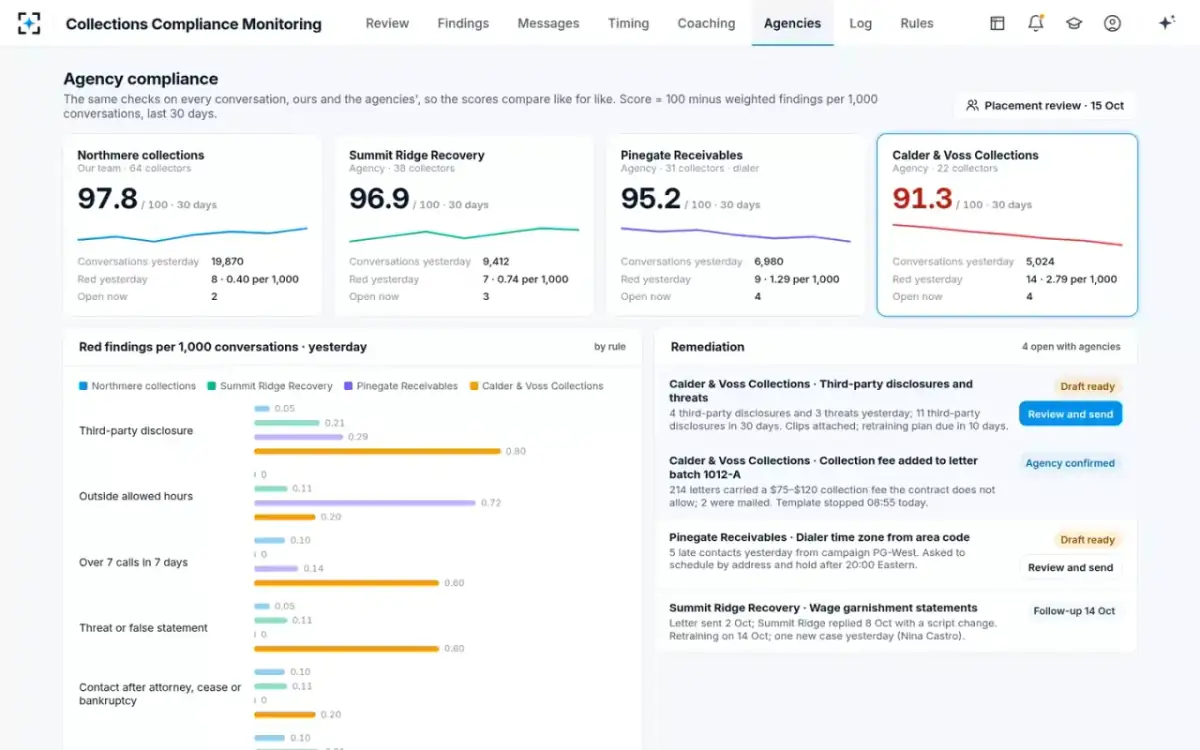
The requirement that fixes it is one sentence: the same rules, on every conversation, from your team and each agency, scored the same way. On the sample day that produces directly comparable rates — the bank's own team at 0.40 red findings per 1,000 conversations, Summit Ridge at 0.74, Pinegate at 1.29 and Calder & Voss at 2.79 — and a remediation letter that goes out the same morning with the recordings attached, sent by a named person rather than by the system. Keep the agency question to this section when you write your requirements; the oversight programme itself is a bigger subject than a procurement document.
Agency oversight on the same checks, in Collections Compliance Monitoring
How long must call recordings be kept?
Under Regulation F, a debt collector that records its telephone calls must retain the recording of each such call for three years after the date of the call, and must retain records that are evidence of compliance or noncompliance with the FDCPA and the rule from the start of collection activity until three years after the last collection activity on that debt (12 CFR 1006.100). Those are two different clocks on two different things, and a product that keeps findings for a year while the audio lives for three has a gap exactly where a late claim lands.
Local rules can be stricter or more specific, and they are the reason "three years" is the floor rather than the answer. New York City's debt collection rules set their own retention schedule for recordings of oral communications with consumers, running three years from the latest oral communication, alongside a set of other record types with their own periods (6 RCNY § 2-193). Ask any product how retention is configured per jurisdiction, and what happens at the end of a period — deletion, hold, or an export you have to arrange.
Recording itself is near-universal in the firms the CFPB surveyed: "Forty-eight of the respondents reported that they record all of the calls made to consumers, and two others said that they record at least some calls." That survey ran from July to September 2015 and was published in July 2016, and the Bureau says its respondents may not be representative; read it as evidence that the raw material usually exists, not as a current market statistic. The scarce thing has never been the audio. It is a record of what anyone did about it.
Who runs it: five seats around one night's findings
Buying decisions get made on features and lived with as a rota. Before the shortlist, write down who will be doing what at 09:00 on an ordinary Tuesday, because the answer determines how many of the product's claims are usable.
The five seats around one night in Collections Compliance Monitoring
Today
Hears a small sample of calls end to end and hopes the breach is in it.
With agents
Clears the night’s red findings by 10:00, hearing only the seconds that matter, then works the exam record.
Still theirs: The decision. No red finding counts until she has heard the moment and confirmed it.
Today
Pieces together who decided what when an examiner asks.
With agents
Co-signs every dismissed red finding and approves each rules version, with every decision in an append-only log.
Still theirs: The second signature, and sign-off on what the rules say.
Today
Cannot tell whether a missed breach was a bad sample or a bad check.
With agents
Double-hears 1% of clean conversations a day and sees which sentence fooled a check when a flag is wrong.
Still theirs: The measurement, and the case for changing a rule.
Today
Coaches from a score and a note, without the call in front of him.
With agents
Coaches each collector from their own moments, with the ten seconds attached to the item.
Still theirs: The coaching conversation, and marking it done.
Today
Scores agencies on recoveries monthly and on compliance from a handful of calls.
With agents
Compares every agency on the same checks of every conversation and sends the remediation letter with the recordings attached.
Still theirs: What goes to an agency. Nothing is sent without her.
Two of those seats are the ones buyers forget. Nobody budgets for the quality analyst until the first wrong flag, and nobody budgets for the second signature until the first dismissal that has to be explained. Both are cheap to staff and expensive to add later, because they are the seats that make the record defensible.
What you bring, and the first ninety days
What a collections programme needs from you on day one is not technical, and it is worth confirming before a contract rather than after. Four things: your collections policy, including anything stricter than the regulation; your letter and message templates as they are actually sent; your agency list, with who at each firm receives a remediation letter; and a sample of recorded conversations across your own team and every agency, covering all five channels. The solution is built and deployed from exactly that material.
A sampled programme and a full-pass programme, as a buyer sees them
Hand-pulled sample, scored by reviewers: A few percent of calls; voicemails, texts, emails and letters usually unread.
Every conversation checked, people confirm: All five channels, every day, against the same rule set — the design target of the programme.
Hand-pulled sample, scored by reviewers: A scorecard line and a reviewer’s note.
Every conversation checked, people confirm: The rule, the citation and the quoted second or sentence, with the account facts it was checked against.
Hand-pulled sample, scored by reviewers: Each agency reviewed on a batch it sent, on its own cadence.
Every conversation checked, people confirm: The same checks on every conversation from your team and each agency, so the rates compare.
Hand-pulled sample, scored by reviewers: Mostly spent choosing the sample and listening to uneventful calls end to end.
Every conversation checked, people confirm: Spent on the flagged moments and a measured slice of the clean conversations.
Hand-pulled sample, scored by reviewers: A sample plan, scorecards and session notes.
Every conversation checked, people confirm: Every conversation checked, the rule version, the finding, the decision and the decider, exportable.
Hand-pulled sample, scored by reviewers: Say anything about a conversation that was not in the sample.
Every conversation checked, people confirm: Decide a serious finding on its own — a named person confirms every red, and a dismissal takes a reason and a second person.
For the first weeks, ask for the programme to run without scoring anyone. Let it check the night, let the analysts confirm and dismiss, let the quality analyst listen to the clean slice, and let the disagreements accumulate — then set the rule set version that goes live. That period is also when the rules that are stricter than the regulation get written down, and it is cheaper to argue about them with real conversations in front of you. How to run that measurement properly is a method rather than a setting, and what the checks may and may not decide is the question to settle in writing before the first night.
Questions people ask
What should a collections QA scorecard include?
Four families with citations attached: disclosure (recording notice, debt-collector disclosure in first and later communications, right-party verification, the limited-content voicemail script, opt-out lines), conduct (third-party disclosure, threats, false statements, actions not on the account, pressing after hardship), contact (allowed hours in the borrower's own time zone, attempts per debt in seven days, stricter state rules, contact after an attorney or bankruptcy) and content (amounts and fees against the system of record and the agreement). Each line should name its source and quote the moment it is found in.
Can QA software cover texts, emails and letters as well as calls?
It has to, because those are communications under the same rules. In the solution's sample day the four non-call channels were 23,334 of 41,286 conversations — voicemails checked as limited-content messages, texts and emails for the opt-out and the hour, letters compared with the bank's system of record. A product scoped to recordings covers less than half the risk.
How long must call recordings be kept?
Regulation F requires a recorded collection call to be kept for three years after the date of the call, and compliance records until three years after the last collection activity on the debt. Local rules can add their own schedules — New York City sets retention for recordings of oral communications at three years from the latest one. Check how the product handles retention per jurisdiction, and what happens when a period ends.
Can we monitor our collection agencies with it?
Yes, and the CFPB's service-provider guidance treats it as part of the obligation rather than an extra: entering a business relationship with a service provider does not absolve a supervised bank of responsibility, and the Bureau expects internal controls, ongoing monitoring and prompt action on what the monitoring finds. The requirement to write is that the same checks run on every conversation from your team and each agency, so the scores compare like for like.
What does an examiner ask to see?
The examination procedures direct examiners to review the entity's monitoring policies and procedures, reports to management and the board, complaint logs, performance metrics and exception and trend reports, and to listen to a sample of calls. They also check that records evidencing compliance or noncompliance are retained, giving telephone logs and copies of documents provided to consumers as examples. Ask any product to produce that list from one export.
What do we have to bring, and how long does it take to go live?
Your collections policy with anything stricter than the regulation, your letter and message templates as actually sent, your agency list with the recipient at each firm, and a sample of recorded conversations across your own team and every agency on all five channels. Plan for a first period where the programme runs and nobody is scored on it — long enough to settle the rule set version, hear the disagreements and set the calibration slice before findings start counting.