A limited-content message is a voicemail a debt collector may leave for a borrower that says so little it does not convey information about a debt to anyone who hears it. The rulebook defines it by what it contains and, more importantly, by what it must not: four required items, four optional ones, and no other content at all. Get it right and the message is not a communication about a debt, so a spouse, a coworker or a flatmate playing it learns nothing. Add one clause about the balance and the protection is gone. Collections Compliance Monitoring is Botminds’ software for collections quality and compliance teams — it reads every voicemail, text, email and letter alongside every call, sentence by sentence, and pins each finding to the words that caused it, which is the only way to judge a rule whose whole content is a prohibition on extra content.
The sample messages and screens below come from one day at a fictional bank, Northmere Bank: its own collectors and three agencies sent 23,334 written and recorded messages to borrowers on Monday 12 October, alongside 17,952 calls. Every person, bank, agency and borrower named is invented.
One voicemail, clause by clause — and the clause that ends it
“Hi, this is Seth from Pinegate Receivables,”
Required · a business name
The definition asks for a business name that does not indicate the collector is in the debt collection business — so the name itself is a test, not a formality.
“calling for Grace Holm.”
Required · a person to reply to
Naming the borrower identifies who the message is for. The names of one or more natural persons the borrower can contact are also required.
“Please call me back at 800-555-0163”
Required · a request to reply, and a number
Two of the four required items in one clause: the request that the consumer reply, and a telephone number to reply on.
“about your Northmere auto loan balance.”
Disqualifying · other content, and a debt
Nothing in the required or optional lists permits this. The message is no longer a limited-content message; it is an ordinary communication that names a debt, played in a freight dispatch office.
“Thanks, have a good day.”
Optional · a salutation
A salutation is one of the four permitted extras. It makes no difference here: the clause before it has already taken the message outside the definition.
What is a limited content message?
It is a creature of definition rather than of permission, and the definition is the shortest operative sentence in the rulebook: a limited-content message “means a voicemail message for a consumer that includes all of the content described in paragraph (j)(1) of this section, that may include any of the content described in paragraph (j)(2) of this section, and that includes no other content.”
Three things follow immediately. It is a voicemail — not a text, not an email, not a note left with a neighbour. It is for the consumer, which means for the borrower and the people the rulebook treats as the borrower. And it is defined with a closing clause that does all the work: no other content.
Nothing requires a collector to leave one. It is a safe route, not an obligation, and a desk that would rather leave no message at all is complying perfectly. What a collector may not do is leave an ordinary voicemail that names the debt on a line other people can reach, which is the third-party problem set out in what a collector may say to the people around a borrower.
What must a limited content message include?
Four items, all of them. The regulation lists them in order: “(i) A business name for the debt collector that does not indicate that the debt collector is in the debt collection business; (ii) A request that the consumer reply to the message; (iii) The name or names of one or more natural persons whom the consumer can contact to reply to the debt collector; and (iv) A telephone number or numbers that the consumer can use to reply to the debt collector.”
The first item is the one that catches firms out, because it is a test applied to the firm’s own name. A business name that announces collections, recovery or receivables is, on its face, a name that indicates the business the collector is in — and a message carrying it tells the person who plays it something about why the call came. A firm whose name announces collections therefore needs a different name it is genuinely entitled to use, such as a registered trading name, before it can leave these messages — and the separate rule against using any name other than the firm’s true name means that name has to be one the firm actually operates under.
The consumer-advocacy reading of the rule is the same as the regulator’s. Summarising it after the rule’s first six months, the National Consumer Law Center wrote that “to qualify as a limited-content message, a voicemail to a consumer must contain four items: a business name for the debt collector not indicating that the collector is in the debt collection business; a request that the consumer call back; a name of a person to call back; and a number to call back.”
Required, optional, and the content that ends the protection
| The content | Standing | Where it comes from |
|---|---|---|
| A business name for the collector that does not indicate it is in the debt collection business | Required | § 1006.2(j)(1)(i) |
| A request that the consumer reply to the message | Required | § 1006.2(j)(1)(ii) |
| The name or names of one or more natural persons the consumer can contact to reply | Required | § 1006.2(j)(1)(iii) |
| A telephone number or numbers the consumer can use to reply | Required | § 1006.2(j)(1)(iv) |
| A salutation | Optional | § 1006.2(j)(2)(i) |
| The date and time of the message | Optional | § 1006.2(j)(2)(ii) |
| Suggested dates and times for the consumer to reply | Optional | § 1006.2(j)(2)(iii) |
| A statement that on replying the consumer may speak to any of the company’s representatives or associates | Optional | § 1006.2(j)(2)(iv) |
| The creditor’s name, the balance, the account, the words debt or past due, a deadline, a consequence, a reference number, an apology for missing them | Disqualifying — “no other content” | § 1006.2(j) |
The four optional lines, and what they are for
The optional list is short and oddly specific, and each entry exists to let a message sound like something a human left. A salutation, so the message can begin with hello. The date and time, so a borrower playing a week of messages can tell them apart. Suggested dates and times to reply, which is the only scheduling a collector may do inside one of these messages. And a statement that if the borrower replies they may speak to any of the company’s representatives or associates, which exists so the named person’s absence does not strand the callback.
What is not on either list is instructive. No reference number, because a reference number invites the question of what it refers to. No reason for the call. No urgency. No apology for the difficulty of reaching the borrower, however warmly meant. A script written by someone trying to be helpful will reach for all four.
Why “no other content” is the whole rule
Most compliance rules are satisfied by adding something: a disclosure, an opt-out line, an identification. This one is satisfied by stopping. That inverts the usual failure mode — the message that fails is almost never missing a required item, it is a correct message with a sentence on the end.
…and that includes no other content.
12 CFR § 1006.2(j)
It also inverts how the message should be reviewed. A script review asks whether the wording covers everything it should; this rule needs a review that asks whether anything else is there, on the message as actually left. The two questions produce different work: the first can be answered once a quarter on a document, the second has to be answered once per voicemail.
Borrowers hear the difference. In the same six-month study, respondents reported that “62.75% said that debt collectors leave ‘limited content messages’ as voicemails, and 25.5% reported that debt collectors leave voicemail messages that do not qualify as ‘limited content messages.’” Those are practitioners’ impressions from a survey rather than a measured breach rate, and they are worth reading as a ratio rather than a number: a quarter as many reports of messages that fell outside the definition as of messages inside it.
An attempt to communicate, not a communication — and why that matters
The rulebook treats a properly formed limited-content message as an attempt to communicate rather than a communication: “An attempt to communicate includes leaving a limited-content message, as defined in paragraph (j) of this section.” The regulator’s examination procedures put the consequence plainly: “A ‘limited-content message’ is not a communication for the purposes of the FDCPA and Regulation F; however, it is an attempt to communicate.”
That distinction decides several things at once. Because it is not a communication, leaving one does not disclose a debt to the person who plays it, which is the whole point. For the same reason it cannot carry the debt-collector disclosure that every later communication owes — adding the line would be other content — so the two rules have to be read together rather than stacked; the disclosure itself is set out in the disclosure every collections call carries. And because it is still an attempt to communicate, every rule written about attempts applies to it: times and places, a borrower’s request not to be contacted by a given medium, and the limits on contacting someone who is represented or has asked the collector to stop.
Does a limited content message count toward call frequency?
The call does. The frequency presumptions in the rulebook count telephone calls placed to a particular person about a particular debt — presuming compliance at no more than seven calls in seven consecutive days, and presuming a violation above it. A collector who dials, reaches voicemail and leaves a message has placed a call, and the only calls the rule excludes from the count are those placed with the person’s prior consent inside a seven-day window, those “not connected to the dialed number”, and those placed to the attorney, the creditor or the other parties the third-party rule lists.
The second clock behaves differently, and this is the part worth getting right. The rulebook also presumes a violation where a collector calls again within seven consecutive days of having had a telephone conversation about that debt. A limited-content message is not a conversation and not a communication, so leaving one does not start that second clock. Speaking to the borrower does.
The practical reading for a dialer strategy is therefore mixed, and both halves need to be in the counting rules: voicemail attempts consume the seven-in-seven allowance, but they do not trigger the post-conversation pause. A desk that counts only connected conversations will undercount; a desk that treats every message as a conversation will stop calling too early.
The voicemail that reaches a dispatch office
On the sample day one agency message shows what the rule is protecting against. It was left for a borrower on the work number held on file, which rings in a freight company’s dispatch office. It gave the agency’s name, asked her to call back and left a number — and then asked her to call back about her auto loan balance with the bank.
What the sample day supports is narrow and sufficient: the message named the debt, so it was not a limited-content message, and the people who could play it were not the borrower. Two other questions a reviewer would ask need facts the sample day does not record — whether the employer prohibits such calls, which is what the separate workplace rule turns on, and whether the borrower had consented to that number. Neither is needed to see what went wrong here.
The message, with the note on the sentence that caused it
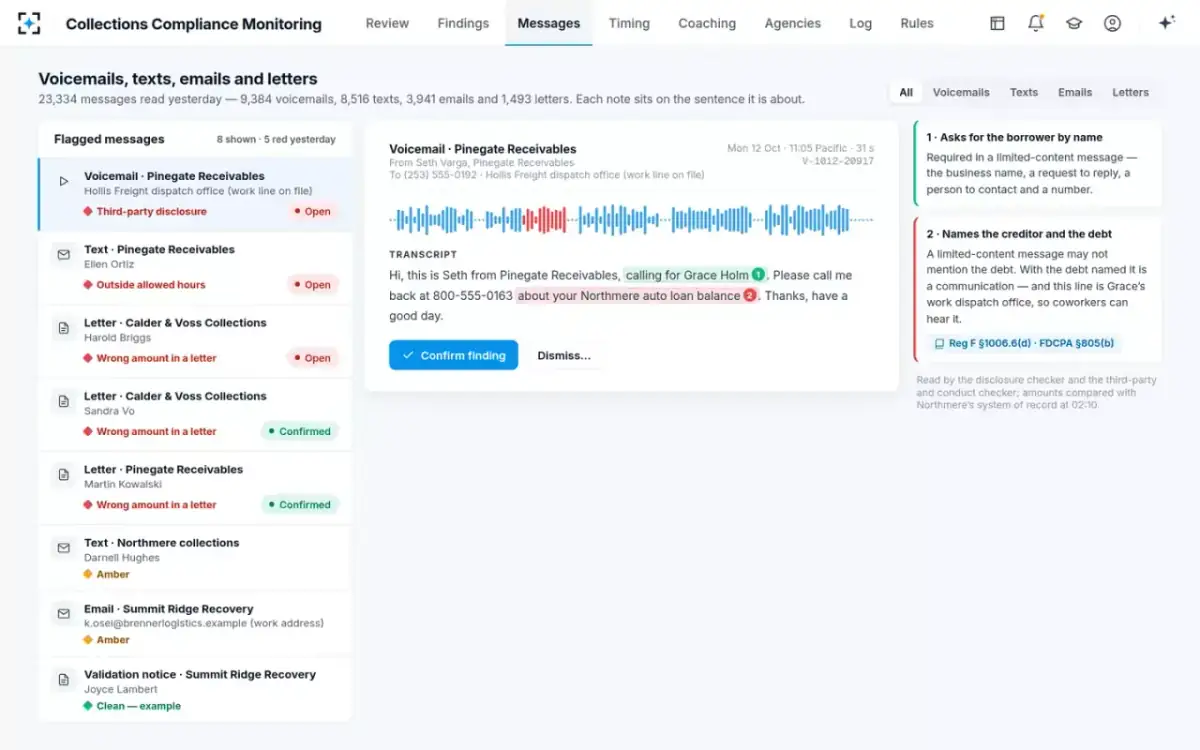
The screen is also an argument about where the note belongs. A finding that says “voicemail non-compliant” sends a trainer back to the whole message; a note pinned to “about your Northmere auto loan balance” tells them which seven words to change, and tells the collector that the first three clauses were right.
Texts and emails: the opt-out line and the address you may not use
There is no limited-content text and no limited-content email. The term is defined for voicemails only, and a desk that applies it to the 8,516 texts in a night is applying a protection that does not exist in that channel. What electronic channels have instead is a set of rules of their own.
The first is the opt-out. A collector communicating electronically “must include in such communication or attempt to communicate a clear and conspicuous statement describing a reasonable and simple method by which the consumer can opt out of further electronic communications” to that address or number. The second is an address restriction: a collector must not email an address it knows the borrower’s employer provided, outside narrow exceptions. The third is a channel prohibition — a collector must not communicate “through a social media platform if the communication or attempt to communicate is viewable by the general public or the person’s social media contacts”, which is the same third-party logic as the voicemail rule applied to a public post.
Taken together, the three say something consistent about electronic channels: the risk is who else can see the message, and the rules work by restricting the address rather than by shortening the words. That is the opposite of the voicemail rule, where the address cannot be controlled and the words are shortened instead.
One night’s 23,334 messages, and the rules each channel answers to
Messages by channel
- Voicemails 9,384 · 40.2%
- Texts 8,516 · 36.5%
- Emails 3,941 · 16.9%
- Letters 1,493 · 6.4%
What a checker reads, message by message
A rule whose content is “nothing else” is hard to audit by sampling and easy to audit exhaustively, because the test is local to the message. There is no account history to reconstruct, no time zone to resolve, no second speaker to identify. The question is whether this message contains anything outside two short lists, and it can be asked of every voicemail a desk leaves.
What a voicemail script has to survive, every time it is left
- A business name that does not announce collections
The first required item is also a test of the firm’s own name — and of which of its names the collector actually used.
- A request to reply, a named person, a number
All three, not two. A message that gives a number but no name of a person to ask for is short of the list.
- No creditor, no balance, no account, no reason
None of these is on either list, so each one on its own takes the message outside the definition.
- Nothing added at the end
The commonest failure is a true, kind, unnecessary sentence after the four required items.
- Nothing added by the system
A dialer prefix, a recorded brand line or an appended reference number is content the collector did not say and the rule still counts.
- The same on the thousandth message as on the first
Which is a fact about messages, not about scripts: it can only be known by reading them.
On the sample day the night’s check reads all 23,334 messages alongside 17,952 calls, against 41 rules, and 1,214 conversations across every channel carry a finding. The voicemail rule has a row of its own in the rulebook the checks run under, with the regulation’s paragraph beside it and the count of messages it ran on. Each result quotes the words it rests on, and nothing becomes a coaching item or moves an agency’s score until a person has read the message and confirmed it.
Where a message finding sits among the night’s work
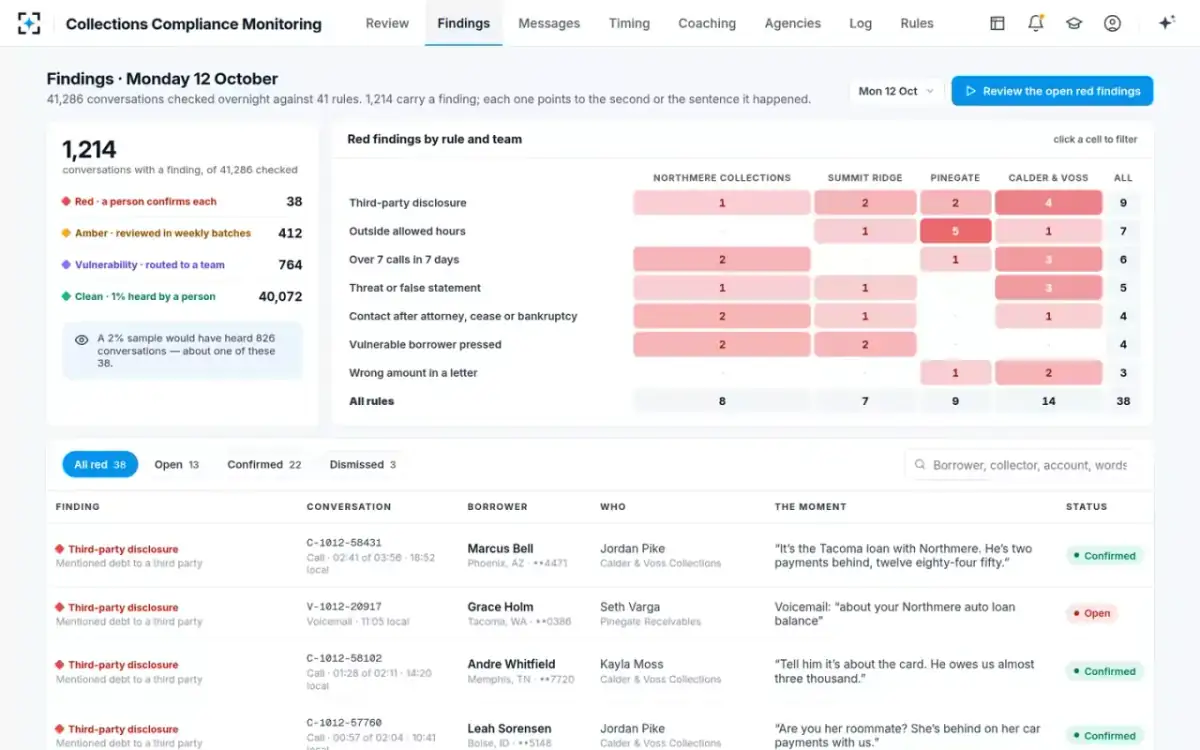
What a message finding becomes is the same as what a call finding becomes: a quoted moment, a person’s decision, a coaching item for whoever wrote or left it, and a line in a review log an examiner can read. Where the other breaches live, channel by channel, is set out in what goes wrong, by channel. To see the message checks on a day of your own voicemails, texts and emails, start from Collections Compliance Monitoring.
Questions people ask
Can a debt collector leave a voicemail?
Yes. A collector may leave a limited-content message, which is designed so that anyone who plays it learns nothing about a debt, or an ordinary voicemail where the collector is confident the borrower alone will hear it. The risk in the second is that voicemail reaches households, shared lines and workplaces, and a message that names the debt is a disclosure to whoever plays it.
What happens if a voicemail mentions the debt?
It stops being a limited-content message, because the definition permits no content beyond the two short lists. It becomes an ordinary communication about the debt, judged by every rule that governs communications — including the prohibition on conveying information about the debt to anyone but the borrower and a small list of others. Whether that prohibition was breached depends on who could play the message.
Can a collector say the company name in a voicemail?
A business name is one of the four required items, with a condition attached: it must not indicate that the collector is in the debt collection business. A name containing collections, recovery or receivables fails that condition on its face, so a firm with such a name needs another name it genuinely operates under, such as a registered trading name, before it can leave these messages.
Can a limited content message be left on a work phone?
Nothing in the definition says where it may be left; the point of the message is that it is safe to leave where others may hear it. The workplace question is governed separately: a collector must not contact a borrower at their place of employment where it knows or has reason to know the employer prohibits such contact. The message’s form and the number dialled are two different tests, and both have to pass.
Does a collection text message need an opt-out?
Yes. A collector communicating with a borrower electronically must include a clear and conspicuous statement describing a reasonable and simple way to opt out of further electronic messages to that address or number. It is not the same thing as the debt-collector disclosure, which a text also owes, and a template carrying one of the two is not carrying the other.
Is there such a thing as a limited-content text or email?
No. The term is defined for voicemail messages only. A text or email about a debt is an ordinary communication and carries the obligations of one, including the disclosure and the opt-out, together with the restrictions on which addresses may be used. Borrowing the voicemail safe route for a text applies a protection the rulebook does not extend to that channel.