FDCPA statutory damages are the additional damages a court may award a consumer who shows a debt collector broke the Fair Debt Collection Practices Act — in an individual action, "such additional damages as the court may allow, but not exceeding $1,000". That figure is where almost every page on the subject stops, and it is the smallest number in the section it comes from. Working out what a single bad conversation actually exposes a lender or an agency to is hard because the exposure is spread across four different meters that no one document sets side by side, and because the defence that cuts across all of them is not about intent alone — it is about what procedures you can show. Botminds' Collections Compliance Monitoring checks every call, voicemail, text, email and letter against the rules overnight and records what was checked, under which rule version, and who decided, which is the material that section is written about. This page prices one conversation four ways and sets out what each route needs.
None of this is legal advice, and no page can tell you what a court will do with your facts. The product figures come from a fictional sample day inside the solution — Northmere Bank, its own collectors and three agencies — and the bank, the agencies, the collectors and the borrowers are invented.
Four numbers from the statute, and one from the rule that keeps the evidence
$1,000
the ceiling on additional damages in an individual action — on top of actual damages, costs and a fee
$500,000
or 1% of net worth, whichever is less, for all other class members in a class action
1year
from the date the violation occurs, to bring the action
3years
that a recorded collection call must be retained under Regulation F
What are FDCPA statutory damages?
They are the part of a successful claim that does not have to be proved as a loss. Section 1692k(a) gives a successful plaintiff actual damages, then — in an individual action — additional damages the court may allow up to $1,000, then the costs of the action together with a reasonable attorney's fee. The middle term is the one called statutory damages in practice, and two words in it do most of the work: "may allow". It is a ceiling the court can award up to, not an entitlement attached to each violation.
The structure matters more than the figure. A borrower with no out-of-pocket loss still has a claim worth bringing, because the second and third terms do not depend on the first. That is the design: the Act is enforced by the people it protects, and the fee award is what makes a claim about a single call economic for a lawyer to take.
How much can you sue a debt collector for?
For one person, on one set of facts: actual damages, up to $1,000 in additional damages, and costs and a reasonable attorney's fee. Those three terms behave very differently. Actual damages have to be evidenced and are often small. The $1,000 is bounded and discretionary. The fee has no ceiling in the statute and is driven by how long the defence takes, which means the largest term in a small case is usually the one nobody is arguing about.
The sum § 1692k(a) actually writes, with the term that has no ceiling
Actual damages
as proved
What the conduct cost the person — wages lost to calls at work, fees paid on an amount that was not owed, medical evidence of distress. Often the smallest term, and the one most often zero.
the claimant proves it
Additional damages, individual action
≤ $1,000
A ceiling the court may award up to, on the factors in § 1692k(b)(1). Not $1,000 per violation, and not automatic.
the court allows it
All other class members
≤ min($500,000, 1% of net worth)
Available only in a class action, and shared — the statute says "without regard to a minimum individual recovery".
the court allows it
Costs and a reasonable attorney’s fee
no ceiling in the statute
Awarded to a successful plaintiff. The one open term, and in a single-call case usually the largest.
the court assesses it
What is the FDCPA class action cap?
In a class action the statute changes shape. Each named plaintiff can recover what an individual could; everyone else shares a single pot, and that pot is capped. The section allows "in the case of a class action, (i) such amount for each named plaintiff as could be recovered under subparagraph (A), and (ii) such amount as the court may allow for all other class members, without regard to a minimum individual recovery, not to exceed the lesser of $500,000 or 1 per centum of the net worth of the debt collector".
Read the cap from the defendant's side and it tells you something about which breaches become class claims. The ceiling is a share of net worth, so for a small agency it is small; what makes a class worth bringing is not the pot but the repetition, because repetition is what makes the practice provable in one go. A collector's script, a letter template, a dialer's time zone setting and a voicemail recording are all mechanical: whatever they do wrong, they do to everyone. That is why a template error is a different kind of exposure from a bad conversation, and why the sample day's letter finding — 214 letters in one batch carrying a $75–$120 collection fee the retail installment contract does not allow, two of them mailed — is the sort of thing a desk wants to find on the night it happens.
Costs, and a reasonable attorney's fee
The fee term is the economic engine of private enforcement, and it is the reason the cost of a claim is weakly related to the damages in it. A defendant who contests a $500 claim through discovery can face a fee award several times the sum in dispute, and the defendant's own costs are additional and not recoverable from the claimant. Nothing in the statute caps either.
The practical consequence for a collections desk is about speed rather than law. The cheapest version of any claim is the one answered in days with a complete, dated account of what happened: the conversation, the rule it was tested against, what the check found, who decided, and when. The expensive version is the one where that account has to be assembled from a recording system, a dialer log and three people's memories months later.
What a court weighs: frequency, persistence and intent
Section 1692k(b) tells the court what to consider in setting the additional damages. In an individual action it is "the frequency and persistence of noncompliance by the debt collector, the nature of such noncompliance, and the extent to which such noncompliance was intentional".
Every one of those three is a fact about a pattern rather than about one call, and every one of them is a question a monitoring programme answers either well or not at all. Frequency and persistence are counts over a population of conversations: how many times did this happen, on how many accounts, over how long, and did it continue after it was known. Intent is read partly from what the organisation did once it knew. A desk that found a problem on the Tuesday, coached the collector, and corrected the template is in a different position from one whose first knowledge of it is the complaint — not because the law says so in terms, but because those are the facts the third factor is assessed on.
What Collections Compliance Monitoring produces on the night, for one agency
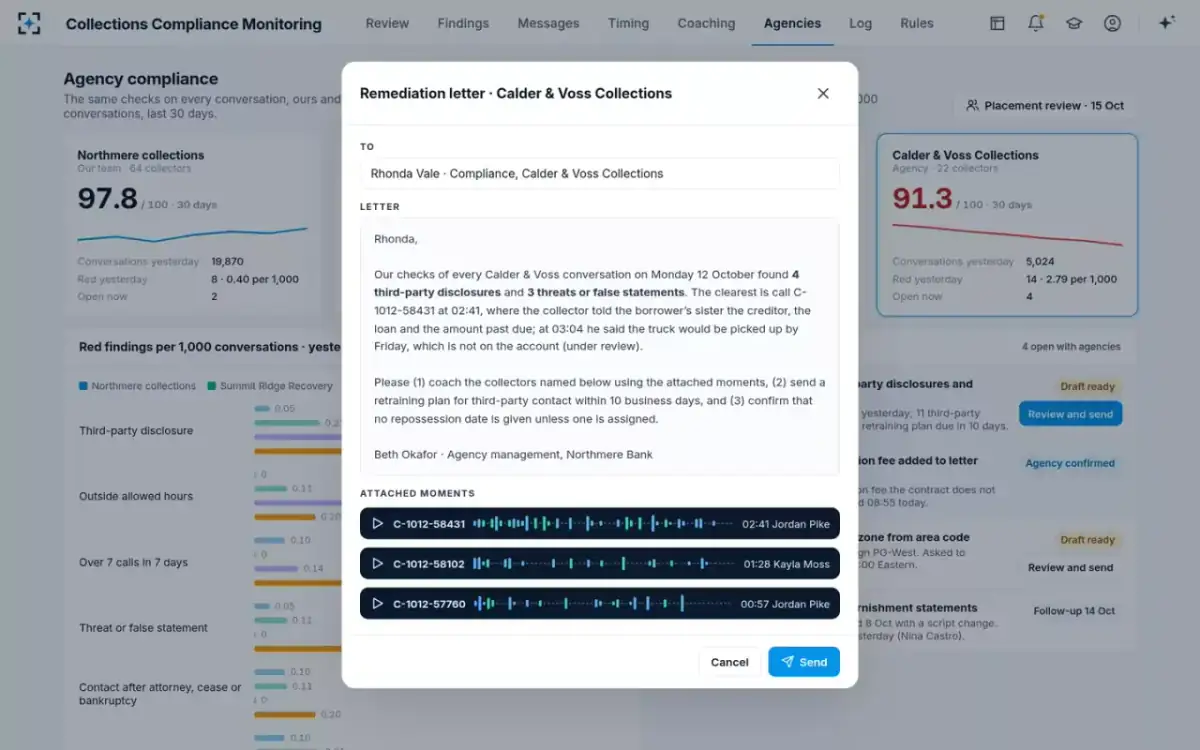
The bona fide error defence, and the word "procedures"
One defence cuts across the whole of section 1692k, and it is worth reading in full rather than in summary, because the summary usually loses its second half.
A debt collector may not be held liable in any action brought under this subchapter if the debt collector shows by a preponderance of evidence that the violation was not intentional and resulted from a bona fide error notwithstanding the maintenance of procedures reasonably adapted to avoid any such error.
15 U.S.C. § 1692k(c)
Three conditions, all of them on the collector, and all of them to be shown by evidence. The violation was not intentional. It resulted from a genuine error. And it happened despite procedures reasonably adapted to avoid that error, which the collector maintained. The third is the one with teeth, because it is the only one that is documentary. Intent is argued; a bona fide error is characterised; procedures either exist, are followed, and can be produced, or they cannot.
Two cautions belong here, and the second is the important one. The defence is narrower than it sounds — courts have read it as covering clerical and factual errors rather than mistakes about what the law requires — and it is a defence, not a shield. Monitoring does not prevent liability, and nothing on this page should be read as promising an outcome in any proceeding. What monitoring does is produce the evidence the third condition asks about, in a form that was created before anyone was in dispute: which rules were tested, on which conversations, under which version of the rule set, and what was done with each finding.
That is why how a programme measures what it missed is not a quality-team nicety. A procedure that has never been tested against the conversations it passed is a procedure nobody has evidence about either way.
One year from the violation
A private action under the Act must be brought "within one year from the date on which the violation occurs". That is a short clock by the standards of consumer litigation, and it has an awkward consequence for anyone relying on records: the evidence that decides a case filed on day 364 is a conversation nobody has thought about for a year.
Regulation F sets the retention that makes that survivable. A debt collector that records its calls must keep the recording of each one for three years after the date of the call, and must keep records that are evidence of compliance or noncompliance with the FDCPA and the rule until three years after the last collection activity on the debt (12 CFR 1006.100). The gap between the two clocks is the point of the figure below: the recording outlives the claim by two years, so the question is never whether the audio exists but whether anything says what was done about it.
Three clocks that start at the same conversation
- Retained under 12 CFR 1006.100(b)36 months
- § 1692k(d): within one year from the date the violation occurs12 months
- After this, no FDCPA action on that violation
- Up to 60 days for the company to respond
- The rest of the year the claim can still be brought in
The other meter: civil penalties measured per day
Private claims are not the only exposure, and the supervisory one is measured differently — not per violation, but per day the violation continues. The Consumer Financial Protection Act sets three tiers. For any violation of a law, rule or final order, a civil penalty "may not exceed $5,000 for each day during which such violation or failure to pay continues"; the second tier applies to reckless conduct; and "for any person that knowingly violates a Federal consumer financial law, a civil penalty may not exceed $1,000,000 for each day during which such violation continues".
Those are the figures in the statute, and they are not the figures in force. The Bureau adjusts the maximums for inflation each year, and the current table is published in its own rule.
The three civil penalty tiers, as written and as adjusted
| Tier | What it applies to | In the statute, per day | Adjusted maximum, per day |
|---|---|---|---|
| First tier | Any violation of a law, rule, or final order or condition imposed in writing by the Bureau. | $5,000 | $7,217 |
| Second tier | Any person that recklessly engages in a violation of a Federal consumer financial law. | $25,000 | $36,083 |
| Third tier | Any person that knowingly violates a Federal consumer financial law. | $1,000,000 | $1,443,275 |
Per day is the phrase to sit with. A conversation is an event; a dialer configured to read the time zone from an area code is a condition, and it persists until someone changes it. On the sample day, five late contacts came from one campaign whose borrowers had moved east while keeping California mobile numbers — 18:18 Pacific on the dialer was 21:18 at the borrower's door. The difference between finding that on the Tuesday morning and finding it in an examination is measured in days, and days are the unit the penalty is written in.
The costs that never reach a court
Most of what a breach costs is spent long before anyone sues, and it is the part a desk can actually forecast. The CFPB received approximately 207,800 debt collection complaints in 2024, seven percent of all complaints it received that year; it sent 77% of them, about 159,700, to companies for review and response, and companies responded to about 97% of those. Almost none of that ends in money.
How debt collection complaints sent to companies were closed
Company responses to debt collection complaints, 2024
- Closed with an explanation · 67% · 67%
- Non-monetary relief · 27% · 27%
- Administrative · 2% · 2%
- Pending · 2% · 2%
- Not timely · 2% · 2%
Beside complaint handling sit the costs nobody invoices: the analyst hours spent assembling an account of what happened, the remediation letters and retraining plans, the examination responses, the collectors taken off the phones to be re-coached, and — at the far end — enforcement by other agencies. The same annual report records one FTC action over fictitious debts in which "The FTC estimates that thousands of consumers were tricked into paying more than $7.6 million in bogus debts."
The solution's own view of the ordinary cost is an estimate rather than a measurement, and it is worth labelling as one: its figure for where a collections compliance analyst's week goes, by hand and with the checks running, is described in the solution as an estimated split for one analyst's week. Six hours a week pulling recordings and choosing a sample, sixteen listening to sampled calls end to end, four reading messages, four checking times and counts, six writing coaching notes and agency letters, four preparing the log for an exam or agency audit. We have not converted that into money, because the hourly rate would be ours and not yours.
The record Collections Compliance Monitoring keeps, and exports as an exam package
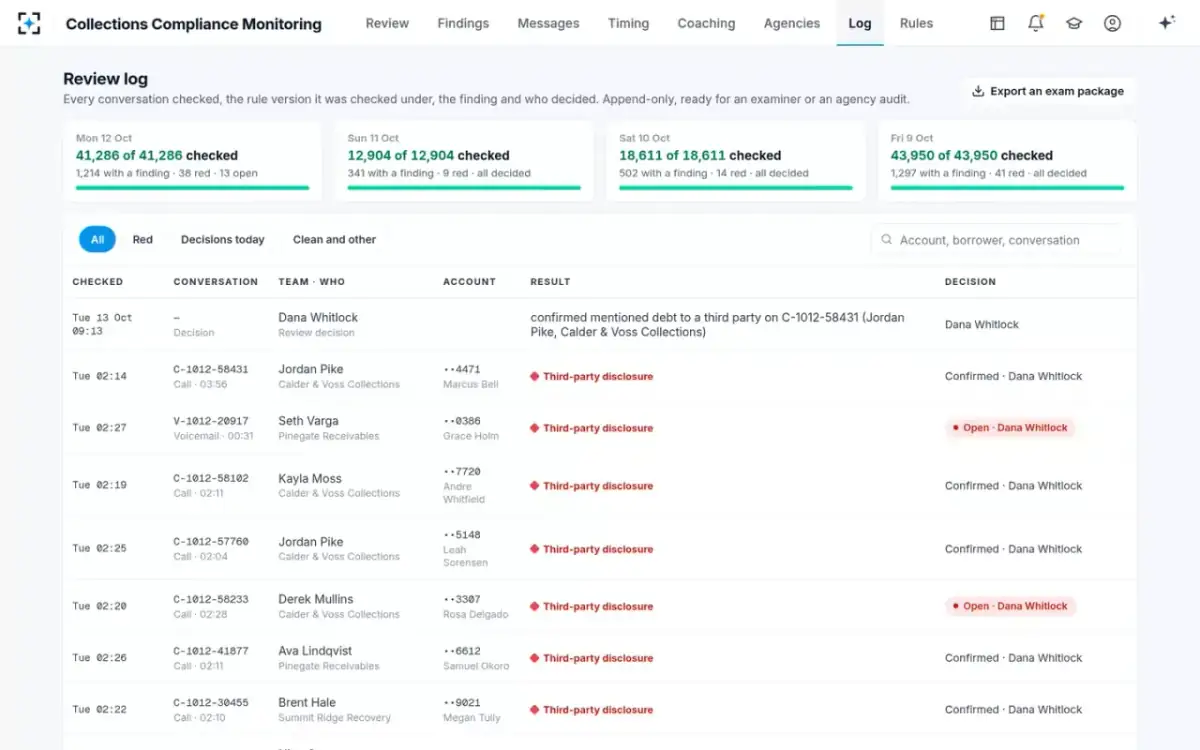
One conversation, priced four ways
As an individual action
What it needsThat the conduct happened, and that the defendant is a debt collector under the Act. Actual damages have to be proved; the additional damages do not.
What is measuredUp to $1,000 additional damages, plus any actual damages, plus costs and a reasonable attorney’s fee.
The limit on itBrought within one year of the violation. § 1692k(a), (d)
As one of a class
What it needsThe same conduct across a group — a script, a letter template, a dialer setting. Mechanical repetition is what makes a practice certifiable rather than an incident.
What is measuredEach named plaintiff as in an individual action, plus an amount for all other class members.
The limit on itThe class amount may not exceed the lesser of $500,000 or 1% of the collector’s net worth. § 1692k(a)(2)(B)
As a supervisory finding
What it needsNothing proved by a borrower at all. An examination finds it, and the response is remediation and a plan.
What is measuredCorrection, redress where there is harm, and management attention — plus civil penalties where they are assessed.
The limit on itCivil penalties under 12 U.S.C. § 5565 are measured for each day the violation continues.
As a complaint answered
What it needsA borrower describing it in a web form. No lawyer, no filing fee, no standard of proof.
What is measuredStaff time to investigate and answer, inside the response window, with the answer on the public record.
The limit on itCompanies have up to 60 days to respond; most debt collection complaints are closed with an explanation.
Read down the "what it needs" column and a pattern appears: three of the four routes are decided largely on records, and only one of them is decided on a borrower's testimony. That is the practical case for checking conversations as they happen rather than sampling them later, and it is a case about evidence rather than about prevention. What the programme is allowed to decide on its own, and what a person must decide, is a separate question — one taken up in what a check may propose and what only a person may confirm. If you are writing requirements, the buyer's questions for a collections desk start from the same evidence.
Questions people ask
Is it $1,000 per violation or $1,000 per case?
The statute caps additional damages in an individual action at $1,000, and it is framed as an amount the court may allow rather than a sum attached to each breach. Courts have generally read it as a per-action ceiling rather than a per-violation multiplier. Actual damages, costs and a reasonable attorney's fee sit outside that ceiling, which is why the $1,000 is rarely the largest figure in a settled case.
What is the bona fide error defence?
Section 1692k(c) says a debt collector may not be held liable if it shows, by a preponderance of evidence, that the violation was not intentional, resulted from a bona fide error, and happened notwithstanding the maintenance of procedures reasonably adapted to avoid that error. All three limbs are on the collector, and the third is documentary: it asks what procedures existed and were kept up, not what anyone intended. Courts have generally confined it to clerical and factual mistakes rather than mistakes about what the law requires.
How long do you have to sue under the FDCPA?
One year from the date on which the violation occurs, under § 1692k(d). The recordings behind it live longer: Regulation F requires a recorded collection call to be kept for three years after the date of the call, and compliance records until three years after the last collection activity on the debt. In practice that means the audio will still exist when a late claim arrives, and the open question is whether anything records what was done about it at the time.
What penalties can the CFPB impose?
Civil penalties under 12 U.S.C. § 5565 are measured for each day a violation continues, in three tiers: a first tier for any violation, a second for reckless conduct, and a third for a knowing violation of a Federal consumer financial law. The statutory maximums are $5,000, $25,000 and $1,000,000 a day; the Bureau's inflation-adjusted table at 12 CFR 1083.1 currently sets them at $7,217, $36,083 and $1,443,275. The Bureau or the court also weighs the size and good faith of the person charged, the gravity of the violation, the harm to consumers and any history of previous violations.
Does the collector or the bank pay?
It depends who did what, and both can be in scope. An agency that made the call is a debt collector under the Act in its own right. A bank that places accounts is answerable for its oversight of the firms acting for it, and a supervisory finding about an agency's conduct lands on the relationship as well as on the agency. Either way, the evidence both sides reach for is the same: what was said, what rule it was tested against, and what was done about it.
Does a monitoring programme stop us being sued?
No, and any page that says so is selling something. Breaches still happen, borrowers still complain, and § 1692k(c) is a defence a court assesses rather than a shield that attaches automatically. What a programme can do is make the facts available early and completely: find the conduct on the night it happened, record which rule it was tested against and who decided, and show the procedures that were in place and the sample that tested them.