Speech analytics in a call center is software that turns recorded calls into searchable text and then looks for things in it: words from a list, where in the call each one fell, how loud each speaker was, how much of the call each one held. In a collections call center that is a real capability with a hard boundary, because several of the rules a collections call can break are not decided by words at all — they are decided by facts on the account the words refer to. Botminds' Collections Compliance Monitoring checks every call, voicemail, text, email and letter against 41 rules and reads the servicing record before it calls a statement false, which is a different question from the one a transcript can answer on its own. This guide sets out which rules fall on each side of that line, and what to ask when a demonstration is mostly a word cloud.
The call used throughout is a fictional sample conversation inside the solution: Jordan Pike of Calder & Voss Collections calling about Marcus Bell's 2019 Tacoma auto loan, 3 minutes 56 seconds, placed at 18:52 local time in Phoenix. The bank, the agencies, the collectors and the borrowers are invented.
What is speech analytics in a call center?
The clearest published description of the category in a collections setting is the CFPB's own, from its survey of third-party collection firms. Seventeen of the fifty-eight firms that answered the written survey reported using it, and the Bureau wrote down what it does:
Speech analytics software generally analyzes call recordings to evaluate the content of a call. Speech analytics software is capable of identifying key words, the timing of the words, and the volume of the conversation.
CFPB, Study of third-party debt collection operations, July 2016 (written survey conducted July–September 2015)
Three signals, then: which words, when, and how loudly. Everything a keyword-driven programme reports is built from those three — a hit list, a position in the call, a loudness curve, and whatever counts and trends are derived from them. Date the adoption figures rather than reading them as a market share: that survey was conducted from July to September 2015 and published in July 2016, it was voluntary, and the Bureau says plainly that the responses "may not be representative of the industry as a whole". The Bureau also noted who was using it then: "Respondents using speech analytics software were all larger collection firms, with the smallest respondent having 83 employees."
What can speech analytics detect, and what it reports
Take the three signals seriously, because a great deal falls out of them. Words plus position gives script adherence: was the disclosure said, and was it said near the start. Words alone gives topic spotting: disputes, cease requests, the word "attorney", the word "bankruptcy", a mention of a hospital. Volume and talk-over give an agitation signal that routes supervisors to calls worth hearing. The CFPB's survey describes the first two uses in exactly those terms: "The first two functionalities can be used to test script adherence (for example, to make sure collectors make mandated disclosures at the right time) and look for disputes (for example, by looking for key words such as 'dispute')."
What the three signals cannot give is a verdict against a rule whose test refers to something outside the recording. That is not a criticism of the software; it is a statement about the rules. A transcript is a complete account of what was said and a silent one about whether what was said was true, permitted, or counted.
Five rules that need the account, not the audio
Five of the rules that decide whether a collections conversation was lawful turn on a fact held in a servicing system, a court file or a bank policy. Each can be broken by a sentence that contains no listed word, and each can be complied with by a sentence that contains several.
Five collections rules a recording alone cannot decide
| The rule | What it turns on | The account fact the check has to read | Where it sits |
|---|---|---|---|
| Contact after an attorney is known | Whether the borrower is represented about this debt, and whether the collector knows it or could readily find out. | Attorney of record on the account, and the date it was entered. | Reg F § 1006.6(b)(2) |
| A medium the borrower refused | Whether that person asked this collector not to use that channel — a text, an email, a work number. | Medium refusals and cease requests on the account, by channel and date. | Reg F § 1006.14(h) |
| The amount stated | Whether the balance, fee or past-due figure said aloud matches what is owed and what the contract allows. | Amount past due as at the moment of the call, and the fee terms of the agreement. | Reg F § 1006.18; FDCPA § 807(2)(A) |
| A threatened action that does not exist | Whether there is a present right and a present intention to take the action described. | Repossession assignment, security interest, and the bank’s own step before it. | Reg F § 1006.22(e); § 1006.18(c)(1) |
| Collection after a bankruptcy filing | Whether the automatic stay is in force for this debtor and this debt. | Bankruptcy filing from court records, matched to the account. | 11 U.S.C. § 362(a)(6) |
Two of them are worth reading in the regulation's own words, because the wording is where the audio runs out. On the channel a person has refused, Regulation F says: "In connection with the collection of any debt, a debt collector must not communicate or attempt to communicate with a person through a medium of communication if the person has requested that the debt collector not use that medium to communicate with the person." Nothing in the recording of a text message tells you whether an earlier call carried that request. On bankruptcy, the Bankruptcy Code stays "any act to collect, assess, or recover a claim against the debtor that arose before the commencement of the case under this title" — a rule about a court filing, tested against a conversation.
The attorney rule is the same shape: a collector must not communicate with a consumer about a debt where the collector knows the consumer is represented by an attorney about it and knows, or can readily ascertain, the attorney's name and address (12 CFR 1006.6(b)(2)). "Can readily ascertain" is a rule about what is in your own records. A monitoring programme that never looks at them has no view on it.
Is speech analytics enough for FDCPA compliance?
Not by itself, and the honest version of the answer is narrower than the question. Speech analytics is sufficient for the class of rules whose test is "were these words said, and said when they should have been" — the recording notice, the debt-collector disclosure, the opt-out line, the limited-content script. It is insufficient for the class in the table above, because those tests name a fact it cannot see. A monitoring programme is complete when something in it reads both.
There is a third class worth naming, because it is where examiners keep finding problems: rules about what the collector did after hearing something. The CFPB's July 2024 supervisory findings on collections put it plainly — "Examiners identified multiple phone calls where the consumer directly informed the collectors' agent that it was an inconvenient time or place for the consumer, but the agents continued the conversations beyond permissible follow-up questions." A word list can find "bad time". Deciding whether what came next was a permissible follow-up question or two more minutes of collecting requires reading the turns that followed, against the rule.
Can keyword spotting find a third-party disclosure?
Sometimes, and not reliably, because a third-party disclosure is defined by who is listening rather than by what is said. The same sentence — "he's two payments behind on the Tacoma loan" — is routine to the borrower and a breach to his sister. No word in it changes between the two cases. What changes is a fact established twenty seconds earlier, by someone else, in a line that contains nothing a list would hold.
One minute of the sample call, read twice
00:14
What was said“I’m his sister. He’s not here.”
Words, timing, volumeNo listed word. A speaker change, and a pronoun.
The rule, and the accountOpens the third-party question for everything said after it. The checker marks the other party as not the borrower and carries that forward.
02:11
What was said“I can only discuss it with Marcus, I’m sorry.”
Words, timing, volumeNothing to flag. If anything, a compliant-sounding line.
The rule, and the accountCorrect refusal, noted. It is also evidence the collector knew who he was speaking to, which matters at 02:41.
02:41
What was said“It’s the Tacoma loan with Northmere. He’s two payments behind, twelve eighty-four fifty.”
Words, timing, volumeNo profanity, no threat word, no “lawsuit”. Volume normal, pace normal.
The rule, and the accountCreditor, collateral, delinquency and amount, to a person identified as a third party at 00:14. Red, quoted at the second.
03:04
What was said“If it’s not paid by Friday, the truck will get picked up.”
Words, timing, volumeMatches a threat list if “picked up” is on it, and misses it if the list says “repossess”.
The rule, and the accountTrue or false depending on the account: whether a repossession is assigned, and where the loan sits against the bank’s own right-to-cure step.
Five flags on one waveform, and the one that depends on another
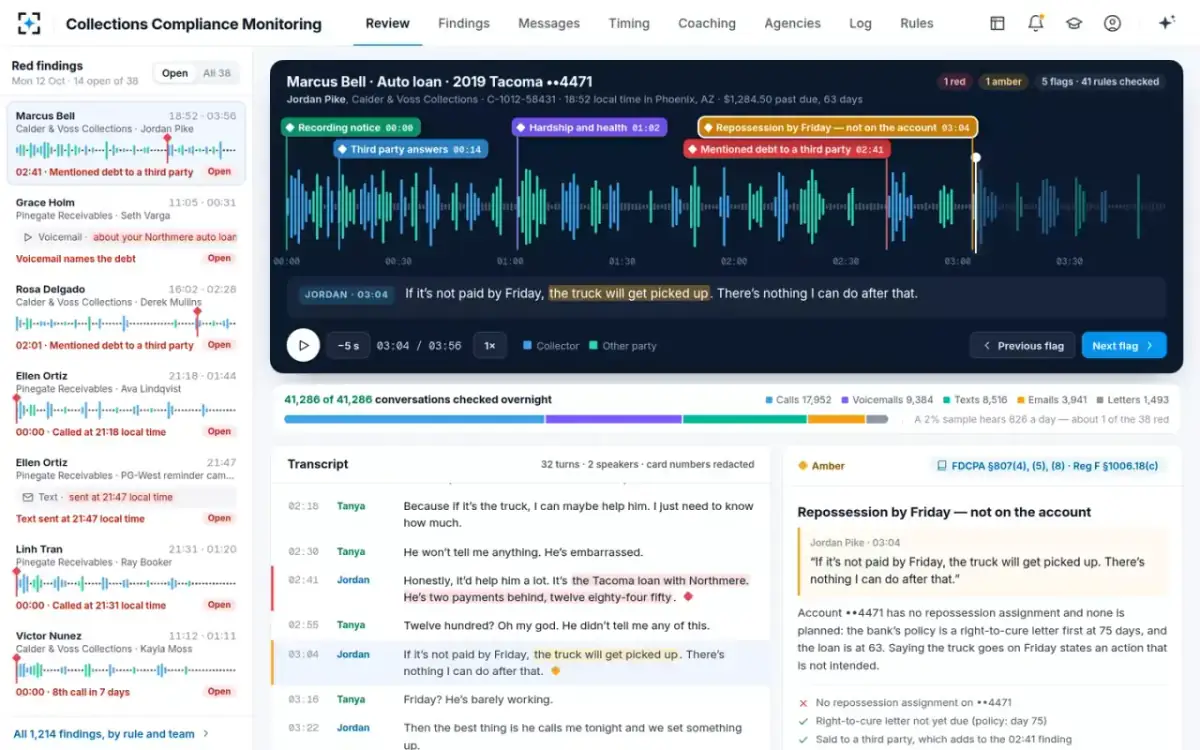
The 02:41 line is the one that decides the call, and the reason the check can decide it is the 00:14 line, which carries no rule of its own. That is the structural point about third-party disclosure: the evidence is a dependency between two moments, one of which is unremarkable. A programme that scores moments independently will keep missing it, however long the word list grows.
A true statement about a repossession, and a false one
At 03:04 of the same call the collector says the truck will get picked up if it is not paid by Friday. Whether that sentence is a breach has nothing to do with how it was phrased. Regulation F prohibits taking or threatening a nonjudicial action to dispossess or disable property where there is no present right to possession through an enforceable security interest, no present intention to take possession, or where the property is exempt by law from being taken (12 CFR 1006.22(e)). Every clause of that test is a question about the file.
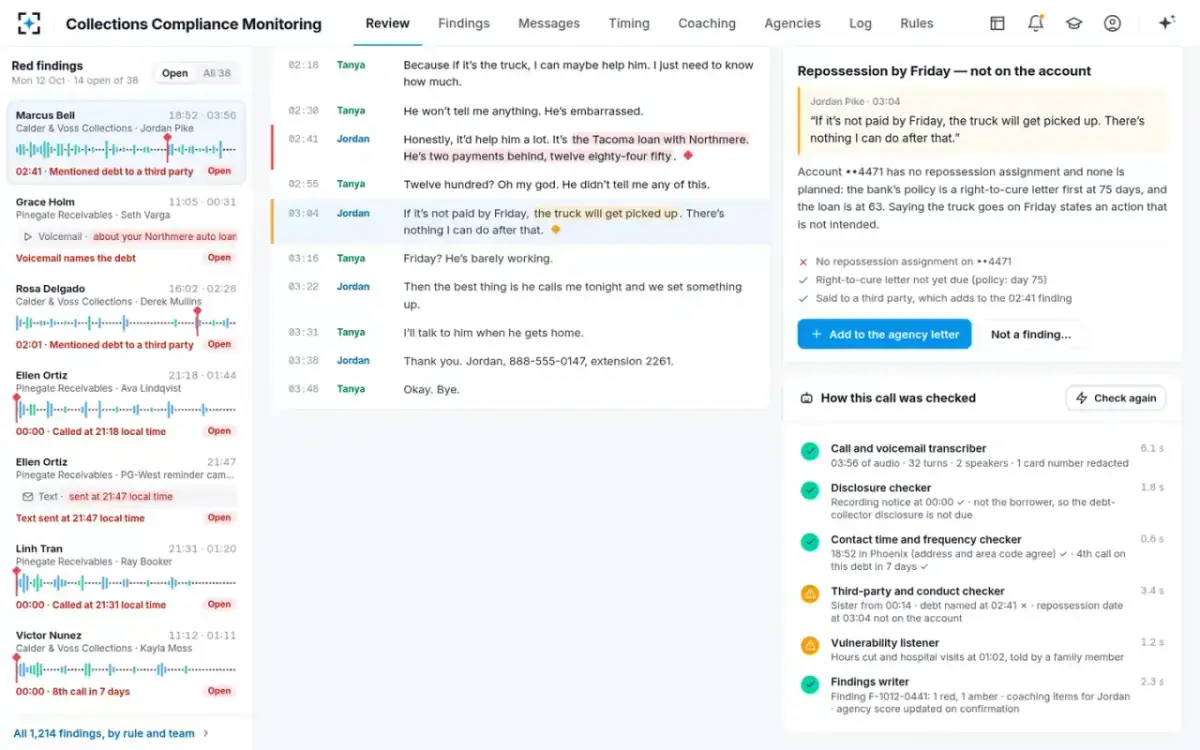
In the sample call the checker went and looked before it said anything. Account ••4471 has no repossession assignment and none is planned; the bank's policy is a right-to-cure letter first at 75 days; the loan is at 63. On those facts the sentence states an action that is not intended, so it is proposed as a finding — amber, with the rule cited and the moment quoted — and a person decides it. On different facts, with the assignment made and the step passed, the identical sentence is an accurate description of what is about to happen.
The same recording, checked by Collections Compliance Monitoring agent by agent
Script adherence is not compliance
Script adherence asks whether the collector said the required words. Compliance asks whether what happened was allowed. They overlap in the disclosure rules and diverge almost everywhere else, and the gap is where a desk gets into trouble while its scores look healthy.
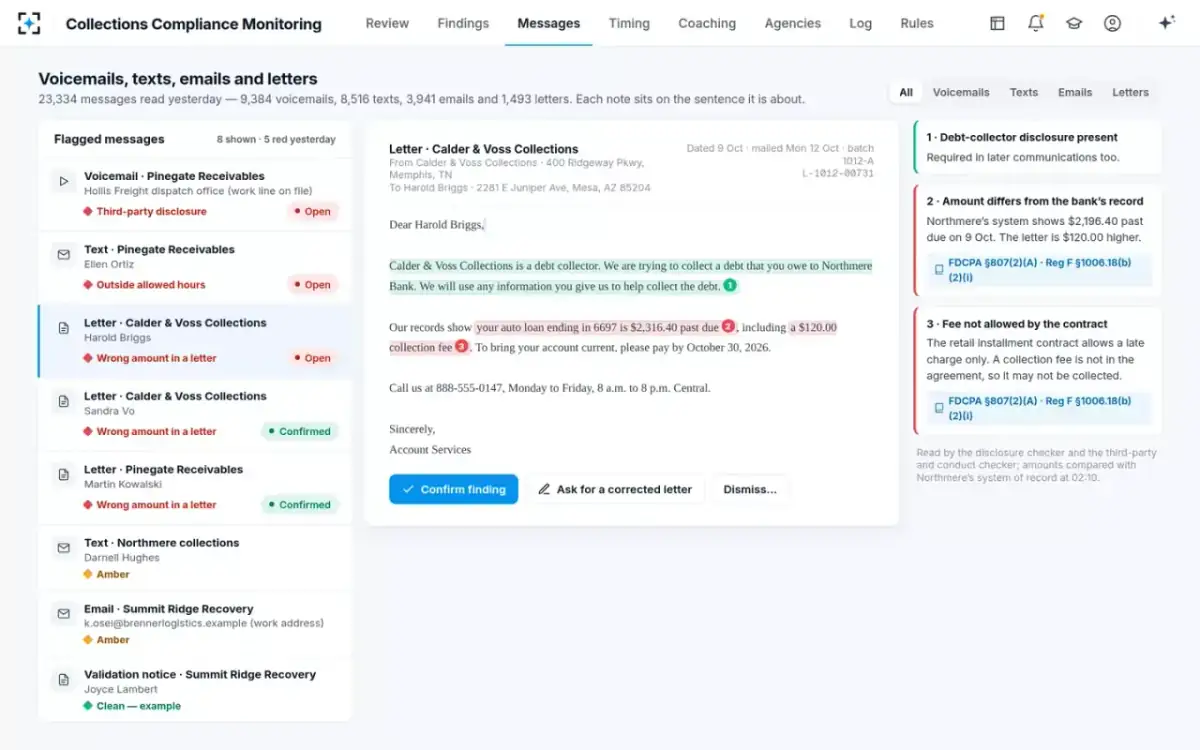
Three examples from the same night's sample data make the point without any argument about software. A letter that carried the debt-collector disclosure perfectly also stated $2,316.40 past due against a system of record showing $2,196.40, and added a $120.00 collection fee the retail installment contract does not allow: the script was followed and the amount was wrong. A dialer campaign whose scripts were word-perfect placed five contacts outside the allowed hours, because it took the time zone from California mobile numbers for borrowers who had moved east. And a voicemail that recited the limited-content wording correctly still named the debt in the same breath.
A letter that followed the script and stated the wrong amount
What to ask when the demonstration is a word cloud
A demonstration built on hit counts and topic clouds is showing you the three signals doing what they do well. The questions that separate programmes are about the rest, and they are answerable in a single meeting.
Six questions to put to any collections monitoring proposal
- Which rules does it decide, and which does it only surface?
Ask for the list, split in two. A programme that surfaces everything and decides nothing leaves the work where it was.
- What account facts does it read, and from where?
Attorney, cease and medium refusals, amount past due as at the call, repossession assignment, bankruptcy filings. Name the system each comes from and how fresh it is.
- What does it quote when it reports something?
A finding should carry the second or the sentence, not a score. Ask to see one on a call you chose.
- Which channels does it cover?
Calls, voicemails, texts, emails and letters are all communications. A programme that covers one of the five sees only the conversations in that one.
- Who confirms, and what does a dismissal need?
Ask who is allowed to close a serious finding, and whether dismissing one takes a reason and a second person.
- What is retained, and can it be exported as it stood?
The conversation, the rule version it was checked under, the finding and the decider — for as long as the retention rules require.
The fourth question is the one most often skipped. Voicemails, texts, emails and letters are communications under the same rules as calls, and in the sample day they are more than half the volume: 9,384 voicemails, 8,516 texts, 3,941 emails and 1,493 letters against 17,952 calls. A programme scoped to call recordings is scoped to 44% of the conversations. If you are writing requirements rather than sitting through demonstrations, the buyer's checklist for a collections desk sets the rest of it out.
Where the two meet: the same recording, two questions
The two readings are not rivals; they answer different questions about one file, and a desk needs both answers. Put them side by side on seven moments from the sample call and the division is clean.
One sample call in Collections Compliance Monitoring, read as words and as rules
Words, timing and volume: Present, and near the start. Position is exactly what this reading is good at.
The rule, with the account open: Same verdict, same evidence. Found at 00:00 and quoted.
Words, timing and volume: A speaker change. No listed term; nothing to report.
The rule, with the account open: The other party is not the borrower. Everything after this is read against that.
Words, timing and volume: Hits a hardship word list, if one is configured.
The rule, with the account open: Routed to the hardship team as a signal about the account, not a label on the person. Red only if payment is pressed after it on the same call.
Words, timing and volume: Normal volume, no listed term, nothing to flag.
The rule, with the account open: Red: debt detail to a third party, quoted at the second, cited to the rule.
Words, timing and volume: Flags only if that phrasing is on the list.
The rule, with the account open: Checked against the account first: no assignment, right-to-cure not due, loan at 63 days. Amber, for a person.
Words, timing and volume: Outside the recording. Not a speech question at all.
The rule, with the account open: Placed on the borrower’s own clock from the address on file; 18:52 in Phoenix is inside the window.
Words, timing and volume: Requires counting across calls and accounts, which is not what a transcript holds.
The rule, with the account open: Counted per debt over seven days, against the setting in force and any stricter state rule.
Whichever reading a desk buys, the obligation to show it works is the same. NIST's AI Risk Management Framework puts it simply: a deployed system's validity and reliability are usually shown by testing or monitoring it continuously to confirm it still does what it was meant to. For a monitoring programme that means a measured sample of what it passed as well as what it flagged, which is what calibration turns into when every conversation is checked. And it means being clear about which decisions a check is allowed to make at all — the subject of propose and confirm, kept apart.
Questions people ask
What is speech analytics in a call center?
Software that transcribes recorded calls and analyses them for content. The CFPB's survey of collection firms describes it as identifying key words, the timing of the words and the volume of the conversation, used in practice to test script adherence and to spot disputes. Those three signals are the basis of everything a keyword-driven programme reports.
How many collection agencies use speech analytics?
The only allowed figure we have is dated and should be read as such. In the CFPB's written survey of third-party collection firms, conducted from July to September 2015 and published in July 2016, seventeen of fifty-eight respondents reported using speech analytics software, and all of them were larger firms, the smallest with 83 employees. The Bureau states the responses may not be representative of the industry as a whole, and the figure says nothing about adoption today.
Can keyword spotting find a third-party disclosure?
Only by accident. A third-party disclosure is defined by who was on the line, not by which words were used: the same sentence about an arrears balance is routine to the borrower and a breach to his sister. The decisive evidence is usually an earlier, unremarkable moment where someone identified themselves, so the check has to carry that fact forward through the rest of the call.
Do you still need people to listen?
Yes, for two different samples. People have to hear the moments that are proposed as serious findings, because a finding scores a collector and may be read back by an examiner. And people have to hear a random slice of the conversations the checks passed, because that is the only way to learn what the checks are missing. In the solution the first is the analyst's morning and the second is a daily percentage setting.
What should a collections call check look at besides the words?
The borrower's local time from the address on file, the number of attempts on that debt over seven days, the attorney of record, any cease request or refused medium, the amount past due as at the call, whether a threatened action is actually assigned, and whether a bankruptcy has been filed. All of those are facts in a servicing system or a court record, and none can be read from the audio.
Is speech analytics enough for FDCPA compliance?
It is enough for the rules whose test is whether certain words were said at the right point — disclosures, opt-out lines, the limited-content script. It is not enough for rules that turn on a fact outside the recording, or on what the collector did after the borrower said something. A programme is complete when something in it reads the account as well as the audio, and when a named person decides the serious findings.