Yes, but for one purpose only, and usually once. A debt collector may call your family, your roommate, your neighbour or your employer to find out where you live and how to reach you, and that is the whole of the permission. The collector has to give their own name, say they are confirming or correcting where you can be reached, and name their employer only if they are expressly asked. The moment they say who you owe, what the loan is or how far behind you are, a permitted location call has become a prohibited disclosure. Collections Compliance Monitoring is Botminds’ software for collections quality and compliance teams: it checks every call, voicemail, text, email and letter overnight against the rules and pins each finding to the second or sentence where it happened, because this breach lives in one clause of a four-minute call.
The screens and sample figures below come from one day at a fictional bank, Northmere Bank, as it runs through the solution: its own collectors and three agencies had 41,286 conversations with borrowers on Monday 12 October. Every person, bank, agency and borrower named is invented. The rules and the complaint counts come from the regulator’s own pages, linked where they appear.
The whole of a permitted call to a relative, in four moves
- Give your own name
“Good afternoon, my name is Jordan Pike.”
The rule names the collector, not the firm. An individual name is the required opening.
Never: A false name, or a name the firm cannot trace back to the person using it.
- Say what the call is for
“I am trying to confirm a current address and phone number for Marcus Bell.”
Confirming or correcting where the borrower can be reached is the only purpose the law allows.
Never: “I am calling about a debt”, “It is a financial matter”, or anything that explains why.
- Name your employer only if asked
“Calder & Voss.” — and only after the other person asks who you work for.
Volunteering the firm’s name invites the next question, and on a collections firm it half answers it.
Never: Offering the firm unprompted, or a firm name that announces debt collection.
- Take the answer and stop
“Thank you, that is all I needed.”
One call to that person, unless they ask to be called again.
Never: Calling back to check, or working through a second relative at the same address.
Can a debt collector call your family?
A debt collector may call a member of your family, but only to acquire what the rule calls location information, and the regulation is unusually literal about what that means. Location information is a consumer’s “place of abode and telephone number at such place; or … place of employment”. Not whether you are working. Not what you earn. Not whether you are good for the money. An address and a telephone number, or a place of work.
The general rule points the other way. In connection with collecting a debt, “a debt collector must not communicate … with any person other than: (i) The consumer; (ii) The consumer’s attorney; (iii) A consumer reporting agency, if otherwise permitted by law; (iv) The creditor; (v) The creditor’s attorney; or (vi) The debt collector’s attorney.” That is a closed list of six, and your sister is not on it. The location call is an exception written into the rule, not a general licence to talk to people around you, and it comes with its own conditions in a section of its own.
The only six the debt itself may be discussed with
- The borrower
And, for this purpose, the people § 1006.6(a) treats as the borrower — a spouse, a minor’s parent, a legal guardian, an executor, a confirmed successor in interest.
- The borrower’s attorney
Once the collector knows there is one and knows or can readily find their name and address, the attorney replaces the borrower as the contact.
- A consumer reporting agency
Where other law permits it. This is the credit-reporting channel, not a conversation.
- The creditor
The bank or lender the debt is owed to — for an agency placement, the client.
- The creditor’s attorney
The lawyer acting for the bank, on the same debt.
- The debt collector’s own attorney
The agency’s lawyer. Everyone else, however close to the borrower, is outside the list.
What a collector may say to a relative, word for word
Because the permission is a purpose and not a topic, the difference between a lawful call and a breach is often a single clause spoken forty seconds in. The regulation sets out what the collector must do on a location call: “Identify himself or herself individually by name, state that he or she is confirming or correcting the consumer’s location information, and, only if expressly requested, identify his or her employer”, and then, flatly, “Not state that the consumer owes any debt”.
Read those two together and the shape of the call appears. The collector gives a personal name, not a firm. They say what they are doing in terms of an address and a number. They name their employer only when the other person asks who they work for. And they never say there is a debt — not the word debt, not the creditor, not the balance, not a hint dressed as a courtesy.
The same forty seconds, twice
A location call: “My name is Jordan Pike. I am trying to confirm an address and a phone number for Marcus Bell.”
A third-party disclosure: “This is Jordan from Calder & Voss Collections. I am trying to reach Marcus Bell.”
A location call: “Calder & Voss.” Asked, so answered — and nothing beyond the name.
A third-party disclosure: “Calder & Voss. We handle accounts for Northmere Bank.” The creditor is now in the room.
A location call: “I am only able to confirm where he can be reached. If you can pass my number on, I would be grateful.”
A third-party disclosure: “It is about his Tacoma loan. He is two payments behind.” The debt is stated; the exception is gone.
A location call: “I am not able to discuss the account with you. The number is 888-555-0147.”
A third-party disclosure: “It is twelve eighty-four fifty. If you can cover it today it stops going further.” A second breach on top of the first.
A location call: One call to that person, logged with the answer it got.
A third-party disclosure: A call that cannot be unmade, and a relative who now knows the balance.
The fourth row is worth dwelling on, because it is where good intentions do the damage. A relative who offers to help is a relief at the end of a long call list, and the collector who takes the offer has to state the amount to take it. There is no version of that sentence that keeps the exception. The only lawful answer is to decline and leave a number.
Can a debt collector call my employer?
A collector may call your place of employment to ask for your address and telephone number, under the same location rule and with the same limits: a personal name, the confirming-or-correcting sentence, the employer named only if asked, and nothing that says you owe anything. Whoever answers the switchboard is a third party like any other.
Calling you at work is a different question, governed by a different paragraph. A collector may not contact a borrower at work if it knows, or has reason to know, that the employer does not allow the borrower to take such calls. The trigger is knowledge of the employer’s policy, not the workplace itself. Tell a collector your employer does not allow these calls and the prohibition attaches from that moment; say nothing and a call to a work number is not automatically unlawful. What is never permitted is the part most people actually fear — the collector telling your employer, or your colleague, what the call is about.
In the night’s sample findings at the fictional bank, both failures appear within a few hours of each other: a collector who named the loan to a borrower’s sister at 02:41 of a recorded call, and an agency voicemail left on a borrower’s work line that named the creditor and the balance where the dispatch office could hear it. The second is a different rule again, and is set out in what a collector’s voicemail may say.
Who counts as you: spouse, parent, guardian, executor
The most common mistake in training material is the sentence “family members are third parties”. They are not, as a class. The regulation opens the section by widening the word consumer: “For purposes of this section, the term consumer includes: (1) The consumer’s spouse; (2) The consumer’s parent, if the consumer is a minor; (3) The consumer’s legal guardian; (4) The executor or administrator of the consumer’s estate, if the consumer is deceased; and (5) A confirmed successor in interest”. Five categories of people the collector may speak to about the debt exactly as if they were the borrower.
Everyone else close to the borrower is a third party. A sister is. So is an adult son, a parent of an adult borrower, a fiancé, a roommate, a neighbour and a coworker. The line does not follow the household, the surname or who answers the phone most often; it follows a list of five legal relationships, and a collector who treats “family” as one thing will get it wrong in both directions — refusing to talk to a spouse who is entitled to the conversation, and discussing the balance with a sibling who is not.
Who the rule treats as the borrower, and who it does not
| The person on the line | How the rule treats them | Where it comes from |
|---|---|---|
| The borrower’s spouse | Treated as the borrower | § 1006.6(a)(1) — the debt may be discussed with a spouse |
| A parent, where the borrower is a minor | Treated as the borrower | § 1006.6(a)(2) — only while the borrower is a minor |
| A legal guardian | Treated as the borrower | § 1006.6(a)(3) |
| The executor or administrator of the estate, where the borrower has died | Treated as the borrower | § 1006.6(a)(4) |
| A confirmed successor in interest | Treated as the borrower | § 1006.6(a)(5) — confirmed, in the mortgage rules’ sense |
| A sister, brother, adult child or parent of an adult borrower | A third party | Location information only, under § 1006.10 |
| A roommate, neighbour, friend or coworker | A third party | Location information only, under § 1006.10 |
| An employer, or whoever answers the switchboard | A third party | Location information only, under § 1006.10 |
Once only, unless they ask to be called again
The location exception is also a quantity. A collector “must not communicate more than once with such person unless requested to do so by such person, or unless the debt collector reasonably believes that the earlier response of such person is erroneous or incomplete and that such person now has correct or complete location information”. One call to that person about that borrower. A second call needs either an invitation from them or a reason to think what they said was wrong or out of date and has since been corrected.
This is the limit that quietly fails at scale, because nothing in a dialer knows that the number it is about to try belongs to someone who was already asked last Tuesday. The count has to be kept per person contacted and per borrower, across campaigns and across agencies working the same book, and it has to survive a relative calling back. A compliance programme that counts calls per account, which is the usual way, will not see it: the relative’s number is not the account’s number.
Is a spouse a third party under the FDCPA?
No. For the purposes of the communication rules a spouse is the consumer, so a collector may discuss the debt with them as freely as with the borrower. That answer surprises people on both sides of the call, and it has a consequence worth stating plainly: everything that protects the borrower in a conversation now protects the spouse too. The call to a spouse is a communication with the consumer, so it must fall inside the permitted hours at their location, it must stop if the borrower has given written notice to cease, and it stops if the collector knows an attorney represents the borrower on that debt.
The same is true of a parent where the borrower is a minor, a legal guardian, an executor or administrator where the borrower has died, and a confirmed successor in interest. These are the people who, in practice, deal with the debt when the borrower cannot. Treating them as strangers to it is the mirror-image error, and it leaves an estate or a guardian unable to get the figures they need to settle.
One caution for a collections desk: the person on the line claiming to be a spouse has not thereby proved it. Right-party verification is a separate check for a reason, and the safe order is to verify first and discuss afterwards. The cost of getting that order wrong is on the record for ever, because the call is recorded.
The voicemail a coworker can hear
A message is a communication like any other, and the third-party rule does not care whether a human was listening when it was left. A voicemail that names the creditor on a shared line, a work number or a household answering machine is a disclosure to whoever plays it. The regulation’s answer is the limited-content message: a short, defined script that may be left without the collector knowing who will hear it, precisely because it says nothing about a debt.
On the fictional bank’s sample day one agency message failed that test by a single clause. It gave a business name, a person to call, a number — and then asked the borrower to call back “about your Northmere auto loan balance”, on a line that rings in a freight dispatch office. Naming the debt costs the message its protection, and the dispatcher who played it now knows. The anatomy of that message, and the four lines a voicemail may carry, are in the limited-content message guide.
What borrowers themselves said, inside complaints about improper sharing
The regulator’s own words for the pattern are worth quoting: in those complaints, “consumers most often reported that the collector talked to a third party about the debt (56 percent), contacted the consumer after being asked not to do so (27 percent), contacted an employer (16 percent), or contacted the consumer directly instead of contacting their attorney (two percent)”. Three of the four are conversations with someone other than the borrower. It is the most-reported failure in this family of complaints by a wide margin.
When an attorney is known, the calls stop
Once a collector knows a borrower is represented, the location exception closes along with the direct line. Under § 1006.10(b)(5), after the collector knows there is an attorney on the subject debt and knows or can readily find the attorney’s name and address, they must not communicate with any person other than that attorney, unless the attorney fails to respond within a reasonable time. The direct prohibition sits beside it: a collector who knows the borrower has an attorney on the debt, and knows or can readily find out who and where that attorney is, must not contact the borrower about it at all.
The operational problem is the word knows. Representation arrives by letter, by a sentence on a call, by a filing — often at one agency and not the other, or at the bank and not the agency working the account. A desk that cannot answer “when did we know?” with a timestamp cannot defend the calls that followed, and the first time anyone asks is usually a complaint.
Not state that the consumer owes any debt.
12 CFR § 1006.10(b)(2)
What to do if a collector told your family about your debt
Write down what you can establish while it is fresh: who was called, on what number, on what date and roughly what time, and what the person was told, in their words as near as they can remember them. If the relative was asked to pass on a message, keep it. If the call came to a workplace, note who else could hear it.
Then put the complaint in writing to the collection firm and to the creditor whose debt it is, because the creditor is usually the party with the contract and the leverage. Ask specifically for the call recording and the account notes for that date — a firm of any size records its calls and keeps them, and the request narrows the dispute to what was actually said. A complaint to the Consumer Financial Protection Bureau, and to your state’s attorney general or licensing regulator, goes on the public complaint counts that produced the figures above.
If you want the collector to stop contacting you altogether, do it in writing. A written notice that you refuse to pay or want communication to cease ends further communication about that debt, with narrow exceptions for telling you that efforts have ended or that a specific remedy may be used. Two practical notes: the written-stop right is about contact with you, and the third-party rule already protects the people around you without any notice from anyone; and what goes wrong by channel sets out which breaches leave the clearest trail.
How a disclosure is found in a recorded call
A third-party disclosure is almost never audible as an event. There is no shouting, no threat, no obviously bad minute. There is a collector being helpful to someone who sounds like family, four minutes into a call that a reviewer would have to hear in full to catch — which is why a quality programme that samples a few percent of calls will hear almost none of them.
The checking is therefore built around two moments rather than a score. The first is the identification: at 00:14 of the sample call, the person who answered says she is the borrower’s sister. The second is the disclosure: at 02:41 the collector names the creditor, the loan, that the borrower is two payments behind, and the amount. Both are quoted, with their timestamps, in the finding.
The flag at 02:41, and the sentence under it
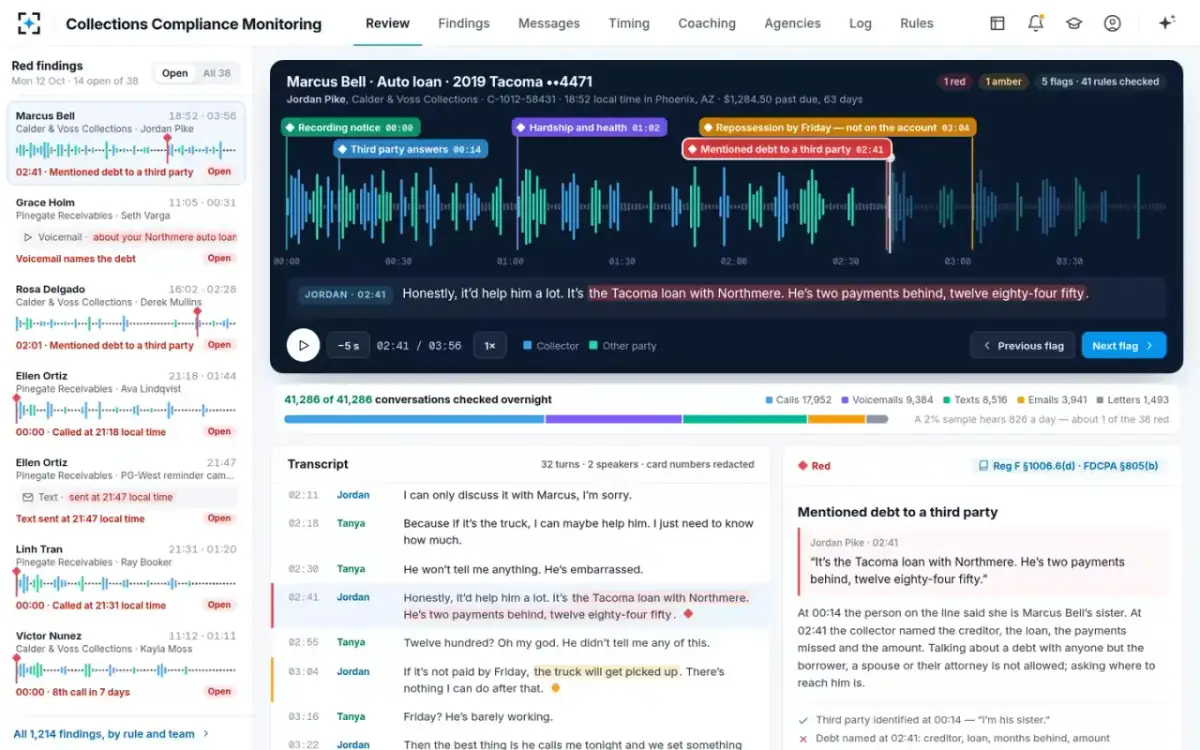
The same call carried a second problem twenty-three seconds later, flagged amber rather than red: the collector said the truck would be picked up on Friday. Checked against the account, no repossession was assigned and the bank’s own policy puts a right-to-cure letter first at day 75, with the loan at 63. That is a statement about an action not intended, which is a different rule and a different severity, and it is handled in the breach-by-breach guide.
Who proposes, and who decides
Agent
TranscriberTurns the audio into time-stamped turns and separates the collector from the other party — 3:56 into 32 turns from 2 speakers on this call.
Never: Scores or summarises a conversation.
Agent
Third-party checkerMarks the moment the other party identifies themselves and the moment the debt is named, and quotes both.
Never: Decides a breach — it proposes, with the quote.
Agent
Findings writerWrites one finding per conversation with the moment, the rule and the coaching item it would create.
Never: Closes a red finding, or writes to an agency on its own.
A person decides
The compliance analystHears the ten seconds and confirms or dismisses. Confirmation creates the coaching item and moves the agency’s score.
Never: Dismisses a red finding alone — that needs a reason and a second signature.
What the finding becomes is the point of checking at all. On the sample day the confirmed disclosure turned into a coaching item for the collector with the ten seconds attached, a movement in the agency’s 30-day compliance score, and a line in an append-only review log that an examiner or an agency audit can read. The trainer gets the moment, not a number.
Coaching from the ten seconds
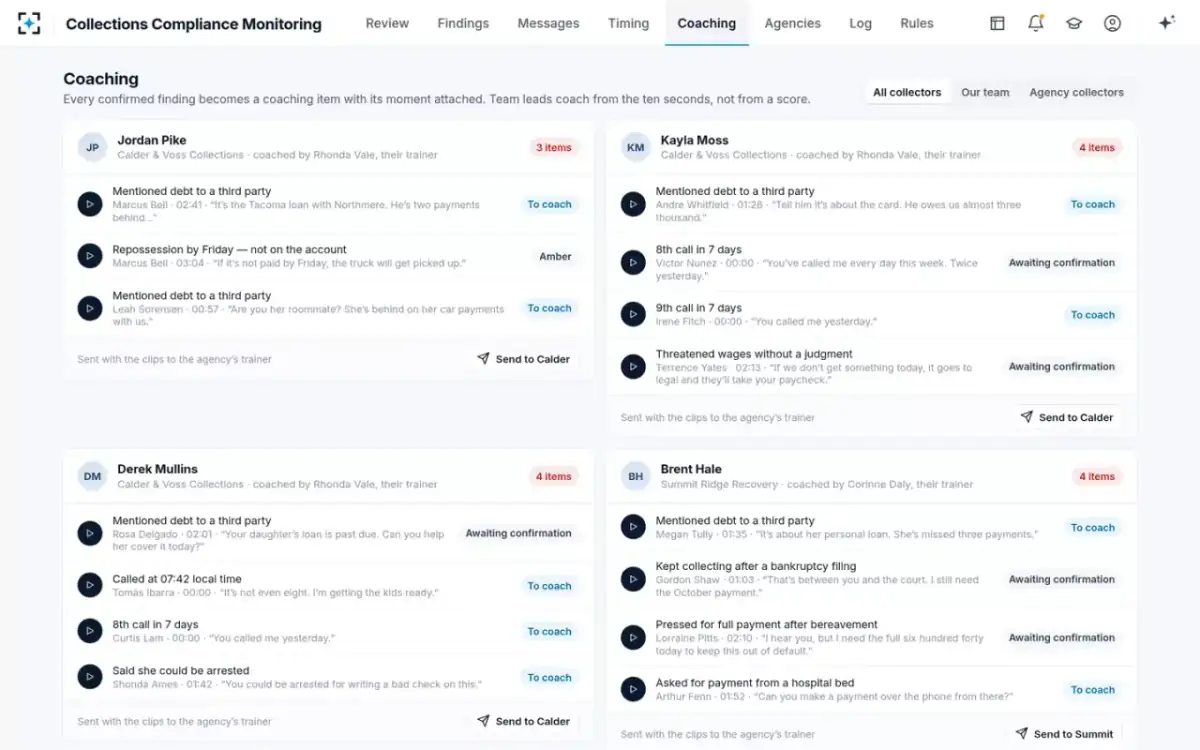
Two of that collector’s three items are the same breach a week apart, on two different calls, with two different people who were not the borrower. That is what a pattern looks like before anyone complains, and it is the argument for checking every conversation rather than a sample: a breach that happens to one borrower in a thousand is invisible in a sample of fifty calls and obvious across forty thousand. To see the checks, the flags and the review log on a day of your own conversations, start from Collections Compliance Monitoring.
Questions people ask
Can a debt collector tell my family about my debt?
No, unless the person is one the rule treats as you — a spouse, a parent where you are a minor, a legal guardian, an executor of your estate, or a confirmed successor in interest. To anyone else, including a sibling or an adult child, the collector may only ask where you can be reached, and must not state that you owe any debt. Your own prior consent, given directly to the collector, is the other way the door opens.
What is location information in debt collection?
It is defined narrowly: your place of abode and the telephone number there, or your place of employment. That is all a collector may seek from a third party. Questions about your income, your hours, your other debts or whether you are good for the money are outside the permission, even when they are asked politely and even when the person answering volunteers the information.
How many times can a collector call a relative?
Once about that debt, as a rule. A second call needs either a request from that person to call again, or a reasonable belief that what they said before was wrong or incomplete and that they now have correct information. The limit is per person, so a collector cannot work around it by calling a second relative at the same address to check the first one’s answer.
Can a debt collector leave a message with my roommate?
A collector may ask a roommate where you can be reached, under the location rule, but may not say what the call is about. Regulation F’s safe message — the limited-content message — is defined as a voicemail, so a message passed on through a roommate has no special protection: anything in it that names the creditor or the balance is a disclosure to the roommate, and the same is true of a message left on a shared answering machine or at a workplace.
Is it a breach if my relative worked out what the call was about?
Not by itself. The rule is about what the collector states, not what a listener infers, and a collector who gives only a personal name, the confirming-or-correcting sentence and a callback number has not disclosed a debt. It becomes a breach the moment the collector confirms the guess — which is why the sentence that follows “is this about money he owes?” is the one a quality programme should look for.
How would anyone know a disclosure happened on a call?
By checking the recording against the account, rather than by waiting for a complaint. The regulator’s examiners expect to see the controls: they are told to assess “whether the debt collector has adequate policies and procedures to avoid disclosure of the existence of a debt to third parties, for example, how does the debt collector identify itself or leave messages with third parties?” A sampled review answers that question for a few percent of calls; checking every conversation answers it for all of them.