The mini-Miranda is the collections industry’s nickname for the disclosure a debt collector must make when it first contacts a borrower: that it is attempting to collect a debt, and that any information obtained will be used for that purpose. The name is borrowed and the comparison is loose — nobody is being arrested — but the obligation is real, it is written in the collections rulebook rather than in criminal procedure, and it is actually two obligations with different wording. The second one, owed in every later contact in every channel, is where programmes fail. Collections Compliance Monitoring is Botminds’ software for collections quality and compliance teams: it reads every call, voicemail, text, email and letter overnight, quotes the words it relied on for each result, and so can say whether each of a night’s 41,286 conversations carried the disclosure it owed.
The sample figures and screens below come from one day at a fictional bank, Northmere Bank, as it runs through the solution; every person, bank, agency and borrower named is invented. The rules quoted are Regulation F, which is the rulebook the FDCPA’s own collection provisions are implemented in — one statute and its regulation, not two sources that could disagree.
Two disclosures, two triggers, two pieces of evidence
The initial communication
“A debt collector must disclose in its initial communication with a consumer that the debt collector is attempting to collect a debt and that any information obtained will be used for that purpose.”
- Trigger
- The first time the collector conveys information about the debt to the borrower, in any medium.
- And again
- If that first contact was spoken, the same disclosure is owed again in the first written contact.
- Proved by
- One call recording, or one letter.
Every communication after it
“In each communication with the consumer subsequent to the communications described in paragraph (e)(1) of this section, the debt collector must disclose that the communication is from a debt collector.”
- Trigger
- Every later communication with the borrower — call, letter, text, email, payment confirmation.
- Wording
- Shorter: that the communication is from a debt collector. Not the full initial sentence.
- Proved by
- Every one of them, one at a time. A script cannot stand in for them.
What is the mini-Miranda?
In the rulebook it has no name at all. It sits in the section on false, deceptive or misleading representations, under the heading “Disclosures required”, and it exists because a borrower who does not know they are talking to a debt collector cannot exercise the rights that come with that knowledge — the right to dispute the debt, to require validation, to tell the collector to stop writing, to be contacted through their attorney instead.
That is also why it is grouped with deception rather than with notices. A collector who opens a call as though it were a customer service callback has not merely skipped a formality; the regulator’s own analysis is that borrowers in that position “may have reasonably believed that the FDCPA did not apply and may have been misled about their rights”. The disclosure is the sentence that switches the rest of the rulebook on in the borrower’s mind.
Two things it is not. It is not the recording notice, which comes from state law and a city rule, and which a collections desk often says in the same breath; recording consent and the notice at second zero is a separate obligation with separate evidence. And it is not the validation notice, the written statement of what is owed and how to dispute it, which follows within five days of the initial communication.
What the disclosure has to say, in the regulation’s words
The rule gives the content, not a script: the collector must disclose that it is attempting to collect a debt and that any information obtained will be used for that purpose. Both halves. A line that says only “this is an attempt to collect a debt” has given half the initial disclosure, and it is the half most scripts remember.
The second sentence of the same paragraph adds a rule about channels crossing: if the initial communication was oral, the disclosure must be made again in the initial written communication. A desk whose first contact is almost always a call therefore owes the full sentence twice on nearly every account — once on the phone and once in the first letter or email — and a letter template written on the assumption that the letter is the first contact will quietly satisfy only one of them.
Is the mini-Miranda required on every call?
No, and the misunderstanding cuts both ways. The full initial disclosure is owed once, in the initial communication. Every call after it owes the shorter line instead — that the communication is from a debt collector — so something is owed on essentially every call to the borrower, but not the same thing.
And some calls owe neither. A call to a relative or an employer to ask where the borrower can be reached is not a communication with the consumer at all; it has its own opening requirements, and stating that a debt is owed is exactly what that call must not do. On the sample day’s check this distinction is a result in its own right: on a call answered by someone who was not the borrower, the check records the recording notice as found and then notes that the debt-collector disclosure is not due, because the person on the line is not the borrower. What that call does owe, and what it must never say, is set out in what a collector may say to a relative.
What each kind of contact owes, and what proves it
| The contact | What it owes | Where it comes from | What proves it |
|---|---|---|---|
| The first call to the borrower | The full sentence: attempting to collect a debt, and any information obtained will be used for that purpose | § 1006.18(e)(1) | The audio of that call, and nothing else |
| The first letter or email, where the first contact was spoken | The full sentence again, in writing | § 1006.18(e)(1) | The letter or message as sent |
| Every later call, letter, text, email or payment confirmation | The short line: that the communication is from a debt collector | § 1006.18(e)(2) | Each one of them, individually |
| A limited-content voicemail | Nothing — it carries only the four defined lines, and adding this disclosure would take it outside the definition | § 1006.2(j) | The voicemail audio, read against the definition |
| A call to a third party asking where the borrower is | Not this disclosure: a personal name and the confirming-or-correcting sentence instead, with no mention of a debt | § 1006.10(b) | The first seconds of that call |
| A formal pleading in a legal action | Nothing — the rule carves it out expressly | § 1006.18(e)(3) | Not applicable |
The second disclosure: what every later contact owes
The shorter disclosure is the one that is hard, and it is hard for a structural reason: it is owed per communication, not per account and not per script. One borrower with a six-month delinquency might receive forty calls, a dozen texts, a handful of emails, three letters and two payment confirmations. Each is a communication with the consumer. Each owes the line.
In each communication with the consumer subsequent to the communications described in paragraph (e)(1) of this section, the debt collector must disclose that the communication is from a debt collector.
12 CFR § 1006.18(e)(2)
Examiners have found it missing exactly where a per-account view would not look. In the regulator’s 2024 supervisory report, “examiners found that debt collectors failed to disclose in subsequent communications that those communications were from a debt collector” — and among the examples, “when consumers requested an electronic payment confirmation, service providers responsible for producing those confirmations on behalf of debt collectors failed to include the required disclosure that the communication was from a debt collector”.
A payment confirmation is the perfect illustration. It is generated by a payments system rather than written by a collector, nobody thinks of it as a collection message, it is triggered by the borrower doing the right thing, and it is a communication with the consumer about the debt. The same logic reaches automated reminders, portal messages and any contact a service provider sends on the collector’s behalf.
One account, from the first call: when each disclosure is owed
- First call — the full sentence, spokenday 0
- Validation information falls due5 days
- First letter — the full sentence againin writing
- Calls, texts, emails, letters, payment confirmationsthe short line
Does the mini-Miranda have to be translated?
Where the rest of the message is in another language, yes — and completely. The rule is short and strict: the disclosures must be made “in the same language or languages used for the rest of the communication in which the debt collector conveyed the disclosures. Any translation of the disclosures a debt collector uses must be complete and accurate.”
Two failures follow from that sentence, and both are common. The first is the message that is translated except for the disclosure, which is left in English at the bottom — the rule asks for the same language as the rest of the communication, and an English line under a Spanish letter is not it. The second is the partial translation: a shortened rendering that drops the second half of the initial disclosure, or softens “debt collector” into something friendlier. Complete and accurate is the standard, and a translation that loses meaning is a disclosure that was not made.
For a bilingual call the practical question is which language the conversation ended up in. A collector who opens in English, switches to Spanish when the borrower is more comfortable, and gives the disclosure only in the opening has given it in a language the rest of the communication was not conducted in.
Does the mini-Miranda apply to texts and emails?
Yes. The rule speaks of communications, not of calls, and a communication is the conveying of information about a debt through any medium. A text message to a borrower about their account is a communication; so is an email; so is a message in a portal. Each owes the disclosure its position in the sequence calls for.
Electronic channels also carry an obligation the telephone does not: a collector communicating electronically must include a clear and conspicuous statement describing a reasonable and simple way for the borrower to opt out of further electronic messages. Disclosure and opt-out are different lines serving different rights, and a template that carries one is not thereby carrying the other. Both have to survive the thing that makes text messages difficult, which is length — and the shorter the channel, the more tempting it is to drop the line that looks like boilerplate.
One night’s contacts, every one of them a place a disclosure is owed or forbidden
Meaningful disclosure of identity, which is a different rule
A second identification obligation sits in the harassment section rather than the deception section, and it is easy to conflate with the mini-Miranda. In connection with collecting a debt, a collector “must not place telephone calls without meaningfully disclosing the caller’s identity, except as provided in § 1006.10”.
The two rules answer different questions. The mini-Miranda says what kind of call this is; meaningful disclosure of identity says who is calling. A collector who announces that this is an attempt to collect a debt but will not say which firm they work for has satisfied one and not the other. The exception for § 1006.10 is the location call again: on a call to a relative, the collector names themselves and not necessarily the firm, because naming a collections firm is itself a disclosure.
State rules add a third layer. Massachusetts, for instance, requires a telephoning collector to disclose the name of the creditor’s business or company and the caller’s first and last name, or a first name with a consistent personal identifier. A single opening line can therefore be judged against three texts at once, and the only safe way to write it is to check it against each.
Assumed names, used consistently
Collectors are allowed to work under a different name, and the allowance is narrower than it looks. The rule permits it “provided that the employee uses the assumed name consistently and that the debt collector can readily identify any employee using an assumed name”. One alias per person, used always, and traceable to a real employee in the firm’s own records.
What is not permitted is the firm doing the same thing. The collector must not use any business, company or organization name other than the true name of its business — and examiners have found exactly that: “in written communications and telephone calls reviewed by examiners, the debt collectors used different names and failed to disclose their true company names”. An alias for the person protects the person; an alias for the firm hides the firm, which is the thing the borrower needs to identify in order to dispute, complain or sue.
What examiners found when the disclosure was missing
The 2024 supervisory findings are worth reading as a list of places to look, because each one is a channel rather than a rule. Examiners “observed that the debt collectors failed to provide these disclosures in written communications and telephone calls with borrowers”; they found the later-communication line missing from calls and text messages sent by service providers on collectors’ behalf; and they found it missing from the payment confirmations those providers produced.
Borrowers report the same gap from the other side. In the regulator’s 2025 annual complaint analysis, nearly half of consumers who complained about written notifications report that the notification did not disclose that it was an attempt to collect a debt (47 percent). Those are complaints rather than findings, and a complaint is not proof of a breach. They are still the largest single thing borrowers say about collection letters.
Three patterns run through all of it. The disclosure goes missing in later contacts more often than in first ones. It goes missing most often in messages a person did not write — templates, automated confirmations, service-provider texts. And it goes missing in channels nobody files under collections. A review that samples recorded calls is looking in the one place it is most likely to be present.
Finding a missing disclosure in a night of calls and messages
A missing disclosure is unlike most compliance failures in that it is an absence. There is no bad sentence to find — the finding is that nothing in the first ten seconds, or anywhere in the message, did the job. That makes it well suited to reading everything and badly suited to sampling, because a sample tells you only that the disclosure was present in the calls you happened to pick.
On the sample day the night’s check reads 17,952 calls, 9,384 voicemails, 8,516 texts, 3,941 emails and 1,493 letters against 41 rules, and 1,214 of those conversations carry a finding. The disclosure checks sit among them with their own rows: the recording notice in the first sentence, the debt-collector disclosure on agency calls, the limited-content voicemail script, the opt-out line on texts and emails. Each result quotes the words it rests on, and where the words are absent it says so against the sentence that should have carried them.
The night’s findings, by rule and by team
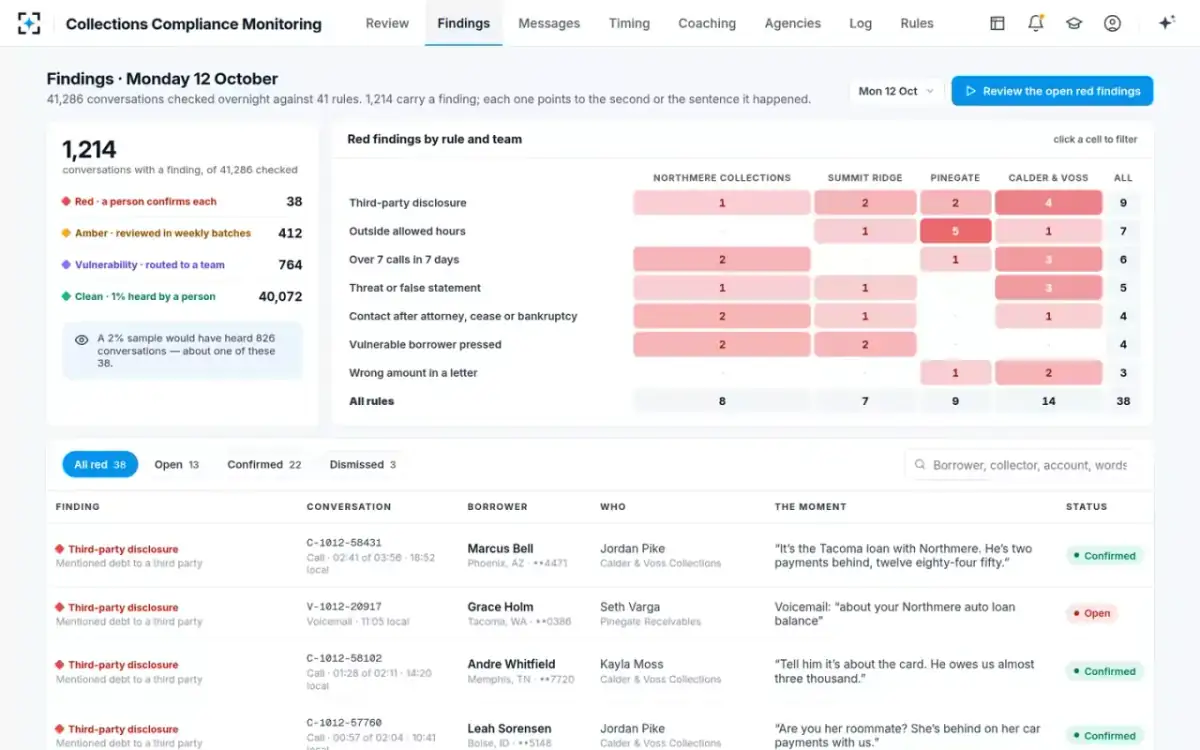
The check that matters for a disclosure is the one that runs on every conversation rather than on a script. A script review proves the words exist; it cannot prove they were said on the call at 21:04 by a collector who was in a hurry, or that they survived into the Spanish version of a letter, or that the payment confirmation generated by a third party carried them. Those are facts about individual contacts, and the only way to know them is to read the contacts.
How one call was checked, agent by agent
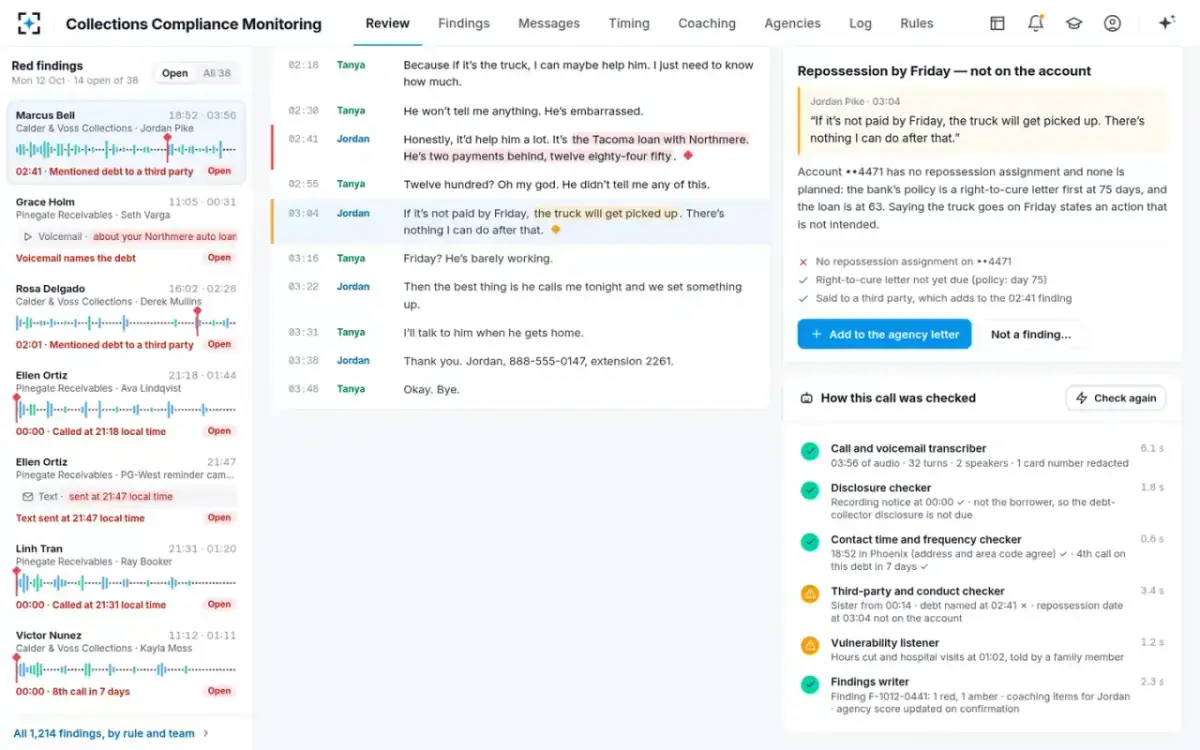
The last line of the panel is the part that turns a check into a programme. A finding is written with the quote attached, a person hears it and confirms it, and only then does it become a coaching item and a line in the review log. Nothing is counted against a collector or an agency on the strength of an automated reading alone. What the night’s findings look like across the whole rulebook, and where each kind turns up, is set out in what goes wrong, by channel; to see the disclosure checks on a day of your own conversations, start from Collections Compliance Monitoring.
Questions people ask
What does the mini-Miranda have to say?
In the initial communication: that the collector is attempting to collect a debt, and that any information obtained will be used for that purpose. Both halves are required; a line carrying only the first is incomplete. In every later communication with the borrower, a shorter disclosure is owed instead — that the communication is from a debt collector.
What is the subsequent communication disclosure?
It is the second half of the same rule: in each communication after the initial one, the collector must disclose that the communication is from a debt collector. It applies per message, in every channel, including letters, texts, emails and payment confirmations produced by a service provider. It is the disclosure examiners most often find missing.
Do first-party collectors have to give the mini-Miranda?
The federal obligation falls on debt collectors as the rulebook defines them, and the definition excludes an officer or employee of a creditor collecting the creditor’s debts in the creditor’s name — though it pulls a creditor back in where it collects under a name suggesting someone else is collecting. That is the federal answer only: several states apply their own collection rules to creditors too, and many banks hold their own team to the disclosure anyway, so that one standard covers in-house collectors and placed agencies alike.
What happens if a collector skips the mini-Miranda?
It is treated as a false, deceptive or misleading practice rather than a missing formality, because a borrower who does not know they are dealing with a debt collector may not know the rights that come with it. In supervision it has produced findings requiring collectors to update call scripts and written correspondence; for a borrower it is a breach that can be raised in a complaint or an action.
Can a collector use a fake name on a call?
An individual collector may use an assumed name, provided they use it consistently and the firm can readily identify which employee is behind it. The firm itself may not: using any business or company name other than its true name is a prohibited practice, and examiners have found collectors doing exactly that in both calls and letters.
Does the disclosure belong in a voicemail?
Not in a limited-content message. That kind of voicemail is defined as containing four required items, four optional ones and no other content, so adding the debt-collector line would take it outside the definition and turn it into an ordinary message that discloses a debt to whoever plays it. A voicemail that is not a limited-content message is a communication like any other and owes what its position in the sequence requires.