An AI copilot for call center agents is an assistant that sits beside the representative during live calls, hears the conversation, and offers answers, sources and next steps that the representative can use or ignore. Whether it pays off depends less on how good its suggestions are than on whether representatives trust them enough to use them on a live call, and the evidence on that is unusually specific. In the first field study of such a tool deployed at scale, representatives followed fewer than half of the suggestions, the newest representatives gained the most, and the people who followed suggestions most closely kept the gains even when the tool went down. Botminds' Real-Time Agent Assist for Insurance is built around those findings: every answer shows its source, the assistant never speaks to the caller, and nothing is saved without the representative. This guide turns the research into a rollout plan for an insurance service floor, week by week, with new hires first.
The reader is the team supervisor, trainer or contact-centre head who has to make the tool stick. Examples come from the solution's fictional sample service floor; its people, insurer and figures are invented.
"It is designed to augment agents, who remain responsible for the conversation and are free to ignore its suggestions."
Brynjolfsson, Li and Raymond, NBER Working Paper 31161, describing the assistant they studied
What an AI copilot for call center agents does, and what the strongest study found
A copilot does three things on a call: it listens, it retrieves, and it suggests. The study that measured those three things at scale followed 5,179 customer support agents at a software firm as a generative AI assistant was rolled out in stages, and compared agents with access to those without it. Access raised the number of issues resolved per hour by 14% on average and by 34% for novice and low-skilled agents, with little change for the most experienced (NBER w31161).
What the NBER field study of an AI assistant for support agents measured
5,179
support agents in the data, at a software firm
14%
more issues resolved per hour, on average
34%
more for novice and low-skilled agents
38%
average share of the assistant’s suggestions agents followed
The study is not about insurance, and its numbers should not be pasted into an insurance business case. Its patterns are more portable: who gains, how use grows, and what makes the gain last. Those patterns are what a rollout plan needs.
Why new hires gain most, and why that decides the rollout order
The study's sharpest finding is about tenure. The authors report that "treated agents with two months of tenure perform just as well as untreated agents with more than six months of tenure". Agents with less than a month on the job gained the most of all, and the study found no effect on resolutions per hour for agents with more than a year. The explanation they offer is that the assistant carries the habits of the best agents to the newest ones.
On an insurance floor that maps onto a familiar bottleneck: the coverage question. The sample insurer's trainer describes new representatives who escalate "anything with the word 'covered' in it" and a long wait before a new hire takes one alone. A copilot that shows the clause, the page and the words to say on every coverage question shortens exactly that wait. So the rollout should start with new hires, where the gain is largest and habits are not yet set, and reach experienced representatives later, where the gain is smaller and the risk of distraction is real.
The study is candid about that risk. For the most skilled agents it found small but statistically significant declines in resolution rate and customer satisfaction, and the authors suggest the suggestions may distract top performers or tempt them to take the faster option. A plan that forces every panel on every expert from day one invites the same result.
Do call center agents trust AI suggestions? They follow a minority, and that is healthy
Representatives trust an assistant selectively, and selective trust is the goal. In the NBER study "The average adherence rate is 38%", with a middle half of agents between 23% and 50%. Adherence rose over time for every group, fastest among the agents who had been most sceptical at first, and the agents who followed suggestions most closely saw the largest gains.
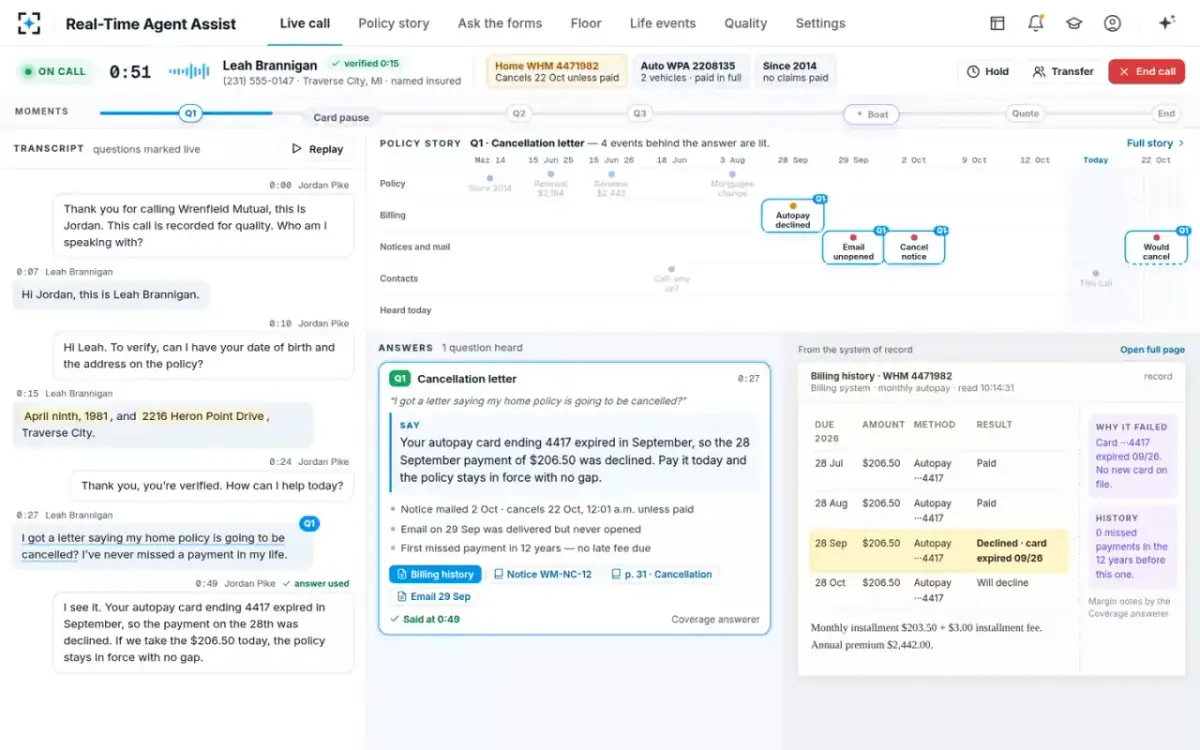
For a supervisor, that changes what to watch. A copilot whose suggestions are used 95% of the time is either trivially right or blindly followed. One used 5% of the time is being ignored. The healthy signal is a rising rate, concentrated on the questions where the assistant is strongest. On the sample floor the screen marks each answer as used, with the time it was said, so a supervisor sees use per question type rather than a single rate.
Real-Time Agent Assist: the answer, its sources and a mark that the rep used it
Showing the source is what earns trust
A representative will repeat an answer to a customer only if they can defend it, and they can defend it only if they can see where it came from. That is why every answer in the solution carries its sources as buttons: on the sample call's cancellation question, the billing history, the notice that was mailed, the cancellation condition on page 31 of the form, and the reminder email. The representative can open any of them before speaking, and the margin note explains why the payment failed: the card on file expired in September.
The study supports the mechanism in a different way. When the assistant went down during outages, agents who had used it longer, and who had followed it more closely, still handled chats faster than before they had it. The authors read that as learning. For a rollout, the implication is that the assistant is also a training tool, and that the trainer should treat the sources it shows as material to teach from, not just answers to read out.
The adoption plan, week by week
Start small, start with new hires, measure before widening. The study's own rollout began with "an initial seven-week randomized pilot featuring 50 agents" before the tool reached everyone. The plan below adapts that shape to an insurance service floor of a few teams.
A twelve-week rollout of Real-Time Agent Assist, new hires first
- Weeks 1–2: on, trainer listening
- Weeks 3–6: unused answers reviewed
- Weeks 7–12: coverage questions alone
- Weeks 1–4: baseline calls
- Weeks 5–8: drafted notes only
- Weeks 9–12: full assistant
- Weeks 1–4: floor view, no scoring
- Weeks 5–12: every call checked, coaching from failures
Three choices in that plan are deliberate. Experienced representatives begin with drafted notes because note-writing is where they lose the most time and where the assistant does not compete with their judgement. Quality scoring waits four weeks so that early mistakes are coached rather than counted. And new hires stop working with a trainer beside them only when they are answering coverage questions with the cited answer, not when a calendar says so.
What supervisors and trainers do differently
A copilot changes the supervisor's job from listening for problems to choosing which ones to join. On the sample floor the supervisor sees 12 live calls, each with talk time, a caller-mood line and what the assistant is showing; three are flagged, one for complaint words, one for a 48-second silence, one for a new hire who has not used a coverage answer that has been on screen for over a minute. The assistant flags; she decides whether to listen, whisper or join.
Who does what when an AI copilot reaches the floor
Today
Sits beside new hires for weeks and answers their coverage questions for them.
With agents
Reviews each answer a new hire left unused and teaches from the clause and the page.
Still theirs: The call on when a new hire works alone
Today
Listens to calls at random and hears about bad ones from complaints.
With agents
Sees flagged calls live and chooses whether to listen, whisper or join.
Still theirs: Whether to step in
Today
Scores a small sample of calls by hand.
With agents
Sees every call against the same checks and sends failures to coaching.
Still theirs: What counts as a failure
Today
Answers from memory; types notes after the call.
With agents
Confirms drafted notes; uses cited answers where the form is unfamiliar.
Still theirs: Every word said and every note saved
The trainer's job is the one that changes most. In the study, managers before the assistant could coach only a small share of conversations in weekly sessions; after it, agents received specific suggestions on every chat. A trainer with a copilot still runs the weekly session, but now with a list of the exact answers each new hire did not use, and the clause each one would have needed.
AI assistant for insurance agents: the licence line belongs in the rollout
An AI assistant for insurance representatives has to know who it is talking to, because some of what it can show is licensed insurance activity. In the solution, coverage answers and life-event offers can be restricted to licensed representatives, and an unlicensed representative is offered a warm transfer instead. That setting should be decided before the rollout, not discovered during it.
Florida shows why. Its customer representative licence lets a salaried agency employee transact insurance only inside the agency's office, and makes the agency answerable for them: the agent or agency "shall be responsible and accountable for all acts of the customer representative within the scope of such appointment." An assistant that offers a boat policy to a caller through a representative who cannot sell one exposes the agency, not the software. The licence types are set out in the Florida 4-40 guide and the general rule in what an unlicensed insurance CSR can do.
What to measure in the first 90 days
Measure use, outcomes and side effects separately, by tenure group. A single satisfaction score or handle-time average will hide the pattern the research predicts: large gains for new hires, small ones for veterans, and a risk of distraction at the top.
Ten measures for the first 90 days of an AI copilot
- Answers used, by question type and tenure.
Expect a rising rate, highest on coverage questions for new hires.
- Coverage answers given with a clause.
The share of coverage questions answered from the customer’s own form, with the page.
- Time to first unaided coverage answer for new hires.
The training bottleneck the copilot should shorten.
- Resolution on first contact.
Repeat calls within 30 days on the same issue, before and after.
- Requests to speak to a supervisor.
The study found these fell after the assistant arrived; watch the trend, not the level.
- Quality of the most experienced representatives.
Watch for the small decline the study found among top performers.
- Notes confirmed, and how much they were edited.
A note confirmed unedited every time may not be being read.
- Life-event offers held back, with the reason.
The guards are working only if some offers are stopped.
- Attrition among new hires.
The study saw lower attrition, especially in the first six months, and urged caution in reading it.
- Complaints per thousand calls.
The outcome an examiner will read.
Call center copilot pricing: what you are really paying for
Ask first whether an offer is priced per seat, per minute of audio or per conversation, because the three behave differently as call volume moves. We know of no public research or regulator source that reports market prices, so compare offers on what they include rather than on a list price. The costs that scale with use are transcription of every minute of every call and the reading of policy, billing and document systems in real time; the costs that do not are integration with your phone system and policy administration, configuration of the rules, and testing on recorded calls.
Two questions separate the offers that look alike. First, whether quality checking of every call and drafted notes are part of the price or separate products, because a copilot that answers during the call and a quality tool that checks after it read the same transcript. Second, whether changes to the rules are something you can make, test and approve yourselves, or a change request each time. The economics of a single call, which is where any price should be judged, are worked through in average handle time at an insurance company.
Questions people ask
What is an AI copilot for call centers?
An assistant that listens to live calls and shows the representative answers, sources and next steps, without speaking to the customer. The representative decides what to say and whether to use each suggestion; in the NBER study of such a tool, agents followed 38% of suggestions on average.
Is a contact center copilot the same as a chatbot?
No. A chatbot talks to the customer; a copilot talks only to the representative. That difference decides who is responsible for what the customer hears, and for insurance, whether the words come from someone licensed to say them.
Who benefits most from an AI copilot?
New and less experienced representatives. In the NBER field study, agents with two months of tenure and the assistant performed as well as agents with more than six months without it, while the most experienced saw little gain.
Do agents lose skills if they rely on an AI copilot?
The study found the opposite for those who used it: during outages, agents who had followed suggestions closely still handled chats faster than before they had the tool, which the authors read as learning. Agents who mostly ignored it showed no such gain.
What are good AI tools for insurance agents on service calls?
Look for answers drawn from the customer's own policy forms with the clause and page, a firm refusal to say a loss is covered, pauses on card numbers, offers restricted to licensed representatives, and notes that wait for the representative to confirm them.
How long does it take for reps to trust an AI copilot?
In the NBER study, use of suggestions rose over the months after rollout for every group, and the most sceptical agents caught up fastest, converging about five months in for the tenure groups the authors tracked. Plan for weeks of coaching, not a launch day.