Contact center AI software is any software that uses machine learning or language models in a customer service operation, and in practice it falls into three categories. Self-service bots and virtual agents talk to customers directly, by voice or chat, and aim to resolve simple requests without a person. Agent assist tools listen to a live conversation and help the human representative with answers, sources and drafted notes. Quality and speech analytics tools review recorded calls and transcripts after the fact, scoring them and finding patterns. Vendors increasingly sell all three under one platform name, which makes them easy to confuse in a buying process. For an insurance service line the categories differ on one point that matters more than any feature: who speaks to the customer, and whether that speaker is allowed to explain coverage. Botminds' Real-Time Agent Assist for Insurance is in the second category; it never speaks to the caller. This guide runs one fictional sample call through all three categories, sets out what each is good for, and gives the questions that sort vendors.
Three facts behind any contact center AI decision in insurance
12%
of US customer service representatives work for insurance carriers and related activities
−5%
projected change in CSR employment, 2025–2035, as self-service takes simple tasks
≈25%
fewer customer requests for a manager after an AI assistant reached support agents
Contact center AI software, sorted into three jobs
Sort contact center AI by whose work it changes. A bot changes the customer's experience by replacing the representative for some requests. Agent assist changes the representative's work during the call. Analytics change the supervisor's and quality analyst's work after the call. The categories overlap in technology, since all three transcribe and interpret language, but not in who is accountable for what the customer hears.
The Bureau of Labor Statistics expects the first category to keep growing at the expense of simple calls. It projects employment of customer service representatives to fall 5% from 2025 to 2035, and gives the reason in one sentence: "Self-service systems, social media, and mobile applications enable customers to do simple tasks". The calls that remain are the ones that are not simple, and on an insurance line those are disproportionately about money owed, coverage and change. That is the territory where the other two categories work.
The same insurance call through each category
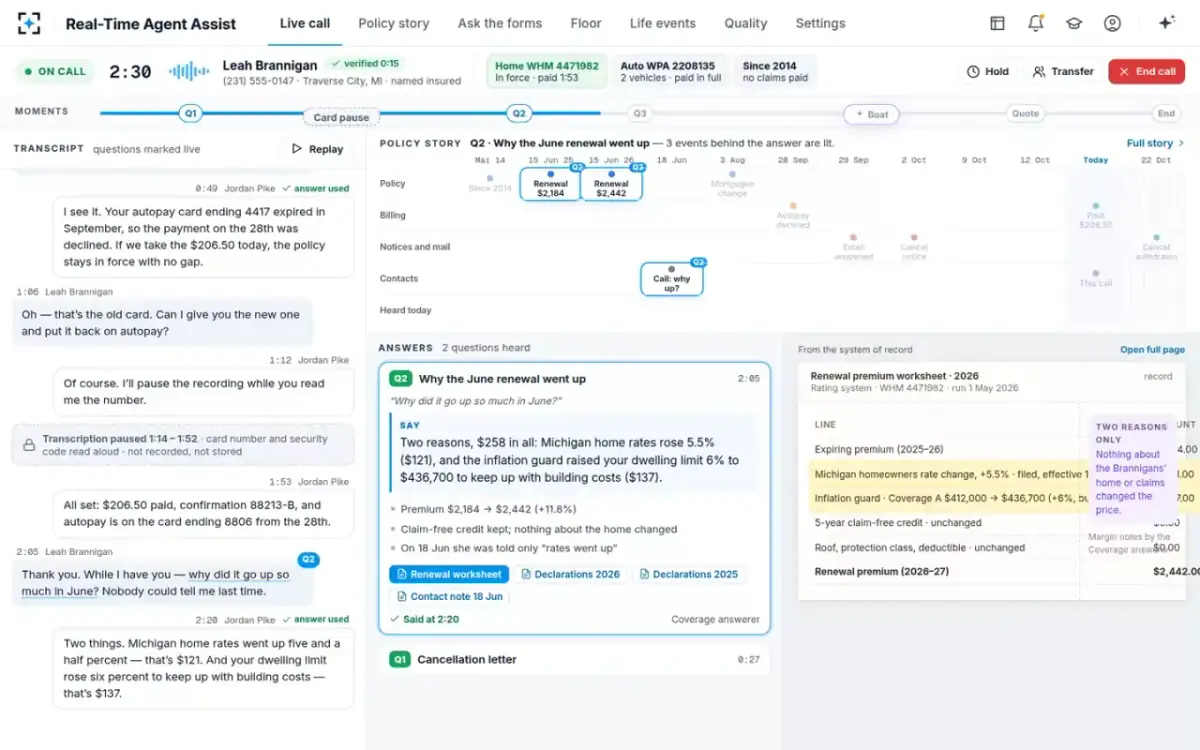
Take the solution's fictional sample call: a policyholder rings about a cancellation letter, pays an overdue installment by card, asks why her renewal went up, reports her son's stolen laptop, and mentions a new boat. The table shows what each category can do at each moment.
One service call, through a bot, Real-Time Agent Assist and after-the-fact analytics
| Moment on the call | Self-service bot | Agent assist (Real-Time Agent Assist) | Quality and speech analytics |
|---|---|---|---|
| “Why is my policy cancelling?” | Can answer from billing if the question matches its script | Shows the four events behind the notice with their sources; the representative explains | Later, checks that identity was verified before account details |
| Card payment | Can take it in a secure payment flow | Pauses the transcript while the card is read; the representative takes it | Later, checks that card details were never recorded |
| “Why did it go up so much?” | Can read out figures; sees the earlier failed call only if built to | Shows the two reasons from the renewal worksheet and the earlier call that failed | Later, may detect repeat-call language |
| “Is my son’s laptop covered?” | Interpreting coverage can be licensed activity, in Florida and California for two; a bot should transfer | Shows the clause, limit and deductible to a licensed representative; never says the loss is covered | Later, checks whether the answer cited a clause |
| “We just bought a boat” | Should not solicit on a service call | Waits until the reason for the call is resolved; licensed representatives only | Later, checks the offer followed the guards |
| After the call | Logs its own transcript | Drafts the note and follow-ups for the representative to confirm | Scores the call; sends failures to coaching |
Who speaks to the customer, and who is licensed to
A bot speaks for the insurer; an assistant speaks only to the representative. That difference decides who is responsible for every word the customer hears, and for insurance it collides with licensing. The NAIC's model producer licensing act, written by state regulators, requires a licence to sell, solicit or negotiate insurance, and defines negotiation as conferring with or advising a purchaser about the substantive benefits, terms or conditions of a contract (NAIC Model #218). A bot that explains what a homeowners policy pays for a stolen laptop is doing what an unlicensed human representative is told not to do. Where the line falls in Florida, Texas and California is set out in what an unlicensed insurance CSR can do.
The second risk is getting stuck. Regulators of consumer finance, not insurance, have described it plainly: the CFPB's review of bank chatbots warned that "Consumers may also find offramps to human customer service support further blocked through unreasonable waits." An insurance bot that cannot recognise a complaint, a coverage dispute or a cancellation about to take effect needs a fast route to a person, and the person needs the context the bot gathered. For insurers that do deploy one, the disclosure and accuracy questions are covered from the claims side in AI chatbot disclosure laws and AI insurance chatbot accuracy.
Contact center AI agent assist: what it adds that a bot cannot
Agent assist keeps a licensed, accountable person in the conversation and makes them faster and better informed. The evidence on that is better than for most contact-centre technology. In the NBER field study of an AI assistant for support agents, access raised issues resolved per hour by 14% on average and by more for newer agents, and it changed how customers behaved: the authors found "AI assistance generates an almost 25% decline in customer requests to speak to a manager." The study was of chat support at a software firm, not insurance, but the mechanism, a representative who sounds like they know the answer, is the same.
On an insurance call, agent assist also does something no bot does: it hears the moment a service call becomes a sales opportunity and holds it until it is appropriate. On the sample floor, in one week, the assistant heard 61 life events, offered 38 and held back 23 with a reason.
Life events on the sample service floor in one week
Agent assist on a question a bot answers badly: “nobody could tell me last time”
Call center AI solutions for quality: every call, after the fact
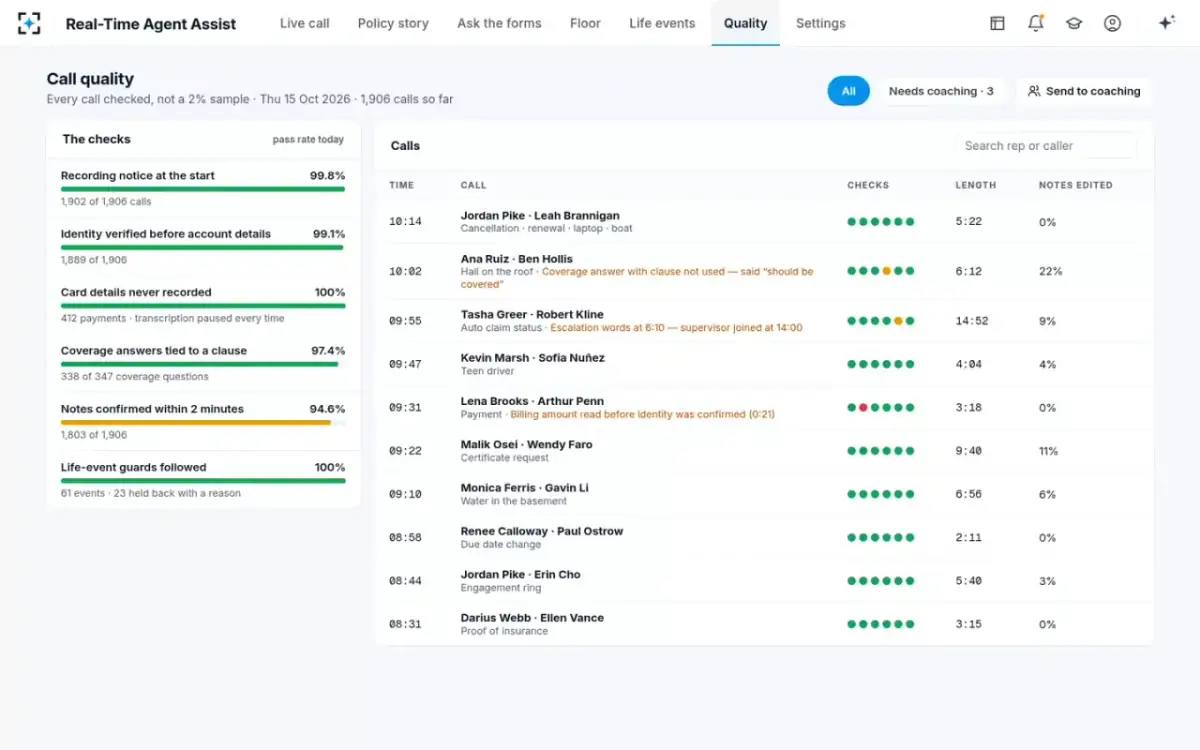
Quality and speech analytics carry the least risk of the three, because they never touch a live customer. They transcribe recorded calls, score them against a checklist, and surface patterns a sampled review would miss. Banks use them under consumer protection rules; the trade-offs of transcript accuracy, verifier agents and cost per reviewed call are covered in depth for that setting in call center QA software: what one reviewed call really costs.
Their limit is time. A quality tool finds the call where a new representative said "should be covered" on a hail claim the next morning; agent assist had the cited answer on that representative's screen at the moment it mattered. The solution does both on one record: answers during the call, and a check of every call afterwards against the same list.
The after-the-fact category, on the same record as the live one
Agentic AI for call center work: what "agentic" should mean on a regulated line
"Agentic" in contact-centre marketing often means software that takes actions, not just answers: it starts a payment, opens a claim, sends an application. On a regulated insurance line the useful definition is narrower: agents that act on the representative's instruction, within limits they cannot exceed, and leave a record of what they did. In the solution the service request starter starts payments, claim reports, applications and callbacks with the facts from the call, but never binds, cancels or changes coverage on its own, and the notes writer never saves without the representative.
The test for any agentic claim is to ask for the list of things the agent may never do, and then to watch it refuse one. The six agents of Real-Time Agent Assist, and the limit each carries, are set out in real time agent assist software.
Who uses each kind of contact center AI on an insurance service floor
Today
Waits on hold while systems are searched, or talks to a bot that cannot explain coverage.
With agents
Talks to a representative who has the answer and its source on screen.
Still theirs: The right to a person, and to be told who decides the claim
Today
Finds, answers and types alone.
With agents
Uses agent assist during the call and confirms the drafted record.
Still theirs: Every word and every save
Today
Learns of bad calls from complaints.
With agents
Sees live flags from agent assist and every-call scores from analytics.
Still theirs: Whether to join a call
Today
Review a sample, after the fact.
With agents
Review every call’s checks and approve changes to the assistant’s rules.
Still theirs: What the rules are
Contact center AI software vendors: questions that sort them
Most vendors will say they do all three. The questions below sort what they actually do, and they apply to any contact center AI platform, including ours. One of them comes straight from the NAIC's model data security law, which state insurance regulators wrote for insurers handling customer data: an insurer must use due diligence when it chooses a vendor that will touch that data (NAIC Model #668). A contact-centre AI vendor that hears every call is that kind of provider, and the oversight owed to it is set out in insurance back office outsourcing companies.
Questions that sort contact center AI software vendors
- Does anything in the product speak to the customer?
If yes, it is a bot, and its words are the insurer’s. Ask how it stops at the licence line.
- Where do coverage answers come from?
The customer’s own declarations, forms and endorsements, or a general knowledge base?
- What does it do when it has no source?
Silence or a referral is the right answer.
- Can it say a loss is covered?
Ask for the test call.
- What does it record and keep, and what does it refuse to?
Card numbers and security codes should never be stored.
- Is quality checking of every call part of the same record?
Or a separate product reading a separate transcript.
- Who saves notes and starts requests?
A representative, or the software on its own?
- How is the vendor itself overseen?
Due diligence, security measures and the right to review, as for any service provider holding nonpublic information.
Where Real-Time Agent Assist fits in a contact center AI platform, and where it does not
Real-Time Agent Assist fits the middle of the stack: the live call between a policyholder and a representative, with policy administration, billing, the document archive, correspondence and contact notes behind it. It includes the every-call quality checks for the calls it assists. It works alongside a self-service bot rather than replacing one, and it is not a dialer, a routing engine or a workforce-management tool.
It is the wrong purchase if the goal is fewer calls reaching people; that is the bot's job. It is the right one if the calls that do reach people are long, repeated or risky because the answer lives in one customer's policy, and the people taking them need that answer, with its source, while the caller is still talking. The cost side of that case is worked through in average handle time at an insurance company.
Questions people ask
What is a contact center AI platform?
A suite that bundles several kinds of AI for customer service, usually self-service bots, agent assist and quality or speech analytics, on shared transcription and data. The parts differ in who they serve: customers, representatives, or supervisors and quality teams.
What is the difference between agent assist and a call center AI agent?
An AI agent in the bot sense talks to the customer and tries to resolve the request itself. Agent assist talks only to the human representative, who stays responsible for the conversation; in insurance that keeps coverage explanations with someone licensed to give them.
Should an insurance chatbot answer coverage questions?
Carefully, if at all. Explaining what a policy pays for a particular situation can be licensed activity, and whether a loss is paid is the adjuster's decision. A bot can give factual policy information and should route coverage interpretation to a licensed person with the context it gathered.
Which call center AI solutions are best for insurance?
The ones that answer from the customer's own policy with the clause, refuse to say a loss is covered, never store card numbers, restrict offers to licensed representatives and keep the representative in charge of the record. Which category leads depends on whether the problem is volume, call quality or oversight.
Does contact center AI replace representatives?
Self-service takes simple tasks; the BLS projects a 5% decline in customer service representative jobs from 2025 to 2035 for that reason. Agent assist does not replace representatives; in the NBER study it raised their productivity, most for newer agents.
Can one product do agent assist and quality monitoring?
Yes, and there is a case for it: both read the same transcript, and checks after the call can test whether the representative used the answer shown during it. In the solution the live answers and the every-call checks sit on the same record.