Insurance back office outsourcing companies take over the keying work of policy servicing, the endorsements, certificates, cancellations and reinstatements, billing fixes, refunds and mortgagee changes that arrive by email, portal and phone every day. They can add capacity quickly and cost less per transaction, but the regulator does not see the outsourcer: state examiners test the insurer, and the standard they apply says the insurer must be "adequately monitoring the activities" of any firm doing that work on its behalf. The hard part is that most insurers see an outsourcer's work only through the outsourcer's own monthly report. Botminds' Policy Servicing Analytics reads every queue and every finished transaction, in-house and outsourced, and measures each one against the request that started it, so the insurer sees who touched a policy and whether they got it right.
The examples on this page come from a fictional sample insurer, Ashcombe Mutual, which runs its servicing across two in-house teams (Columbus and Dayton) and two outsourcers (Harrowfield Solutions in Pune and Selwyn Process Services in Manila). Every person and policy named is fictional. Regulatory figures come from state insurance departments and the NAIC, linked where they appear.
When servicing slips, the complaint names the insurer, not the outsourcer
1,624
Texas complaints closed in 2025 citing delays in policyholder service
1,164
of them named a licensed insurer as a respondent
13
named a third-party administrator
What insurance back office outsourcing companies do on a policy file
An insurance back office outsourcer works inside the insurer's servicing process: it reads the request, keys the change into the policy or billing system, issues the document and closes the item. The work is the same work an in-house processor does, done by another company's people, usually on another continent and often overnight.
The scope varies by contract, but the request types are consistent across personal and small commercial lines. At the sample insurer the two outsourcers cover endorsements and billing (Harrowfield) and certificates, cancellations and reinstatements and mortgagee changes (Selwyn), while the in-house teams keep the work that is harder to write down, such as anything already touching a claim. Each request type carries a promise: two business days for an endorsement, one for a certificate or a cancellation, three for billing and refunds, two for a mortgagee change.
What the outsourcer does not take on is accountability. The policy, the filed forms, the rates and the customer relationship stay with the insurer, and so does every consequence of a wrong key. A vehicle added with the wrong effective date is the insurer's coverage problem the day the customer has an accident.
What is BPO in insurance, and how is it different from an MGA or a TPA?
BPO in insurance, business process outsourcing, means a vendor runs a defined back office process for the insurer under the insurer's rules and authority, without underwriting or settling anything on its own account. That is what separates it from a managing general agent or a third-party administrator, which the NAIC's model acts (the Managing General Agents Act and the Third Party Administrator Statute, both cited in the examiners' procedures) bring under licensing of their own.
The examination standards do not draw that line sharply, which is the point. The NAIC's operations standard for contracts covers "entities assuming a business function or acting on behalf of the regulated entity, such as, but not limited to, managing general agents (MGAs), general agents (GAs), third-party administrators (TPAs) and management agreements" (NAIC 2024 Market Regulation Handbook examination standards, Operations/Management Standard 5). A servicing outsourcer keying endorsements assumes a business function. Whatever its licence status, its contract is in scope when the examiners arrive.
Who answers to the examiner when an outsourcer keys the change?
The insurer does. Operations/Management Standard 6 of the same summary states the expectation in one sentence: "The regulated entity is adequately monitoring the activities of any entity that contractually assumes a business function or is acting on behalf of the regulated entity." The examiner tests the insurer's monitoring, not the outsourcer's intentions.
The handbook's review procedures say how. The examiner reads the contract, and "The contract should specify the responsibilities of the subcontractor regarding recordkeeping and responsibilities of the regulated entity for conducting audits." The examiner then turns to the insurer's own checking: "Review audit reports to determine whether the regulated entity is adequately monitoring the activities of the contracted entity" (NAIC Market Regulation Handbook, 2017 edition, Chapter 16, Operations/Management Standards 5 and 6). An insurer whose only evidence of oversight is the vendor's monthly self-assessment has little to show.
The old Florida examination of Gateway Insurance Company shows what happens when the outsourced piece breaks. Examiners reviewed 7,903 unearned premium refunds and found 4,857 not returned within the 30 days Florida law allows. The company blamed its managing general agent's computer system, which had been failing for five months in 1999, and the citations went to Gateway (Florida Department of Insurance, target examination of Gateway Insurance Company, filed 14 September 2001; the refund clocks it tested are set out in how long an insurer has to refund premiums). The report is a quarter-century old; the allocation of blame has not changed.
Every seat that touches one outsourced transaction
An outsourced transaction passes through more hands than the org chart suggests, and most of them sit on the insurer's side of the contract. Take one sample request: on Monday 28 September a customer emails to add a newly financed car to her auto policy, effective that day. The vendor keys it effective 1 October with no lienholder. She is rear-ended the next evening, the claim is held because the car is not on the policy, and an in-house processor in Columbus re-keys the endorsement on Thursday. The hold lasts 27 hours. The sample walks through the trail in detail in the rework rate formula and whose error it was; here the question is who was involved and what each could see.
Six seats on one outsourced endorsement, and what each sees with Policy Servicing Analytics
Today
Keys the add-vehicle endorsement from the customer’s email at 02:12, a day after starting on the line. Nobody on the insurer’s side sees the transaction until something goes wrong.
With agents
Keys it the same way. The transaction is compared with the email within the hour, and a wrong effective date comes back with the sentence it contradicts.
Still theirs: Keying, inside the vendor’s own process
Today
Samples the month’s work (220 endorsements, 2 errors found) and reports the team’s accuracy as 99.2%, the number the contract would otherwise be judged on.
With agents
Sees the insurer’s measured figure for every transaction, can dispute any charged rework within 5 business days, and gets a supervision request with the evidence attached.
Still theirs: Staffing, training and the right to dispute
Today
Her queue carries the vendor’s mistakes: re-keyed endorsements, customer calls, reprints and lienholder notices, all counted as her team’s backlog.
With agents
Sees her own work separated from the work vendors caused, and which corrections must be fixed by her team today because they touch a claim or a lienholder.
Still theirs: Same-day fixes where a claim is at stake
Today
Checks sixty files a day out of two thousand, picked by hand.
With agents
Starts from every finished transaction already compared with its request, and rules on the reworks a vendor disputes.
Still theirs: Every disputed call
Today
Reviews the vendor’s own report once a month and cannot price a service credit on a figure the vendor wrote.
With agents
Gets the contract’s credit worked out on the insurer’s measure, and a drafted accuracy notice that waits for sign-off.
Still theirs: The commercial conversation
Today
Learns about the outsourced desk from a weekly spreadsheet, a customer complaint, or an examiner.
With agents
Sees every queue, in-house and outsourced, with promises at risk three business days ahead, and signs the weekly report.
Still theirs: Every decision and every signature
Two things stand out. Only one of the six seats does the keying, and that seat is the vendor's. And the people who carry the cost of a wrong key, the in-house team that redoes it and the customer who calls about it, are the furthest from the vendor's quality report. In the sample, Harrowfield's 181 wrong transactions over ten working days caused 433 more items of in-house work: 196 customer calls, 118 reprints, 71 billing fixes and 48 lienholder notices.
What the complaint file says about where the blame lands
Customers complain to the company whose name is on the policy. A customer has no way of knowing that an endorsement sat in a vendor's queue in another time zone, so the Texas delay complaints counted at the top of this page name insurers almost ninety times as often as administrators, and an outsourcer that holds no Texas licence cannot appear at all: the department handles complaints against the people and organizations it licenses.
The same data shows how large servicing is in a regulator's complaint file. Delays in policyholder service are one of six servicing reasons, alongside refunds of premium, cancellation, nonrenewal, premium and rating, and general policyholder service, which together appear on 5,089 of the 22,564 Texas complaints closed in 2025, again by our count. Most of those complaints are about work that, at many insurers, is now keyed by an outsourcer.
One outsourcer on one strip: open work, promises at risk and accuracy measured by the insurer
Why the outsourcer's own monthly report is not oversight
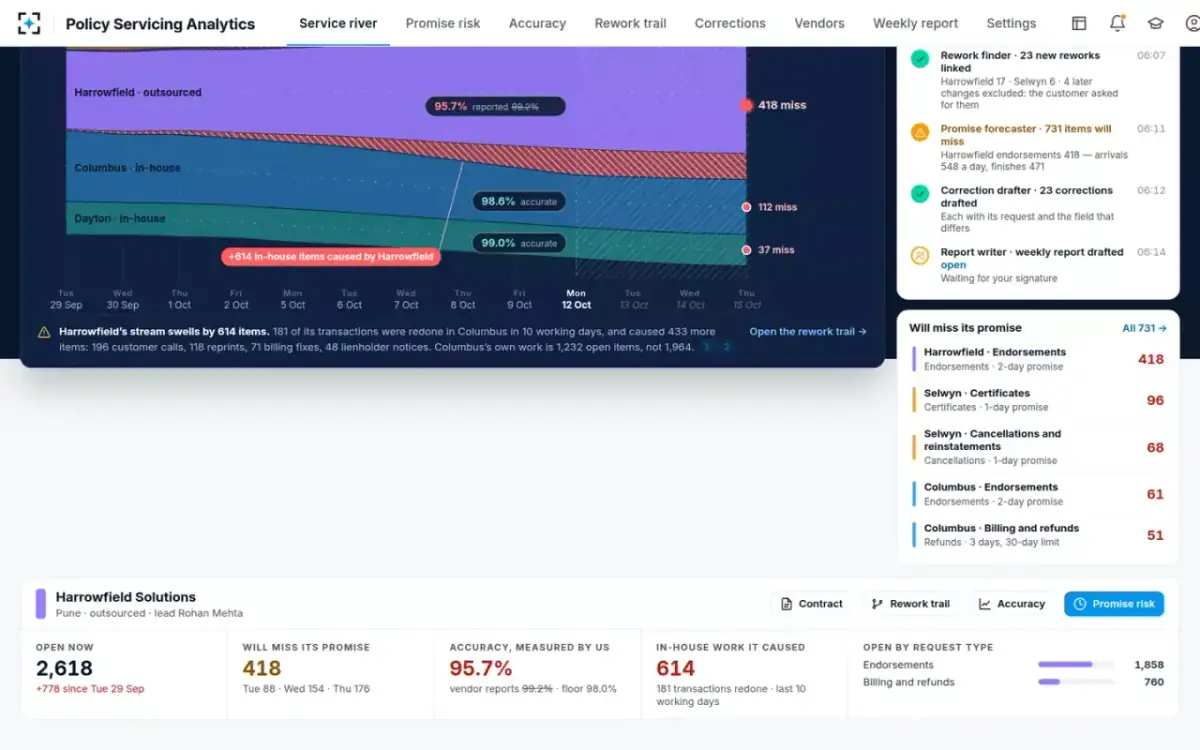
A vendor's report is the vendor's view of the vendor's work, and the gap between that view and the insurer's can be wide. At the sample insurer, Harrowfield reports 99.2% accuracy; measured by the insurer on all 4,212 transactions it finished between 29 September and 12 October, counting any transaction the insurer had to redo within ten business days as wrong, it is 95.7%. Selwyn reports 98.8% and measures 97.2%. Both sit below the 98.0% floor in their contracts on the insurer's measure, and above it on their own.
The vendor's monthly report against what oversight of an outsourced desk needs
The vendor's monthly report: A rate from the vendor's own sample, drawn and scored by the vendor.
What the insurer needs to see: Every finished transaction compared with the request that started it, field by field, and the transactions the insurer had to redo.
The vendor's monthly report: Often measured from when the vendor picked the item up.
What the insurer needs to see: Measured from first receipt in any of the insurer's systems, so time waiting to be assigned counts.
The vendor's monthly report: The vendor's queue at month end.
What the insurer needs to see: Every open item, every 15 minutes, with the items that will miss their promise in the next three business days.
The vendor's monthly report: A count, sometimes with categories.
What the insurer needs to see: Each wrong transaction with the request sentence it contradicts, its impact and who fixes it under the contract.
The vendor's monthly report: Not reported.
What the insurer needs to see: The in-house work each error caused: re-keying, calls, reprints, billing fixes, lienholder notices.
The vendor's monthly report: The team as a whole.
What the insurer needs to see: Down to tenure: at the sample vendor, 14 processors in their first two weeks keyed 109 of 147 endorsement errors.
The new-starter line matters most for oversight. Harrowfield's endorsement accuracy measured 94.1% overall, but its 32 tenured processors were at 98.0% and its 14 processors who started on 28 September were at 82.2%. A monthly team average hides a staffing decision the insurer would want to know about in the first week, not the fifth. A vendor's sample and a check of every transaction answer different questions; 100% inspection vs sampling works through how far apart they can sit and why.
One outsourced transaction, from first receipt to a decided correction
Agent
Queue readerPicks up the request from the insurer's mailbox, portal or call notes and the vendor's work log, gives it a request type and starts its promise clock at first receipt.
Never: moves or closes a work item
A person decides
Vendor processorKeys the change in the vendor's process, as today.
Agent
Source checkerCompares the finished transaction with the request, field by field: effective date, vehicle, driver, limits, additional interests, holder wording, amounts.
Never: edits a policy
Agent
Rework finder and Correction drafterLink any later change to the same policy and field back to this transaction, count what it caused in-house unless the customer asked for the change, and put each wrong transaction on the send-back list with the request sentence it contradicts.
Never: contacts a customer or vendor
A person decides
Quality analyst and vendor managerThe vendor may dispute within 5 business days; the quality analyst decides, and the vendor manager uses the result in the contract review.
What to ask insurance BPO providers before you sign
The questions that matter in an outsourcing evaluation are the ones that decide whether the insurer can monitor the vendor's work transaction by transaction. Price per transaction and headcount are easy to compare; the terms below are the ones an examiner, and a vendor manager pricing a service credit, will lean on later.
Questions for insurance back office outsourcing companies, and why each matters
- Will every transaction carry your item number beside ours?
Without a shared identifier the insurer cannot link a wrong transaction to its request, or a rework to its cause.
- Who measures accuracy, on what, and over what window?
Write down that the insurer measures, on completed work, and that a transaction the insurer must redo within a stated window is not accurate.
- When does the turnaround clock start?
At first receipt in the insurer's systems, not when the vendor picks the item up, or the contract measures a shorter time than the customer experiences.
- What files and logs do you keep, and what audit rights do we have?
The examiners' procedures expect the contract to set out the vendor's recordkeeping and the insurer's responsibility for audits.
- How are corrections sent back, and how fast must you fix them?
A correction clock (one business day from send-back at the sample insurer) keeps errors from becoming the in-house team's backlog.
- How do you dispute a rework we charge to you?
A fixed dispute window and a named decision-maker on the insurer's side keep the measure credible to both parties.
- How do you protect our policyholders' data?
Under the NAIC data security model as states enact it, the insurer must select its service providers with due diligence and require security measures from them.
- What happens to quality when you add new people?
Ask for accuracy by tenure, not only by team: new starters are where floors are missed.
The data question deserves its own line in the contract. The NAIC's Insurance Data Security Model Law requires that a licensee "exercise due diligence in selecting its Third-Party Service Provider" and "require a Third-Party Service Provider to implement appropriate administrative, technical, and physical measures to protect and secure the Information Systems and Nonpublic Information that are accessible to, or held by, the Third-Party Service Provider" (NAIC Model Law #668, Section 4F). It is a model, enacted state by state in each state's own words, so the obligation that applies is the one in the state statute.
Where Policy Servicing Analytics sits between you and your outsourcers
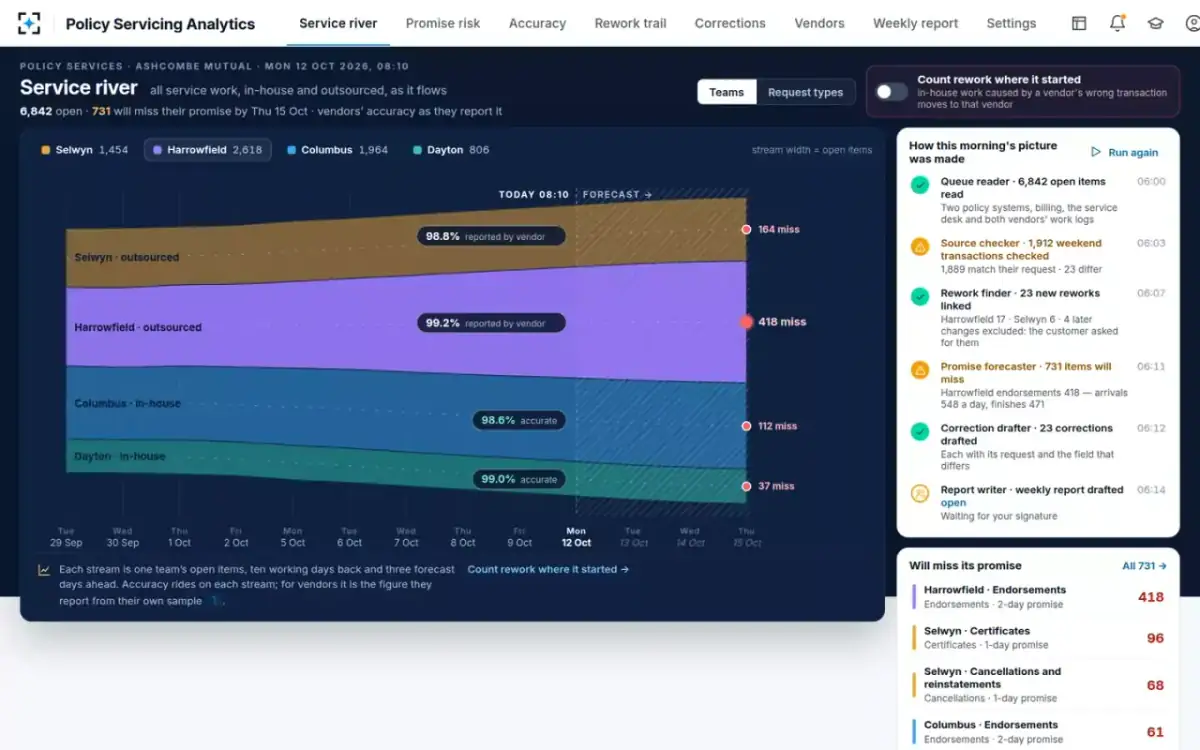
Policy Servicing Analytics does not replace an outsourcer, choose one or key anything. It reads: two policy systems during a core migration, billing, the service desk and mailbox, each vendor's work log with its own item number kept beside the insurer's, the staffing rosters and the outsourcing contracts. From those it builds one view of all servicing work and measures every finished transaction.
The service river: every team's open work, with each outsourcer's accuracy as it reports it
The fit is best where servicing is split: two or more outsourcers, or an outsourcer and an in-house team sharing request types, or two policy systems during a migration. It is weakest where the vendor's work cannot be read at all, for example if the contract gives the insurer no access to the vendor's work log and the vendor keys into its own system. In that case the first change is contractual, and the checklist above is where to start. Once the measure is the insurer's own, the SLA penalty calculation follows from the contract's arithmetic.
Every action that changes anything stays with a person. The agents never move work, edit a policy or contact a customer or vendor; the quality analyst decides disputes, the workforce planner approves any rebalance, and the head of policy services signs the weekly report and every notice to a vendor. To see the whole picture on sample data, start from Policy Servicing Analytics.
Questions people ask
What do insurance back office outsourcing services usually include?
Most cover the high-volume keying of policy servicing: endorsements, certificates of insurance, cancellations and reinstatements, billing and refunds, and mortgagee or lienholder changes, often with document issue and inbox triage. The insurer keeps underwriting decisions, coverage interpretation and claims. Contracts usually set a turnaround promise per request type and an accuracy floor.
How do you compare insurance BPO providers?
Compare them on your own work, measured by you, over the same weeks. On the sample data, the two outsourcers reported 99.2% and 98.8% accuracy and measured 95.7% and 97.2% on every transaction, so their own figures would have ranked them in the wrong order of distance from the truth. Add the in-house work each one caused, which a price per transaction leaves out.
Does an outsourcer that handles policy data fall under insurance data security rules?
Usually, where a state has enacted the NAIC model. The model defines a third-party service provider as a person that "contracts with a Licensee to maintain, process, store or otherwise is permitted access to Nonpublic Information through its provision of services to the Licensee," which describes a servicing outsourcer. Check the enacted state statute for the exact duties.
What is policy administration outsourcing?
It is a wider arrangement in which a vendor runs the policy administration system itself, or the whole policy lifecycle, rather than keying servicing requests into the insurer's system. The oversight question is the same, only larger: the insurer still answers for every transaction, so it needs the same per-transaction view of what was asked and what was done.
Can an outsourcer's accuracy be measured without slowing it down?
Yes, if the measure reads finished work rather than interrupting it. In the sample, the overnight vendor's weekend output of 1,912 transactions was compared with its requests by 06:03 on Monday, with 23 differences found and drafted for send-back. The vendor's keying process did not change.
What should an outsourcer's monthly report include?
The vendor's view is still useful if it sits beside the insurer's: volumes and turnaround from first receipt, accuracy as the vendor sampled it, corrections received and fixed on time, and accuracy by tenure. At the sample insurer the contract adds one line the vendor does not write: rework the insurer did, linked to each source transaction.