Turnaround time in insurance means the elapsed time between receiving a request, such as an endorsement, a certificate, a cancellation or a refund, and completing it. The meaning is simple; the measurement is not, because the same request can show three different turnaround times depending on four choices: when the clock starts (first receipt, or when someone picked it up), what stops it (keyed, issued, or right), whether it counts business days or calendar days, and whose waiting time is excluded. State laws make some of these choices for refunds and notices, and they do not all make them the same way. Botminds' Policy Servicing Analytics gives every item a request type and a promise clock that starts at first receipt in any of the insurer's systems, and forecasts which items will miss their promise up to three business days ahead.
The examples use a fictional sample insurer, Ashcombe Mutual, and one fictional customer's request. State rules are quoted from the Florida, Texas and New York statutes, linked where they appear.
One endorsement request, three turnaround times: keyed, right, and what the customer lived
- Received to keyed17 h
- Received to keyed17 h
- On the policy, wrong55 h
- Waiting17 h
- Covered wrongly30 h
- Claim held27 h
Turnaround time in insurance: the meaning, and the four choices behind it
Turnaround time is the time a customer, agent or lender waits between asking for something and getting it done. In servicing operations it is usually expressed against a promise per request type, such as two business days for an endorsement, and reported as the share of items finished within it. Every one of those numbers depends on four definitions, and two teams that define them differently can report very different turnaround for identical work.
The sample request in the figure above shows how far apart the answers can be. Measured to the moment it was keyed, the endorsement took 17 hours and met its two-business-day promise. Measured to the moment the policy was right, it took 72 hours and missed. Measured as the customer lived it, she waited 17 hours, was covered on the wrong terms for 30 and had a claim held for 27. Only the second and third describe what the service promised.
When does the turnaround clock start?
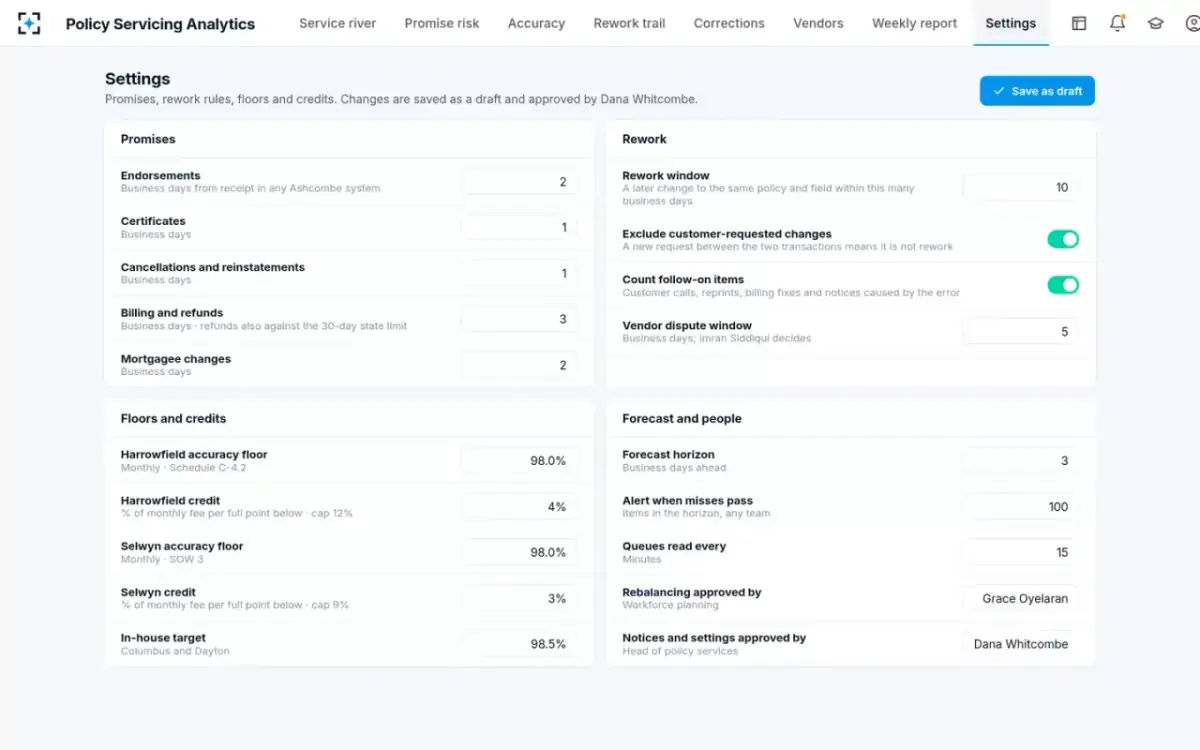
At first receipt, in any of the insurer's systems. A clock that starts when a processor or an outsourcer picks the item up hides the time it spent waiting to be assigned, and that is often the longest wait in the process. At the sample insurer the rule is written into the setting itself: endorsements are measured in "business days from receipt in any Ashcombe system", and the queue reading agent starts the clock at first receipt, never at vendor pickup.
The law sometimes picks the start for you, and it is not always the obvious date. Florida's auto refund rule gives the insurer 30 days when the insured cancels, counted from the cancellation's effective date or the day the request arrives, whichever is later, and 15 days from the effective date when the insurer cancels (Florida Statutes §627.7283(1)–(2), 2026; the refund rules of each state are compared in how long an insurer has to refund premiums). A refund clock built on the cancellation date alone would be wrong for every insured who asks to cancel back-dated.
Business days or calendar days?
Both appear in state law, and the choice changes deadlines by days. Texas sets the personal auto and residential property refund deadline at the 15th business day after the cancellation or termination takes effect (Texas Insurance Code §558.002(d)). Florida's auto refund rule, above, counts days. Internal promises at the sample insurer all count business days, and refunds are also tracked against the 30-day state limit.
Turnaround clocks written into state law: where each starts, what it counts and what stops it
| Rule | Clock starts | Counts | Clock stops |
|---|---|---|---|
| Florida, auto refund, insured cancels (§627.7283(1)) | The cancellation's effective date or receipt of the request, whichever is later | 30 days | Refund mailed or electronically transferred; late refunds carry 8 percent interest |
| Florida, auto refund, insurer cancels (§627.7283(2)) | Effective date of the cancellation | 15 days | Refund mailed or electronically transferred |
| Texas, personal auto and residential property refund (§558.002(d)) | Effective date of cancellation or termination | 15 business days | Refund to the policyholder |
| Texas, notices after a premium finance cancellation (§651.161(f)) | Insurer receives the finance company's notice | 2 business days | Notice given to each mortgagee or other third party |
| Texas, unearned premium to the finance company (§651.162(b)) | Cancellation date | Before the 61st day | Premium returned to the finance company |
| New York, premium finance cancellation notice (Banking Law §576) | Notice mailed | Ten days, plus "at least three days for mailing" | Cancellation may take effect |
The table makes a practical point: one servicing operation can be bound by several clocks at once, with different starts and units. A refund at a Florida auto insurer that is also financed is subject to the insurer's own promise, the statute's day count from the later of two dates, and the finance arrangement's rules. A turnaround measure that tracks only the internal promise can be on time and still late under the law.
When does the clock stop: keyed, issued, or right?
It should stop when the request is done correctly, and a correction should restart nothing but count against the first attempt. If the clock stops at keying, a fast wrong transaction scores better than a slower right one, and the time spent fixing it disappears from the measure, or worse, appears as new work in another team's turnaround. That is what happened in the sample: the outsourcer's turnaround on the endorsement looked good, and the in-house team that corrected it two days later absorbed the time.
Accuracy and turnaround are therefore one measure seen twice. At the sample insurer, the outsourcer's endorsement line was 81.4% on time against its two-business-day promise on the contract's measure, and its endorsement accuracy was 94.1%; the rework that connects the two is followed in the rework rate formula.
Who owns the pauses?
Some waiting is genuinely outside the insurer's control: a vehicle replacement waiting for the lienholder's letter, a certificate waiting for the holder's wording, a reinstatement waiting for a no-loss statement. A turnaround measure may pause for those, but only for a defined reason, noted on the item, and never for the insurer's own queue. The sample insurer's forecast shows the reason on each item that will miss: "needs lienholder letter", "holder wording to check", "queue position 1,212".
The distinction between the two kinds of reason is the whole point. "Queue position 1,212" is the insurer's capacity, not the customer's delay, and pausing the clock for it would hide a staffing problem. The forecast that tells the two apart, item by item, is described in the workload forecasting guide.
Promise clocks held as settings in Policy Servicing Analytics: business days from first receipt
What is lead time in insurance, and how is it different from turnaround?
Lead time usually means the notice given before something takes effect, such as the days between a billing notice and its due date or between a nonrenewal notice and the policy's expiry; turnaround is the time taken to complete a request. The two are often confused with cycle time and handle time, which measure different parts of the same journey.
Four time measures in policy servicing, and what each one hides
What it measures: First receipt to completion, against a promise.
What it hides if used alone: Errors, if it stops at keying rather than at a correct result.
What it measures: Pickup to completion, the time the work was being worked.
What it hides if used alone: The wait before anyone picked the item up.
What it measures: Minutes of a person's effort on the item.
What it hides if used alone: Everything except effort: queues, handoffs, pauses.
What it measures: Days of notice before something takes effect.
What it hides if used alone: Whether the notice actually arrived, and when it was mailed.
Policy service turnaround times: what examiners test, and what promises look like
Examiners test turnaround file by file, against the time the request was received. The handbook's procedures for the timeliness standard tell them to time it directly.
“Perform a time study on policy issuance to determine that policies and endorsements are issued in a timely manner.”
NAIC Market Regulation Handbook, 2017 edition, Policyholder Service Standard 2, review procedures
The same procedure adds: "Determine if insured-requested cancellations are handled in a timely manner without excessive paperwork requirements for the insured." A time study works only if each item carries the date it was first received, which is the strongest argument for starting every clock there.
Promises differ by request type because the work and the stakes differ. The sample insurer's settings are two business days for endorsements and mortgagee changes, one for certificates, one for cancellations and reinstatements, and three for billing and refunds. A certificate is often wanted by a landlord or a client before work can begin; a cancellation date has legal effect. Those settings are the insurer's own choices, not industry standards, and they are the ones its contracts and reports measure against.
Average, percentile or share within promise: how to report turnaround
Report the share of items finished correctly within their promise, the age of the oldest open item, and the items forecast to miss; avoid the average on its own. An average turnaround of a day and a half for endorsements is consistent with every endorsement finishing on time, and equally with most finishing in hours while a few hundred wait a week. The customer who waits a week is the one who complains.
The sample insurer's numbers show why the forecast belongs in the report. On Monday morning its largest outsourcer had 1,858 open endorsements, arrivals had risen to 548 a day after 1 October renewals against 471 finished, and 418 endorsements were forecast to pass their two-business-day promise by Thursday: 88 on Tuesday, 154 on Wednesday and 176 on Thursday. Last week's share within promise could not have shown that; it was a statement about work already done.
For outsourced work, the contract should measure turnaround the same way the insurer does. The sample contract states the endorsement promise as two business days, and the solution measures it from first receipt in the insurer's systems; a vendor reporting from its own pickup time would be measuring a shorter interval than the customer experienced, and the two figures could not be reconciled in a vendor review.
What a missed turnaround looks like in the complaint file
Delays are among the commonest servicing complaints a regulator sees. By our count of the Texas Department of Insurance's published data, 1,624 complaints closed in 2025 cited delays in policyholder service, 504 of them about automobile coverage and 398 about homeowners; in 612, the department confirmed that a respondent was in error (Texas Department of Insurance complaint data). A complaint about a delay is a turnaround measure taken by the customer, starting from the moment they asked.
The internal measure should start at the same moment. Policy Servicing Analytics reads every queue every 15 minutes, gives each item its clock at first receipt and forecasts which promises will be missed three business days ahead; on the sample Monday, 731 of 6,842 open items. To see the clocks on sample data, start from Policy Servicing Analytics.
Questions people ask
What is TAT in insurance?
TAT is short for turnaround time: the time from receiving a request to completing it. In servicing it is reported per request type against a promise, for example endorsements within two business days, and it is only comparable between teams that define the start, the stop and the day count the same way.
What is a good turnaround time for an endorsement?
There is no regulatory standard for an ordinary endorsement; examiners test whether it was issued "in a timely manner." The sample insurer promises two business days from first receipt, and the measure that matters is the share finished correctly within the promise, not the average.
What does insurance response time mean?
It usually means the time to a first reply to a customer, agent or lender, which is shorter than the time to complete the request. Both matter to examiners: correspondence must be answered by the right department in a timely way, and the request itself must be processed. A fast acknowledgement does not stop the turnaround clock.
Should turnaround be measured in business days or calendar days?
Use business days for internal promises if that is how staffing works, but measure each legal deadline in the unit the statute uses. Texas counts business days for personal lines refunds; Florida's auto refund rule counts days from the later of two dates. Track both where they apply.
Does insurance processing time include waiting for the customer?
It can exclude genuine waits for the customer or a third party, if the reason is noted on the item and the pause ends when the information arrives. It should never exclude time the item spent in the insurer's or its vendor's own queue.