The policy servicing KPIs and metrics worth tracking are the ones that mirror what state examiners test: whether policies, endorsements and insured-requested cancellations are processed on time, whether transactions are accurate and complete, whether unearned premium is calculated correctly and refunded within the legal limit, whether billing notices go out with enough notice, and whether correspondence is answered. Each needs a precise definition, a clock or a rule for what counts as an error, so that a scorecard and an examiner measure the same thing. Most servicing scorecards instead count activity, items closed and calls handled, which say little about whether the work was right. Botminds' Policy Servicing Analytics measures promise-keeping, accuracy and rework on every transaction, in-house and outsourced, against definitions the insurer sets.
The sample figures on this page come from a fictional insurer, Ashcombe Mutual, over two weeks from 29 September to 12 October. The standards are quoted from the NAIC's examination standards summary and its examiners' handbook, linked where quoted.
Policy servicing KPIs, how each is defined, and the examination standard it answers to
| KPI | Defined as | Examination standard (NAIC) | Sample value |
|---|---|---|---|
| Promise kept | Items finished within their promise clock, from first receipt in any of the insurer's systems, in business days | Policyholder Service 2: "Policy issuance and insured-requested cancellations are timely." | Outsourced endorsements: 81.4% on time against 2 business days |
| Forecast misses | Open items forecast to pass their promise in the next 3 business days | Leading indicator for Policyholder Service 2 and 3 | 731 of 6,842 open items |
| Measured accuracy | Finished transactions that match their request and were not redone within 10 business days | Policyholder Service 5: "Policy transactions are processed accurately and completely." | Teams from 95.7% to 99.0% |
| Endorsement accuracy | Accuracy as above, for endorsements only | Underwriting and Rating 6: endorsements "issued or renewed accurately, timely and completely" | From 94.1% to 98.9% by team |
| Rework caused | Later corrections linked to their source transaction, plus the calls, reprints and notices they caused | Policyholder Service 5 | 810 in-house items caused by vendors |
| Refund on time | Unearned premium refunds paid within the state limit, from the date the statute names | Policyholder Service 7: refunds calculated correctly and returned to the right party on time | Clock: 3 business days, and the 30-day state limit |
| Billing notice lead time | Days between the notice being mailed and the date it takes effect | Policyholder Service 1: billing notices sent far enough ahead | Checked against each state's minimum |
| Correspondence answered | Customer and agent letters and emails answered by the right department within the promise | Policyholder Service 3: correspondence "answered in a timely and responsive manner by the appropriate department" | Part of each request type's clock |
What do examiners test in policy servicing?
Examiners test seven policyholder service standards, and for property and casualty servicing five of them carry most of the weight. The NAIC's 2024 summary lists them in plain terms: billing notices sent far enough ahead of their dates; timely "Policy issuance and insured-requested cancellations"; correspondence "answered in a timely and responsive manner by the appropriate department"; policy transactions "processed accurately and completely"; and unearned premiums calculated correctly and returned to the right party on time, as each state's law requires (NAIC 2024 Market Regulation Handbook examination standards summary, Chapter 20, Policyholder Service Standards). The billing and refund standards are read in full in P&C insurance billing software and how long an insurer has to refund premiums.
The underwriting and rating standards add the endorsement test: "Policies, contracts, riders, amendments and endorsements are issued or renewed accurately, timely and completely." Read together, the standards ask three questions about every servicing transaction: was it done on time, was it done right, and was any money due returned correctly and on time. A servicing scorecard that answers those three questions with defined measures is also an exam preparation file.
The examiners' procedures show how the standards become tests. For correspondence, the handbook tells them to "Ensure the original question or problem was properly addressed in a timely manner" and to "Review correspondence contained in the policy files from the regulated entity to determine appropriateness and timeliness of handling" (NAIC Market Regulation Handbook, 2017 edition, Chapter 16, Policyholder Service Standard 3). Both are file-by-file tests. A KPI computed the same way, item by item, can be reconciled with what an examiner will find.
Timeliness KPIs: promise kept, forecast misses and age
The core timeliness KPI is the share of items finished within their promise, and its definition needs three decisions: when the clock starts, whether it counts business or calendar days, and what stops it. At the sample insurer the clock starts at first receipt in any of its systems, never when a vendor picks the item up; it counts business days; and it stops when the transaction is finished. The promise varies by request type: two business days for endorsements and mortgagee changes, one for certificates and for cancellations and reinstatements, three for billing and refunds. How much those choices move the number is worked through in turnaround time in insurance, whose clock and starting when.
Promise kept is a lagging measure: it reports the misses after they happen. The leading measure is forecast misses, the open items that will pass their promise in the next few days at the current rate of arrivals and the current roster. On the sample Monday, 731 of 6,842 open items were forecast to miss by Thursday, 418 of them endorsements at one outsourcer whose arrivals had risen to 548 a day against 471 finished. The age of the oldest open item per request type completes the set, because an average turnaround can look healthy while a few items wait for weeks.
Accuracy KPIs: measured accuracy, rework rate and first-time-right
Accuracy is the share of finished transactions that match the request that started them and did not have to be corrected afterwards. That second clause is what makes it a policyholder service measure rather than a keying measure. At the sample insurer, a later change to the same policy and field within ten business days, which the customer did not ask for, makes the first transaction wrong.
Rework rate is the complement, and first-time-right is the same number seen from the other side. The useful refinement is to split rework by source: whose transaction was wrong, and whose team fixed it. Without that split, a team that fixes other teams' errors looks slow and the team making them looks accurate; the formula and the attribution rules are in the rework rate formula for policy services.
Error rate by team and request type, highest first: where accuracy KPIs point
Refund KPIs: the servicing metric with a statute behind it
Refund timeliness is the servicing KPI most often written into law, so it should be measured against the statute, not a service target. The clock and its start differ by state and line: Texas, for example, counts business days for personal auto and residential property refunds, while Florida's auto statute counts days and starts the clock differently depending on who cancelled. The sample insurer runs a three-business-day internal promise for billing and refunds and tracks every refund against the 30-day state limit as well.
Examiners test the calculation as well as the date. The handbook's procedure for the refund standard is to "Calculate the unearned premium (short rate, pro rata or sum of digits method) in accordance with policy provisions or state law" and to "Verify that refunds provided to producers are properly distributed." The sample corrections list shows why: one outsourced refund was keyed at $286.12 short-rate when the policy called for pro rata, $318.40.
The failures are visible in public reports. Illinois examiners reviewing midterm cancellations at American Freedom Insurance Company found the refund more than 30 days late in 9 of the 50 files they reviewed, an error rate of 18% (Illinois Department of Insurance, market conduct examination of American Freedom Insurance Company, 2025). In Texas, our count of the insurance department's complaint data finds 1,724 complaints closed in 2025 citing refund of premium, 509 of them with a respondent the department confirmed was in error (Texas Department of Insurance complaint data).
Billing notice and correspondence KPIs: measured from the date it left
Billing notice lead time is the number of days between the date a premium or billing notice was mailed and the date it takes effect, measured for every notice against the state's minimum. The examiners' procedures for the billing standard are practical: "Check underwriting files to determine if premium notices for endorsements were sent timely, and not at audit or policy expiration," and "Check mailroom for billings sent out by the regulated entity to ensure timeliness" (NAIC Market Regulation Handbook, 2017 edition, Policyholder Service Standard 1). The first of those is an endorsement KPI in disguise: an endorsement that adds premium mid-term should produce its notice when it is keyed, not months later.
Correspondence is the KPI most servicing scorecards leave out, because customer letters and emails rarely arrive as a typed request. The fix is to give every inbound message a request type and a promise clock at first receipt, so an unanswered letter ages like any other item. The complaint data shows the cost of not doing it: our count of Texas complaints closed in 2025 finds 3,088 citing customer service on policyholder services, 1,027 of them with a respondent the department confirmed was in error.
One team's KPIs on one strip: open work, forecast misses, measured accuracy and the rework it caused
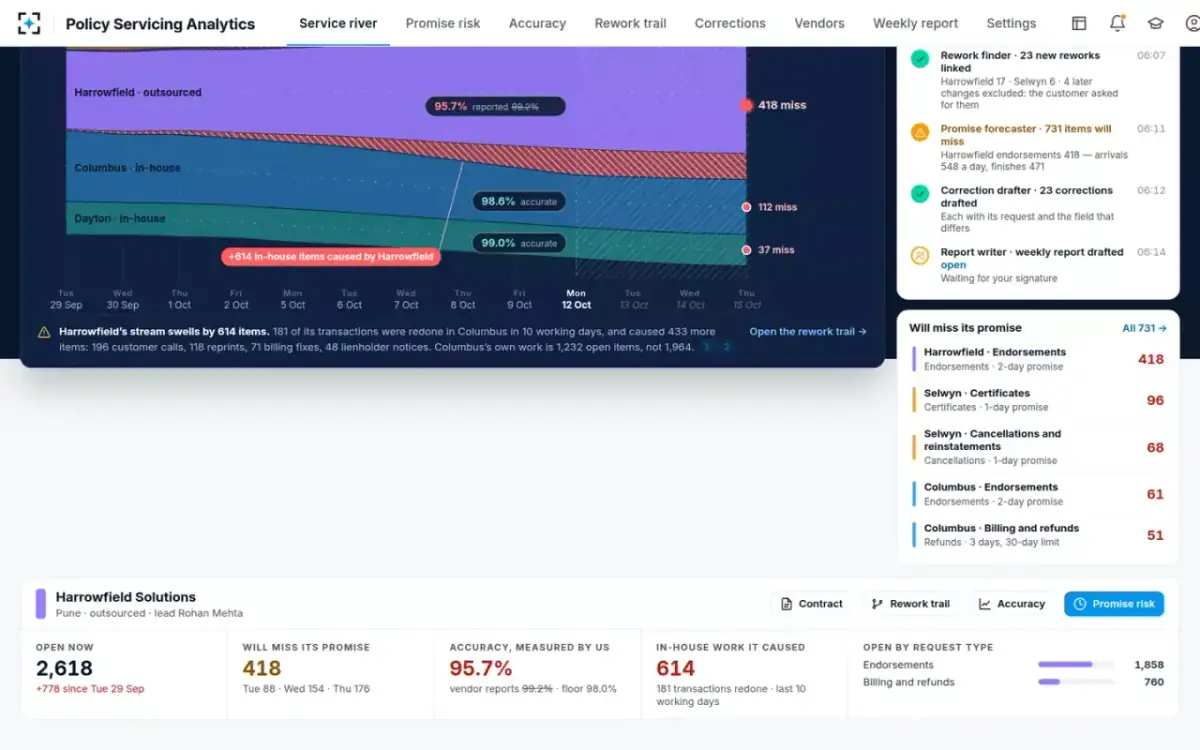
Insurance operations KPIs examples: one scorecard, built on sample data
A servicing scorecard needs fewer KPIs than most have, each defined so that it can be traced to the items behind it. The sample insurer's weekly report carries four groups: the picture this morning (open items by team), promises at risk (forecast misses and the proposed rebalance), accuracy measured on every transaction beside each vendor's reported figure, and rework the in-house teams did for vendors. Each of its 38 numbers opens the screen and items it came from.
The example values read like this. Open: 6,842 items across four teams. At risk: 731 forecast to miss by Thursday, falling to an estimated 46 at the worst queue after a tested rebalance. Accuracy: 97.2% and 95.7% at the two outsourcers against 98.8% and 99.2% they report; 98.6% and 99.0% in-house against a 98.5% target. Rework: 268 vendor transactions redone in-house in ten working days, causing 810 items of work. A reader can act on every one of those lines the same morning.
KPIs by request type inside each team's stream, with rework moved to the team that caused it
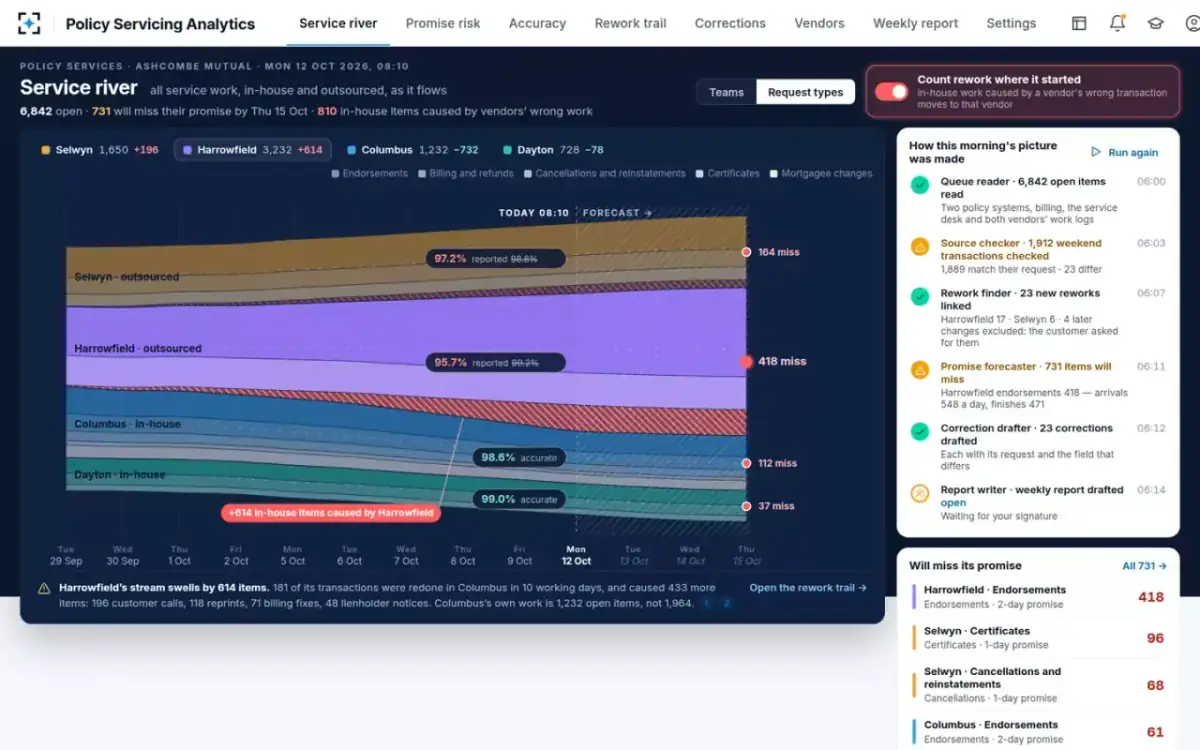
Activity metrics or exam-aligned metrics: what a scorecard should count
Activity metrics count effort; exam-aligned metrics count outcomes a regulator and a customer would recognise. The first kind is easy to collect and easy to improve without anyone being better served. The comparison below sets common servicing metrics beside the version that answers to a standard.
Common servicing metrics and the version an examiner would recognise
Activity metric: Items closed this week.
Exam-aligned metric: Items finished within their promise, by request type, from first receipt.
Activity metric: Average handle time.
Exam-aligned metric: Age of the oldest open item, and items forecast to miss in the next three business days.
Activity metric: QA score on a sample the team chose.
Exam-aligned metric: Measured accuracy on every finished transaction, against its request and later corrections.
Activity metric: Open items per team, as each team reports.
Exam-aligned metric: Open items per team with work caused by other teams' errors moved to the team that caused it.
Activity metric: Refunds issued.
Exam-aligned metric: Refunds correctly calculated and paid within each state's limit.
Activity metric: The vendor's reported accuracy.
Exam-aligned metric: The insurer's measured accuracy, beside the vendor's figure.
How many policy servicing KPIs, and who owns each?
Eight is enough for a servicing operation: the ones in the opening table, each with one owner who acts on it. The head of policy services owns promise kept and the weekly report; the workforce planner owns forecast misses and approves any rebalance; the quality analyst owns measured accuracy and rules on disputed rework; team leads own their own rework and same-day corrections; and the vendor manager owns each contract's measures and credits.
Two governance rules keep the KPIs honest. Definitions are settings, not formulas buried in a spreadsheet: at the sample insurer, changes to promise clocks, rework windows, floors and credits are saved as a draft and approved by the head of policy services. And every figure links to the items behind it, so a disputed number can be settled by opening it. To see the scorecard on sample data, start from Policy Servicing Analytics.
Questions people ask
What is a KPI in insurance operations?
A key performance indicator is a defined measure tied to an outcome someone is accountable for, such as the share of endorsements finished within two business days or the share of transactions keyed right the first time. In insurance servicing the useful KPIs map to the examination standards for timeliness, accuracy, refunds and correspondence.
What does straight-through processing mean in insurance?
It means a transaction completed from request to issued document without a person re-keying or touching it. It is a useful efficiency measure, but it is not an accuracy measure: a transaction processed straight through with the wrong effective date is still wrong, so it should sit beside measured accuracy, not replace it.
What is a good accuracy rate for policy servicing?
No regulator publishes a target. Contracts at the sample insurer set floors of 98.0% for outsourcers and a 98.5% target in-house. For comparison, North Carolina's examiners have applied a 5% error tolerance to most areas they review, and the NAIC handbook's 2017 edition uses a 10% benchmark for non-claims trade practices as the point where errors are presumed to be a general business practice.
Are policy administration KPIs different from policy servicing KPIs?
Policy administration KPIs usually add system measures, such as straight-through rates, issuance time for new business and document generation errors. Servicing KPIs focus on the requests that change policies in force. Both should share one definition of accuracy, one clock and one rule for what counts as rework.
How often should servicing KPIs be reported?
Weekly for the scorecard, daily or faster for anything that can still be acted on. A one-business-day promise cannot be managed from a weekly report; the sample insurer reads its queues every 15 minutes and signs a weekly report built from the same numbers.