The usual SLA penalty calculation formula for an outsourcing contract is: credit = the monthly fee × the credit rate × the number of points the measured result falls below the floor, capped at a stated share of the fee. In policy servicing the result is usually accuracy or turnaround, the rate is a percentage of the monthly fee per point, and the cap is a percentage of the fee or of a year's charges. The arithmetic is simple; the disputes are not, because they are about which number goes in: the vendor's sampled figure or the insurer's own measure. Botminds' Policy Servicing Analytics measures every finished transaction, then computes each contract's credit exactly as its schedule states and drafts the notice for the vendor manager, so the formula is applied the same way every month and nothing is sent until a person signs.
The worked example uses a fictional sample insurer, Ashcombe Mutual, and its fictional outsourcer, Harrowfield Solutions, under a master services agreement with a fee of $186,400 a month. Contract wording on public templates comes from the UK government's Model Services Contract and the US Federal Acquisition Regulation, linked where quoted.
From the contract schedule to a setting to October's credit, in Policy Servicing Analytics
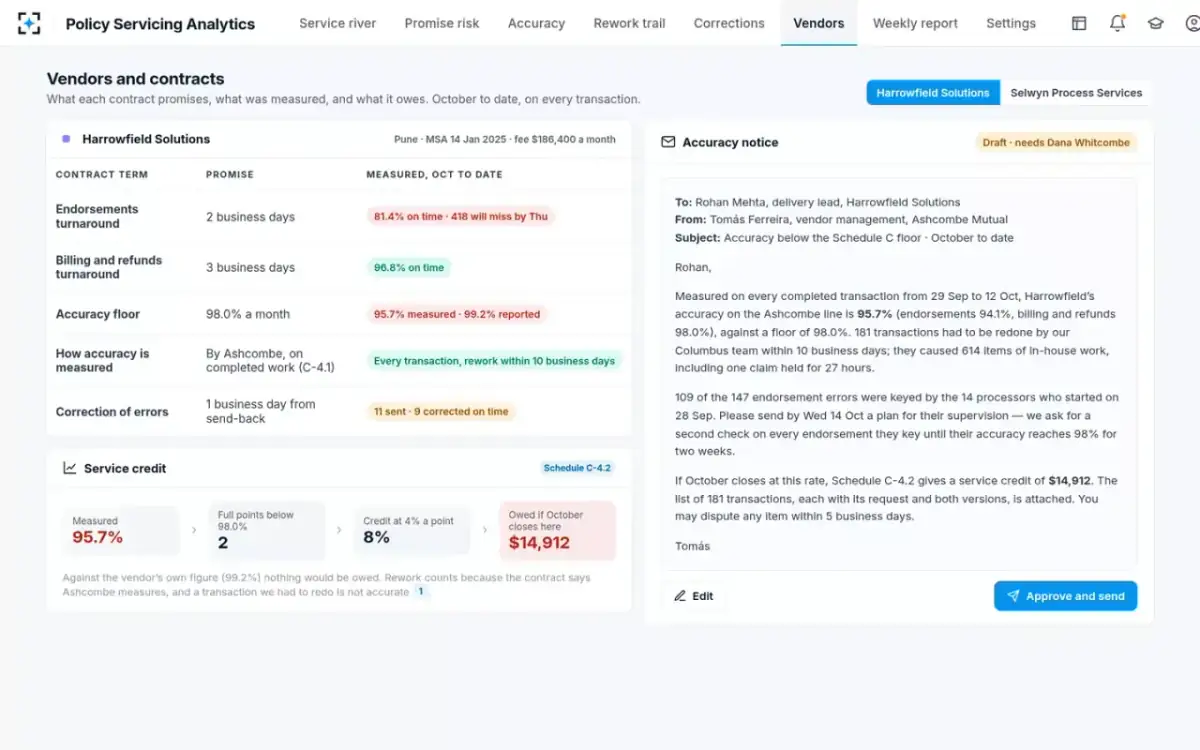
| Term | What the schedule says | The setting | October to date |
|---|---|---|---|
| Accuracy floor | 98.0% a month | Floor 98.0%, monthly | Measured 95.7% |
| Who measures, on what | The insurer, on completed work | Every finished transaction, checked against its request | 4,212 transactions, 29 Sep to 12 Oct |
| What counts as inaccurate | A transaction the insurer must redo within 10 business days | Rework window 10 business days; customer-requested changes excluded | 181 transactions redone |
| Shortfall unit | Full points below the floor | Whole points only | 2.3 points, so 2 full points |
| Credit rate | 4% of the monthly fee per full point | 4% a point | 8% |
| Base | The monthly fee | $186,400 | $186,400 |
| Cap | 12% of the monthly fee | Cap 12% | Not reached |
| Dispute window | 5 business days per charged rework | Vendor dispute window 5 business days; the quality analyst decides | Open |
| Credit | Computed on the measured month | Drafted, sent only after sign-off | $14,912 if October closes here |
The SLA penalty calculation formula, term by term
Every service credit formula answers the same five questions: what is measured, where the floor is, how the shortfall is counted, what each unit of shortfall costs, and where the total stops. Write them as one line and the formula for a floor-and-rate schedule is: credit = min(cap, units below floor × rate per unit) × fee for the period.
The terms carry more judgement than the line suggests. The measure decides whose view of the month counts. The unit decides whether 2.3 points below the floor is two points or 2.3. The rate decides how much a point hurts, and the base decides what it hurts: the monthly fee, a share of it allocated to that service level, or the charges for the service that failed. The cap decides when the credit stops growing and other remedies take over. A contract that leaves any of the five vague will be argued over every month in which the vendor misses.
Public-sector templates make the same terms explicit. The UK Cabinet Office's Model Services Contract converts service level failures into "Service Points", and its charging schedule turns points into money "on the basis of one point equating to a [Insert percentage]% deduction in the Service Charges", applied to "the total Services Charges payable for the relevant Service Period (prior to deduction of applicable Service Credits)" (UK Cabinet Office, The Model Services Contract, Schedules, version 2.2A, Schedule 11 Part C). The base is the charge before credits, so a credit is never computed on a fee already reduced by another credit.
What is a service level credit, and is it a penalty?
A service level credit is a reduction in the price of a service that did not meet its stated level, usually deducted from the next invoice. Contracts are written to treat it as a price adjustment rather than a punishment: the UK model states that "Service Credits are a reduction of the Service Charges payable in respect of the relevant Services to reflect the reduced value of the Services actually received", and that they are "shown as a deduction from the amount due from the Authority to the Supplier in the invoice for the Service Period immediately succeeding the Service Period to which they relate."
US federal contracting uses the same logic. Under the standard fixed-price services inspection clause, when defects "cannot be corrected by reperformance", the government may "reduce the contract price to reflect the reduced value of the services performed" (Federal Acquisition Regulation 52.246-4(e)). "SLA penalty" is what people search for; "service credit" is what the contracts say, and the framing as reduced value is why a credit should be priced on what the buyer actually received.
SLA penalty calculation example: one month, worked to the dollar
Here is the sample contract's credit for October, computed in the order a worksheet should follow. Each step uses only the contract's terms and the measured month, so anyone with the schedule and the list of transactions can reproduce it.
SLA penalty calculation worksheet for one month of outsourced endorsements and billing
| Step | Calculation | Result |
|---|---|---|
| 1. Transactions finished in the period | Endorsements 2,486 + billing and refunds 1,726 | 4,212 |
| 2. Transactions the insurer redid within 10 business days | Endorsements 147 + billing 34, customer-requested changes excluded | 181 |
| 3. Measured accuracy | 1 − 181 ÷ 4,212 | 95.7% |
| 4. Shortfall below the floor | 98.0% − 95.7% | 2.3 points |
| 5. Full points (the contract's unit) | Whole points in 2.3 | 2 |
| 6. Credit rate | 2 × 4% of the monthly fee | 8% |
| 7. Check the cap | 8% against a cap of 12% | Under the cap |
| 8. Credit | 8% × $186,400 | $14,912 |
| 9. The same steps on the vendor's own figure | 98.0% − 99.2% is above the floor | $0 |
Step 2 is where the money is. Each of the 181 transactions is linked to the request that started it and to the later change that corrected it, and four later changes in one morning's run were left out because the customer had asked for them. A vendor that disputes a rework within five business days gets a ruling from the insurer's quality analyst, and the credit moves with the ruling. How those links are made, and why the team that fixes errors should not be charged with them, is set out in the rework rate formula for policy services.
Whose measure goes into the formula?
The contract should say, and it should name the buyer. The US rule for performance-based service contracts requires "Measurable performance standards (i.e., in terms of quality, timeliness, quantity, etc.) and the method of assessing contractor performance against performance standards", and requires any incentives to "correspond to the performance standards set forth in the contract" (Federal Acquisition Regulation 37.601(b)). The method of assessment is part of the deal, not a detail for later.
The same October under the vendor's measure and under the insurer's
Vendor's own sample: 220 endorsements across the month, chosen by the vendor.
Insurer's measure, every transaction: All 4,212 transactions finished from 29 Sep to 12 Oct, each against its request.
Vendor's own sample: What the vendor's checker finds on review.
Insurer's measure, every transaction: Any field that differs from the request, and any transaction the insurer had to redo within 10 business days.
Vendor's own sample: 2
Insurer's measure, every transaction: 181 transactions redone, causing 433 more items of in-house work.
Vendor's own sample: 99.2% reported
Insurer's measure, every transaction: 95.7% measured
Vendor's own sample: $0
Insurer's measure, every transaction: $14,912
The difference is not a rounding question. A sample of 220 endorsements that finds 2 errors cannot come from a population where 5.9% of endorsements were wrong except by very bad luck, so the two measures are counting different things: the vendor's checker looks at a transaction on its own, the insurer's measure looks at what happened to it afterwards. Why a vendor's sample and a check of every transaction diverge, and what a sample of that size can prove, is the subject of 100% inspection vs sampling.
The contract term, the measured month and the credit worked out step by step
Full points, fractions or bands: one month priced four ways
The unit of shortfall changes the credit as much as the rate does. The same measured month, 95.7% against a 98.0% floor on a $186,400 fee, produces four different credits under four common structures. None is wrong; each has to be written down so that nobody chooses after the month is known.
The same month under four credit structures: from $4,287 to $22,368
Whole-point schedules are easy to explain and leave a cliff at each point: at 97.00% the sample vendor owes 4% of the fee, at 97.01% it owes nothing. Fractional schedules remove the cliff and add an argument about decimal places, which is why the rounding rule belongs in the clause. Banded schedules, like the UK model's minor, serious and severe failures, trade precision for predictability and are often paired with a multiplier for repeat failures.
For a second, smaller vendor the unit decides whether anything is owed at all. Selwyn measured 97.2% against the same 98.0% floor: 0.8 points short, which is zero full points, so its full-point schedule at 3% a point produces no credit, while a fractional schedule would produce 2.4% of its fee. That is a commercial choice the contract made, and the measure should show the shortfall either way.
Caps, repeat failures and when credits stop being the only remedy
A cap limits the vendor's exposure in a bad month, and a well-written contract says what happens when the cap is reached. The UK model sets the cap, after the first year, at a percentage of "the Service Charges paid and/or due to be paid to the Supplier under this Contract in the period of 12 months immediately preceding the Service Period in respect of which Service Credits are accrued". It then treats credits that "meet or exceed the Service Credit Cap" as a "Critical Performance Failure", and credits reaching "75% of the Service Credit Cap" as an event that lets the buyer step in with a remedial adviser.
Repeat failures are the other lever. Under the same model, a failure on the same indicator in two consecutive periods is a "Repeat KPI Failure", and its points are calculated as "SP = P x 2". On the sample month, a vendor in the severe band for a second month running would reach the 12% cap.
The American clause sets the fallback in plain terms. If the contractor fails to reperform promptly, the government may "by contract or otherwise, perform the services and charge to the Contractor any cost incurred by the Government that is directly related to the performance of such service" or "terminate the contract for default" (Federal Acquisition Regulation 52.246-4(f)). In servicing, the first of those already happens every day without a contract term: the in-house team re-keys the vendor's wrong transaction. A clause that recognises it lets the insurer charge for it.
Service level credits clause: what to write down before the first month
Most service credit disputes come from a term the clause did not settle. The checklist below lists the terms that decide the arithmetic, in the order they enter the formula.
Terms a service level credits clause should settle
- The measure, and who takes it
Name the buyer as the party that measures, on completed work, over every transaction or a stated sample.
- What counts as an error
Field-level differences from the request, and any transaction the buyer must redo within a stated window.
- What does not count
Changes the customer asked for after the first transaction; items the buyer itself delayed.
- The floor and the period
For example 98.0% a calendar month, per service line or across the contract.
- The unit and the rounding
Full points, fractional points to one decimal, or bands, written with an example.
- The rate and the base
A percentage of which fee, before or after other credits.
- The cap and what happens at it
A share of the monthly fee or of the last 12 months' charges, and the remedy that applies once it is reached.
- Repeat failures
A multiplier or a step up when the same service level fails in consecutive periods.
- Disputes
A window for the vendor to dispute each charged error, and the person on the buyer's side who decides.
- Timing
Deducted from the next invoice, as the UK model provides, or settled at a quarterly review.
Why the credit belongs in settings an agent applies, not in a spreadsheet
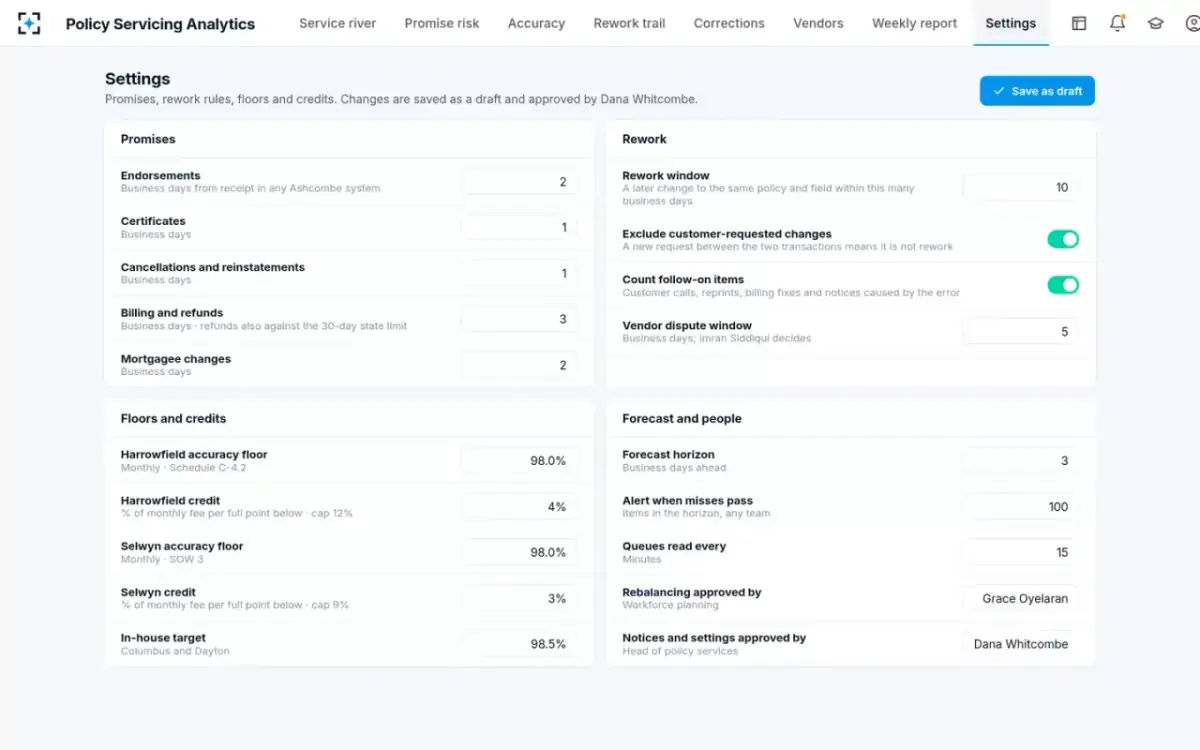
A service credit is arithmetic the contract has already defined, so it should be computed the same way every month by something that cannot be talked into a different rounding rule. In Policy Servicing Analytics each schedule's floor, rate, unit, cap and windows are settings; changes are saved as a draft and approved by the head of policy services, and every change is kept on the audit trail.
Floors, credit rates, caps and windows held as settings, changed only by approval
The Report writer computes the credit from the measured month and drafts the accuracy notice in the vendor manager's voice, with the list of charged transactions attached, each with its request and both versions. On the sample, the notice also asks the vendor for a supervision plan for its new starters, whose 612 endorsements were 82.2% accurate against 98.0% for its tenured staff. Nothing reaches the vendor until the head of policy services approves it.
What the solution does not do is negotiate. It does not decide whether to waive a credit for a vendor that is fixing a staffing problem, or whether to invoke the cap remedies; those are commercial decisions for the vendor manager and the head of services. Its job is to make sure the number in front of them is the contract's number, on the insurer's measure. For how the measured month compares with running the same work in-house, see policy servicing outsourcing services, costed, or start from Policy Servicing Analytics.
Questions people ask
What is the difference between an SLA penalty and a service credit?
In practice they describe the same money: an amount the vendor gives back when a service level is missed. Contracts call it a credit and present it as a reduction in price for reduced value, as both the UK Model Services Contract and the US federal inspection clause do. Writing it that way, rather than as a punishment, keeps the amount tied to what the buyer actually lost.
How is a service level credit allocation percentage set?
In contracts that use one, a share of the monthly fee is put at risk and the allocation percentage spreads that share across the service levels, so a contract might put 10% at risk and allocate 40% of it to accuracy and 30% each to two turnaround measures. The allocation should follow the cost of failure: on the sample, one wrong endorsement caused a 27-hour claim hold and 74 minutes of in-house work, so accuracy deserves a large share.
Are service credits the only remedy for poor service?
Usually not. The UK model treats credits that reach the cap as a critical performance failure with further remedies, and lets the buyer appoint a remedial adviser once credits pass 75% of the cap. The US fixed-price services clause lets the government reperform the work at the contractor's cost or terminate for default if the contractor does not correct it.
Can a vendor dispute a service credit?
It should be able to, item by item, within a fixed window. In the sample contract the vendor has five business days to dispute any rework charged to it, and the insurer's quality analyst confirms or removes it; one disputed effective-date correction was waiting for that ruling on the sample Monday.
How do you calculate service credits for several service levels in one month?
Compute each service level's credit separately under its own floor and rate, add them, then apply the cap to the total, unless the contract caps each one. Keep the base as the charge before any credit, as the UK model does, so one credit never shrinks another.