A transaction quality audit checklist for policy servicing asks, for each finished transaction: was the request identified, was the right policy changed, does every field match what was asked, did anything change that was not asked for, was any premium or refund calculated by the right method, were the right forms attached and the required notices sent, and was it done within the promise. Each file is then scored once, as correct or in error, and errors that touch a claim, a lienholder or a cancellation date are marked critical. Scored that way, the audit uses the same arithmetic state examiners use, which means an insurer can estimate the odds that an examiner's sample would find a problem before the examiner arrives. Botminds' Policy Servicing Analytics compares every finished transaction with the request that started it, field by field, so the checklist runs on all of the work and the quality analyst rules on what it finds.
Examples come from a fictional sample insurer, Ashcombe Mutual, whose servicing is split between in-house teams and two outsourcers. The examination rules are quoted from state reports and the NAIC's handbook, linked where they appear.
The transaction quality audit checklist: ten checks on one finished servicing transaction
- The request is in the file
The email, PDF, portal form or call note that started the transaction, with its date of first receipt.
- The right policy and the right insured
Policy number, named insured and, for commercial lines, the right location or vehicle schedule.
- The effective date is the one asked for
The most common error at the sample insurer: 61 wrong effective dates at one outsourcer in two weeks.
- Every requested field changed, exactly
Vehicle and VIN, driver and licence status, limits and deductibles, garaging address, holder wording.
- Additional interests are complete
Lienholder, loss payee, mortgagee or additional insured added, replaced or kept as the request says.
- Nothing changed that was not asked for
An unrequested change is an error even when the requested ones are right.
- Premium and refund by the right method
Pro rata, short rate or the policy's own method, with the amount recomputed, not read off the screen.
- Filed forms and endorsements attached
The endorsement form used is the filed one and is attached to the policy.
- The notices the change triggers went out
Lienholder or mortgagee notices, billing notices and documents to the insured, with proof of mailing where the law requires it.
- Done within the promise and any legal limit
From first receipt in any system, in business days, and against the statute for refunds and cancellations.
What does a transaction quality auditor do?
A transaction quality auditor reads finished work against its source and decides whether it is right. In policy servicing that means opening the request, opening the transaction, comparing the two field by field, recomputing any premium or refund, checking that the notices went out, and logging an error with the evidence for it. The job description usually adds root-cause work, finding which team, process or new starter the errors come from, and feedback to the teams.
The constraint has always been volume. The sample insurer's quality analyst describes the old job in one line: sixty files a day out of two thousand. At that rate the auditor's time goes on finding errors, and very little is left for the two things only a person can do: deciding the hard cases and changing the process that produces the errors. Checking every transaction automatically reverses the ratio; the analyst starts from the differences already found and rules on them.
The standards behind the checklist are the examiners' own: the policyholder service standard on accurate and complete transactions, the underwriting standard on accurately issued endorsements, and the forms standard, which expects every form in use, endorsements and certificates included, to be on file with the insurance department where filing is required (NAIC 2024 Market Regulation Handbook examination standards, Chapter 20). An internal audit built on the same wording produces findings an examiner would recognise.
The checklist by request type: where each kind of transaction goes wrong
The ten checks apply to every transaction, but each request type fails in its own places, and the audit should weight its attention there. The sample insurer's correction list and accuracy table show the pattern across five request types.
Where each servicing request type fails, with sample error rates
| Request type | Checks that catch most errors | Sample error | Sample error rate |
|---|---|---|---|
| Endorsements | Effective date, VIN, driver licence status, lienholder or loss payee | Vehicle added effective 1 Oct when the customer asked for 28 Sep, no lienholder | 1.1% to 5.9% by team |
| Cancellations and reinstatements | Effective date against the notice period, refund method and amount | Cancellation effective one day after the notice period | 1.7% to 4.4% |
| Billing and refunds | Payment plan, refund method, amount recomputed | Ten-pay plan keyed as monthly | 1.1% to 2.0% |
| Certificates | Holder name and address, additional insured and waiver wording | Wording "primary and non-contributory" missing | 0.8% to 1.6% |
| Mortgagee changes | New servicer and loan number, old clause removed | Old servicer kept on the mortgagee clause | 1.6% to 3.7% |
How to score a transaction: one file, one error, every finding cited
Score each file once, as in error or not, and cite every finding in it separately. That is how examiners compute an error ratio. New Jersey's examiners put it plainly: "Even though a file may contain multiple errors, the examiners counted the file only once in calculating the error ratios; however, any file that contains more than one error will be cited more than once in the report" (New Jersey Department of Banking and Insurance, market conduct examination of Colonial Penn Insurance Company, report adopted 3 January 2003).
The distinction matters because the two numbers answer different questions. The error ratio, files in error over files reviewed, is what gets compared with a tolerance. The count of findings tells the team what to fix. A transaction with a wrong effective date and a missing lienholder, like the sample customer's new car, is one file in error and two findings, and both findings go on the correction list.
Write the error ratio the way regulators write it, with the count and the denominator. Illinois examiners reported a non-renewal finding at American Freedom Insurance Company as "In 4 of 86 files reviewed, for an error rate of 4.65%" (Illinois Department of Insurance, 2025). A percentage without its denominator invites the question of how many files were looked at, and the answer matters.
Critical and minor errors: which ones are fixed the same day
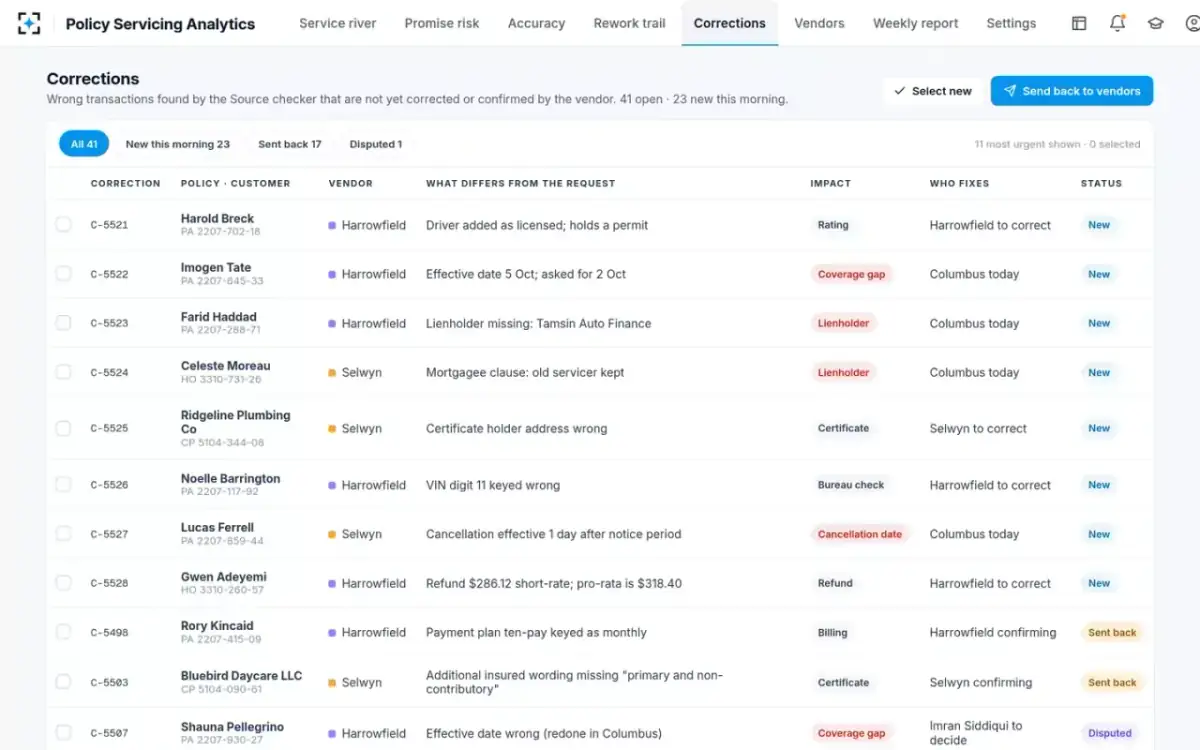
Classify each error by what it can do to the customer before anyone notices. At the sample insurer the rule is simple: anything touching a claim, a lienholder or a cancellation date is corrected in-house the same day and charged to the team that made the error; everything else goes back to that team with the request and the field that differs. The categories that follow are the ones its correction list uses.
Errors from one sample morning's correction list, by impact and who fixes them
| What differs from the request | Impact | Who fixes it | Class |
|---|---|---|---|
| Effective date 5 Oct; customer asked for 2 Oct | Coverage gap | In-house team today | Critical |
| Lienholder missing | Lienholder | In-house team today | Critical |
| Mortgagee clause: old servicer kept | Lienholder | In-house team today | Critical |
| Cancellation effective one day after the notice period | Cancellation date | In-house team today | Critical |
| Driver added as licensed; holds a permit | Rating | Vendor corrects | Standard |
| Refund $286.12 short rate; pro rata is $318.40 | Refund | Vendor corrects | Standard |
| VIN digit 11 keyed wrong | Bureau check | Vendor corrects | Standard |
| Certificate holder address wrong | Certificate | Vendor corrects | Standard |
The corrections list: each wrong transaction with what differs, its impact and who fixes it
What error rate triggers a regulatory finding?
Examiners compare a sample's error rate with a tolerance, and the tolerance depends on the state and the area reviewed. North Carolina states its rule in each report: it cites a company only when a sample's errors fall outside a tolerance, and that tolerance was zero for forms and rates never filed with or approved by the department and 5 percent for every other area, judged at a 95% confidence level (North Carolina Department of Insurance, target examination of Titan Indemnity Company, 2017).
The NAIC handbook sets a separate benchmark for trade-practice laws that turn on frequency. In its 2017 edition the long-standing benchmarks are an error rate of 7% for claim practices and 10% for other trade practices, and a rate above them is presumed to be a general business practice (NAIC Market Regulation Handbook, 2017 edition, Chapter 14; explained in the NAIC error tolerance chart). Many servicing rules do not depend on frequency at all: a single refund paid late, or a cancellation notice with too little notice, is a violation on its own.
The odds that an examiner's sample finds what you already have
If you know your true error rate, you can estimate the chance that an examiner's sample shows an error rate above the tolerance. The table uses North Carolina's 5% tolerance and sample sizes from real reports, and treats a sample as a finding when its error rate exceeds 5%. It is a simplification of what examiners do, who also weigh confidence levels and second samples, but it shows the shape of the risk.
Chance that a sample's error rate exceeds a 5% tolerance, by true error rate and sample size
| True error rate | Sample of 50 | Sample of 86 | Sample of 119 |
|---|---|---|---|
| 2% | 8% | 3% | 3% |
| 4% | 32% | 26% | 34% |
| 6% | 58% | 59% | 72% |
| 10% | 89% | 94% | 98% |
Two readings follow. A desk running at 4% errors, comfortably under a 5% tolerance on average, still has about a one-in-three chance of a sample that says otherwise. And a desk at 6%, the endorsement error rate of the sample insurer's largest outsourcer, is more likely than not to produce a finding. The same arithmetic is why a vendor's small internal sample can look clean while the true rate is not; 100% inspection vs sampling works through it.
Quality audit report: what it should contain
A quality audit report should let a reader reproduce every number in it. That means, for each team and request type: transactions finished, files in error, the error ratio with its denominator, the findings by category, the critical errors and when they were fixed, and the rework each team caused for others. At the sample insurer, the weekly report carries accuracy measured on every transaction beside each vendor's reported figure, and every number opens the items behind it.
It should also say what changed. The most useful line in the sample week was not an average: 109 of one outsourcer's 147 endorsement errors were keyed by 14 processors who had started on 28 September, whose accuracy was 82.2% against 98.0% for their tenured colleagues. The accuracy notice drafted for the vendor asks for a second check on every endorsement they key until they reach 98% for two weeks.
Quality audit plan: sample by hand, or check every transaction and audit the checker
A quality audit plan sets what is checked, how often and by whom. The traditional plan samples finished work once a month. The alternative checks every transaction as it is finished and spends the auditor's time on rulings and on auditing the checker. The difference in how fast an error is found and fixed is large.
One wrong transaction keyed mid-month: business days until it is found and fixed
- Waiting for month end10 d
- Sample drawn and reviewed5 d
- Findings sent and fixed5 d
- Checked overnight1 d
- Vendor fixes1 d
Auditing the checker is the part of the plan that keeps the second approach honest. Each month the quality analyst reviews a random set of transactions the comparison passed, and every rework a vendor disputes, within five business days at the sample insurer. If the analyst finds errors the check missed, the definition of an error changes, as a draft approved by the head of policy services. For the formula behind the rework counts, see the rework rate formula; to see the checklist running on sample data, start from Policy Servicing Analytics.
Questions people ask
What is a transaction quality audit?
It is a review of finished transactions against their source documents to measure how many were processed correctly and why the others were not. In insurance servicing the source is the customer's or agent's request and the transaction is the change keyed to the policy or bill. The result is an error ratio by team and request type and a list of findings to fix.
How many files should a quality audit sample?
Enough to answer the question being asked. Testing whether a desk is under a tolerance takes the sample sizes examiners use: 50 and 86 files per area in Illinois's 2025 report on American Freedom, 119 in North Carolina's 2017 report on Titan Indemnity. Measuring a low error rate to within a point, the figure a service credit is priced on, takes far more files than that, often more than a month's work.
Do examiners count a file with two errors twice?
For the error ratio, no: New Jersey's examiners, for example, count a file once in the ratio and cite each error in it separately in the report. An internal audit should do the same, so its ratio can be compared with an examiner's.
What is the difference between a quality audit checklist and a market conduct exam checklist?
A quality audit checklist tests individual transactions against their requests and the insurer's own rules. A market conduct exam checklist prepares the whole company for a regulator's review, from complaint registers to producer licensing. The first feeds the second: an exam asks for evidence that servicing transactions are accurate, and a transaction audit produces it.
Should the outsourcer audit its own transactions?
It can, as a first line, but the insurer should not rely on it. On the sample data, one outsourcer's own sample found 2 errors in 220 endorsements while the insurer's check of all its endorsements found 147 in 2,486. The insurer's audit is the one an examiner will ask about.