Policy servicing outsourcing services move the keying of endorsements, certificates, cancellations, billing changes and refunds to a vendor for a fee, usually priced per transaction or as a monthly fee for a staffed line. The comparison most insurers make, the vendor's price against the cost of in-house processors, leaves out the cost that decides the answer: the work the insurer's own people do to fix the vendor's errors, and the calls, reprints, billing reversals and lienholder notices those errors cause. Counted that way, the choice between in-house, outsourced and agent-assisted servicing often looks different. Botminds' Policy Servicing Analytics measures every finished transaction and charges each rework, and the work it caused, to the team that made the first mistake, so the cost of each option can be read from the insurer's own queues.
The worked figures use a fictional sample insurer, Ashcombe Mutual, with two in-house teams and two outsourcers. Labour market figures are from the US Bureau of Labor Statistics. Every cost estimate on the page is Botminds' estimate, and each one says how it was made.
The in-house benchmark: a shrinking occupation with a known wage
239,100
insurance claims and policy processing clerks employed in the US in 2025
$49,230
median annual wage, May 2025
−2%
projected change in employment, 2025 to 2035
Policy servicing outsourcing services: what the price per transaction leaves out
A vendor's quote prices the transactions it keys. It does not price the transactions the insurer keys again because the first one was wrong, the customer contact a wrong transaction creates, or the time the insurer spends overseeing the vendor. Those costs land in other budgets, the in-house team's, the service desk's, billing's, and so they rarely appear on the comparison sheet.
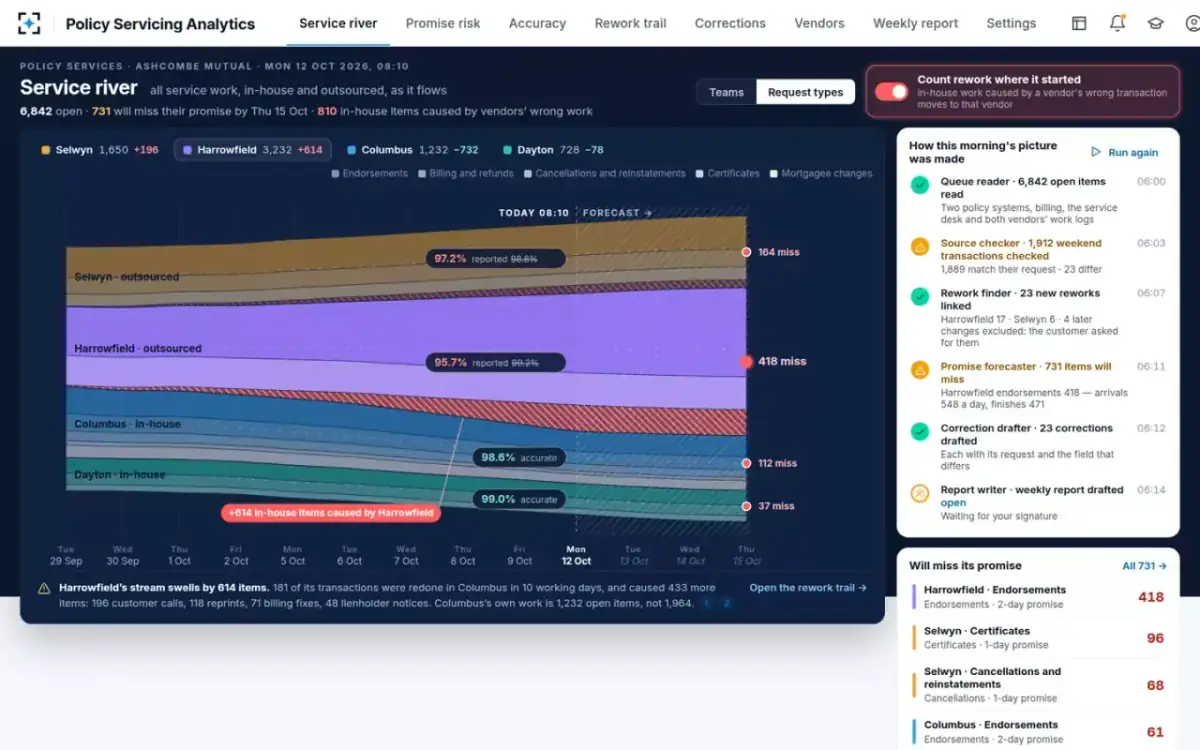
The sample insurer shows how large they are. In ten working days, its in-house Columbus team redid 181 of its largest outsourcer's transactions, and those errors caused 433 more items of in-house work: 196 customer calls, 118 reprints, 71 billing fixes and 48 lienholder notices. Of Columbus's 1,964 open items on the sample Monday, 732 existed only because a vendor's transaction had been wrong.
Three ways to run policy servicing, cost line by cost line
Outsourced, judged on the vendor's report: The vendor's fee: per transaction or a monthly fee for a staffed line.
In-house or outsourced, measured with Policy Servicing Analytics: Unchanged: the vendor's fee, or in-house wages. Agents read and measure; people still key.
Outsourced, judged on the vendor's report: Absorbed by in-house teams and counted as their backlog.
In-house or outsourced, measured with Policy Servicing Analytics: Counted per wrong transaction, with the follow-on items it caused, and charged to the team that caused it.
Outsourced, judged on the vendor's report: Found at claim time or by a complaint.
In-house or outsourced, measured with Policy Servicing Analytics: Found the morning after keying, with the request sentence they contradict.
Outsourced, judged on the vendor's report: Priced on the vendor's own sampled figure, often zero.
In-house or outsourced, measured with Policy Servicing Analytics: Priced on the insurer's measure, as the contract states.
Outsourced, judged on the vendor's report: Collecting sheets, sampling by hand, tracing rework: about 28 hours a week for two people, by Botminds' estimate.
In-house or outsourced, measured with Policy Servicing Analytics: About 4.5 hours a week for the same two people, by the same estimate.
Outsourced, judged on the vendor's report: Seen when the weekly sheet shows it, after promises are missed.
In-house or outsourced, measured with Policy Servicing Analytics: Forecast three business days ahead, with a rebalance tested before anyone moves.
What does in-house policy servicing cost? Start with the clerk's wage, loaded
The in-house cost of a servicing transaction is the loaded hourly cost of the person who keys it divided by the transactions they finish in a productive hour. The wage half is public. The Bureau of Labor Statistics puts the median annual wage of insurance claims and policy processing clerks at $49,230 in May 2025 (BLS Occupational Outlook Handbook), about $23.67 an hour over a 2,080-hour year.
The load comes from the same agency. In June 2026, for private industry workers, wages and salaries made up 70.0 percent of employer costs and benefits the other 30.0 percent, an average of $14.07 an hour (BLS, Employer Costs for Employee Compensation, released 9 September 2026). If a clerk's benefits match that average, a median clerk costs about $33.80 an hour before space, systems and supervision, by our arithmetic.
The productivity half is not public and should not be borrowed. It depends on the request mix, the policy systems and the share of requests that arrive complete. The honest way to get it is to measure handle time on your own queues by request type, which is also the input a backlog forecast needs; the workload forecasting guide shows the arithmetic. The occupation's outlook matters too: BLS projects employment falling to 234,700 by 2035, so an in-house plan that assumes easy hiring of experienced processors should be tested.
The rework your own people absorb, priced
Rework is a cost of the outsourced line, not of the team that fixes it, and it can be priced from the sample insurer's own numbers. Take the outsourcer with a $186,400 monthly fee. Over the two sample weeks it finished 4,212 transactions, which at that pace is roughly 8,845 a month, or about $21 a transaction, by our arithmetic.
Now count what its errors cost in-house. Scaled to a month, its 181 wrong transactions in ten working days become about 380, and the 433 follow-on items about 909. One fully traced sample case, a vehicle added with the wrong date and no lienholder, took 74 minutes in-house: the re-keyed endorsement, two calls, a reprint and a lienholder notice. Calibrated on that case, at 30 minutes per redo and 11 per follow-on item, and at $42 an hour, the in-house rate implied by the sample's overtime quote ($4,536 for 72 hours at time and a half), the month's rework comes to about 357 hours, roughly $15,000.
One outsourced line for one month: who pays for the vendor's errors depends on whose measure the contract uses
The comparison makes the point of the measure plain. On the insurer's measure, the contract's credit, $14,912, roughly covers the in-house rework the vendor caused. On the vendor's own figure, the credit is zero and the insurer pays twice: once in the fee for the wrong transaction, and again in its own staff time to fix it. Nothing in the vendor's price changed; only the measure did. The credit's arithmetic is worked through in the SLA penalty calculation formula.
Who carries the cost of one vendor error today, and with the rework charged where it started
Today
Re-keys the vendor’s wrong endorsement, effective the date the customer asked for, with the lienholder added. The work counts against her team’s queue.
With agents
Does the same fix the same day when a claim or lienholder is at stake, but the item is counted on the vendor’s stream, not hers.
Still theirs: The fix
Today
Takes the customer’s call asking why the claim is on hold, and the follow-up when the corrected documents arrive.
With agents
Takes the same calls; each one is linked to the transaction that caused it.
Still theirs: The customer
Today
Reverses a refund keyed short-rate when the policy called for pro rata, and reissues it.
With agents
The correction goes back to the vendor first, with the request and the amounts, unless the refund deadline forces a same-day fix.
Still theirs: Deadline fixes
Today
Samples by hand and cannot say how much in-house work the vendor caused.
With agents
Starts from the measured month and rules on the vendor’s disputes.
Still theirs: Every disputed item
Today
Sees the fee and the vendor’s report, and no line for rework.
With agents
Sees the fee, the rework the vendor caused and the credit the contract owes on the insurer’s measure.
Still theirs: The renewal decision
What a policy servicing outsourcing agreement should say about cost
The agreement should make the vendor's errors the vendor's cost, and give the insurer the evidence to show them. The NAIC's examination standards for third-party administrators, which are written for another kind of outsourcer but describe the same need, expect the administrator to process transactions accurately and completely and to keep full books and records of everything it does for the insurer, open to the insurer on request (NAIC 2024 Market Regulation Handbook examination standards, Chapter 30; how those records are reconciled is covered in TPA reconciliation). A servicing contract that gives the insurer the vendor's work log, with the vendor's item number beside its own, meets the same need.
US federal contracting sets a clean default for correcting nonconforming work: the contracting officer "ordinarily must give the contractor an opportunity to correct or replace nonconforming supplies or services when this can be accomplished within the required delivery schedule", and "correction or replacement must be without additional cost to the Government" (Federal Acquisition Regulation 46.407(b)). In servicing, the delivery schedule is often too short: a transaction touching a claim, a lienholder or a cancellation date cannot wait for the vendor. The sample insurer's rule is that those are fixed in-house the same day and charged to the vendor; everything else goes back to the vendor, which has one business day to correct it.
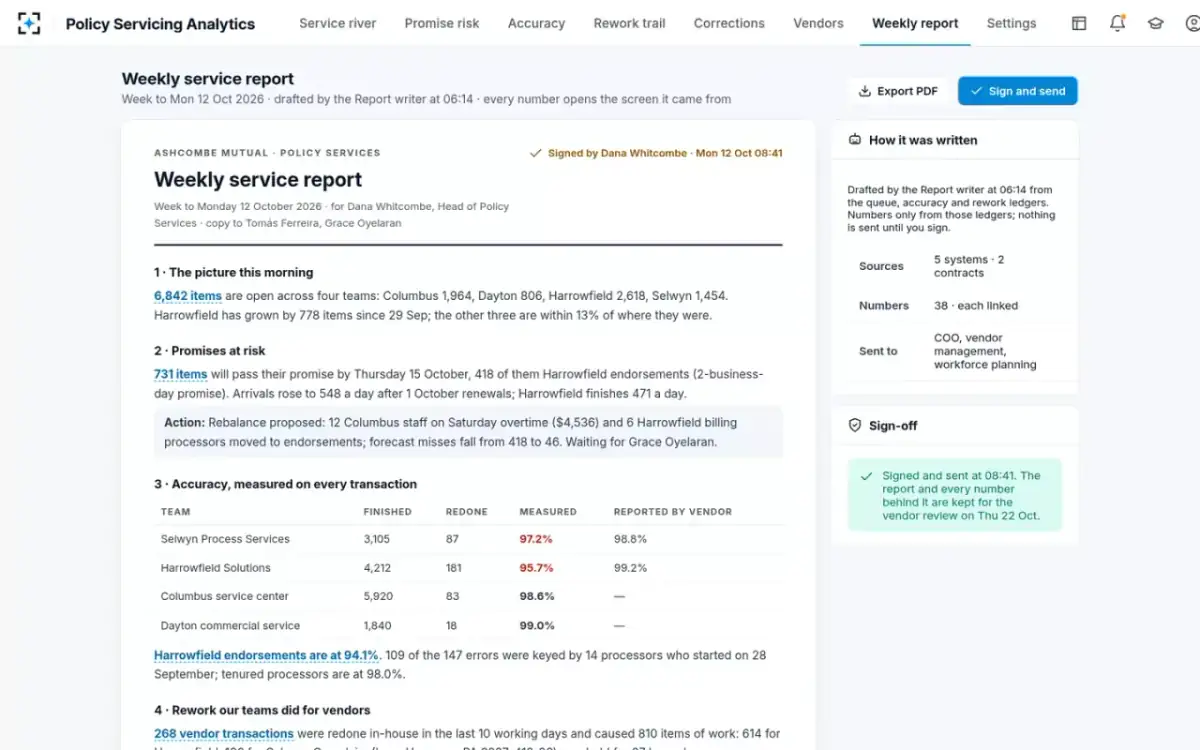
The weekly report: each team's measured accuracy beside what the vendor reports, and the rework done for vendors
Where agents fit: a measuring layer, not a third workforce
"Agents" in this comparison does not mean software that keys policies in place of processors. In Policy Servicing Analytics the agents read every queue, compare every finished transaction with its request, link reworks to their source, forecast which items will miss their promise and draft the weekly report and the vendor notices. They never move work, edit a policy or contact a customer or vendor. The keying stays with people, in-house or at the vendor.
That makes the third option a layer over either of the first two rather than a replacement for them. It changes the costs that depend on seeing the work: oversight hours, rework that goes unattributed, credits priced on the wrong figure, and backlog found after the promise is missed. It does not change the price of keying a transaction.
The monthly cost of one outsourced servicing line, written as a sum
Vendor fee
Transactions × price, or the monthly fee
Sample: $186,400 a month
Procurement
In-house rework
Redone × minutes + follow-on items × minutes, × loaded rate
Sample estimate: about $15,000
Head of policy services
Oversight
Hours a week × loaded rate × weeks
Estimate: 28 hours a week by hand, 4.5 with the solution
Head of services and quality
Service credits
Points below floor × rate × fee, capped
Sample: $14,912 on the insurer's measure
Vendor manager
How to decide: run one measured month before the renewal
The decision between in-house, outsourced or a mix should be made on a measured month, not on a quote and a vendor's report. Take four weeks of your own queues, finished transactions, source requests, rosters and contracts; measure every team's accuracy the same way; count the rework each one caused and what that work cost; and price the contract's credit on the measured figure. The same month shows which request types each team handles well: at the sample insurer, the in-house teams run between 98.3% and 99.2% on every request type, while one outsourcer is at 94.1% on endorsements and 98.0% on billing.
Every team's open work split by request type, the view a sourcing decision starts from
When does a mixed model beat all in-house or all outsourced?
Often, once accuracy is measured by request type. The mix follows from that view: request types a vendor handles accurately stay outsourced, and request types where its errors are expensive, because they touch claims, lienholders or cancellation dates, come back in-house or get a second check until accuracy recovers. The sample insurer's accuracy notice does the second: it asks the vendor for a second check on every endorsement its new starters key until their accuracy reaches 98% for two weeks. For the oversight side of the same decision, see what to ask insurance back office outsourcing companies, or start from Policy Servicing Analytics.
Questions people ask
What are insurance process outsourcing services?
They are contracts under which a vendor runs part of an insurer's operations: policy servicing, billing, claims intake, document processing or policy administration. For servicing, the vendor usually keys requests into the insurer's systems under a turnaround promise and an accuracy floor per request type, while the insurer keeps underwriting and coverage decisions.
Is outsourcing policy servicing cheaper than doing it in-house?
Per transaction keyed, often; per transaction finished correctly, it depends on the vendor's measured accuracy. On the sample data, the in-house rework one vendor's errors caused was worth about 8% of its monthly fee, by Botminds' estimate. A credit priced on the insurer's measure can recover it; one priced on the vendor's report cannot.
How much does an insurance claims and policy processing clerk cost an employer?
The median wage was $23.67 an hour in May 2025 on a 2,080-hour year. Adding benefits at private industry's June 2026 average share of 30% of compensation brings it to about $33.80 an hour, before space, systems, supervision and training, by our arithmetic.
How do you compare quotes from insurance outsourcing companies?
Normalise each quote to your own request mix and volumes, then add the costs the quote leaves out: rework at the vendor's likely error rate, oversight time and transition. Ask each vendor to accept the insurer's measure of accuracy and a defined rework window, because those terms decide whether the vendor or the insurer pays for errors. What to ask each company about oversight, rather than price, is in insurance back office outsourcing companies.
Can agents replace an outsourcer?
Not the kind described here. The agents in Policy Servicing Analytics read and measure; they never key a transaction, move work or contact anyone. They change what the insurer can see about either option, which is what the cost comparison depends on.