TPA reconciliation is the monthly proof that a third-party administrator's report of claims paid on an insurer's behalf, usually a claims bordereau or loss run, agrees with the money the insurer sent it, with what actually cleared the bank, and with the paid losses, loss adjustment expense (LAE) and reserves in the insurer's general ledger. It matters because outsourcing the payments does not outsource the responsibility: under the NAIC's guideline for regulating administrators, the insurer answers for what its TPA does (NAIC, Registration and Regulation of Third Party Administrators, 2011; how that differs from an MGA's position is in the difference between an MGA and a TPA). A gap between what the administrator reports and what the insurer books is the insurer's misstatement. Botminds' Premium & Claims Reconciliation ties the claims accounts at each close, from paid losses and LAE to case reserves and recoveries, and this guide covers the extra tie that comes before them when someone else pays the claims.
The rules here come from NAIC guidance and interpretations, the NAIC examiners' control repository and the PCAOB's audit standard, linked where they appear. Amounts in figures are illustrative unless marked as the fictional sample insurer, Larkspur Mutual Insurance Group, at its third-quarter 2026 close in the solution.
Three sources, three ties: the TPA reconciliation
What is TPA reconciliation?
TPA reconciliation is matching an administrator's claims activity to the insurer's funding and to the insurer's books, claim by claim and in total, every period. It sits upstream of the ordinary claims-to-ledger tie: until the administrator's payments are proved, the insurer's paid losses and LAE rest on someone else's report.
The arrangement varies. Some administrators draw on an account the insurer funds in advance; some send a funding request each week or month and pay after it is met; some pay from an account in the insurer's own name. Some insurers load the administrator's claims into their own claims system, others book a monthly summary. In every case three things have to agree: what was reported paid, what cash moved, and what the general ledger says.
The NAIC's statutory disclosures show how material this can be. The premium standard requires insurers to disclose the direct premium written through managing general agents or third-party administrators, and where it reaches 5% of surplus to name each one and the authority it holds, such as underwriting or claims payment (NAIC Issue Paper No. 53, paragraph 12).
Who is responsible for LAE when a TPA handles claims?
The insurer is. Paying an administrator a fee to adjust claims does not reduce the insurer's liability for the cost of adjusting the claims still open. The NAIC settled the question in 2002: "The working group reached a consensus that the liability for unpaid LAE should be established regardless of any payments made to third party administrators, management companies or other entities" (NAIC INT 02-21). The interpretation was later folded into SSAP No. 55, the standard for unpaid losses and LAE.
The reasoning is in the same document: establishing the liability gross of amounts paid to administrators "results in more meaningful financial statements in that the financial condition of the reporting entity is more appropriately stated." For the reconciliation, it means the administrator's fee invoices are paid LAE when paid, while the reserve for adjusting the open claims stays on the insurer's books until those claims close.
The NAIC's TPA guideline makes the same point about everything else. The payor "shall retain responsibility for the benefits, premium rates, collateral and reimbursement procedures, underwriting criteria and claims payment procedures applicable to the coverage," and the rules for those matters, to the extent the administrator applies them, must be agreed in writing (NAIC GL-1090, Section 7).
What is a loss fund, and when is a claim paid?
A loss fund is the money an insurer places with or makes available to an administrator to pay claims, held in a fiduciary capacity and, under the NAIC guideline, kept in a fiduciary account at a federally insured institution. A claim is paid when the claimant receives the money, not when the insurer funds the account.
"...the return of collateral or the payment of return premiums or claim payments forwarded by the insurer to the TPA shall not be deemed to have been paid to the insured party or claimant until the payments are received by the insured party or claimant."
NAIC, Registration and Regulation of Third Party Administrators (GL-1090), Section 4
That sentence draws the line the reconciliation has to draw. Money in the loss fund is the insurer's asset, held for it; money the administrator has drawn but whose checks have not cleared is in transit; only money that reached the claimant is a paid loss. A general ledger that books the funding wire as paid losses will tie neatly to the insurer's bank and still overstate claims paid and understate the open liability, until the administrator catches up.
One month's funding to an administrator: where the money actually is at month-end
$2.4M funded to the loss fund in the month
- Paid to claimants and cleared · 78%
- Not yet a paid loss · 22%
The 22% that is not yet a paid loss
- Checks issued, not yet cleared · 41%
- Approved, not yet issued · 36%
- Unspent, still in the fund · 23%
The guideline also sets the paperwork that makes the tie possible. The administrator "shall render a periodic accounting to the payor detailing all transactions performed by the TPA pertaining to the business of the payor," and where one fiduciary account holds money for several insurers, it must keep records "clearly recording the deposits in and withdrawals from the account on behalf of each payor" (NAIC GL-1090, Section 8). States adopt the guideline with their own variations; the written agreement with the administrator should name the accounting it owes and when.
What is a claims bordereau, and what should it carry?
A claims bordereau is the administrator's periodic schedule of claims activity for the insurer: each claim with its payments, reserve changes, recoveries and expenses for the period, and usually the cumulative position. For the reconciliation it should carry enough to tie each line to the bank and to the insurer's claims system: claim number, policy, dates of loss and payment, payee, payment reference, amount split between loss and expense, reserve before and after, and any recovery.
Where the bordereau is a summary rather than a line listing, only the total can be tied, and a total that agrees can hide a payment on the wrong claim or the wrong policy. The NAIC guideline requires the administrator to "maintain and make available to the payor complete books and records of all transactions performed on behalf of the payor," kept for at least five years (NAIC GL-1090, Section 5), so the detail exists and the insurer can ask for it. Premium reported on bordereaux by managing general agents is a separate reconciliation, handled by Premium Bordereaux Reconciliation.
How often should TPA data be reconciled?
TPA data should be reconciled at every close the paid losses and LAE feed, which for most insurers is monthly, and the administrator's operations should be reviewed on a regular cycle besides. A quarterly reconciliation leaves two month-ends resting on the administrator's report alone, and a quarter's worth of mismatches is far harder to trace than a month's.
The NAIC guideline sets a minimum for one group of lines: where an administrator handles life, annuity, health or employee benefit stop-loss coverage for more than one hundred covered persons, the insurer must review its operations at least semiannually, with at least one on-site audit (NAIC GL-1090, Section 7H). For property and casualty business the examiners' expectation is "regular audits", described in the next section. Neither replaces the monthly tie.
Common TPA reconciliation breaks
Most TPA breaks are timing between funding, payment and clearing; the ones that matter are payments that cannot be traced to a claim the insurer knows about, expenses classified differently on each side, and reserves that drift between the two systems.
Seven TPA breaks, what each looks like, and what resolves it
| Break | What it looks like | What resolves it |
|---|---|---|
| Funding booked as paid | Paid losses jump on the funding date, the bordereau catches up weeks later | Book funding to the loss fund asset; book paid losses from cleared payments |
| Checks in transit | Bordereau shows payments the bank has not yet cleared | Timing: carry with the check numbers; clears on presentment |
| Voids and reissues | A void on one side, the reissue on the other, in different months | Pair by claim and payee; net the cluster |
| Unknown claim | A payment on the bordereau with no matching claim in the insurer’s system | Investigate at once: set-up error, wrong insurer, or worse |
| Expense classification | Defense or adjuster fees coded as loss by one side and LAE by the other | Agree the mapping in the contract; reclass with an approved entry |
| Fee on the wrong account | The administrator’s own fee netted from the fund and booked as a claim payment | Separate the fee; the open-claim LAE reserve stays |
| Reserve drift | Case reserves on the bordereau differ from the insurer’s claims system | Tie reserves claim by claim before the general ledger tie |
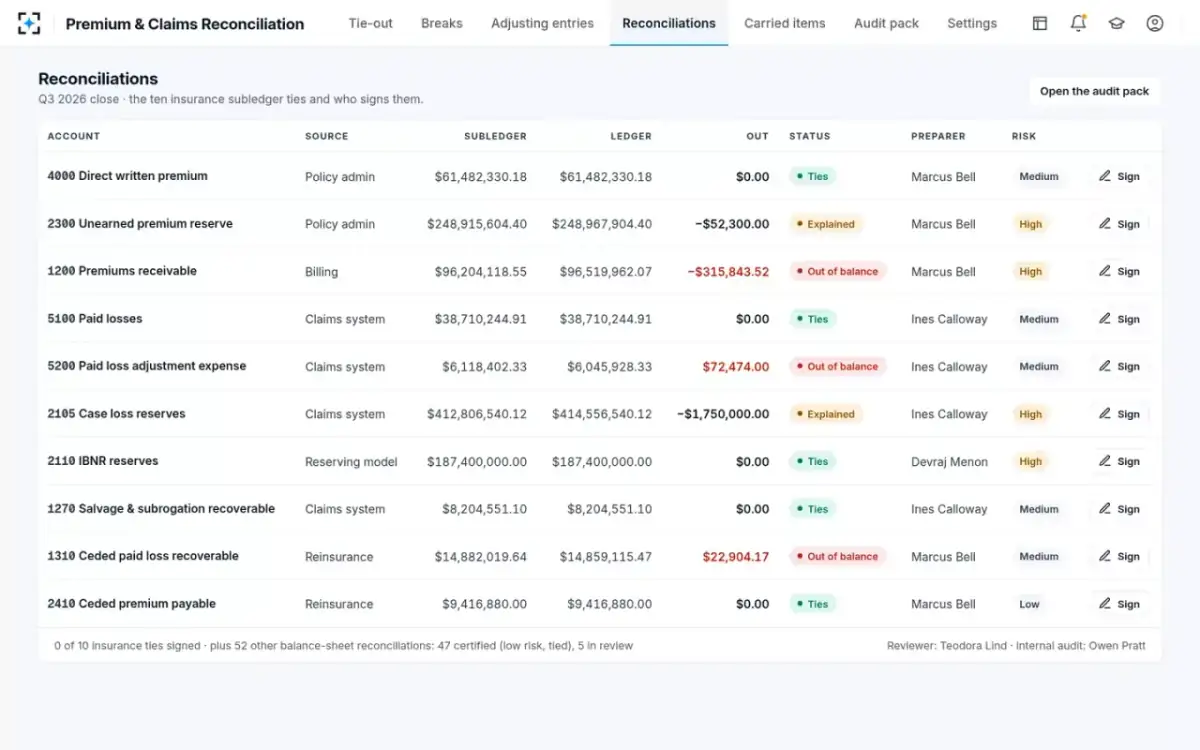
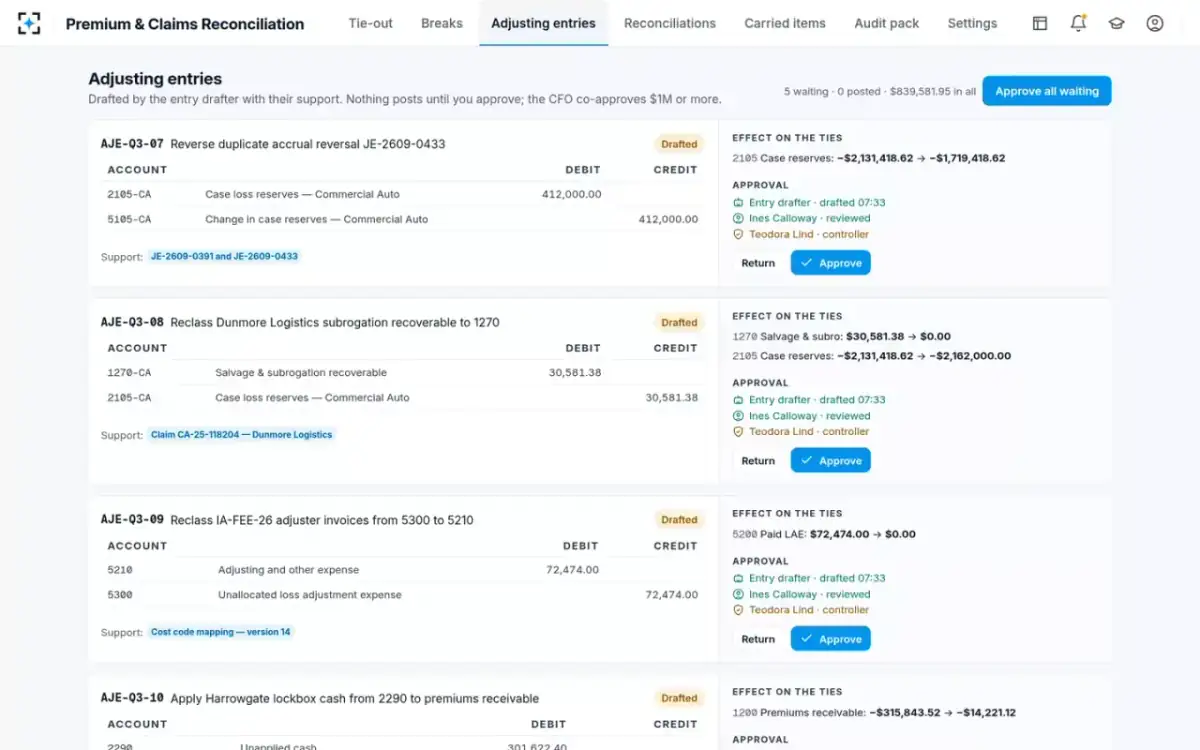
The expense row has a direct parallel in the sample close. Sixty-one independent adjuster invoices on a new cost code were mapped to the wrong LAE account, putting paid LAE out by $72,474.00; the solution traced them to the mapping change and drafted the reclass for approval, with a proposal to correct the mapping from October.
The claims ties at the sample close, with who prepares each
How do you audit a TPA?
You audit a TPA by testing a sample of its claim files against your claims standards and its contract, by reviewing its controls report, and by checking that your own side of those controls is working. The NAIC examiners' control repository for property and casualty reserves, as exposed for comment in 2020, lists two controls an examiner looks for: the insurer "performs regular audits of its TPAs/MGAs to determine whether the insurer's claims-handling standards and additional contract provisions are being consistently followed," and "Management obtains a Type II SOC 1 report for all TPAs and reviews the report to verify the TPA has adequate controls and that the insurer is adhering to user control considerations" (NAIC Financial Examiners Handbook (E) Technical Group, exposure drafts, October 2020).
The user control considerations are the insurer's half of the deal, and the reconciliation is usually one of them. The PCAOB's standard for integrated audits names it among the ways an auditor can get evidence about a service organization: "testing the user organization's reconciliation of output reports with source documents" (PCAOB AS 2201, Appendix B). In other words, the insurer's own TPA reconciliation is evidence the auditor will test.
Eight checks for a TPA review
- Written agreement on file
With the claims payment authority, funding method, reporting and the accounting the administrator owes.
- Type II SOC 1 report reviewed
For the right period and systems, with exceptions followed up and user controls mapped to your own.
- Claim file sample
Payments, reserves and settlements tested against your claims standards and authority limits.
- Bordereau tied to bank, monthly
Every cleared payment on the bordereau, every bordereau payment cleared or in transit.
- Bordereau tied to your claims system
Paid and open reserve per claim, before the general ledger tie.
- Fees separated from claims
Administrator fees as LAE paid; the reserve for adjusting open claims kept on your books.
- Fiduciary account records
Deposits and withdrawals on your behalf shown separately where the account serves several insurers.
- Unknown payees and claims
Any payment to a claim or payee you cannot find is investigated before the close is signed.
Where Premium & Claims Reconciliation fits with a TPA
Premium & Claims Reconciliation ties the insurer's claims accounts (paid losses, paid LAE, case reserves, salvage and subrogation) to the general ledger at each close, clusters what does not match by cause and drafts the corrections for approval. Where an administrator pays claims, its activity reaches those accounts through the insurer's claims system or a booked summary, and the three-way tie above is what proves that feed before the claims ties run. The solution's agents never post, change a source system or write anything off, and an entry for a TPA break goes through the same approval as any other.
For the claims ties themselves, and for how accounting, the actuary and the auditor each reconcile the same claims data, read insurance claims reconciliation: the three-way tie nobody owns. For the person who does this work, see claims reconciliation specialist. For audits of claims handled under delegated authority, see Delegated Claims Audit; and for the whole close, start from Premium & Claims Reconciliation.
A mis-mapped LAE invoice run, traced and corrected with an approved entry
Questions people ask
How do insurers reconcile TPA claim payments?
Monthly, by tying the administrator's bordereau of payments to the loss fund bank account and to the insurer's own claims system and general ledger, claim by claim. Payments in transit and voids are carried as timing; payments that cannot be traced to a known claim are investigated before the close is signed.
Is money sent to a TPA a paid loss?
No. Under the NAIC's TPA guideline, claim payments forwarded to an administrator are not paid to the claimant until the claimant receives them. Until then the money is held for the insurer, and the claim is still open on its books.
Can an insurer reduce its LAE reserve because a TPA handles its claims?
No. NAIC interpretation INT 02-21, later folded into SSAP No. 55, says the liability for unpaid LAE is established regardless of payments made to third-party administrators. The fees paid are LAE paid; the cost of adjusting open claims remains a liability.
What is a SOC 1 report, and why do insurers ask TPAs for one?
A SOC 1 report is an independent auditor's report on a service organization's controls relevant to its clients' financial reporting; a Type II report also tests whether those controls operated over a period. Insurers use it, together with their own claim file audits, to rely on the administrator's processing, and examiners look for evidence that it was obtained and reviewed.
Who keeps the claim records when a TPA pays claims?
The administrator keeps them and must make them available to the insurer; under the NAIC guideline, complete books and records of transactions on the insurer's behalf are kept for at least five years, and the insurer is responsible for producing them to the commissioner on request.