Uncollected premiums and agents' balances are the premiums an insurer has written but not yet collected, whether the policyholder owes them directly or an agent or broker owes them on the insurer's behalf. On the NAIC property and casualty annual statement they sit on the assets page under premiums and considerations: line 15.1 for balances in the course of collection, line 15.2 for deferred premiums and installments not yet due, and line 15.3 for accrued retrospective premiums. Each line has four columns, and the second, nonadmitted assets, is where balances more than 90 days due go, removed from surplus however collectible they may be. Getting the line right is a reconciliation job: billing, the agents' statements, the cash and the general ledger have to agree, policy by policy, before the aging means anything. Botminds' Premium & Claims Reconciliation does that tie at every close and drafts the entries that fix what does not agree.
The figures in the annotated line below are illustrative, not from any company. The worked examples come from a fictional sample insurer, Larkspur Mutual Insurance Group, at its third-quarter 2026 close in the solution, and the rules from the NAIC, a Casualty Actuarial Society study text, New York law and a North Carolina examination report, linked where they appear.
The assets page, lines 15.1 to 15.3, annotated
15.1
Uncollected premiums and agents’ balances in the course of collection
1 · Assets48,620
2 · Nonadmitted1,315
3 · Net admitted47,305
4 · Prior year45,980
Premium due on or before the statement date, billed directly or through agents. Anything over 90 days due goes to column 2.
15.2
Deferred premiums, agents’ balances and installments booked but deferred and not yet due (including earned but unbilled premiums)
1 · Assets22,410
2 · Nonadmitted186
3 · Net admitted22,224
4 · Prior year20,870
Premium booked but due after the statement date, mostly later installments. An installment over 90 days due on line 15.1 pulls its policy’s later installments into column 2.
15.3
Accrued retrospective premiums and contracts subject to redetermination
1 · Assets3,050
2 · Nonadmitted305
3 · Net admitted2,745
4 · Prior year2,610
Premium that depends on a policy’s own loss experience, governed by its own statutory rules.
What are uncollected premiums and agents' balances?
Uncollected premiums and agents' balances are receivables for premium already written: the insurer has recorded the policy and its premium, and the money has not arrived. The name suggests agents, but the line also carries premium owed directly by policyholders. The line's own name says so, and statutory guidance has long treated the two together: the NAIC's issue paper on amounts due from agents sets out the older manual's rule that agents' balances or uncollected premiums more than three months due are nonadmitted (NAIC Issue Paper No. 6).
The same text puts the two lines together at nearly 10% of the industry's assets at the end of 2011, which is why it calls collectibility relevant to an insurer's financial health and "a measure of the efficiency of its collections’ department." The figure is old; the point is not. A large receivable line rests on the billing system, the agencies and the cash application process all being right at the same moment.
Lines 15.1, 15.2 and 15.3: what each line holds
Line 15.1 holds what is due now, line 15.2 what is booked but not yet due, and line 15.3 premium that depends on a policy's own losses. The split is by due date, not by billing route, and the CAS text draws it exactly: "Uncollected premiums and agents’ balances include premiums due on or before the financial statement date, while deferred premiums and agents’ balances include premiums due after the financial statement date."
Line 15.2's caption also includes earned but unbilled premium, the estimate of additional premium that audits of payroll- or sales-rated policies will produce. The NAIC's premium standard requires a portion of it to be nonadmitted: ten percent of earned but unbilled premium in excess of collateral held for the policy (NAIC Issue Paper No. 53). Line 15.3 carries accrued retrospective premium, which the NAIC treats under its own standard, so its nonadmitted column follows different rules from the lines above it.
What is premiums in course of collection, and what are deferred premiums?
Premiums in course of collection are premiums due on or before the statement date and not yet received; deferred premiums are premiums recorded but not yet due, most often the later installments of a policy billed in installments. When an installment falls due it moves from the deferred line to the in-course-of-collection line, and from that day it starts counting toward ninety days.
The movement is what catches aging reports out. A policy billed monthly has one installment on line 15.1 and the rest on 15.2. If the oldest one passes ninety days unpaid, the rule nonadmits it and every later installment already booked on that policy, so the nonadmitted column of line 15.2 can carry amounts that are not yet due at all. The guide to non-admitted premium receivables works through the clock and the surplus cost.
Direct bill and agency bill: two receivables, two rules
A direct-billed receivable is owed by the policyholder; an agency-billed receivable is owed by the agent, who has collected or is due to collect from the policyholder and remits to the insurer net of commission. The difference changes both the reconciliation and the statutory treatment.
On aging, the NAIC treats them the same. Issue Paper No. 6, from which SSAP No. 6's rules on amounts due from agents were written, measures the due date of original premium from the policy’s effective date for both, building on earlier codification drafts that proposed aging "as of the effective date of the policy regardless of whether the reporting entity is using a direct bill or account current system" (NAIC Issue Paper No. 6, 1998). On nonadmission they differ: an agent's receivable over ninety days due is nonadmitted in full, while a direct-billed balance is nonadmitted only to the extent no related unearned premium covers it. On reconciliation they differ again: a direct-billed balance is tied to the insurer's own cash, while an agency balance has to be tied to the agent's account current, the agent's own statement of what it owes.
One agency's account current against the insurer's billing: where the difference sits
Agency statement, $1.25M for the month
- Agrees to billing · 91%
- Differs: $112,500 · 9%
The $112,500 difference, by cause
- Endorsements not yet billed · 56%
- Cash received, not applied · 33%
- Disputed commission · 11%
When do agents' balances become nonadmitted?
Agents' balances become nonadmitted when they are more than ninety days due, measured from the policy's effective date for original premium, regardless of any unearned premium on the same policies. Two further rules in Issue Paper No. 6 matter for anyone reconciling them. Premiums owed by the agent are reported net of commission "if permitted by the contract," and where amounts are both payable to and receivable from the same agent under an agreement that permits offset, the nonadmitted portion is calculated on the net balance.
"Reconciling items between a Reporting Entity’s Account and Agent’s Account - If such amounts are over ninety days due, the amounts shall be nonadmitted."
NAIC Statutory Issue Paper No. 6, Amounts Due From Agents and Brokers (1998), paragraph 4.e
That last rule turns the reconciliation itself into a statutory question. An unresolved difference between the insurer's books and the agent's statement is not a neutral worksheet entry; once it is more than ninety days due it is a nonadmitted asset. State law can add its own line. New York's admitted-asset statute allows "Premiums in course of collection, other than life insurance premiums, not more than ninety days past due, less commissions payable thereon," with exceptions for premiums payable by the U.S. government and certain reinsurance premiums (N.Y. Insurance Law §1301(a)(6)).
What North Carolina's examiners found when cash was misapplied
A misapplied payment does not just put one policy in the wrong column; it can misstate the whole line. In a limited-scope examination of a risk retention group as of December 31, 2018, North Carolina's examiners found that the affiliate billing and collecting the company’s premium had not applied policyholder remittances in the order the examiners concluded it should have, and "as a result, the uncollected premium balance was understated by $580,807 at December 31, 2018 and $460,566 at March 31, 2019" (North Carolina Department of Insurance, County Hall Insurance Company RRG, 2020).
The same report found deferred premiums that should have been reported as premiums in course of collection, because premium finance agreements made the annual premium immediately due, and it could not verify subsequent collections because the cash reports lumped money "without regard to the effective dates of the policies, renewals or endorsements." The company reported on a GAAP basis as a risk retention group, but the failures are the ones any reconciliation of this line has to prevent: cash applied to the wrong balance, balances on the wrong line, and collections that cannot be traced to a policy.
How do you reconcile agents' balances?
You reconcile agents' balances by tying each agent's account current to the insurer's billing detail policy by policy, applying every payment received, and carrying each remaining difference as a dated reconciling item until it is resolved, with the total tied to the general ledger. The steps below are the ones the line depends on.
Seven checks behind a reliable agents' balances line
- Tie each account current to billing, policy by policy
The agent’s statement and the insurer’s billing must agree on policies, premium and commission.
- Apply every payment before aging
Cash in suspense or unapplied cash leaves the policies it paid for open and aging.
- Net commission only where the contract allows it
Report what the agent owes net of commission if the agency agreement permits it, and gross if not.
- Age from the effective date
Not from the agent’s remittance date or the date the statement arrived.
- Date every reconciling item
An unresolved difference with the agent is nonadmitted once it is more than ninety days due.
- Watch for round trips
A balance paid just before quarter-end and handed back just after is treated as never paid.
- Tie the total to the general ledger
The sum of agents’ balances and direct receivables must equal the receivable accounts, or the nonadmitted figure rests on the wrong total.
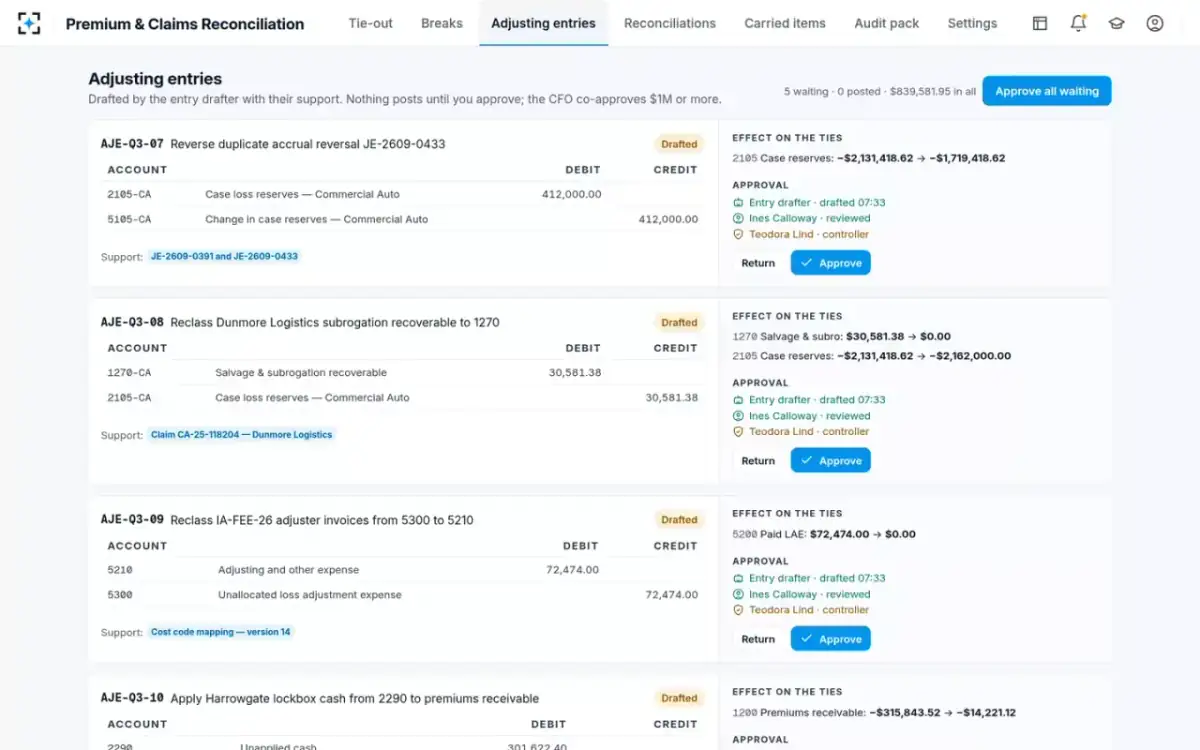
At the sample insurer the largest premium difference of the quarter came from an agency's lockbox: 214 agency-billed payments arrived on September 30 without policy numbers. Billing applied them by amount and insured, but the general ledger feed sent them to unapplied cash, so the premiums receivable tie was out by −$301,622.40. The solution traced the 214 lines to that feed and drafted an entry to move the cash to premiums receivable, for the controller to approve.
The fix for the agency lockbox, drafted with its effect on the premium tie
What the line tells an analyst
To an analyst the line says how much of the insurer's surplus rests on money not yet collected, and how much of that is already overdue. The NAIC's Insurance Regulatory Information System measures the first with ratio 10, agents' balances in course of collection against policyholders' surplus, and treats a result of 40% or more as unusual (NAIC IRIS ratios, 2025). The second shows directly in column 2: a nonadmitted amount growing faster than the line itself points to collection or cash application slipping.
The reconciliation is what makes both readings trustworthy. If billing, the agents' statements and the general ledger disagree, the analyst is reading a number nobody has proved. At the sample close the solution reported premiums receivable more than 90 days past due of $1,842,116.30 across 312 accounts, down from $2,014,880.12 at June 30, for the statutory statement; the nonadmitted amount follows from each policy's billing route and unearned premium. The general ledger reconciliation process explains how the tie behind it is proved.
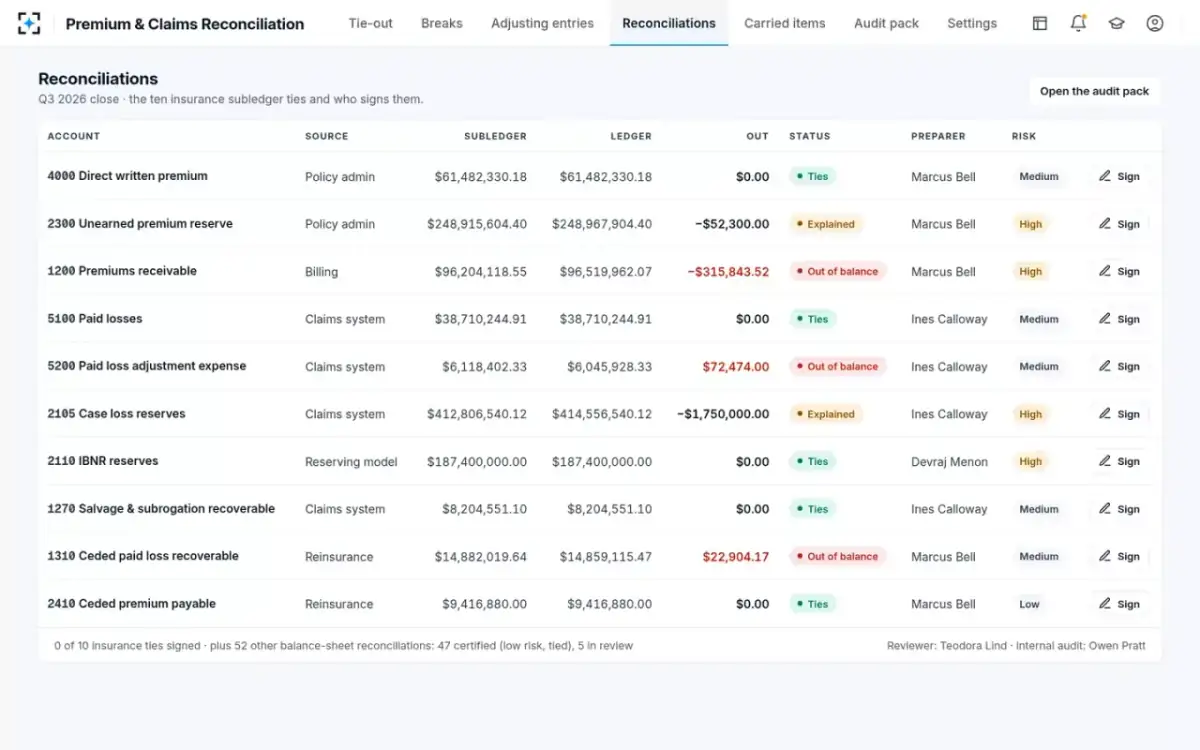
The premium ties beside the claims ties, with preparer and risk
To see the receivable tie, the aging and the drafted entries on a sample of your own extracts, start from Premium & Claims Reconciliation. Premium owed by employer groups under list bills and premium reported by managing general agents on bordereaux are reconciled by Group Premium Reconciliation and Premium Bordereaux Reconciliation.
Questions people ask
Where are agents' balances reported in the annual statement?
On the assets page of the property and casualty annual statement, under premiums and considerations: line 15.1 for balances in the course of collection and line 15.2 for deferred balances and installments not yet due, with accrued retrospective premium on line 15.3. The nonadmitted portion appears in column 2 of the same lines.
Are agents' balances an admitted asset?
Yes, until they are more than ninety days due; then they are nonadmitted, regardless of any unearned premium on the same policies. Balances found uncollectible are written off whatever their age.
What is an account current?
An account current is an agent's periodic statement of premiums it owes the insurer for policies it billed, net of its commission where the contract allows, plus any adjustments. The insurer reconciles it to its own billing detail, and differences left unresolved for more than ninety days are nonadmitted.
Does a premium finance agreement change which line a premium sits on?
It can. Where a premium finance company owes the insurer the full premium at once, the premium is due in full, not in installments. North Carolina's examiners found premium financed this way reported as deferred when it should have been reported as premium in course of collection.
What is SSAP 6?
It is the NAIC's statutory accounting statement for premium receivables of every kind, whether owed by policyholders or by agents and brokers. It sets the ninety-day nonadmission rule and the due-date rules, and it grew out of NAIC Issue Papers No. 6 and No. 10; the clock itself is worked through in non-admitted premium receivable.