The difference between an MGA and a TPA is what the insurer lets each one do. A managing general agent manages part of an insurer's business and underwrites for it, accepting or rejecting risks in the insurer's name, and may also adjust and pay the claims on that business if its contract allows. A third-party administrator administers: it collects premiums or adjusts and settles claims for an insurer or a self-funded plan, usually without the authority to write the risk. The two are licensed under different laws, owe the insurer different reports, and are reviewed on different clocks, though one firm can be both. For a carrier the practical difference is what it must watch. Botminds' Delegated Claims Audit is a claims oversight solution for carriers that reads every note, reserve, payment and letter a delegate posts, MGA or TPA, and checks it against the authority that delegate was actually given.
The examples come from a fictional sample carrier, Harrowgate Specialty, and its five fictional claims administrators. The definitions come from the NAIC's model laws, state statutes and UK government and FCA texts, linked where they appear. US model laws bind no one until a state enacts them, so each state's own text is the one to check.
MGA and TPA compared: what each may do, under which licence, watched how often
| Question | Managing general agent (MGA) | Third-party administrator (TPA) |
|---|---|---|
| Core role | Manages all or part of an insurer’s business and underwrites for it. | Collects premiums or adjusts and settles claims for an insurer or plan. |
| Underwrites? | Yes: underwriting, in the model act, is the authority to accept or reject risk for the insurer. | May, under some state definitions, but most TPA work is claims and premium administration. |
| Handles claims? | If the contract permits; the model act then sets reporting triggers and a claim cap. | Yes, usually its main job. |
| Which lines the law covers | Property and casualty in most states; Texas excludes life, health and accident. | NAIC guideline: life, annuity, health, stop-loss and (one version) workers’ compensation. |
| Licence | A producer licence, plus an MGA licence or appointment in many states. | A TPA licence or certificate where the state requires one; a P&C claims handler is usually an adjuster. |
| Carrier’s review clock | On-site review of underwriting and claims at least semiannually under the model act. | Semiannual review, one on site, for life and health administrators serving more than 100 people. |
| Money | Premium held in a fiduciary account; no more than three months of estimated claims kept. | Funds held in a fiduciary capacity, under a written agreement with the insurer. |
What is the difference between an MGA and a TPA, in one sentence?
An MGA decides which risks the insurer takes on; a TPA administers the business once it is written. Everything else follows from that. Because an MGA can bind the insurer to new exposure, the law asks for a written contract with underwriting guidelines, a surety bond, audited financial statements and regular on-site reviews. Because a TPA handles money and claims for someone else, the law concentrates on its licence, its fiduciary account, its records and the insurer's duty to keep an eye on it.
The line blurs in two places. Many MGAs settle claims on the business they write, which brings them into delegated claims territory. And some state TPA laws define administration broadly enough to include underwriting. A carrier that thinks of a delegate only by its label will apply the wrong rulebook, which is why the next three sections go to the statutory text.
What is an MGA, in law?
Under the NAIC's Managing General Agents Act, an MGA is someone who "Manages all or part of the insurance business of an insurer" and, separately or with affiliates, produces and underwrites premium equal to at least five percent of the insurer's policyholder surplus in any quarter or year, together with either adjusting or paying claims above $10,000 per claim or negotiating reinsurance for the insurer. A firm that calls itself an MGA but does not meet the test is not one for the purposes of the act, and a firm that meets it is one whatever it calls itself.
States did not all copy the model. Texas defines a managing general agent as a person "that has supervisory responsibility for the local agency and field operations of an insurer in this state or that is authorized by an insurer to accept or process on the insurer's behalf insurance policies produced and sold by other agents," and its MGA chapter does not apply to life, health and accident insurance. A carrier writing through the same delegate in several states can therefore find it is an MGA in one and not in another.
What does a TPA do in insurance?
A TPA collects premiums or contributions, or adjusts and settles claims, for an insurer or a self-funded plan, without being the insurer. The NAIC's guideline defines it as a person who "directly or indirectly underwrites, collects charges, collateral or premiums from, or adjusts or settles claims on residents of this state", but only in connection with life, annuity, health, stop-loss or workers' compensation coverage. State statutes follow that scope closely. Florida's covers administrators of life and health programmes and commercial self-insurance funds; Texas's covers annuities and life, health, accident, pharmacy and workers' compensation benefits.
That scope surprises people who work in property and casualty. A firm adjusting a carrier's commercial property claims is often not a "TPA" under the state's TPA act at all. It is a firm of licensed adjusters acting under a claims administration agreement, and the carrier's controls come from that contract and from the state's adjuster and unfair-claims-practices rules. Which licence a delegated claims handler needs, state by state, is set out in TPA license requirements by state.
Can an MGA handle claims?
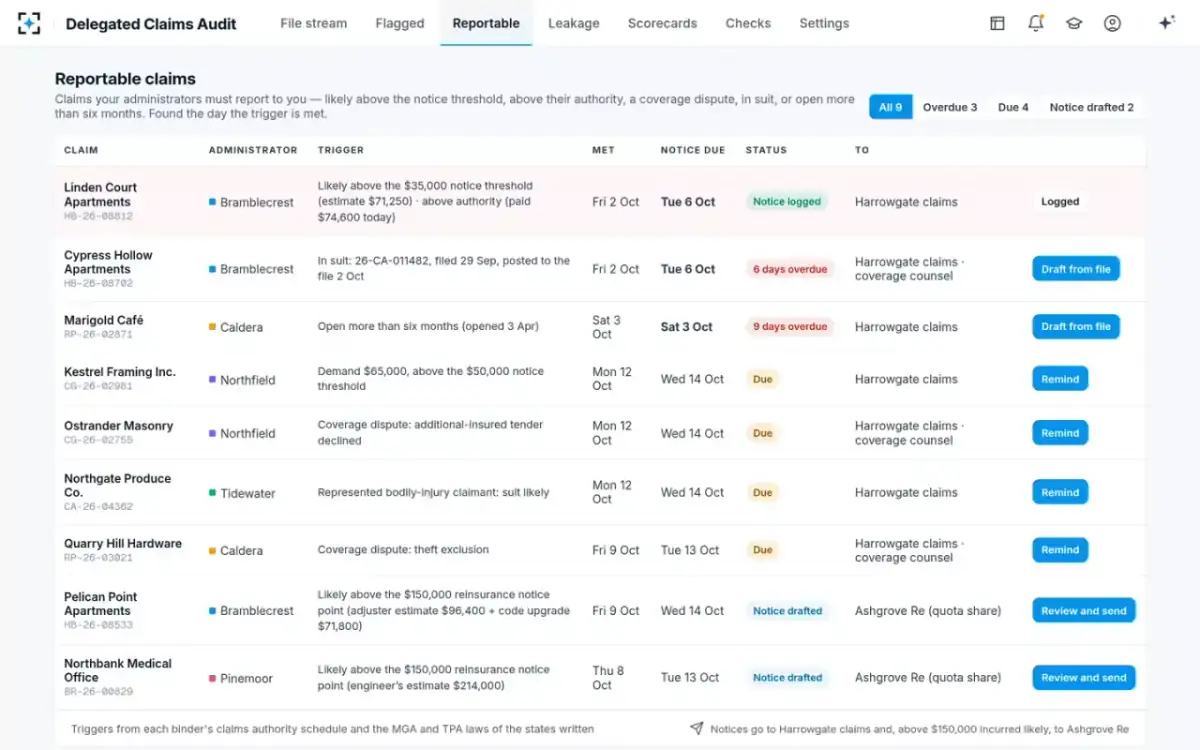
Yes, if its contract with the insurer allows it, and then the model act attaches conditions. All claims must be reported to the insurer "in a timely manner". A copy of the file goes to the insurer when a claim involves a coverage dispute, may exceed the MGA's settlement authority, stays open more than six months, or crosses amount thresholds. The claim files become the joint property of insurer and MGA. And the MGA may not, without the insurer's prior approval, pay or commit the insurer to pay a claim above a set amount, net of reinsurance, which cannot exceed 1% of the insurer's policyholder surplus.
States add their own conditions. Florida requires every claim to be adjusted by a properly licensed person. Texas asks, when an MGA is appointed, whether it may exercise claim settlement authority and whether that authority "exceeds $25,000 on any one claim". How those triggers become a usable authority letter is the subject of the claims settlement authority letter.
The claims a delegate must send back, by trigger
Is a TPA an insurance company?
No. A TPA carries no insurance risk of its own; it acts for the insurer or plan that does. The NAIC guideline is explicit about where responsibility lands: an insurer using a TPA "is responsible for the acts of the TPA", and where insurer and TPA disagree about which of them must meet an obligation to a policyholder or claimant, the guideline says the payor shall fulfil it. Texas goes further in the other direction, exempting an insurer administering its own policies from the TPA chapter altogether.
The converse matters as much. An insurer's own claims department is not a TPA, and neither, in many states, is an affiliate that handles claims only for its group's insurers. The UK regulator still asks insurers to oversee affiliated claims handlers as if they were external, a point the FCA made after finding six of the 23 insurers in its 2025 claims review used intra-group arrangements.
Where the two overlap: the MGA that settles claims, the TPA that underwrites
The two regimes are written to avoid each other, with mixed success. The NAIC's TPA guideline excludes a licensed MGA while it acts within its licence, Florida excludes an appointed MGA whose activities stay within its appointment, and Texas excludes an agent licensed under its MGA chapter who is acting under appointment and within the customary scope of an agent. The model MGA act carries a drafting note for state legislators that says the same thing from the other side:
"If the enacting state has a third party administration (TPA) Act, it should be reviewed to eliminate any conflict."
NAIC Managing General Agents Act (Model #225), drafting note to §2
In practice the overlap is where a carrier's oversight is thinnest. An MGA that settles claims is often audited by the underwriting side of the carrier, which reads its bound risks closely and its claim files lightly. A claims administrator that also issues endorsements or collects premium may be watched by the claims team and never by underwriting. A delegate should be mapped by function, not by label: who binds, who reserves, who pays, and who holds the money.
Map each delegate by function before deciding which rules apply
- Who binds?
If the delegate can accept or reject risks for you, it underwrites, and the MGA act’s contract terms, bond and reviews follow, whatever the firm calls itself.
- Who settles claims, and up to what amount?
Settlement authority brings the reporting triggers and, for an MGA, the 1%-of-surplus cap. Write the amount per binder, indemnity and expense separately.
- Which lines?
Life, health, stop-loss and workers’ compensation administration usually falls under the state TPA act; property and casualty claims handling usually falls under adjuster licensing and the contract.
- Who holds the money?
Premium or claim funds held by the delegate must sit in a fiduciary account; a delegate that pays claims from your funds needs a loss fund you can reconcile.
- Who sets reserves?
If the delegate sets them, the model act asks for an annual actuarial opinion, and any profit share it earns is held back while the reserves mature.
- Who else touches the file?
Sub-delegation is barred for MGAs under the model act; for a TPA, check the agreement for any onward contracting of adjusting or payments.
What is a delegated claims administrator? The UK words
In the London market, a delegated claims administrator is a firm given authority to handle and settle claims for an insurer or a Lloyd's syndicate, the UK counterpart of a US claims TPA. The vocabulary differs, but the structure is recognisable. HM Revenue & Customs explains that a Lloyd's managing agent may delegate its authority to bind insurance, that the firm receiving it is called a coverholder, and that coverholders act as agent of the managing agent rather than of the policyholder.
The FCA Handbook describes agency agreements that let an intermediary commit the insurer to risk, settle claims or handle premium refunds, commonly called binding authorities. A coverholder with claims authority is thus the nearest UK equivalent of an MGA that settles claims, and a delegated claims administrator the nearest equivalent of a TPA. The FCA's supervisory stance does not depend on the label: in either case the insurer keeps the regulatory responsibility.
Who audits whom, and how often?
The insurer audits the delegate, on a clock that depends on what the delegate is and where. The model laws set a semiannual floor for both kinds; states vary it. The table gathers the clocks a carrier with mixed delegates is likely to meet.
Review clocks the carrier owes its delegates
| Delegate and rule | What the carrier must do | How often |
|---|---|---|
| MGA · NAIC Model #225 §5C | On-site review of the MGA’s underwriting and claims processing operations. | At least semiannually |
| MGA · New York 11 NYCRR §33.6 | On-site review of underwriting and claims processing; actuarial opinion where the MGA sets reserves. | At least semiannually; opinion annually |
| MGA · Florida §626.7454 | On-site review of underwriting and claims processing. | At least annually; within 6 months of engaging a new MGA |
| TPA · NAIC GL-1090 §7H | Review of the TPA’s operations, at least one on site (life, annuity, health, stop-loss; over 100 people). | At least semiannually |
| TPA · Texas §4151.1042 | Review of the administrator’s operations; an audit of them (over 100 people covered). | Review semiannually; audit at least every two years |
What the difference means for the carrier's claims oversight
For an MGA that settles claims, the carrier watches the statutory triggers and the claim cap as well as the contract; for a TPA, it watches the contract's authority schedule and service levels and, in life, health and workers' compensation, the state's TPA act. In both cases the evidence is the same: what the delegate's people did on each file, and when. A delegate can hold more than one binder, with different authority on each, so the unit of oversight is the binder rather than the firm.
Watching an MGA and a TPA in Delegated Claims Audit: the same file events, different rulebooks
MGA settling claims on its own business: The contract’s settlement authority, under a statutory cap of 1% of surplus without prior approval.
TPA settling claims under an administration agreement: The authority schedule in the claims administration agreement, per binder.
MGA settling claims on its own business: Statutory triggers: coverage dispute, beyond authority, open six months, amount thresholds.
TPA settling claims under an administration agreement: The contract’s triggers, which sensible carriers write to mirror the statutory list.
MGA settling claims on its own business: Annual actuarial opinion where the MGA sets reserves.
TPA settling claims under an administration agreement: The reserving rules in the agreement; no statutory opinion.
MGA settling claims on its own business: The same firm prices, binds and pays: profit share can reward low reserves.
TPA settling claims under an administration agreement: Fees paid per claim or per file can reward speed over accuracy.
Delegated Claims Audit sets authority per binder, not per firm
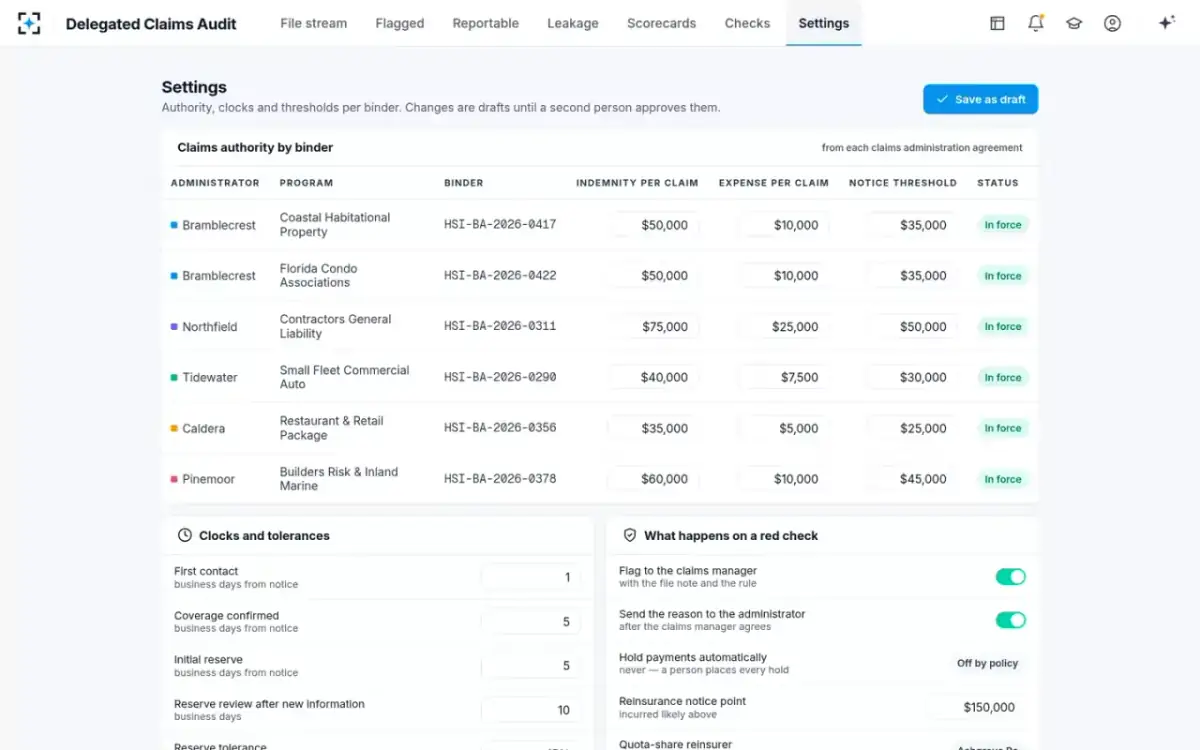
That is how the solution treats delegates. Each binder carries its own indemnity and expense authority, notice threshold and clocks, taken from the agreement, and the seven checks run against whichever binder the claim sits under. Whether the delegate is an MGA or a TPA changes which reporting triggers apply, not whether the carrier sees the file. Who in the carrier owns that view is covered in the TPA oversight manager's seat.
Questions people ask
Is a TPA the same as an MGA?
No. An MGA underwrites for the insurer and may also settle claims; a TPA administers premiums or claims without, as a rule, writing the risk. The NAIC's TPA guideline even excludes a licensed MGA acting within its licence from the TPA definition, so the same firm is regulated as one or the other for each activity.
What is the difference between a TPA and an insurance company?
The insurance company carries the risk and pays from its own balance sheet; the TPA administers on its behalf. The insurer stays responsible for the TPA's acts under the NAIC guideline, and must make the TPA's books and records available to the regulator on request.
Can an MGA pay claims without the insurer's approval?
Up to its settlement authority, yes. Above a set amount, net of reinsurance, the model act requires the insurer's prior approval, and that amount may not exceed 1% of the insurer's policyholder surplus at the last year-end. New York and Florida carry the same cap in their own rules.
What is an MGU, and is it different from an MGA?
A managing general underwriter is, in most usage, the same kind of firm: a delegate with underwriting authority. The legal test is what the firm does, not its name; the NAIC model act applies to anyone meeting its definition "whether known as a managing general agent, manager or other similar term".
Do TPAs handle property and casualty claims?
Yes, many do, but they are often not "TPAs" under the state's TPA act, which usually covers life, health, stop-loss and workers' compensation. A P&C claims handler is typically licensed as an adjuster, and New York's regulator said in a 2007 opinion that it does not license TPAs at all, only the adjusting they do.